Net revenue retention (NRR) is a KPI that shows the percentage of recurring revenue a business is able to retain and grow from existing customers. It’s a critical metric particularly in SaaS and subscription-based businesses where sustainable long-term growth depends on customer retention. Getting new customers is still important, but maintaining a loyal customer base who renew their plans or invest more is key for healthy businesses.
Read on to learn more about NRR including how to calculate it, why it’s important, how it affects valuation and revenue, plus common interview questions about it.
Net revenue retention (NRR), also called net dollar retention (NDR), is the percentage of recurring revenue a business retains and grows from their existing customers over a set period, typically monthly or annually. It includes revenue added through upgrades and upsells, and subtracts what’s lost through downgrades and cancellations. In other words, NRR tells you whether a company’s revenue would be higher, the same, or lower if they added no new customers during that period.
Generally, anything greater than 100% is considered a good net revenue retention as it means the existing customers are spending more than they were at the start of the period. That could be through upgrades, add-ons, or increased usage. But an NRR below 100% implies less recurring revenue from the existing customer base due to churn and downgrades.
How Is NRR Calculated?
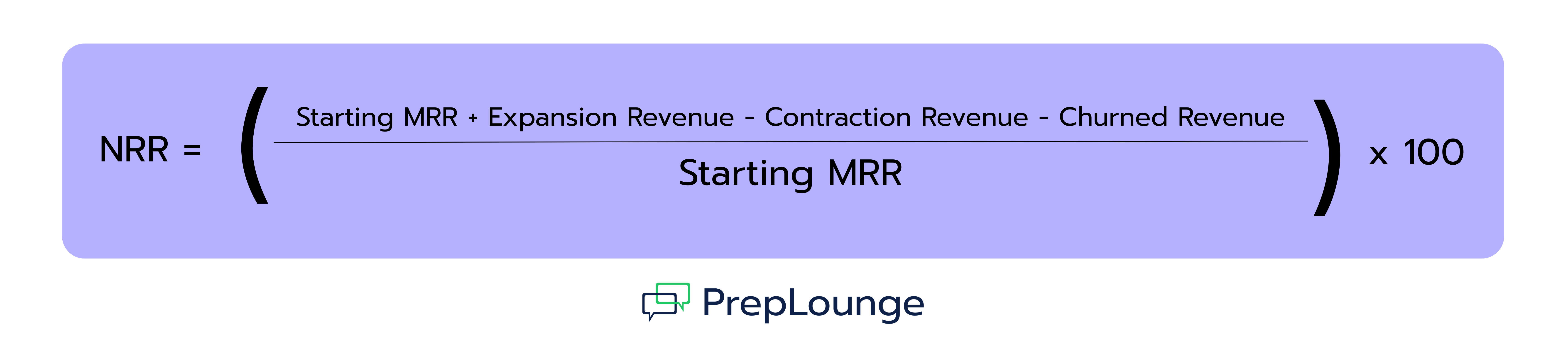
The formula for calculating NRR is:
Where:
Starting MRR is the total monthly recurring revenue at the beginning of the period
Expansion Revenue is the additional revenue from upsells, cross-sells, or increased usage
Contraction Revenue is the amount lost from customers who downgraded their plan
Churned Revenue is what’s lost from customers who cancelled entirely
If the goal is to calculate annual NRR, swap the MRR with annual recurring revenue (ARR) and measure expansion, contraction, and churn across the full year.
Net Revenue Retention Calculation Example
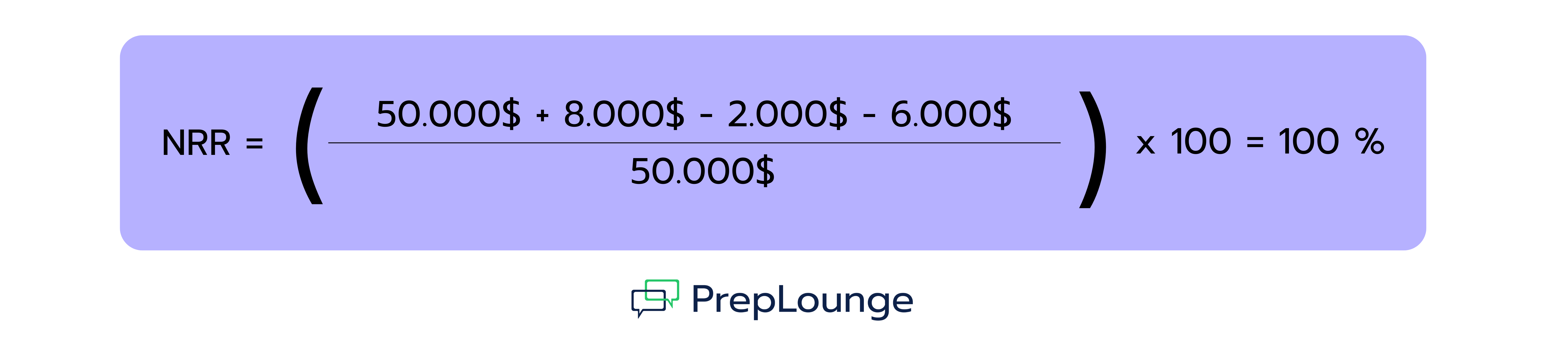
Consider a business which offers a B2B SaaS tool to help small e-commerce stores track their sales performance. They have 80 active subscribers paying a monthly subscription and their figures in January were as follows:
Starting MRR: $50,000
Expansion Revenue: $8,000 (12 customers upgraded to the Pro plan)
Contraction: $2,000 (5 customers downgraded)
Churned Revenue: $6,000 (8 customers cancelled)
Using the NRR formula:
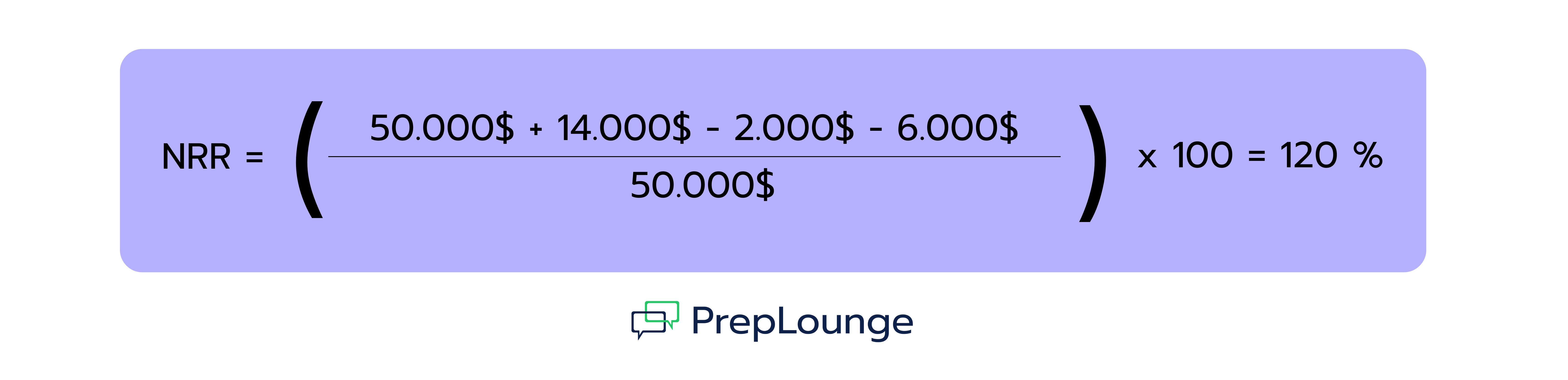
During the next month, more customers upgraded their plans, raising the expansion revenue to $14,000. That pushed the NRR to 120%.
An NRR of 120% means that even if the company signed zero new customers, their existing customer base would generate 20% more revenue than it did at the start of the period.
Why Is NRR Important for Companies?
Even if a subscription-based company’s total revenue is growing, it still matters where that income comes from. NRR helps companies determine if growth is sustainable, assess product stickiness, measure customer success, and attract investors.
It Shows Whether Growth Is Cost Efficient
Acquiring a new customer usually costs more than retaining an existing one. If a company’s NRR is high, the existing customers are driving growth on their own through renewals, upgrades, and expanded usage. That reduces reliance on new customer acquisitions and makes revenue predictions easier.
Also, a track record of high NRR signals a sustainable business model and proves a company’s strategy for generating expansion revenue is effective.
It's a Sign of Product-Market Fit
A consistently high NRR is strong evidence that a product is solving a real problem well enough that customers don't just stay but also invest more. On the other hand, a declining NRR is often an early warning sign, even when new customer acquisition looks healthy on paper.
It Measures Customer Success & Effectiveness of Retention Strategies
If a product or service meets or exceeds customers expectations, the other things that determine whether they’ll stay, upgrade, and spend more is the quality of onboarding and responsiveness of support. So, a high and growing NRR can imply the customer success tactics and retention strategies are working. But if NRR is trending down, something in the customer experience might be failing, whether that's poor onboarding, unresolved support issues, or a product that isn't delivering enough value to justify renewal.
Attracting Investors
Investors pay close attention to NRR and use it to determine the financial health and funding eligibility of a subscription-based business. That’s mainly because it tells them how sustainable the revenue growth is. A higher NRR typically goes hand in hand with greater customer lifetime value, scalability, and stability. Hence, the growth outlook for a company with a high NRR will be more optimistic.
Impact of NRR on Revenue Growth and Valuation
A growing NRR tends to increase total revenue and valuation of a company while a lower NRR especially below 100% does the opposite. Below is an overview of how that happens.
NRR Compounds Over Time
One of the biggest impacts of NRR on a company’s revenue is that it compounds. If a firm has an NRR of 120% and an existing $50,000 MRR, that amount grows by 20% each year without a single new sale. Over five years, that base alone could grow from $50K to over $124K in monthly recurring revenue.
If you compare that to a company stuck at 90% NRR, the picture is quite different. Such a business is losing 10% of their base revenue every year before new sales even begin. Every dollar their sales team brings in is partly just refilling a shrinking pool.
Higher NRR Increases Valuation
NRR affects valuation primarily because it paints the picture of how efficiently a company grows. A business with a track record of high NRR is growing from within its existing customer base, which is far cheaper than constantly acquiring new ones. This makes future revenue more predictable, more defensible, and less dependent on acquiring new customers.
Since investors care much about the revenue source and sustainability, they tend to price revenue compounding and predictability heavily. As such, two competitors may have the same total revenue growth rate but get different valuations if their NRR track records vary.
How to Improve Net Revenue
Improving net recurring revenue requires working on each of the factors that drive it. This includes reducing churn, minimizing downgrades, and finding expansion opportunities. Here’s how to go about it.
Monitor and Reduce Customer Churn
Churn is the most damaging factor in the NRR equation. So, it’s important to watch out for signs of churn and intervene early. Some of the warning signs of churn include declining login frequency, low feature adoption, unanswered support tickets, or reduced data usage.
Besides the common signs of churn, companies do gather data on reasons for cancellation from churned customers. That information helps in crafting effective retention strategies and preventing more cancellations. Generally, here are some of the most effective pillars of customer retention:
Delivering consistent product value in a way that customers see ongoing ROI
Monitoring customer health signals and engaging before problems escalate to churn
Smart pricing strategies that make staying and expanding the natural path of least resistance
Maintaining close relationships and constant engagement with the existing customers
Limit Service Downgrades (Contraction)
Downgrades are subtler than cancellations, but they still pull the NRR number down. Customers downgrade when they no longer see enough value to justify a higher tier. That often happens when they haven't fully adopted the features that made the upgrade worthwhile in the first place.
The fix isn't to make downgrading harder but to make staying on the higher tier feel worth it. Clear analytics dashboard or regular check-ins that show customers the actual value they've received like data saved, time spent, or outcomes achieved can make a real difference.
Maximize Upselling and Cross-Selling Opportunities
Upselling is helping a customer move to a higher-value plan while cross-selling means introducing them to a product or feature they don't currently use. Both are forms of expansion revenue, and they're the primary reason NRR can exceed 100%.
The most effective upsell and cross-sell moments are triggered by usage or behavior patterns, not by the sales calendar or quarterly business reviews. They should also be highly personalized using data analytics. For instance, if a customer is consistently using 80% of their data limit, that's the natural moment to introduce the Pro plan. Customers who feel the nudge is relevant to their situation are far more likely to upgrade than those who receive a generic upsell pitch. Also, an ill-timed or non-personalized upsell or cross-sell pitch might cause churn instead.
Leverage Customer Feedback
It’s hard to enhance the customer experience without first knowing what's working and what isn't. But customer customer feedback from surveys, NPS scores, churn exit interviews, and even support ticket patterns provide valuable insights into that. Implementing the feedback and making tangible improvements where necessary can help to improve customer success, satisfaction, and retention.
Retention Challenges in Measuring NRR
Measuring NRR reliably requires overcoming several pitfalls or challenges like the 100% NRR trap, large account distortion, and inconsistent timelines. Otherwise, it’s possible to get a misleading NRR number that can lead to wrong business decisions.
The 100% NRR Trap
One of the retention challenges when measuring NRR is a figure that masks the reality of churn. A 100% NRR sounds neutral, but it can conceal serious instability. A good example might be when 20% of a company’s customers are churning every month, but another group of customers is upgrading enough to offset the loss.
The NRR reads 100%, and the dashboard looks fine. The underlying business, however, is burning through its customer base and relying on a shrinking group of loyal users to hide it. This makes it essential to dig deeper if both churn rate and expansion rate are both unusually high.
The Single-Account Distortion
Sometimes the customer success team at a SaaS company may present an NRR above 100%. But if you look keenly, you discover there’s one account or customer that carries the entire metric. They expand the revenue and consequently NRR whenever they upgrade and drop it when they downgrade.
This is why blended NRR which considers all customers can be misleading. The solution is to also segment NRR by customer size, contract value, or industry. That means an expansion from one big account won’t be able to mask a churn problem among the rest.
Inconsistent Timelines
Most firms calculate NRR over 12 months. That’s usually long enough to capture the full customer lifecycle and smooth out seasonal patterns. But some teams mix monthly and annual calculations without realizing it, creating numbers that aren't comparable over time. Choose a consistent window, apply it uniformly, and stick with it.
Typical Interview Questions
If you’re preparing for a finance interview, here are some of the common questions interviewers tend to ask. Use them for your practice.
1. What's the difference between GRR, NRR and ARR?
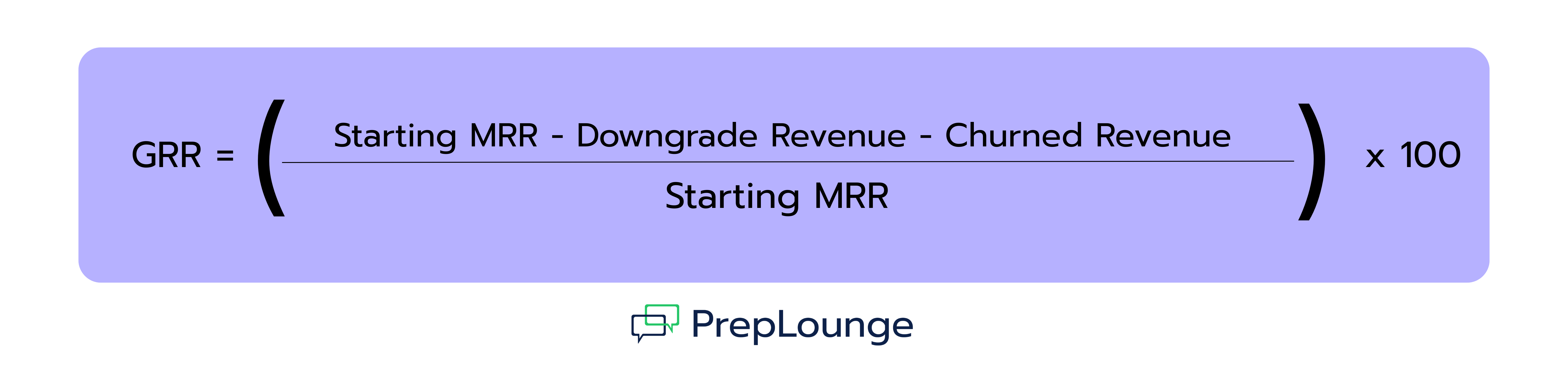
Both NRR and GRR measure the percentage of recurring revenue a business retains from existing customers. However, NRR calculation includes expansion revenue, while GRR does not. Because it ignores upsells and cross-sells, GRR can never exceed 100% but NRR can go above 100% as customers who upgrade or buy more push the number higher.
Here’s the Gross Revenue Retention formula:
The annual recurring revenue (ARR) measures the total recurring revenue a business earns in a year, while NRR measures what percentage of that revenue was retained and grown from the existing customers over the same period.
2. What is considered a good NRR for a SaaS company?
NRR benchmarks vary by business stage and sector. But a good NRR in a SaaS company is typically 100% or more which means all lost revenue is replaced with expansion. Anywhere between 110% to 120% is considered good.
3. If NRR is low but new sales are high, is the company healthy?
Not necessarily as high sales can mask a churn problem. If NRR is low, for instance 70%, the company will be constantly fighting an uphill battle to replace lost revenue, which is unsustainable and leads to high Customer Acquisition Costs (CAC) relative to Lifetime Value (LTV).
Key Takeaways
NRR is a key KPI in SaaS and subscription-based business that measures revenue retention and health. It considers expansion, contraction, and churn to give a complete picture of whether the existing customer base is growing or shrinking in value. An NRR above 100% means growth while figures below 100% implies existing customers are spending less than they were at the start of the period.
The lower the NRR, the more the business depends on new sales just to stay flat. On the other hand, a strong NRR shows satisfied customers, effective retention strategies, and sustainable revenue growth. A 100% NRR can be a warning sign the figure is achieved by equal parts churn and expansion. The most effective strategies for improving NRR include reducing churn, limiting downgrades, and growing expansion revenue.
Let's Move On to the Next Articles!
Purchase Price Allocation (PPA)
Key Figures & Terms
Purchase price allocation (PPA) is an accounting process where a buyer breaks down the price paid to acquire a company across all of its identifiable assets, assumed liabilities, and any residual goodwill. The official PPA is done after the deal is closed. But some parties do a pre-deal PPA at some point in the M&A transaction lifecycle to uncover what they might miss during the typical due diligence process and assess the effects of the potential acquisition.
Read on to learn more about PPA accounting including how it works, its importance, how it affects the three statements, challenges, and common interview questions.
Comparable Company Analysis: Guide, Example & Interview Questions
Key Figures & Terms
Most of the business valuation methods investment bankers use fall into two main categories: relative and intrinsic valuation. Intrinsic valuation estimates a company’s worth based on its fundamentals and future cash flows while relativevaluation, also called market-based valuation, determines a firm’s value by comparing it to the market pricing of similar businesses.
The most common intrinsic method is the Discounted Cash Flow (DCF) analysis. On the relative side, bankers rely on Precedent Transactions and Comparable Company Analysis (CCA). These three valuation methods are heavily tested in investment banking interviews because bankers use them constantly in real work including M&A advisory.
But this guide will focus on CCA and includes Comparable Company Analysis steps, key valuation multiples, advantages and limitations, a worked example, and common interview questions.
Merger Model: How It Works, Example & Interview Questions
Key Figures & Terms
M&A transactions require a thorough analysis of how merging companies will affect the financial health of the combined business once a deal closes. To do such analysis, bankers use a merger model. It covers standalone forecasts of income statements, total deal costs, transaction structure, and combined financials to find out whether the acquirer ends up in a stronger or weaker financial position than before.
Read on to understand the key components of an M&A merger model, get a step-by-step breakdown of how to build a merger model, and walk through a simple merger model example.