What Is Mezzanine Financing?
Mezzanine financing is a form of business funding that combines characteristics of both debt and equity. It functions like a loan, as the company is required to repay principal and interest over time, similar to high yield debt. However, mezzanine capital is subordinated to secured debt, meaning that in a financial distress scenario, mezzanine lenders are only repaid after senior lenders.
That subordinate position introduces the first equity-like characteristic: higher risk. If the company struggles financially, mezzanine lenders may not be repaid at all, so they require higher interest rates than senior lenders.
The other equity-like characteristic is that mezzanine lenders often gain conversion rights or warrants, allowing them to participate in the company’s upside rather than only collecting fixed interest payments.
Key Features of Mezzanine Capital
Although mezzanine financing blends some characteristics of the two major forms of corporate funding, it has unique features that set it apart from pure debt or equity. These features are meant to balance risk and reward for all parties involved. They include:
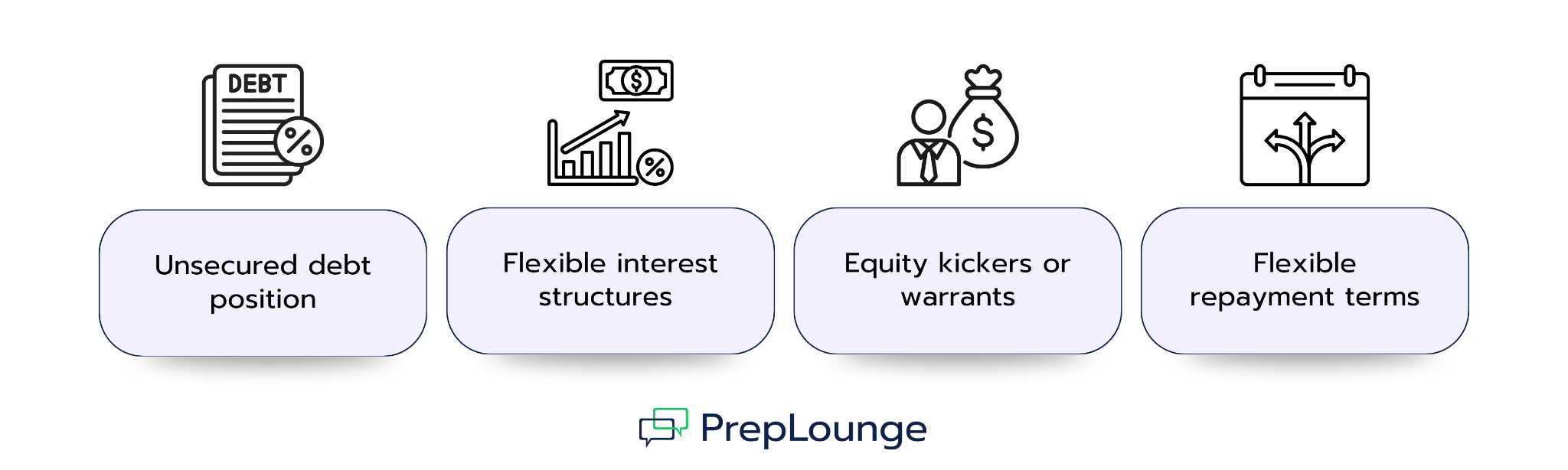
- Unsecured and subordinated debt position
- Flexible interest structures
- Equity kickers or warrants
- Flexible repayment terms & longer maturity
Unsecured and Subordinated Debt Position
The three main sources of business capital are arranged in a hierarchy called the capital stack, which determines who gets paid first if the company defaults or goes bankrupt. The type of corporate borrowing that holds the highest repayment priority in a company's capital structure is called senior debt. It’s typically loans from banks and requires collateral.
Mezzanine financing is often not secured by a company's assets and ranks below senior debt in repayment priority.
Flexible Interest Structures
The added risk introduced by a subordinated debt position makes mezzanine lenders charge higher interest rates of 12–20%. That’s substantially higher than senior debt which might range from 5–10%. But to avoid draining a company's immediate cash flow, mezzanine lenders often use a split interest model. It consists of:
- Cash Interest: A regular coupon payment made in cash either monthly, quarterly, or annually.
- PIK (Payment-in-Kind) Interest: The company doesn’t pay this interest in cash. Instead, they add the interest to the loan’s principal and the total accumulated amount is paid off at the very end rather than monthly.
Equity Kickers
Because a mezzanine lender is taking on more risk than a bank, they want a "kicker" which is a share in the company’s future success. These usually come as warrants which are options to purchase shares at a set price or conversion rights that give them the ability to convert debt into equity. If the company’s value sky-rockets, the lender profits alongside the owners.
Flexible Repayment Terms and Longer Maturity
Mezzanine loans have maturity periods of 5–10 years while most senior debt ranges from 3 to 5 years. Besides, the company only pays interest periodically while the principal amount is paid at maturity. The extended timeline gives companies more breathing room to execute their growth plans and generate the returns needed to repay the debt.
The financing also comes with fewer restrictive covenants than senior debt. Mezzanine lenders allow companies greater flexibility in how they operate and deploy capital. They are more like patient investors than strict creditors.
Advantages & Risks for Companies and Investors
Like every other form of corporate financing, mezzanine capital has its benefits and drawbacks for companies and the lenders. Here’s an overview of what each party gains and what they risk.
Mezzanine Fnancing Pros And Cons For Companies
Pros
- Cheaper than equity finance
- Mostly appears as equity on the balance sheet, keeping debt levels low
- Preserves ownership and control
- Requires no collateral
- Provides cash flow flexibility especially with PIK interest
- Interest payments are tax deductible
Cons
- Can dilute or reduce equity eventually
- Higher cost than debt financing
Mezzanine Fnancing Advantages And Risks For Investors
Advantages
- High yields or better returns than senior debt
- Equity upside participation
- Gets repayment priority over equity in liquidation scenarios
Risks
- Possibility of losing entire investment if no money is left after repaying senior debt
- Lacks liquidity
- Limited security and covenants
Role of Mezzanine Financing in Corporate Finance
In corporate finance, mezzanine financing is not a substitute for debt or equity. It’s a complementary layer that enables complex transactions when traditional options fall short. Companies typically turn to mezzanine capital when they've exhausted what senior lenders will provide but don't want the dilution or control concessions that come with issuing new equity.
As such, mezzanine capital fills the financing gap and allows companies to pursue strategic opportunities that might otherwise be out of reach. These deals include growth expansions, acquisitions, leveraged buyouts, and recapitalizations.
Compared to senior debt, mezzanine financing offers greater borrowing capacity without requiring additional collateral, imposes fewer operational restrictions through lighter covenants, and provides longer repayment timelines that accommodate growth-oriented cash flows. Borrowers also pay interest only and the principal amount is paid on maturity which isn’t the case with traditional debt.viel
In comparison to equity, it allows companies to raise substantial capital while preserving ownership and control in the near term. However, that comes at the cost of higher interest payments and potential future dilution through equity kickers. Also, interest payments are tax-deductible, reducing the effective cost of capital, whereas equity dividends come from after-tax profits.
Interview Questions on Mezzanine Financing
During investment banking, private equity, and corporate finance interviews, you may get questions on mezzanine financing. They test your understanding of the concept, structure and features, risk and return, and corporate strategy. Here are a few sample questions you may get on mezzanine financing during finance interviews.
1. How does mezzanine fit into the capital stack?
Mezzanine financing sits between senior debt and equity in the capital stack. It ranks above equity but below senior debt for repayment priority.
2. Walk me through an LBO model using mezzanine debt.
In an LBO model, mezzanine debt is used after senior debt to fill the funding gap. It increases leverage, reduces equity needed, and is repaid after senior debt but before equity in an exit or liquidation
3. What is a PIK (Payment-In-Kind) feature? How do you model warrants?
A PIK (Payment-In-Kind) feature allows interest to be added to the principal instead of paid in cash, deferring cash outflows until maturity.
Warrants are modeled by attaching an option to purchase equity in future at a set price, and included as part of the mezzanine return.