Sometimes businesses experience financial problems such as declining profitability measured by EBIT or EBITDA, rising leverage reflected in higher debt-to-equity ratios, or temporary liquidity shortages visible in the Cash Flow Statement. If such issues persist and are not resolved early enough, the next and most severe outcome is insolvency. At that point, the company can no longer meet its financial obligations on time.

Once a company is already in or on the brink of insolvency, it may seek help from restructuring advisory, distressed debt investing, and turnaround consulting teams. In such situations, preserving Free Cash Flow becomes critical to stabilize operations. Read on to learn what insolvency really means, how it’s determined, preventative measures, and consequences.


What Does Insolvency Mean?

Insolvency means a business or individual is in a financial state where they can’t pay creditors on time. In such scenarios, the company and its stakeholders usually have two options:

  • Out-of-Court Restructuring: The company and its creditors attempt to fix the problem without the court.
  • In-Court Bankruptcy Filing: Seeking protection and structure under the U.S. Bankruptcy Code. Chapter 7 requires liquidating the debtor’s assets to pay creditors while Chapter 11 allows the company to continue operating while attempting to restructure its finances.

So, insolvency is different from bankruptcy. While insolvency is a financial condition, bankruptcy is a specific legal process that may be used to address insolvency. 
 

What Criteria Lead to Insolvency?

Professionals usually use two primary tests to determine whether a company is insolvent.

The first one is the cash flow test, also called equitable insolvency. It assesses whether the debtor can pay its financial obligations including invoices, rent, loan repayments, and payroll as they become due. Analysts often review the Cash Flow Statement, short-term Working Capital, and overall liquidity planning to evaluate this. If the company cannot generate sufficient Free Cash Flow or maintain stable EBITDA, it is considered cash flow insolvent even if it has substantial assets on paper.

The second one is the balance sheet test, which examines whether total liabilities exceed total assets at fair value. This often requires a reassessment of asset values using valuation approaches such as Discounted Cash Flow Analysis (DCF) to estimate their realistic Present Value. If liabilities are greater than total assets, the company is considered balance sheet insolvent even if it still has enough liquidity to meet current obligations. In such cases, the company’s Equity Value may effectively be wiped out.
 

How Can Insolvency Be Avoided?

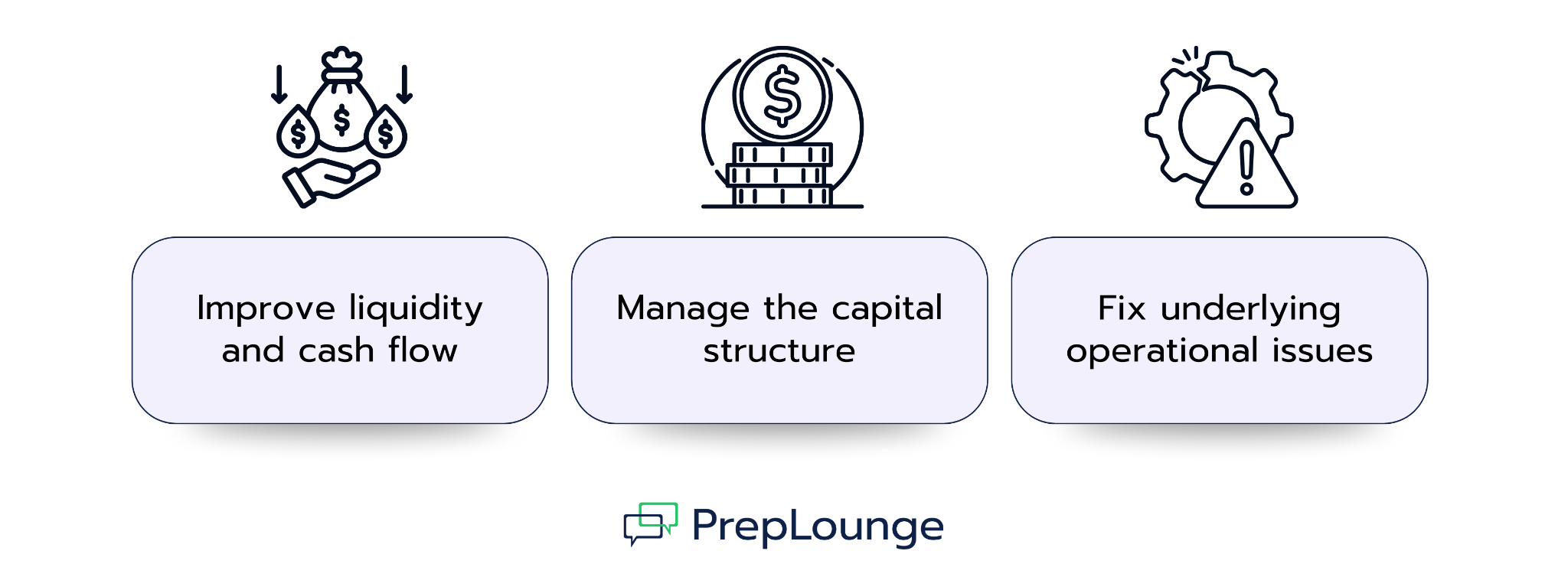
Fortunately, insolvency is something companies can avoid if they detect and address the underlying financial problems early on. The general steps to prevent insolvency involve strengthening liquidity or cash flow, capital structure, and operations

How Can Insolvency Be Avoided?

Fixing liquidity issues prevents cash flow insolvency. It calls for accurate and regular cash flow forecasting to identify shortfalls early and make adjustments. These changes can include prioritizing collections from debtors or negotiating extended creditor terms.​

Managing the capital structure diligently prevents balance sheet insolvency. The goal is to maintain a healthy balance between debt and equity. Companies can achieve this by monitoring the ratios, avoiding over-leveraging, diversifying funding sources, and negotiating loan covenants.

But most importantly, taking measures to address the underlying business issues or operations goes a long way. Depending on what the problems are, the solutions may include cutting costs, exiting loss-making activities, reassessing the business plan, and repositioning the business for improved cash generation. 
 

What Are the Consequences of Insolvency?

Once a company becomes insolvent, the actions from management and creditors affect operations, reputation, and legal standing. Creditors may file lawsuits, seize collateral, or petition the court to force the company into involuntary bankruptcy. If a formal bankruptcy process is initiated, a trustee or the court-approved management takes control over major financial and strategic decisions.

Other consequences include:

  • Reputational Damage: The news of financial distress can damage confidence among customers, suppliers, and the public. This can lead to possible termination of contracts with suppliers, clients, and partners.
  • Loss of Access to Capital Markets: Trade creditors may tighten terms or refuse to extend credit, creating a liquidity spiral.
  • Liquidation or Closure: If no viable path to reorganization exists, the company is forced to shut down. Assets are sold off to pay creditors in order of priority.

For the creditors, they may not recover all the money owed, as asset distribution follows a legal hierarchy with secured creditors paid first.
 

Typical Interview Questions Related to Insolvency

You will most likely get insolvency related interview questions if you’re seeking to join restructuring IB groups or consulting teams. The questions test your understanding of the process and problem solving skills within the context of corporate distress. Here are a few sample questions.

1. Can a company be insolvent without being bankrupt?

Yes, a company can be insolvent without being bankrupt. Insolvency means a company cannot pay its debts when they are due, cash-flow insolvency, or its liabilities exceed its assets (balance-sheet insolvency). Bankruptcy is the legal process initiated when a company formally seeks protection from its creditors under applicable law.

2. How do you analyze a company's financial statements to determine if it is insolvent?

Check for cash-flow insolvency by analyzing the Statement of Cash Flows for negative operating cash flow and the Balance Sheet for low cash-to-short-term-liabilities ratio. For balance-sheet insolvency, check the Balance Sheet to see if total liabilities are greater than total assets.

3. What’s automatic stay and debtor-in-possession financing?

Automatic stay is a protection in the bankruptcy process which immediately halts most legal actions, foreclosures, and debt collection efforts by creditors against the debtor and its property.

Debtor-in-possession financing refers to loans provided to a company while it is in bankruptcy, usually Chapter 11, to fund its operations during reorganization. These loans often receive priority repayment status.

 

Practice Insolvency With Our Question Sets

Expert case by
Ashwin
New
UrbanBrew Coffee Roasters
Our client is UrbanBrew Coffee Roasters, a specialty coffee roaster and café chain that currently operates five locations in Denver, Colorado. UrbanBrew is known for ethically sourced single-origin beans and a community-oriented café experience. UrbanBrew has been saving up capital to launch a new flagship location in Chicago, as they have been facing competitive saturation in Denver, and they believe there is a larger serviceable addressable market in the Chicago metro area.UrbanBrew has brought in your firm to help them understand the answers to two main questions:1. Which neighborhood within Chicago is the most desirable?2. How should UrbanBrew go about increasing their profitability as a business?
100+ times solved
Difficulty: Intermediate
Interviewer-led
Market entry
Profitability analysis
Company case provided by Company case by
thyssenkrupp Management Consulting
tkMC Case: Market entry strategy in the lithium materials trade market
Your client tk Commodity Trade (tk ComT) is a global materials trader - they buy and sell raw materials. tk ComT had stable EBITDA margins in recent years. They consider expanding their target market and entering the Lithium (electric vehicle battery grade) trade, due to the current high demand for electric cars and Lithium-ion batteries. The client is concerned about minimizing the cash spending and about improving the payback period for this market-entry campaign, due to corporate cash policy.As a consultant, you are expected to calculate the size of the Lithium market and to assess the payback periods for an organic market entry (with own resources) as well as for the acquisition of an established company. Finally, the client expects a proposal about the best market entry strategy and potential opportunities and risks.
24.3k times solved
Difficulty: Intermediate
Interviewer-led
Market entry
New product
Profitability analysis
Expert case by
Benjamin
BCG Beginner Case: Fashion startup
Your client is a D2C (direct to customer) online fashion business in a developing country. It is a new brand, launched about 2 years ago and founded by ex-investment bankers. Their brand focuses on trendy, edgy design that is less main-stream (versus big brands like H&M, Uniqlo, Zara etc) for adult men. While they have been growing fast, they want to understand how they can further improve their sales.
700+ times solved
Difficulty: Beginner
Interviewer-led
Growth strategy
Expert case by
Benjamin
Revolut Mock Interview: Strategy & Operations
You are part of the Strategy & Operations team at Revolut.Revolut has had significant growth over the past couple of years, with customer base growing 20-30% per year. Our apps have also been highly rated in the various app stores - be it GooglePlay or on the Apple store.Revolut's current customer strategy is to segment customers based on their subscription tiers/plans. Standard: FreePlus: $3.99/mthPremium: $7.99/mthMetal: $14.99/mthUltra: Ultra $55/mthKey differentiation between the plans are in the pricing and features. Namely, the more expensive tiers like Metal and Ultra have additional features such as personalized and premium card design, free access to lifestyle apps (e.g. Financial Times, Class Pass etc), better FX rates and priority customer support.It's great that Revolut has been expanding rapidly, but we are starting to see some stresses on our existing operations and processes. One key area of concern is in customer service, our satisfaction scores have started to trend down and call center headcounts and costs have been increasing in recent years, but we are struggling to handle the load of incoming requests and tickets.You have been tasked to lead a project to solve this problem without ballooning costs. 
700+ times solved
Difficulty: Advanced
Interviewer-led
Operations strategy
Expert case by
Benjamin
McKinsey Unconventional Case: Inclusive Cafes
Your client is a leading retail coffee chain. They are present in several countries globally and are a popular brand in most of the markets that they operate in, with several thousands stores in operation.A key focus of the company currently is diversity & inclusion. In their biggest market which is the US, 1 in 4 people have some sort of disability. One realization the client has had is that their retail stores are not as inclusive to individuals with disabilities. McKinsey has been brought on to help them design more inclusive spaces in their retail stores.
800+ times solved
Difficulty: Intermediate
Interviewer-led
Non-conventional


Key Takeaways

Insolvency is a financial condition in which a company can no longer meet its debt obligations. It can take the form of cash flow insolvency, where liquidity and Free Cash Flow are insufficient, or balance sheet insolvency, where liabilities exceed assets and the Equity Value is effectively eroded and the Enterprise Value may fall below outstanding debt.

Companies have multiple tools to avoid insolvency if they act early. These include closely monitoring the Cash Flow Statement, improving Working Capital, reducing OpEx, postponing CapEx, and stabilizing profitability at the EBIT or EBITDA level. In restructuring situations, renegotiating debt terms or adjusting Financial Covenants can also be critical.

However, options become more limited as financial distress deepens. If insolvency occurs, consequences may include loss of financial control, reputational damage, breaches of Financial Covenants, and ultimately liquidation.
 

Let's Move On With The Next Articles!

Financial Covenants
Key Figures & Terms
Financial covenants are fixed rules written into loan agreements. They define which financial conditions a company has to meet throughout the life of a loan. Covenants play an important role in corporate finance and come up regularly in interviews for investment banking, private equity, and venture capital.This article explains financial covenants from the ground up, step by step. You’ll learn what the term actually means, why covenants exist, and how they work in practice. 
To the article
Dividend Recap
Key Figures & Terms
Divided recaps are one of the popular ways private equity firms take money out of their portfolio companies after a few years of value creation. Instead of waiting for a big exit, like a sale or IPO, the owners make the company borrow money just to pay them a big, fast dividend.The process and due diligence required also makes dividend recaps one of the most common types of private equity deals investment bankers advise clients on. Read on to understand how this financial strategy works, its pros and cons, real-life considerations, and how it compares to other exit strategies. What Is a Dividend Recap?A dividend recapitalization, often called a dividend recap, refers to a situation where a company takes on new debt to pay a large, special cash dividend payment to its shareholders. The debt can be in the form of loans, bonds, or both.In most cases, divided recaps are done by private equity (PE) firms that own a controlling stake in a particular company. Their motivation is to quickly recoup a portion of their initial investment, or even all of it, before they’re able to collect gains from a sale of the company. So, it is a form of partial exit.The move might seem greedy on the surface. However, the logic behind the dividend recap strategy serves the ultimate investors behind PE firms, the limited partners (LPs). These include pension funds, university endowments, sovereign wealth funds, and insurance companies. For such investors, receiving cash back early is critical for financial stability and liability matching. Pension funds, for instance, need regular cash flows to meet their promised retirement payments to beneficiaries. How Does a Dividend Recapitalization Work?In terms of how dividend recapitalizations work, the process can be simplified in two main steps. The company, at the request of its shareholders, issues new term loans or high-yield bonds. Then they use the cash to pay a special, one-time cash dividend to shareholders. But there’s usually a lot of work behind those steps. The PE firm and its financial advisers must first assess the potential portfolio company to ensure it’s a good candidate for a dividend recap, evaluate the maximum amount of new debt the company can prudently take on, and perform solvency checks. A solvency check double-checks if a company will be able to pay its debt immediately after the transaction. This is crucial to protect the transaction from being challenged later as a "fraudulent conveyance" by creditors.After the transaction, the company’s balance sheet shows an increase in liabilities and a decrease in equity. Pros and Cons of a Dividend RecapSo far, you can probably tell a dividend recap carries more benefits for the owners and substantial risks for the company. Pros of a Dividend RecapHere are the benefits of dividend recapitalizations: Early Return on Investment (ROI): The PE firm takes cash off the table quickly, often within 3-5 years of acquisition, without having to sell the company.Boosted Internal Rate of Return (IRR): Returning cash early in the holding period significantly boosts the Internal Rate of Return (IRR) for the PE firm due to the time value of money.De-Risking the Investment: Recovering a good portion of their original cash investment means the PE firm lowers its exposure to the company.Maintained Control: The owners get cash out while retaining 100% of their equity stake and control over the company. This means they can still benefit from any future value creation before the final sale or exit.For the portfolio company, the main benefit might be financial discipline. The increased debt service burden forces management to operate more efficiently, manage working capital tightly, and cut unnecessary costs to ensure they meet their interest payment obligations.Cons of a Dividend RecapThe downsides of dividend recaps include:Higher Leverage: This makes the company much more sensitive to economic downturns, operational missteps, or rising interest rates.Cash Flow Strain: New debt means higher interest payments, reducing free cash flow available for reinvestment/Capex.Reduced Credit Quality: Rating agencies may downgrade the company due to the aggressive capital structure.Fraudulent Conveyance: If the company becomes insolvent (unable to pay its debts) shortly after the dividend recap, creditors may file a lawsuit claiming the transaction was a fraudulent conveyance. If successful, the PE firm may be forced to return the dividend money.  Dividend Recap in Practice Practically speaking, dividend recaps usually happen in the middle of the holding period. That’s around year 3-5 of a Leveraged Buyout (LBO). This gives the company time to either pay down the initial LBO debt, grow its EBITDA, or stabilize cash flows to create debt capacity.The credit markets also determine whether it’s an ideal time for dividend recaps or not. They are most common when lenders are willing to lend at low interest rates with loose covenants.A dividend recapitalization also tends to be a plan B. PE firms sometimes result in dividend recaps if the sell offers are too low. This allows them to pay their investors a return now while waiting another 1–2+ years for a better selling price.Dividend Recap Real-World Example A good real-world example of this is Clarios International Inc. which executed a $4.5 billion dividend recapitalization in early 2025. Brookfield Business Partners L.P. acquired Clarios from Johnson Controls in 2019 and maintains controlling ownership. The company filed for an initial public offering in 2021 but it indefinitely postponed and eventually withdrew the IPO plans in early January 2025, citing market conditions and volatility. Instead of going public, Clarios launched debt sales including a $2.5 billion USD term loan B, an €800 million euro term loan B, and a $1.2 billion high-yield bond. Dividend Recap vs. Other Exit StrategiesBesides dividend recapitalization, there are other exit strategies private equity firms use. These include:Strategic Sale (M&A)A full sale or trade sale involves selling 100% of the company to a strategic buyer or another financial sponsor. It provides complete liquidity in contrast to a dividend recap which provides partial liquidity while retaining ownership and future value creation opportunities.Initial Public Offering (IPO)An initial public offering (IPO) takes the company public, creating a liquid market for shares and allowing the sponsor to sell down their stake gradually. IPOs usually have premium valuations, but they require preparation, regulatory compliance, ongoing reporting obligations, and market conditions that support public offerings. Dividend recaps are faster, less complex, and maintain private ownership status.Secondary BuyoutSecondary buyouts involve selling the company to another private equity firm. This provides full liquidity and may achieve attractive valuations when the buyer sees additional value creation opportunities. However, like trade sales, it is a complete exit. Dividend recaps allow sponsors to realize some returns while betting on continued appreciation. Common Interview Questions About Dividend RecapsHere are some examples of questions you may come across during investment banking, private equity, or corporate banking interviews about dividend recaps. 1. How would you assess whether a company is a good candidate for a dividend recap?To assess whether a company is a good candidate for a dividend recap, I would look for: Strong, predictable cash flowsModerate existing leverageMinimal or no heavy capital expenditure requirements 2. Why would a PE firm choose a dividend recap over a sale?A PE firm might choose a dividend recap if the company is performing well but exit markets are unfavorable, when the sponsor believes more upside remains, or when the fund needs to distribute cash to LPs but wants to retain strong performers.3. How does a dividend recap show up in the financial statements?A dividend recap has no impact on the Income Statement. The Cash Flow Statement shows an inflow from debt and an outflow for dividends while on the Balance Sheet, debt increases and equity decreases equivalently. 
To the article
Mezzanine Financing
Key Figures & Terms
Businesses mainly use two types of products when they need to raise funds. One is debt, which mostly requires using the company’s assets as security and is often assessed in relation to metrics like EBITDA. The other one is equity finance, which involves selling shares in the company and directly affects its equity value. Together, these forms of financing determine a business’s capital structure, which describes how it funds its operations and long-term growth.But sometimes, there’s a financing gap when a company needs more funding yet it doesn't want to issue new equity or can't obtain additional secured debt. Mezzanine financing exists to fill that gap. 
To the article