It is calculated using balance sheet items and shows how much capital a company has available for its day-to-day operations after short-term liabilities have been settled.
🔎 In this article, you’ll learn:
what net working capital is,
how it is calculated,
what it is used for, and
which typical interview questions are asked about it.
Working capital is the difference between a company's current assets and its current liabilities as per the balance sheet. Current assets are resources that can be converted into cash within one year, such as cash and cash equivalents, accounts receivable, inventory, prepaid expenses, and marketable securities. On the other hand, current liabilities are obligations the company must settle within the same period, including accounts payable, short-term debt, accrued expenses, wages, and taxes.
How is Working Capital Calculated?
Working capital is calculated using the formula:
Both current assets and liabilities are available on a company’s balance sheet. Finance professionals also calculate other metrics related to working capital such as working capital ratio and net working capital.
Net Working Capital (NWC) = (Current Assets - Cash) - (Current Liabilities - Debt)
Working Capital Ratio: Current Assets / Current Liabilities
What Does Working Capital Tell You About a Company?
The primary goal of working capital calculations is to assess a company's short-term financial health and liquidity. It paints a clear picture of the firm's ability to cover its short-term obligations using its current assets like cash, receivables, and inventory.
Generally, a positive working capital shows the company can meet its immediate obligations like payroll, suppliers, and rent without raising external capital. Negative working capital may signal potential cash issues, though context matters. For instance, capital intensive businesses like manufacturing typically need substantial working capital for inventory and receivables. Others like subscription services often use a negative working capital model where they collect cash from customers before paying suppliers.
Working capital also indicates:
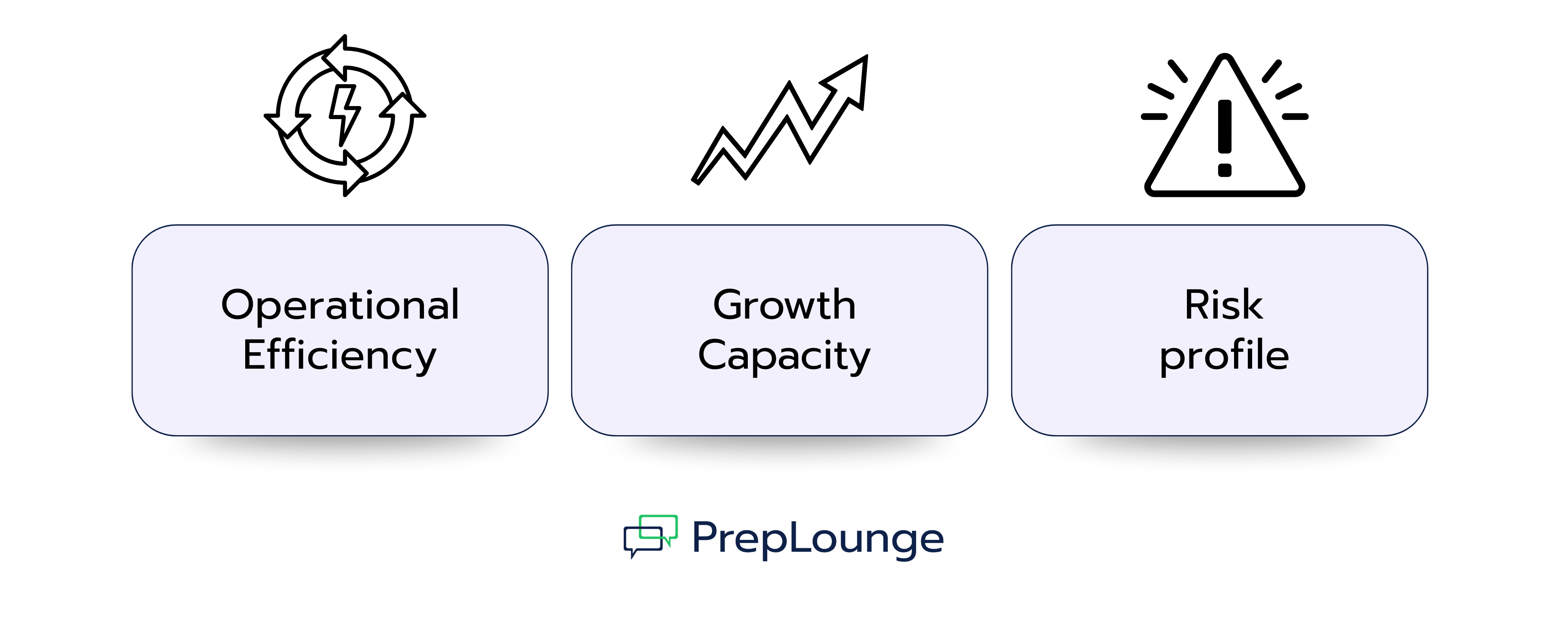
Operational Efficiency: High working capital might mean excess inventory, slow collections, or inefficient cash management. Low or optimal working capital suggests efficient operations including collecting receivables quickly, managing inventory tightly, and negotiating favorable payment terms with suppliers.
Growth Capacity: Adequate working capital allows companies to fund growth without immediate financing. Insufficient working capital constrains expansion even if the business is profitable.
Risk profile: Persistently negative, tight, or deteriorating working capital increases refinancing and supplier risk while excess idle working capital may imply underutilized resources.
Common Interview Questions About Working Capital
Here are a few sample interview questions about working capital to help you practice.
1. What does positive vs. negative working capital indicate?
Positive working capital means that a company's current assets exceed its current liabilities. That’s often a sign of good short-term financial health and the ability to cover immediate debts and invest in growth or operations.
Negative working capital means current liabilities are greater than current assets. It can signal liquidity challenges or a need to rely heavily on operational cash flow. However, in some industries with fast turnover or advance payments, negative working capital can actually imply efficient operations and improved cash flow.
So, you must assess the why behind the negative or positive result and consider the business model.
2. If inventory increases, what happens to working capital and cash flow?
Inventory is a current asset. So, an increase in inventory raises current assets and therefore increases working capital. The build up of inventory means more assets are tied up and not yet converted to cash. As a result, cash flow usually decreases because the company has spent cash acquiring or producing the additional inventory.
3. What do you understand by “the change in working capital”?
The change in working capital implies the difference in the amounts of current assets and current liabilities from one period to another. A positive change means the company has increased its net current assets, which might indicate building inventory, collecting more receivables, or paying down short-term liabilities.
A negative change means a reduction in net current assets, potentially due to selling inventory, collecting receivables faster, or taking on more short-term liabilities. Changes in working capital directly affect cash flow. For instance, an increase in working capital usually means a use of cash, while a decrease releases cash into the business.
Practice More Question Sets For Your Finance Interview
CLIENT OBJECTIVE
Our client, Lumen Cinemas, an Italian cinema chain, has seen its profit decline and wants McKinsey's help to understand why and how to restore it.
BACKGROUND INFORMATION
Lumen runs multiplex cinemas in mid-sized Italian cities. It earns money from ticket sales, from food and drinks such as popcorn and soft drinks, and from advertising shown before the films. A share of every ticket goes to the film distributors. Most of Lumen's other costs, such as rent, staff, energy and maintenance, don't change much with the number of visitors. Since the pandemic, films reach streaming services sooner, and audiences come back mainly for big releases. Lumen's sites are older than those of a premium chain that has been expanding with large halls and reclining seats. The CEO wants a clear view of what is driving the decline before deciding what to do.
CLIENT OBJECTIVE
Our client, Ledgerline, a US provider of accounting software for small businesses, wants to know whether and how it should move its customers from one-time licenses to a monthly subscription.
BACKGROUND INFORMATION
Ledgerline's desktop software handles invoicing, bookkeeping and tax preparation for small businesses such as shops, tradespeople and agencies. Customers buy a license once and use it for several years, until a new version or a tax rule change prompts them to upgrade. Many also pay for an annual support plan. Ledgerline sells through its website and through independent accountants, who recommend it to their clients and earn a referral fee. Cloud-based competitors are growing fast with monthly plans, automatic bank connections and mobile apps. Ledgerline's customers are loyal, but its customer base is aging and new customers increasingly choose cloud tools. Investors value recurring revenue, but the board worries about upsetting long-standing customers.
CLIENT OBJECTIVE
Our client, Nordhavn, a Norwegian seafood company, wants to know whether it should acquire Patagonia Salmon, a family-owned salmon farmer in southern Chile.
BACKGROUND INFORMATION
Nordhavn farms Atlantic salmon in Norway's fjords and sells it fresh and frozen across Europe and Asia. Farming sites in Norway are limited by regulation and expensive to obtain, so Nordhavn's growth at home has stalled. Chile is the world's second-largest salmon producer, with lower costs in some areas, but the industry has a history of biological crises: algal blooms, sea lice and a virus outbreak that once destroyed a large part of the country's production. Patagonia Salmon owns hatcheries, sea farming sites and a processing plant in the Los Lagos and Aysén regions. It sells fresh fillets by air to the US and Brazil and frozen products to Asia. The founding family wants to sell, and Nordhavn has been invited to bid.
Your client is NovaBank, a fast-growing European digital bank offering current accounts, debit cards and credit cards.
Over the past year the value of fraudulent card transactions has increased significantly. NovaBank relies on a rule-based fraud system, for example blocking transactions above certain amounts or coming from unusual locations. The system has two problems: it misses many sophisticated frauds, and it blocks a large number of legitimate customer payments.
NovaBank is considering replacing or complementing its rules with a machine-learning model, and has asked BCG X to assess whether machine learning can materially improve fraud detection, how the solution should be designed, what value it could generate, and how to roll it out without damaging the customer experience.
"FemVest" is a venture-backed fintech aiming to launch a mobile neobroker in Germany in 2026. The company believes that women are structurally underserved in the area of retail investing: women are less likely to hold a securities account, invest smaller amounts on average, and enter the market later than men. At the same time, the financial relevance of women is growing — driven by rising incomes, demographic shifts, and inheritances.
FemVest has already secured regulatory approval as well as a custodian bank and execution partner. However, key strategic decisions remain open: the target segment has not been finalized, the product and service offering is not yet defined, the business model has not been established, and the go-to-market strategy has not yet been developed.
The board is asking you, as a consultant, to analyze the market potential, develop an initial business case, and derive concrete strategic recommendations for market entry.
Working capital equals current assets minus current liabilities. Current assets are items that can be converted into cash within a year, such as receivables, inventory, or marketable securities. Current liabilities are short-term obligations like accounts payable, accrued expenses, wages, taxes, and short-term debt.
Efficient working capital management appears in tight inventory control, fast receivable collection, and favorable payment terms with suppliers. Low or optimized working capital often signals that the company converts resources into cash quickly rather than letting capital sit idle.
Adequate working capital allows a business to fund expansion, new projects, and daily operations without relying on immediate external financing. If working capital is insufficient, growth may stall even when the business is profitable.
Persistently negative or shrinking working capital increases liquidity, refinancing, and supplier risk. In contrast, excessively high idle working capital can signal poor cash management and underutilized resources.
Let's Move On With the Next Articles
High Yield Debt
Key Figures & Terms
Did you know that companies can raise money not only through bank loans or equity, but also through the capital market? One important way to do this is through corporate bonds. Investors lend money to a company, receive regular interest payments called coupons, and get their money back at maturity.
Besides regular corporate bonds, there is another type called High Yield Debt, also known as Junk Bonds. These bonds offer higher interest rates because they are riskier for investors. For this reason, they are often used to finance large projects such as leveraged buyouts, growth investments, or restructurings. Let us now look at how High Yield Bonds work in more detail. 🔎
In finance, the tax shield refers to the tax savings a company achieves by deducting certain expenses from its taxable income. The most common examples are interest payments on debt and depreciation of assets. These deductions reduce taxable income, which lowers the company’s tax bill. As a result, more cash flow is left over for shareholders or for reinvestment.
The idea of the tax shield is simple but powerful: by lowering taxes, companies can increase their value. That’s why the tax shield is often tested in finance interviews, especially in connection with valuation, capital structure, and leveraged buyouts (LBOs).
When companies talk about success, they often focus on profit. But profit does not always show how much cash actually ends up in the business. This is where Free Cash Flow (FCF) comes into play.
Free Cash Flow shows how much cash a company really has available after running its day-to-day operations. That is why FCF is especially important for investors and plays a major role in company valuation.
In this article, we will look step by step at what Free Cash Flow is, how it is calculated, and why it is often more meaningful than profit.