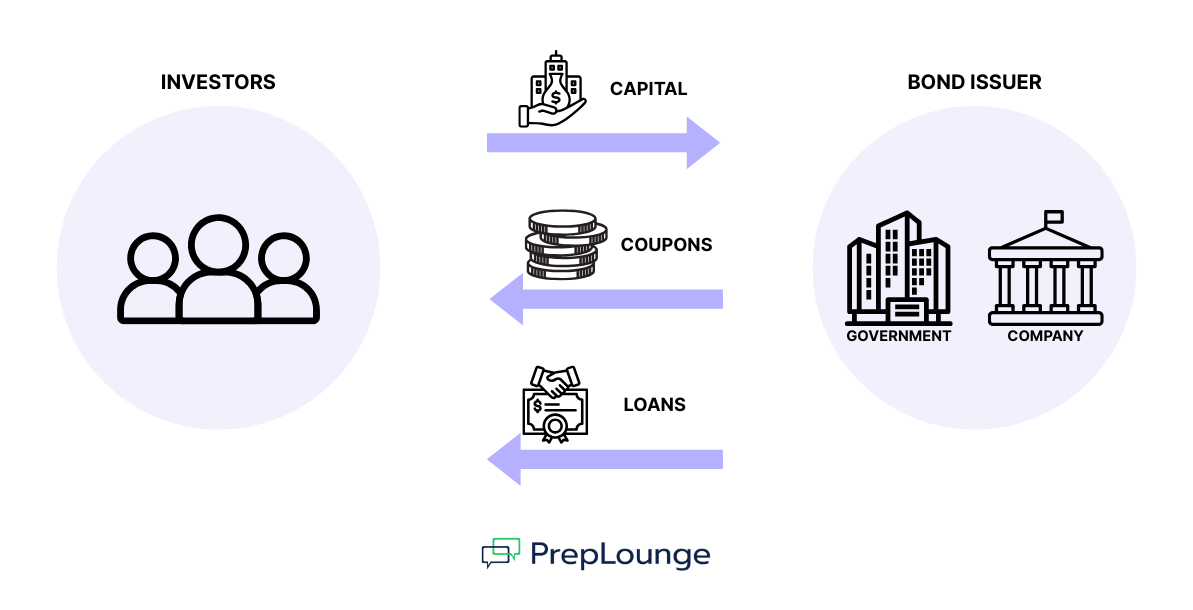
Did you know that companies can raise money not only through bank loans or equity, but also through the capital market? One important way to do this is through corporate bonds. Investors lend money to a company, receive regular interest payments called coupons, and get their money back at maturity.
Besides regular corporate bonds, there is another type called High Yield Debt, also known as Junk Bonds. These bonds offer higher interest rates because they are riskier for investors. For this reason, they are often used to finance large projects such as leveraged buyouts, growth investments, or restructurings. Let us now look at how High Yield Bonds work in more detail. 🔎
Companies can borrow money on the capital market by issuing bonds. Investors provide capital to the company. In return, they receive regular interest payments and get their investment back at maturity.
During the life of a bond, it can be traded on the market. Its price can go up or down, for example when interest rates change or when the financial situation of the company improves or worsens. For investors, this means bonds can generate gains in addition to interest payments, but also losses if they are sold before maturity.
High Yield Debt refers to bonds issued by companies with lower credit quality. Because the default risk is higher, these bonds offer higher yields than Investment Grade bonds.
When Is Debt Considered High Yield?
A company’s creditworthiness is assessed by specialized rating agencies such as S&P Global Ratings, Fitch Ratings, and Moody’s Investors Service. These agencies analyze a company’s financial position and assign letter-based ratings that indicate how safe or risky a bond is.
In general:
“A” and “BBB” ratings indicate relatively strong and stable companies
“BB”, “B”, and lower indicate significantly higher risk
The dividing line is called Investment Grade:
BBB- for S&P and Fitch
Baa3 for Moody’s
Any rating below this threshold is classified as High Yield Debt.
👉 The lower the rating, the higher the default risk and the higher the interest rate investors require as compensation.
What Are Fallen Angels and Rising Stars?
Bond ratings can change over time. Sometimes a company’s financial situation gets worse, sometimes it improves.
Fallen Angels are companies whose bonds are downgraded from Investment Grade to High Yield. They were once seen as relatively safe, but are now considered riskier.
Rising Stars are the opposite. These are companies whose bonds improve in quality and return to Investment Grade status.
These examples show that credit ratings are not fixed and change with a company’s performance.
Key Characteristics and Risks of High Yield Debt
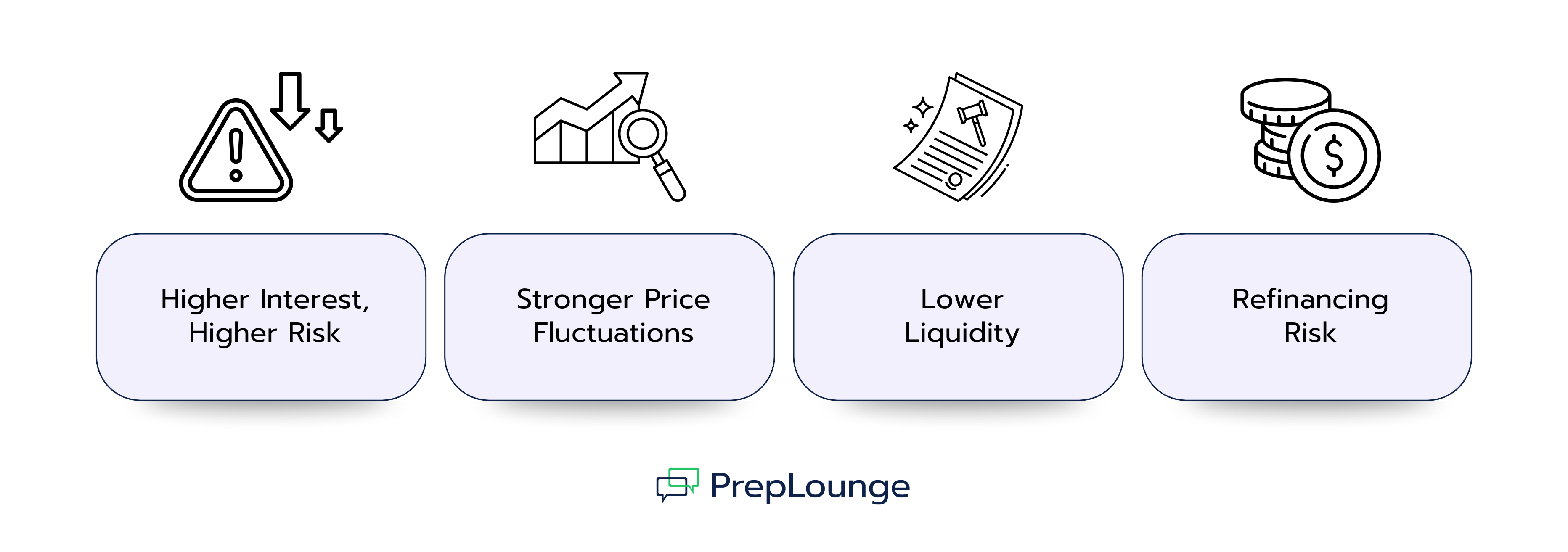
Higher Interest, Higher Risk
High Yield Bonds pay higher interest than Investment Grade bonds. This is because the issuing companies are less creditworthy. Investors receive higher coupons as compensation for the risk of default.
Stronger Price Fluctuations
High Yield Bonds react more strongly to economic conditions. When the economy weakens, default risk increases and bond prices can fall sharply. Investors who need to sell during such periods may face losses.
Lower Liquidity
High Yield Bonds are traded less frequently than safer bonds. This means there are fewer buyers and sellers. As a result, the difference between buying and selling prices is larger, which can reduce returns, especially if the bond is sold before maturity.
Refinancing Risk
When a High Yield Bond matures, companies often need to issue new debt to replace it. In weak market conditions, this is usually only possible at higher interest rates, increasing financial pressure and the risk of payment problems.
Why Companies Use High Yield Debt
Many companies cannot access Investment Grade bonds or traditional bank loans because their credit quality is too weak. High Yield Debt still allows them to raise large amounts of capital.
It is often used to finance growth, acquisitions, or leveraged buyouts. Another advantage is that companies can raise capital without issuing new shares. Existing owners keep their ownership stakes, and there is no dilution. This makes High Yield Debt an important financing tool for growing companies with higher risk profiles.
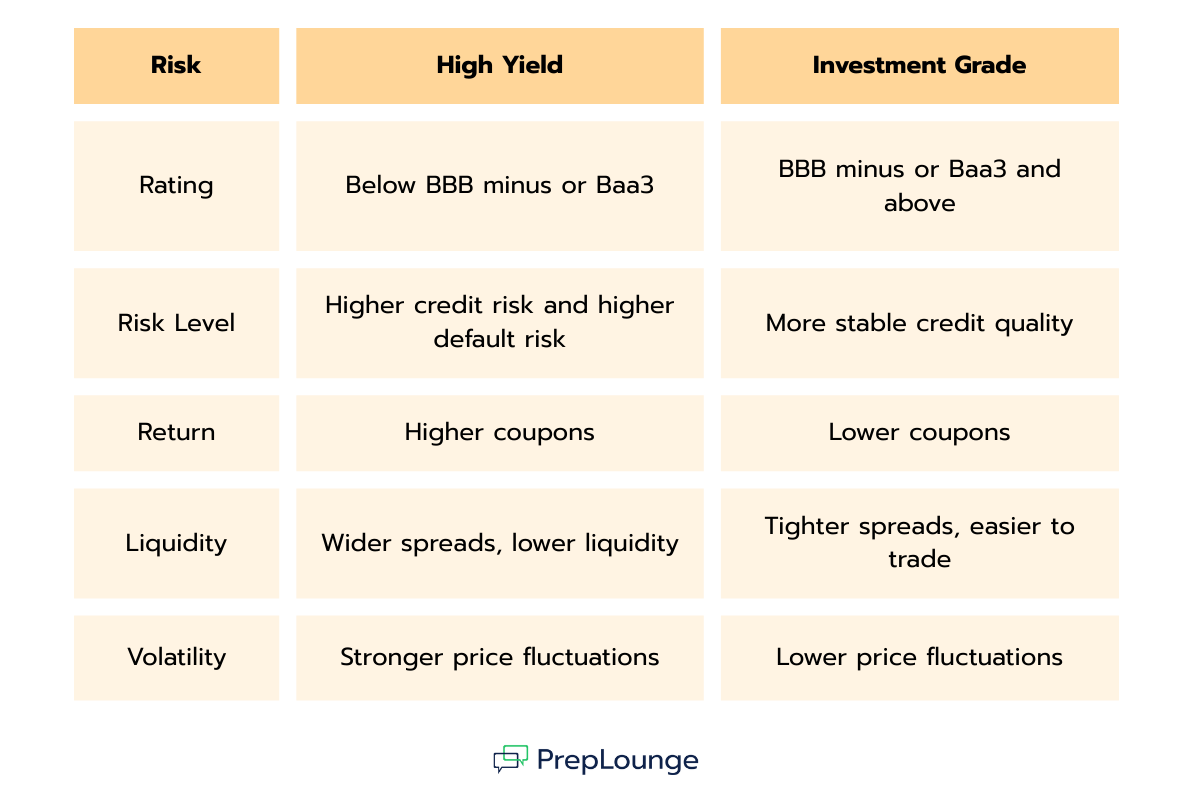
Differences Between High Yield and Investment Grade
High Yield Bonds and Investment Grade bonds differ in several key areas, including credit rating, risk, return, liquidity, and price volatility. The table below highlights the most important differences.
Typical Interview Questions on High Yield Debt
Below are three common interview questions with simple answers you should remember for finance interviews.
1. What is High Yield Debt?
High Yield Debt consists of corporate bonds rated below Investment Grade. These bonds offer higher interest because the risk of default is higher. Unlike equity, they do not dilute ownership. Since they are traded on the market, their prices react to interest rates, company performance, and rating changes.
2. How do High Yield Bonds differ from Investment Grade bonds?
High Yield Bonds offer higher returns but come with higher risk. Issuing companies have lower credit quality, leading to stronger price movements. These bonds are also less liquid, meaning buying and selling prices are further apart. There is also refinancing risk when companies need to replace maturing debt in weak markets.
3. Why do companies use High Yield Debt and what are the risks for investors?
Companies use High Yield Debt when they cannot access cheap bank loans or Investment Grade bonds. The capital is often used for growth, acquisitions, or leveraged buyouts. Investors benefit from higher interest payments, but face higher default risk, price volatility, and the risk that the company’s financial situation worsens.
Working capital and cash flow are core drivers of a company’s liquidity and financial health, and they frequently come up in finance interviews. This case will test your understanding of working capital basics, the cash conversion cycle, links to free cash flow, and practical ways companies manage short-term financing needs.
Valuing energy and natural resources companies is very different from other industries. Commodity price swings, capital intensity, and the role of reserves make traditional models harder to apply directly.
In interviews, you’ll be expected to show that you can adapt standard finance tools to the specifics of oil & gas, midstream, and renewables. This set covers the most common technical questions so you can demonstrate both solid finance fundamentals and an understanding of sector nuances.
An Initial Public Offering (IPO) is one of the most important events in a company’s lifecycle and a frequent topic in investment banking interviews. This case will test your understanding of IPO basics, process steps, valuation methods, and recent market dynamics.
High Yield Debt refers to corporate bonds below Investment Grade. They pay higher interest because investors take on higher default risk. Compared to Investment Grade bonds, they are riskier, more volatile, and often harder to trade.
Companies use High Yield Bonds to raise capital for growth, acquisitions, or leveraged buyouts without issuing new shares. For investors, these bonds offer attractive return potential, but also higher risks from price volatility, lower liquidity, and possible refinancing problems.
Let's Move On With The Next Articles!
Tax Shield
Key Figures & Terms
In finance, the tax shield refers to the tax savings a company achieves by deducting certain expenses from its taxable income. The most common examples are interest payments on debt and depreciation of assets. These deductions reduce taxable income, which lowers the company’s tax bill. As a result, more cash flow is left over for shareholders or for reinvestment.
The idea of the tax shield is simple but powerful: by lowering taxes, companies can increase their value. That’s why the tax shield is often tested in finance interviews, especially in connection with valuation, capital structure, and leveraged buyouts (LBOs).
When companies talk about success, they often focus on profit. But profit does not always show how much cash actually ends up in the business. This is where Free Cash Flow (FCF) comes into play.
Free Cash Flow shows how much cash a company really has available after running its day-to-day operations. That is why FCF is especially important for investors and plays a major role in company valuation.
In this article, we will look step by step at what Free Cash Flow is, how it is calculated, and why it is often more meaningful than profit.
Sometimes businesses experience financial problems such as declining profitability measured by EBIT or EBITDA, rising leverage reflected in higher debt-to-equity ratios, or temporary liquidity shortages visible in the Cash Flow Statement. If such issues persist and are not resolved early enough, the next and most severe outcome is insolvency. At that point, the company can no longer meet its financial obligations on time.
Once a company is already in or on the brink of insolvency, it may seek help from restructuring advisory, distressed debt investing, and turnaround consulting teams. In such situations, preserving Free Cash Flow becomes critical to stabilize operations. Read on to learn what insolvency really means, how it’s determined, preventative measures, and consequences.