What Is Customer Acquisition Cost?
Customer acquisition cost (CAC) is the total amount of money a business spends to win one new paying customer. It answers the question, “how much did it cost to get each new customer through the door?”
A fully-loaded CAC, which is the most common, accounts for every dollar spent to move the needle on new customer acquisition. It includes all aspects of the sales and marketing costs such as:
- Ad spend across all channels (paid search, social, display)
- Salaries and commissions of marketing and sales staff
- Software tools and platforms (CRM, marketing automation, analytics)
- Creative production costs (agency fees, content creation, design)
- Events and lead generation activities
Costs related to retaining existing customers, such as account management, customer success, or support, should be excluded. The CAC calculation is specifically about the cost of winning new customers, not servicing the existing ones.
How Is Customer Acquisition Cost Calculated?
The customer acquisition cost (CAC) formula is:

Both the numerator and denominator figures must cover the same time period, whether that’s monthly, quarterly, or annually. For instance, if a company spent $40,000 on sales and marketing in Q1 and acquired 160 new customers in that same quarter. The CAC is:
$40,000 ÷ 160 = $250 per customer
This customer acquisition cost formula typically calculates blended CAC. It takes the total sales and marketing expenses and divides it by all new customers, including those who came through organic search, referrals, or word-of-mouth. However, there’s a variation called paid CAC that isolates the performance of paid channels. Paid CAC divides total paid marketing spend by only those customers acquired via paid ads.
Why Is Customer Acquisition Cost Important?
One of the reasons why CAC is a valuable business metric to track is that it reveals if a company is operating or growing efficiently. It’s particularly helpful when used alongside revenue figures and customer lifetime value (LTV). Generally, a good CAC is one that's sustainable relative to lifetime value. The widely used benchmark is an LTV:CAC ratio of at least 3:1, but it also depends heavily on the industry. That data helps in improving the marketing return on investment and overall profitability.
Another reason why CAC is important is that it helps in modeling growth scenarios with precision. If a company plans to add 500 new customers next quarter and the current CAC is $300, they can estimate the acquisition budget needed, stress-test it against different assumptions, and sense-check whether the projected revenue justifies the spend.
Tracking CAC also helps in identifying changes and adjusting accordingly. A rising CAC over time may mean a company's marketing channels are becoming saturated or inefficient. A falling CAC, on the other hand, often reflects the compound benefits of brand awareness, word-of-mouth, and organic reach that reduce dependence on paid spend.
In short, tracking CAC measures cost effectiveness and thus helps in making sound decisions about where to invest regarding customer acquisition, when to scale back, and whether a growth strategy is genuinely profitable and sustainable.
What Factors Influence Customer Acquisition Cost?
While CAC quantifies the cost effectiveness of a business, there are several factors that influence it such as sales cycle length, business model, channel mix in marketing strategies, brand awareness, competition, and targeting precision. Below is an overview of how each of these factors impact CAC.
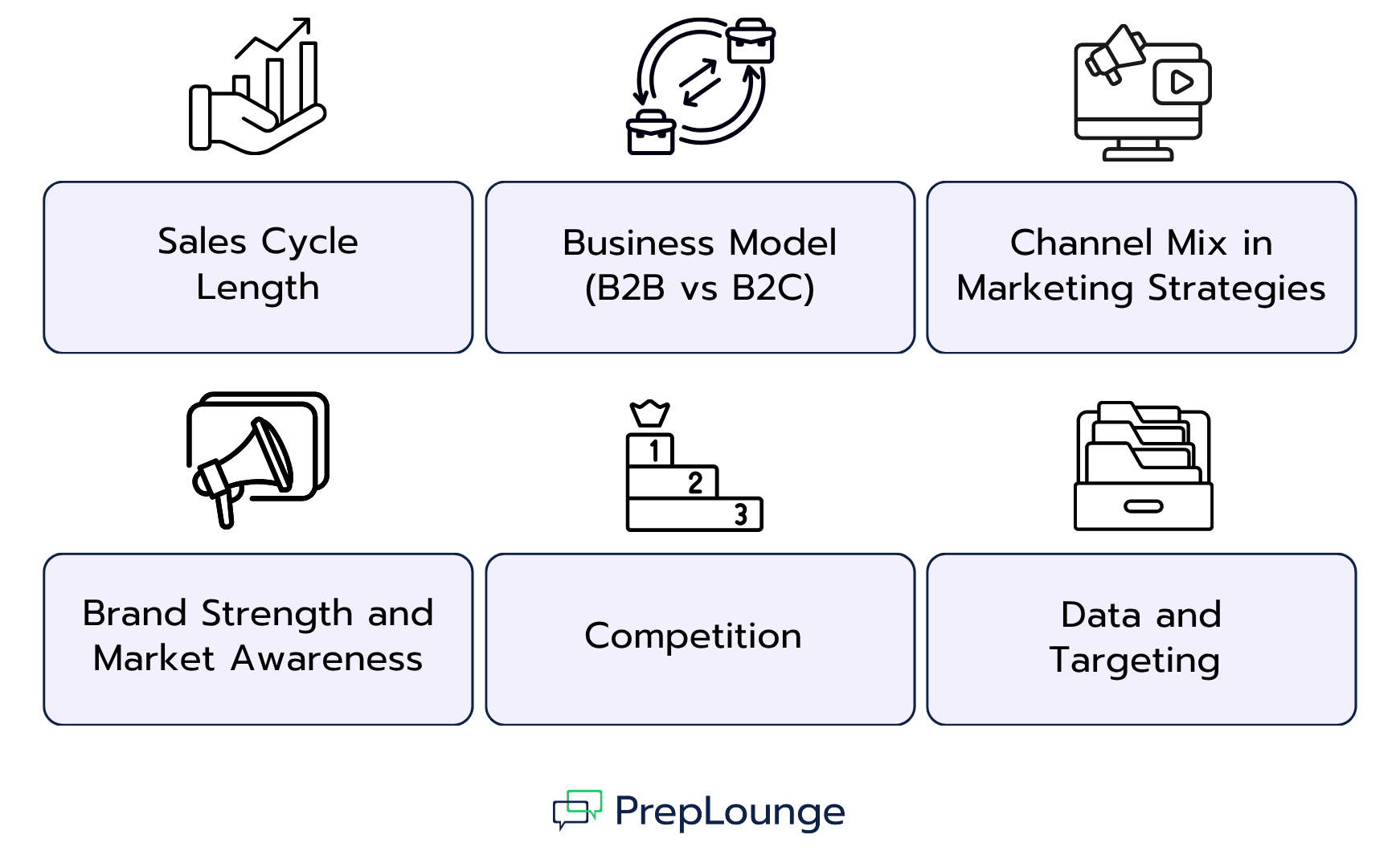
Sales Cycle Length
If a buyer takes months to make a decision, as is common in enterprise software, professional services, and financial products, the CAC figure tends to be higher. Every step of that journey costs money, for instance salespeople need to make multiple calls, attend demos, navigate procurement committees, and often travel. Also, the higher the CAC, the longer the CAC payback period, which is the time it takes the business to recover that acquisition cost from the revenue the customer generates.
If a consumer decides to buy in seconds from a product page, CAC is often a fraction of that, and payback can be near-immediate.
Business Model (B2B vs B2C)
B2B companies almost always have higher CAC because they're selling to organisations, not individuals. The buying process involves multiple stakeholders, longer consideration periods, and more tailored outreach, all of which are expensive. B2C businesses benefit from higher purchase volumes and self-serve transactions, which distribute acquisition costs more broadly.
Channel Mix in Marketing Strategies
Paid advertising generates customers quickly but at a tangible per-click cost. Organic channels, like SEO, content, referrals, and word-of-mouth, take longer to build but tend to produce customers at a fraction of the paid cost once they're established. Companies that rely heavily on paid search tend to see CAC creep upward over time as competition for ad placements intensifies. Those that invest in organic and brand-led growth often see their CAC decline as scale compounds.
Brand Strength and Market Awareness
A well-known brand in its category can convert a prospect with far less marketing effort than an unknown competitor trying to earn the same trust from scratch. This is one reason why established financial services firms can justify higher absolute acquisition spend as the brand does a portion of the persuasion work before the sales process even begins.
Competition
Competitive intensity also pushes CAC up or down. In crowded markets where multiple companies are bidding for the same audiences and advertising slots, costs rise for everyone. In less contested niches, the same budget goes further.
Data and Targeting
Finally, data and targeting quality separates efficient acquirers from wasteful ones. Companies that know precisely who their best customers are, and can reach similar profiles with precision, consistently achieve lower CAC than those casting a wide net and hoping for the best.
Typical Interview Questions About Customer Acquisition Cost
CAC comes up in finance interviews often woven into questions about business performance, growth strategy, and unit economics. Here are a few sample CAC interview questions.
What's the difference between CAC and CPA?
CAC is the total, fully-loaded company-wide cost to acquire a paying customer. CPA is a campaign-level metric measuring the cost of a specific conversion event, which may not even be a purchase.
A SaaS business has a CAC of $1,200 and an LTV of $2,400. Is that a healthy business?
The LTV:CAC ratio of 2:1 is below the standard 3:1 benchmark, which would normally signal concern. However, the CAC payback period, churn rate, and gross margin all matter too. This means a 2:1 ratio might be acceptable in an early-stage business still building brand awareness, but would be a red flag in a mature company that should have achieved greater efficiency.
What are the common mistakes people make when calculating CAC?
Some of the errors that come up include:
- Mixing time periods. If your cost data covers Q1 but your new customer count includes some from Q4 sign-ups completing in Q1, your CAC will be distorted.
- Including the wrong costs. Blending customer success or retention costs into acquisition figures is one of the most common mistakes. These are operational costs for the existing base, not acquisition costs for the new one.
- Ignoring channel-level CAC. Company-wide CAC is useful, but breaking it down by channel, such as paid search, referrals, organic, or events, is crucial. Two channels might both generate customers at $250 CAC, but one of those customers might have three times the lifetime value of the other.
Key Takeaways
Customer acquisition cost (CAC) is the total sales and marketing spend required to win one new paying customer. It’s calculated by dividing those combined expenses by the number of new customers gained in the same period.
CAC is a valuable business metric because it helps in understanding the cost effectiveness of a company’s customer acquisition strategies and thus aids in making improvements on the marketing return on investment. It also helps in modeling growth scenarios. So, understanding what a changing CAC signals about a business's efficiency, sustainability, and growth trajectory is important.
Tracking the CAC payback period adds a further dimension by showing how long it takes to recover acquisition costs, which matters for cash flow planning and capital efficiency. Some of the factors that influence CAC include sales cycle complexity, business model, channel mix, brand strength, and competitive intensity. This means a rising CAC isn't always a failure of execution as sometimes it could be market conditions outside a company's control.