What Is Customer Lifetime Value?
Customer lifetime value (CLV) is the total net profit a company expects to generate from a customer throughout their entire relationship. It’s often confused with customer profitability analysis (CPA), but they’re different. Customer lifetime value predicts the future net profit from the first to last purchase with a brand, while customer profitability shows how much a customer has already spent over a defined period.
How Is Customer Lifetime Value Calculated?
Basic CLV Formula

For instance, if a customer generates $1,200/year and stays for an average of 4 years, CLV = $4,800. That’s the simplest customer lifetime value calculation method. However, there are other variations such as margin-adjusted formulas and CLV with a discount rate. These account for gross margin and the time value of money, which the basic formula ignores.
Margin-Adjusted CLV Formula
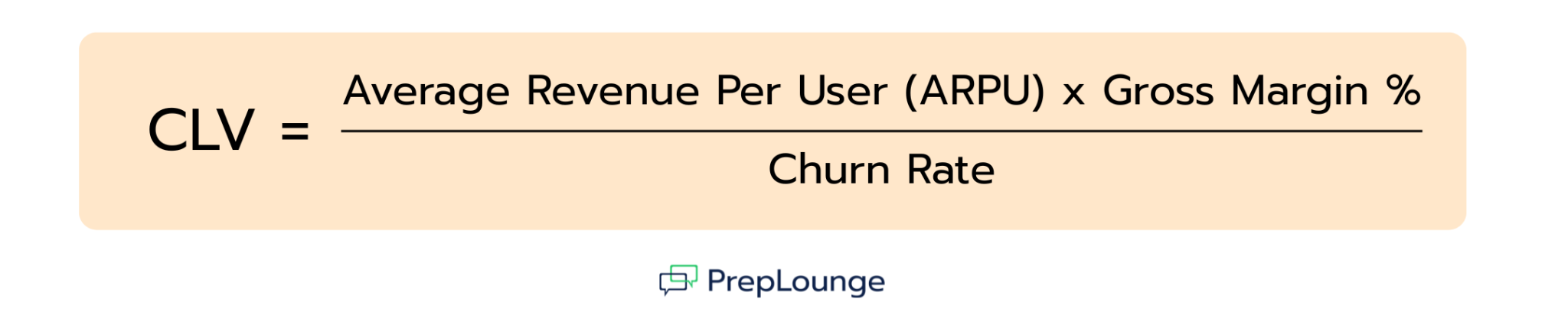
This is the most common and finance standard customer lifetime value calculation method. That’s because the figure obtained reflects what the business actually keeps after direct costs of delivering the product or service to the customer. Dividing by churn rate implicitly converts churn into customer lifespan.
Discounted CLV Formula
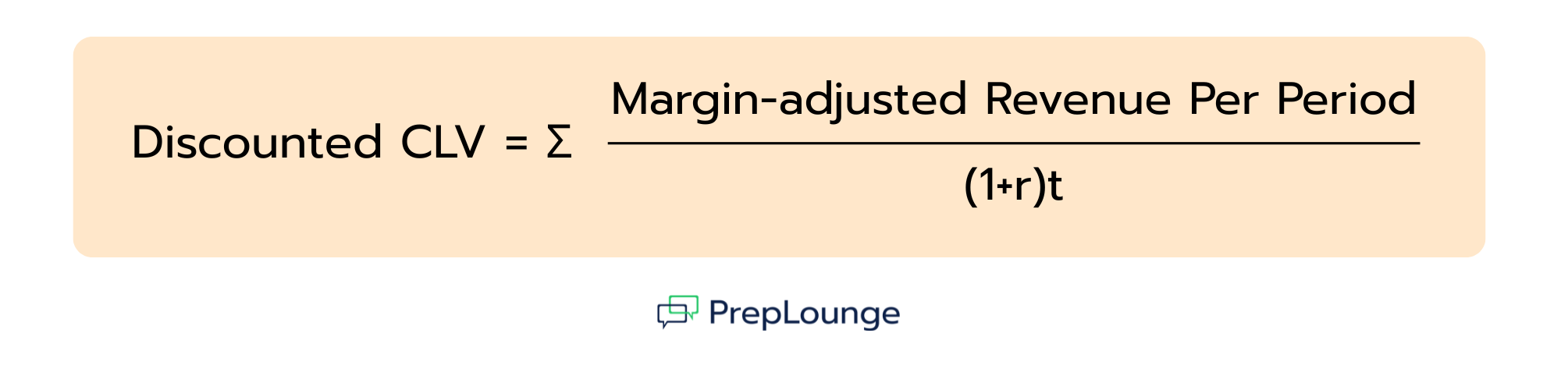
Where
- r is the periodic discount rate
- t is the time period (month 1, month 2, month 3, …) until the customer churns
Or
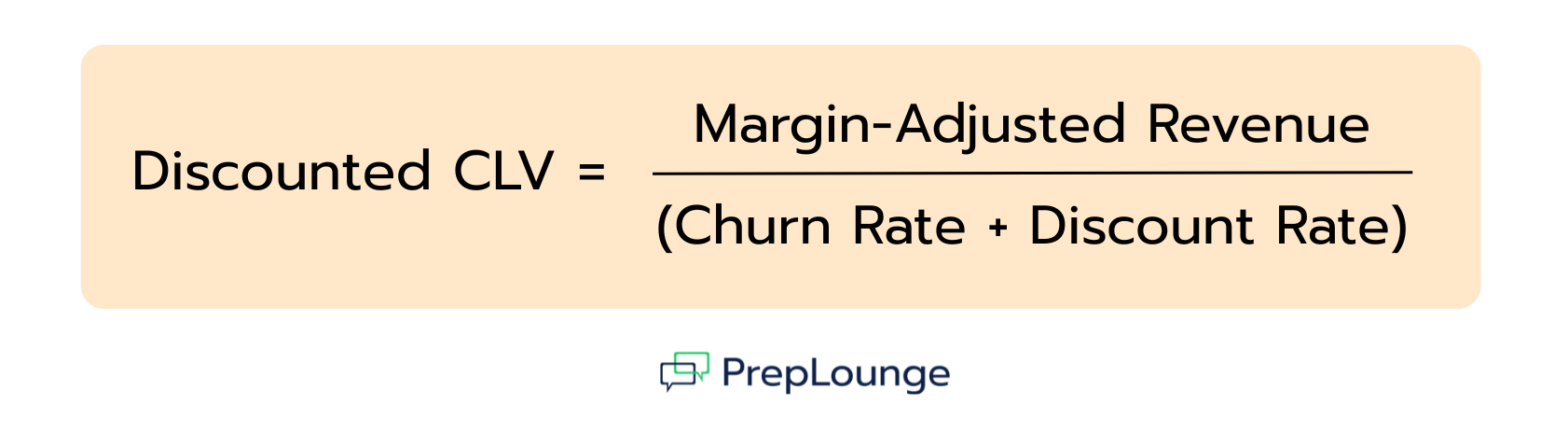
Since CLV relies on predictions of future cash flows, it’s often helpful to discount the figures to today’s value. A dollar received three years from now is worth less than a dollar today.
So, a discount rate, often the company's WACC or a risk-adjusted rate, is applied to compress future cash flows and produce a more conservative and defensible CLV figure. This kind of CLV calculation is usually necessary when CLV is being used to support a valuation, investor deck, or M&A analysis.
Why Is Customer Lifetime Value Important for Companies?
As highlighted earlier, CLV is one of the most important metrics a business can track. One of the reasons for this is that it helps to optimize acquisition costs while assessing a business model's viability. Knowing CLV helps a company determine their maximum allowable customer acquisition cost (CAC). A healthy business usually aims for a CLV:CAC ratio of 3:1.
CLV also helps companies to segment audiences based on long-term value. The customer segments with a high CLV tend to stay longer and spend more. Once identified, a company can double down on similar profiles in their marketing to find more people just like them. Picking out those with low CLV means a company can realize that spending money to acquire them might actually be a net loss.
Another reason why CLV is important for companies is that it can lead to increasing profitability through customer retention. Tracking CLV reveals the direct financial impact of a high churn rate and helps spot risks early to prevent churn. It shifts the goal to keeping the current customers happy. In most cases, acquiring a new customer can be more expensive than retaining an existing one.
Besides, knowing CLV is useful when valuing a company. If a business knows their average CLV is $1,000 and they have 1,000 customers, they can reasonably forecast $1,000,000 in future value. Companies with high CLV and low churn are valued much higher by VCs.
What Are the Limitations of the Customer Lifetime Value?
Though customer lifetime value (CLV) is a powerful and useful business metric, it is built on assumptions, which creates limitations.
If there are small changes in churn rate or gross margin assumptions, the output can change substantially. Finance professionals try to work around this by performing sensitivity analysis on their CLV models. They ask and model questions like “What happens if churn increases by 20%?” or “What if the discount rate rises due to inflation?” Ideally, the business model shouldn’t collapse under those minor adjustments.
Besides, CLV doesn't easily account for sudden market shifts, competitor entry, or radical product changes.
Measures to Increase Customer Lifetime Value
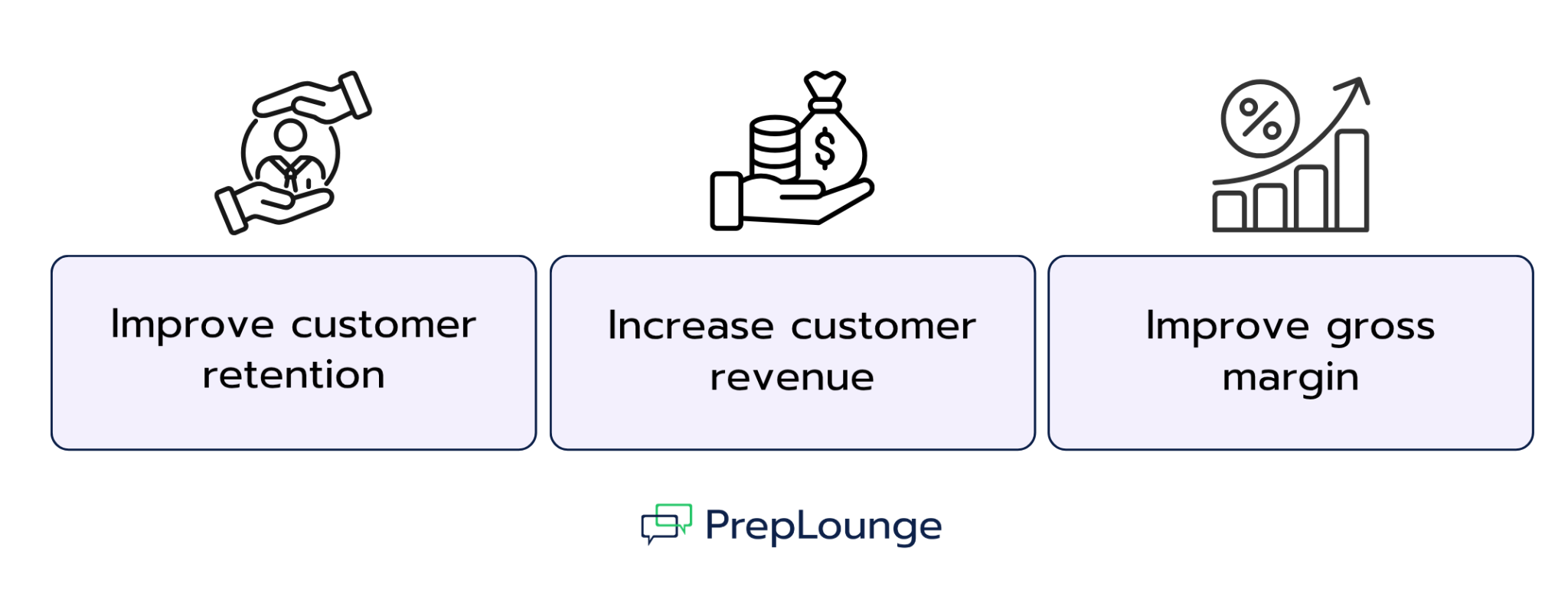
Since CLV is a function of revenue per period, gross margin, and churn, the measures for improving it fall into three categories.
Improving retention is one of the most impactful strategies for increasing customer lifetime value. Even a modest reduction in churn rate can double CLV. Efforts to reduce churn include improving onboarding quality, customer support, and product stickiness. Loyalty programs also tend to strengthen customer loyalty.
Another measure is improving revenue per customer through upselling and cross-selling. A customer who started on a basic plan and migrated to a premium tier contributes materially more CLV over the same lifespan.
There’s also improving gross margin to raise the margin-adjusted value of every customer relationship without requiring a single new customer acquisition. This can be achieved through pricing optimization, cost reduction, or product mix shifts.
Typical Interview Questions About Customer Lifetime Value
If you're preparing for a finance role where CLV is likely to come up, here are some of the questions interviewers commonly ask to aid in your practice.
How does churn rate affect CLV?
Because customer lifespan is derived from churn (lifespan = 1 / churn rate), even a small change in churn rate has a disproportionately large effect on CLV. A 5% improvement or reduction in churn rate can double the output, while an increase can do the opposite.
For instance, a company with 5% monthly churn has customers with a 20-month average lifespan. But at 10% monthly churn, the customer lifespan halves to 10 months, cutting CLV in half with no change in revenue per customer.
What’s the relationship between CLV and the WACC?
WACC is the discount rate most commonly used in CLV calculations for investor-grade work. A higher WACC reduces CLV more aggressively because it treats future cash flows as less certain. So WACC calibrates CLV, adjusting the output to reflect the company's cost of capital and the risk embedded in assuming customers stay and pay as modeled.
How would you calculate CLV for a company with negative net churn?
A negative churn rate means customers are expanding their spending faster than they’re leaving, or that existing customers spend more over time than is lost from cancellations. Calculating CLV in such scenarios requires summing the initial revenue plus the compounding expansion revenue over a set timeframe, typically 3 to 5 years. Because the revenue per customer increases over time, you must pick a realistic time horizon so that the math doesn’t suggest the customer stays forever and pays infinite money.
Key Takeaways
CLV is a forward-looking cash flow metric that estimates the net value a customer generates over their entire relationship with a business. CLV helps companies identify high-value customer segments, determine their maximum allowable customer acquisition cost, increase profitability through customer retention, and make future value forecasts.
While CLV is a powerful business metric, it has limitations like sensitivity to churn assumptions, dependence on historical behavior, and assumptions of a steady environment.