Consulting Consulting
Back to overview

Business Sense

Business sense refers to the ability to quickly grasp economic dynamics and make decisions that are both strategically and commercially sound. In consulting, it’s not enough to repeat theories from your business degree. What matters is a deep understanding of how companies operate, what drives markets, and what different stakeholders are aiming to achieve.

Consultants with strong business acumen can quickly adapt to new industries, understand client needs, and set priorities that make economic sense. They don’t just ask, “What is analytically correct?” – they also ask, “What truly benefits the company?” This mindset often makes the difference in a case interview.


Why Your Business Sense Matters in Consulting

As a consultant, you’re expected not only to analyze complex problems but also to think in a solution-oriented and entrepreneurial way. A strong business mindset helps you put analyses into context, assess actions realistically, and focus on generating maximum client value.

In day-to-day consulting, you're working under pressure, collaborating with decision-makers, and constantly weighing trade-offs. Those who think commercially and can strategically prioritize have a clear edge.

In a case interview, showing that you understand markets and business models is key – it sets you apart and proves your readiness for the job.

👉 In our Case Library, you can prepare effectively with curated practice cases and put your business sense to the test.

Company case provided by Company case by
E.ON Inhouse Consulting
E.ON Inhouse Consulting Case: Heating Systems
The European Union pursues the target of lowering the CO₂ emissions of their residents. Therefore, the EU introduced a CO₂ tax to create incentives for consumers to switch to more climate friendly alternatives and stabilize carbon dioxide emissions. Accordingly, and as E.ON’s strategy focuses on creating a better tomorrow for its customers, E.ON is investing significantly to grow its ‘Customer solutions’ area with climate-friendly solutions, including its heating solutions business. You have recently joined E.ON Inhouse Consulting and E.ON’s Head of Heating Solutions has hired you to conduct an analysis concerning the European CO₂ tax. Specifically, you are asked to assess whether the EU uses the right tool to steer consumers towards more climate-friendly heating systems.
4.4
4.9k times solved
Difficulty: Intermediate
Interviewer-led
Market analysis
Company case provided by Company case by
Bain & Company
Bain Case: Old Winery
You have inherited the “Old Winery” from your grandfather, a winery that has been family-owned for five generations and can be dated back to the 16th century. Half of the eleven hectares are used to grow white grapes, the other half to grow red grapes. They are grown in a conventional way, i.e. they are not organically farmed and certified. The vine stocks are in a good condition regarding age and care. Overall, the only ¼ of the harvest is made into wine by the winery itself; the rest is sold. Your grandfather never wanted to change the image of the winery and left the managerial and administrative task to a young and energetic wine-maker. Due to the not so well-known brand, the demand for the “Old Winery” wine is currently rather low. You do not intent to run the winery operatively, given your limited knowledge of winemaking, but find the idea of owning a winery exciting.
4.3
151.5k times solved
Difficulty: Intermediate
Candidate-led
Growth strategy
Market analysis
Market sizing
Mergers & Acquisition
Company case provided by Company case by
Mercedes-Benz Management Consulting
MBMC Case: AMG | Turning the most affluent prospects into loyal clients
Mercedes‑AMG stands for uncompromising performance, engineering excellence, and emotional driving experiences. Yet recently, AMG’s top management has become concerned that while the product itself continues to exceed customer expectations, the moment of purchase no longer does. The trigger for this case was a concrete incident: a highly affluent customer configured an AMG top‑end vehicle in detail, was technically convinced, but ultimately decided against the purchase, stating: “It’s a fantastic car – but it didn’t feel special.” For the CEO of Mercedes‑AMG, this statement raises a critical question. In the luxury and performance segment, emotional differentiation at the point of decision is as important as horsepower or technology. Against this backdrop, AMG is exploring new ways to elevate the buying experience for its most valuable customers. One idea under discussion is the introduction of AMG Individualization Hubs – exclusive physical spaces where customers would finalize their vehicle together with AMG experts in a highly personalized and immersive setting. The management now asks you and your Consulting Team to assess this idea holistically: How can AMG strengthen emotional differentiation during the purchase decision, and do Individualization Hubs represent a strategically sound and economically viable solution? The objective is to develop a clear recommendation that balances brand impact, customer experience, and profitability.
4.8
17.2k times solved
Difficulty: Intermediate
Interviewer-led
Growth strategy
New product
Profitability analysis
Company case provided by Company case by
FTI-Andersch AG
FTI-Andersch AG Case: Business Transformation – Global Plastics AG
Die Global Plastics AG ist ein im M-DAX gelistetes Unternehmen mit weltweit 2.500 Mitarbeitenden und einer Gesamtleistung in Höhe von € 395,0 Mio. in 2021. Der Umsatz des Unternehmens ging 2020 nach dem Ausbruch der COVID-19-Pandemie stark zurück und soll im Jahr 2022 wieder an das Niveau vor COVID-19 anknüpfen. Neben Umsatzrückgängen hat die Global Plastics AG auch mit einer erhöhten Varianz in den OEM Call-Offs zu kämpfen, was zu Überkapazitäten in der Produktion führt. Zusätzlich befindet sich die Global Plastics AG in Kundenverhandlungen zu bestehenden und neuen Verträgen. Das Thema Nachhaltigkeit ist tief in der Unternehmensidentität verankert. Das Unternehmen investiert kontinuierlich in die Forschung und Entwicklung von neuen Technologien. Diese Investitionen dienen im Wesentlichen dazu ... - ... das bestehende Produktportfolio weiter zu verbessern und sich einen Wettbewerbsvorteil zu erarbeiten. - ... den zu erwartenden strengeren Vorschriften hinsichtlich CO2-Neutralität der Wert-schöpfungskette als auch einer steigenden Beimischungsquote von recyceltem Kunststoff und Alternativmaterialien in den nächsten Jahren gerecht zu werden. Das Unternehmen ist bei den Kunden für seine innovativen Technologien bekannt und für seine branchenweit Maßstäbe setzende, präzise und qualitativ hochwertige Fertigung geschätzt. Die Global Plastics AG produziert weltweit in fünf Werken (USA, BRA, HUN, CHN, DEU) Kunststoffbauteile für Fahrzeuginnenräume in den Anwendungsbereichen PKW (PT-Segment), LKW (CT-Segment) sowie Baumaschinen (CON-Segment). Global Plastics beliefert primär deutsche Premium-OEMs weltweit und gilt als Qualitätsführer im Interior-Markt. Der globale Interior-Markt ist zunehmend von einem durch asiatische Wettbewerber generierten Preisdruck geprägt, die den Qualitätsansprüchen europäischer Kunden immer besser entsprechen. Sie wurden durch den Vorstand der Global Plastics AG beauftragt, einen Transformationsplan zu entwickeln, der die langfristige Wettbewerbsfähigkeit des Unternehmens sicherstellt. Ziel Ihres Workstreams ist die Analyse des aktuellen Produktionsnetzwerks sowie die Erarbeitung neuer Hebel für Wachstum. Die Global Plastics AG hat Ihnen zur Analyse ihre GuV und Bilanz zur Verfügung gestellt. Dort sind die Ergebnisse der Geschäftsjahre 2019 bis 2021 sowie der Forecast für das Geschäftsjahr 2022 (drei Monate Ist + neun Monate Plan) enthalten. Bitte lösen Sie die beiden unten aufgeführten Aufgaben.
5.0
1.3k times solved
Difficulty: Intermediate
Interviewer-led
Growth strategy
Market analysis
Operations strategy
Case by
PrepLounge
M&A & Synergies Interview Questions Set
This question set explores the essentials of Mergers & Acquisitions (M&A) with a strong focus on synergies, valuation implications, and deal structuring. The progression starts with a general rationale for M&A, then moves into mechanics like accretion/dilution and synergy valuation, before covering more advanced areas such as goodwill, tax attributes, cross-border deals, and earn-outs. Working through this set should take around 30–35 minutes, making it well-suited for interviews in investment banking, private equity, and corporate finance.
5.0
200+ times solved
Difficulty: Intermediate
Interviewer-led
Mergers & Acquisition
Company case provided by Company case by
Mercedes-Benz Management Consulting
MBMC Case: Software-Revolution im Automobilsektor
Ein Automobilhersteller hat zu einer Strategiekonferenz mit dem Vorstand eingeladen. Es soll die zukünftige Positionierung des Unternehmens diskutiert werden. Sie sind als Speaker in der Konferenz eingeplant und sollen einige Fragestellungen beantworten, die Sie vom Vorstand erhalten haben. Grundsätzlich kommt es dem Unternehmen darauf an, mit der strategischen Ausrichtung einen mittel- bis langfristigen Wettbewerbsvorteil auf dem Markt zu erlangen.
4.6
8.7k times solved
Difficulty: Intermediate
Interviewer-led
New product
Profitability analysis
Expert case by
Hagen
Grocery Wholesaler
GroceryWholesaleCo is a leading international grocery wholesaler that sells, markets, and distributes food products, equipment, and supplies to restaurants, healthcare and educational facilities, lodging establishments, and other customers who prepare meals away from home. Historically, the client was able to ensure sustainable growth; however, profits have plummeted over the last three years. As a result, GroceryWholesaleCo wants to discover the reasons for this decline in profitability and identify strategies to turn the situation around.
4.7
14.1k times solved
Difficulty: Intermediate
Candidate-led
Growth strategy
Market analysis
Profitability analysis
Case by
PrepLounge
Fast Food Pricing
Our client is a global fast-food restaurant that offers a wide range of breakfast and rest of day products including burgers, salads, fries, and beverages, and offers combo bundles. Over the last ~5 years in the US, our client has seen a relatively flat guest count, but a decline in profitability. They have launched several large national advertising campaigns focused on highlighting their "value" products which have not turned around profits the way they had hoped. The head of the US business has asked us to help him understand why gross margin is decreasing, and specifically to take a look at his menu's pricing. - Is there an issue with the menu pricing structure? If so, what would you recommend to restructure the pricing? - What is the overall implications to volume and gross margin with a revised pricing structure?
4.5
8.4k times solved
Difficulty: Intermediate
Interviewer-led
Pricing
Profitability analysis
Case by
PrepLounge
New magazine
Your client is the CEO of a publishing company that publishes an educational magazine and a women's magazine. Although both businesses are profitable, they are not growing fast enough. Thus, the CEO is thinking about starting a third monthly magazine that is targeted towards 30 to 60-year-old men in the US. He wants to know whether he can reach his first-year goal of $15 million in revenue.
4.4
18.7k times solved
Difficulty: Intermediate
Candidate-led
Market entry
Market sizing
Company case provided by Company case by
Roland Berger
Roland Berger Case: Onlinestar
Onlinestar, an online retailer of furniture and garden products (core business), has grown significantly in recent years as a result of an expansion of its product portfolio. The company mainly imports goods from Chinese manufacturers but also operates its own production of cat lavatories (special business) in Eastern Europe. The company sells its goods via Amazon and eBay, and recently via an online shop on its website. Despite this development, the financial ratios have deteriorated in recent years. In particular, the gross profit margin decreased significantly. Combined with a significant increase in shipping costs, this led to a negative result for the first time in the recently ended fiscal year and a resulting strained financial situation. Against the background of expected stagnating sales for the current financial year, short-term action is required. The board of Onlinestar asks you for an analysis of the reasons for the negative result as well as a derived recommendation for action. As a consultant, you should bring in your knowledge in online trading and develop solutions. In addition, the management board would like to receive a sales and gross profit plan from you for the current financial year.
4.2
116.5k times solved
Difficulty: Intermediate
Candidate-led
Growth strategy
Market analysis
Profitability analysis
Case by
PrepLounge
Inverto Case: FashionForward’s Sourcing Shake-up
FashionForward is a mid-sized, private-label fashion retailer headquartered in Europe with €600 million in annual revenue. Its product portfolio includes fast-fashion collections for men and women, sold in 220 stores across six countries, and online. The company currently sources approximately 85% of its total production volume from Bangladesh, heavily relying on just three key suppliers for over 70% of that volume. Their procurement strategy is highly cost-driven, and supplier relationships are transactional. FashionForward has now asked Inverto to develop a new sourcing strategy. Over the last 18 months, FashionForward has faced increasing procurement challenges: - A drop in demand for trend-sensitive fashion categories - Long lead times (up to 40 days), limiting reactivity to seasonal trends - Repeated shipping delays and FX volatility from Banglades - Overstocking in basics and stockouts of fashion-forward items - ESG non-compliance flagged in two factories during an audit - Growing pressure from the board to increase agility and reduce dependency on Bangladesh
4.4
11.0k times solved
Difficulty: Intermediate
Interviewer-led
Market analysis
Operations strategy
Company case provided by Company case by
BearingPoint Germany
BearingPoint Case: Nachhaltigkeit on the Road – Potenziale der Kreislaufwirtschaft für den Automobilhersteller
Der Automobilhersteller YourCars denkt zunehmend darüber nach, wie er seine Kosten senken und gleichzeitig seinen ökologischen Fußabdruck minimieren kann. Eine mögliche Lösung besteht darin, die Prinzipien der Kreislaufwirtschaft, insbesondere die „5Rs" – Refuse, Reduce, Reuse, Repurpose, Recycle – in seine Produktionsprozesse zu integrieren. Hauptziel dieser Überlegungen ist es, den Verbrauch und die Verschwendung von Ressourcen zu minimieren, die Lebensdauer von Produkten und Materialien zu maximieren und letztendlich einen nachhaltigeren und effizienteren Betrieb zu gewährleisten. Zu diesem Zweck beauftragt die Geschäftsführung eine Unternehmensberatung mit der Erarbeitung erster Ansätze. Du als Unternehmensberater:in sollst der Geschäftsführung die Chancen und Risiken des Kreislaufwirtschaftsansatzes erläutern. Darüber hinaus möchte die Geschäftsführung wissen, in welchen Bereichen Einsparpotenziale bestehen. Schlussendlich sollst du basierend auf der Analyse eine Empfehlung aussprechen.
4.3
10.3k times solved
Difficulty: Intermediate
Interviewer-led
Operations strategy
Profitability analysis
Company case provided by Company case by
RSM Ebner Stolz Management Consultants
RSM Ebner Stolz Case: Noch zu retten?
Sie werden vom Management der mittelständischen Packaging-Group gebeten, eine Einschätzung zur wirtschaftlichen Lage des Konzerns abzugeben. Im Rahmen der Analyse der operativen Ergebnisse der Auslandswerke soll das Werk identifiziert werden, bei dem der aktuell größte Handlungsbedarf besteht. Davon ausgehend sollen Optionen erarbeitet und bewertet werden, die der Kandidat dem Management im Umgang mit diesem Auslandswerk empfehlen würde und was ggf. auf Basis der Analyse für Rückschlüsse hinsichtlich der Konzernzahlen gezogen werden können.
3.0
12.8k times solved
Difficulty: Intermediate
Interviewer-led
Operations strategy
Profitability analysis
Case by
PrepLounge
Spirits distribution
Our client, Ooze, is one of the market leaders in the US spirits market (strong alcohol products). They are thinking of restructuring their distribution strategy and want to know whether they should invest in 1 or 5 distribution centers. What would you recommend?
4.4
21.6k times solved
Difficulty: Beginner
Candidate-led
Operations strategy
Profitability analysis
Expert case by
Agrim
BCG Final Round: Stadium Naming Rights
Our client is NeuBank, a neobank in the US. A soccer stadium in Ohio is offering exclusive naming rights, and NeuBank is considering bidding for them. The client wants to understand the following: - If this is a good idea? - How much they should bid? - How to make the deal a win-win? NOTE that this case is very long and is meant for learning casing skills. If you intend to use it for mock practice then focus on very specific segments to complete it in time. Also check out the video solution at the bottom of this page for a step-by-step work-along and detailed explanantion
4.4
3.5k times solved
Difficulty: Intermediate
Candidate-led
Brain teaser
Competitive response
Growth strategy
Market analysis
Market entry
Mergers & Acquisition
New product
Pricing
Profitability analysis
Valuation
Expert case by
Moritz
Nordhavn Seafood (McKinsey)
CLIENT OBJECTIVE Our client, Nordhavn, a Norwegian seafood company, wants to know whether it should acquire Patagonia Salmon, a family-owned salmon farmer in southern Chile. BACKGROUND INFORMATION Nordhavn farms Atlantic salmon in Norway's fjords and sells it fresh and frozen across Europe and Asia. Farming sites in Norway are limited by regulation and expensive to obtain, so Nordhavn's growth at home has stalled. Chile is the world's second-largest salmon producer, with lower costs in some areas, but the industry has a history of biological crises: algal blooms, sea lice and a virus outbreak that once destroyed a large part of the country's production. Patagonia Salmon owns hatcheries, sea farming sites and a processing plant in the Los Lagos and Aysén regions. It sells fresh fillets by air to the US and Brazil and frozen products to Asia. The founding family wants to sell, and Nordhavn has been invited to bid.
4.0
100+ times solved
Difficulty: Advanced
Interviewer-led
New
Mergers & Acquisition
Expert case by
Gaurav
Case with a twist: Chinese Alloy Wheels – US Market Entry
Our client is an alloy wheels manufacturer based in China. The client is contemplating entering the US market. At this point of time, the client sells the wheels in the China market. In order to make the wheels for the US market, he will have to expand its production capacity. As a result, whether to enter the US or not is a high-stake decision. He has hired BCG to advise him on this issue.
4.3
5.5k times solved
Difficulty: Intermediate
Candidate-led
Capacity change
Market entry
Market sizing
Expert case by
Benjamin
BCG Beginner Case: Fashion startup
Your client is a D2C (direct to customer) online fashion business in a developing country. It is a new brand, launched about 2 years ago and founded by ex-investment bankers. Their brand focuses on trendy, edgy design that is less main-stream (versus big brands like H&M, Uniqlo, Zara etc) for adult men. While they have been growing fast, they want to understand how they can further improve their sales.
3.9
2.1k times solved
Difficulty: Beginner
Interviewer-led
Growth strategy
Company case provided by Company case by
CTcon
CTcon Case: Das beste Eis der Stadt!
Deine Klientin ist die Besitzerin der Eisdiele TOTO in einer deutschen Großstadt. Das Geschäft läuft so gut, dass die Besitzerin eine weitere Filiale eröffnen will. Sie ist hellauf begeistert und möchte auf Nummer sichergehen. Sie fragt Dich daher: Ist das eine gute Idee?
4.6
16.8k times solved
Difficulty: Intermediate
Interviewer-led
Capacity change
Growth strategy
Market entry
New product
Profitability analysis
Case by
PrepLounge
FibOp fibers
The new CEO of an optical fiber manufacturer, called FibOp, has come to you complaining that their revenues went down by 40% this year compared to last year. He wants you to help him figure out what they need to do in order to achieve the previous year’s revenues again.
4.3
12.8k times solved
Difficulty: Intermediate
Candidate-led
Market analysis
Operations strategy
Profitability analysis

How Business Sense Shows Up in Case Interviews

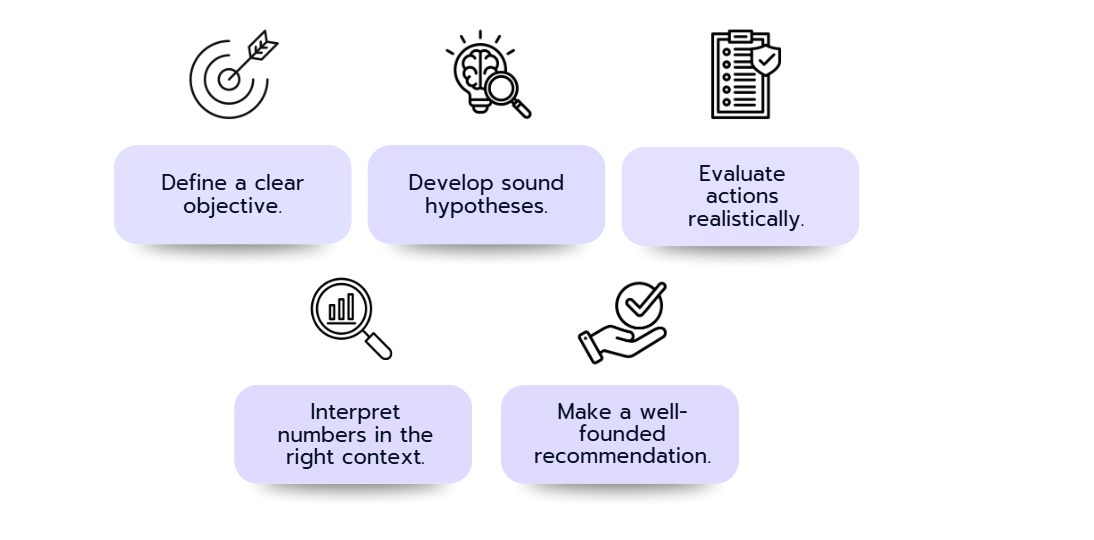
Your business sense won’t be tested directly – but it shows up in your thinking, your assumptions, and your recommendations. Here are five moments when it really counts:

5 tips on how to show business sense in case interviews

1. Define a clear objective.

Clarify what the company wants to achieve in the case. Is it short-term profit, long-term growth, or a stronger market position? A well-defined goal aligns your analysis and recommendations – and shows you understand the business context.

2. Develop sound hypotheses.

Top candidates derive economically plausible hypotheses. If revenue is dropping, explore potential causes like demand, pricing, or competitive pressure.

3. Evaluate actions realistically.

Go beyond theory. Consider real-world feasibility, conflicting objectives, and strategic risks. Instead of simply saying “raise prices,” consider price elasticity, customer segments, and likely competitor reactions.

4. Interpret numbers in the right context.

Numbers only make sense when interpreted correctly. High margins might signal a premium position – or upcoming competitive threats. Business sense means understanding what the numbers imply in context.

5. Make a well-founded recommendation.

Your final recommendation should be logical and economically viable. Acknowledge risks or gaps, and show that your solution could succeed in the real world.
 

How to Train Your Business Sense

Business sense isn’t innate – it’s a skill you can develop. The key is to build a solid understanding of economic principles and learn how real-world decisions are made.

Start by regularly reading business news. Outlets like New York Times, the Wall Street Journal or the Financial Times will help you get a feel for markets, business models, and strategic thinking. Go beyond the facts – try to understand the economic rationale behind each story.

When practicing case interviews, stay sharp and reflective. Ask yourself: Is my reasoning not only logical but also economically sound?

Mock interviews with peers are especially helpful. You’ll improve your communication skills and receive valuable feedback.

👉 Use our Meeting Board to find peers and practice together.

Oct 26
2:30 AM – 4:00 AM
Novice
67% Reliability
English
Novice, Advanced, Pro
Oct 26
4:00 AM – 5:30 AM
Novice
100% Reliability
Dutch, English
Novice, Advanced, Pro
Oct 26
5:00 AM – 6:30 AM
Pro
92% Reliability
English
Advanced, Pro
Oct 26
5:00 AM – 6:30 AM
Pro
94% Reliability
English, Swedish
Novice, Advanced, Pro
Oct 26
7:00 AM – 8:30 AM
Novice
100% Reliability
Dutch, English
Novice, Advanced, Pro
V
Oct 26
9:15 AM – 10:45 AM
Novice
Reliability: N/A
English
Novice
Oct 26
11:30 AM – 1:00 PM
Pro
96% Reliability
English
Advanced, Pro
Oct 26
1:30 PM – 3:00 PM
Pro
94% Reliability
English, Swedish
Novice, Advanced, Pro
Oct 26
3:30 PM – 5:00 PM
Novice
100% Reliability
English
Novice, Advanced, Pro
Oct 26
6:00 PM – 7:30 PM
Novice
100% Reliability
English
Advanced, Pro
You did not find the right meeting?
Find more meeting invitations on our meeting board and post your own suggestion.

👉  Want to take it a step further? Connect with our experienced coaches.

Coach Annika intro video. Visit their profile to find more information in text.
Annika
USD 179 / h
5.0
69 Coachings
10% off first session | ex-Bain | MBB Coach | ICF Coach | HEC Paris MBA | 13+ years experience
Coach Allen intro video. Visit their profile to find more information in text.
Allen
USD 299 / h
5.0
219 Coachings
Ex-McK Experienced Hire and EM - I show you how to perform at your best
Coach Moritz intro video. Visit their profile to find more information in text.
Moritz
USD 249 / h
5.0
264 Coachings
Ex-McKinsey interviewer, genuinely invested in you | 100% McKinsey case & PEI prep turning nerves into real confidence
Coach ALEXANDRE intro video. Visit their profile to find more information in text.
ALEXANDRE
USD 169 / h
5.0
35 Coachings
FREE INTRO I exMcKinsey EM I exKearney consultant I High Success Rate I Official Coach for HEC (160 coachees in 2022/23)
Coach Giulia intro video. Visit their profile to find more information in text.
Giulia
USD 189 / h
5.0
91 Coachings
McKinsey | 6+ years in Consulting + Health Tech |Certified High Performance + Systemic Coach | Women Empowerment
Coach Ian intro video. Visit their profile to find more information in text.
Ian
USD 399 / h
5.0
1,180 Coachings
Ex-BCG | NYU Stern | MBB, Tech, & Strategy Coach | 5,000+ Sessions | 500+ Offers | 1,000+ Candidates | 100+ Countries
Coach Irene intro video. Visit their profile to find more information in text.
Irene
USD 149 / h
5.0
9 Coachings
BCG consultant & MIT MBA | Supported 20+ students for MBBs or MBA
Coach Alberto intro video. Visit their profile to find more information in text.
Alberto
USD 699 / h
5.0
306 Coachings
Ex-McKinsey AP | Professional MBB Coach | +13yrs experience | +2,000 real interviews | +150 offers
Coach Zoe intro video. Visit their profile to find more information in text.
Zoe
USD 149 / h
0.0
0 Coachings
Former BCG Associate | 50% off first case interview prep diagnostic call

Also, think like an entrepreneur in daily life. Observe companies, analyze new strategies, and reflect on what drives success or failure. The more often you go through this process, the sharper your business intuition becomes – and that’s what sets you apart in interviews.
 

Key Takeaways

Business sense is one of the most important success factors in both consulting and case interviews. It reflects your ability to quickly recognize economic patterns, form sound assumptions, and make realistic, client-oriented decisions. In interviews, what sets top candidates apart isn’t memorized theory but the ability to see the bigger picture: understanding what really matters to a business, prioritizing strategically, and proposing solutions that are both practical and value-driven.

To demonstrate your business sense, it’s crucial to clearly define the objective of the case, develop plausible hypotheses, assess potential actions not only analytically but also from a business standpoint, and interpret numbers within the correct context. Your final recommendation should be not just logical, but economically viable and well thought through.

The good news is that business sense can be learned. By regularly reading business news, reflecting on strategic decisions, working through case interviews critically, and actively seeking feedback, you’ll build a strong foundation in economic thinking. Over time, this mindset will not only boost your interview performance but also set you up for long-term success in consulting.

Let's Move On With the Next Articles:

Presentation and Communication
Consulting Skills & Preparation
The majority and the most obvious part of preparation is, of course, the substantive preparation for your case interview. However, you also need to present what you have learned in a way that gives your interviewer an impression of your personality and character. This means that you must appear confidentand communicate clearly and precisely. The best preparation is useless if you come across as closed-off and insecure. As a consultant, you must always appear trustworthy and confident when interacting with clients to be taken seriously and to enable you and your team to work in a solution-oriented manner. This is already tested in the case interview – albeit indirectly ;)
To the article
General Knowledge
Consulting Skills & Preparation
In case interviews, having solid general knowledge can make a big difference, especially in market sizing questions. Knowing basic facts about regions, population sizes, and economic indicators helps you build stronger arguments. It’s not just about the analysis itself but also about showing interviewers that you understand global trends and can quickly process key information — an important skill in consulting. In a case interview, quick and accurate estimates are essential. For example, if you're asked to evaluate the potential market for a product in a specific country, having solid data — like the population size — is crucial. Without this information, it can be challenging to make a meaningful calculation. In addition to national market data, it's important to know about key global markets. Being familiar with major economic regions like the U.S., China, and the EU is valuable because large consulting firms such as McKinsey and BCG operate extensively in these areas. A solid understanding of these regions shows that you can think about global factors and helps you stand out from other candidates. What Your Knowledge of Population, Economy & Geography Says About You Having strong general knowledge in specific areas not only shows that you are well-prepared, but also that you can quickly understand economic relationships—a crucial skill in consulting. When you have information like population sizes or a country's Gross Domestic Product (GDP) at your fingertips, you can quickly verify assumptions and make informed decisions, which is exactly what case interviews expect. Additionally, your knowledge of these topics demonstrates a genuine interest in world affairs and your ability to recognize and understand global trends. This insight is vital for evaluating how political, economic, and social changes affect businesses. It also highlights your capability to absorb and use complex data effectively. Population Country/Region Population (approx.) Worldwide 8.05 billion China 1.426 billion India 1.419 billion Europe (EU states) 450 million USA 335 million Indonesia 277 million Brazil 203 million Russia 143 million Japan 124 million Germany 83 million UK 68 million GDP Forecast in USD for 2024 Country/Region GDP 2024 (approx. in trillions USD) Worldwide 105 trillion USD USA 25 trillion USD China 18 trillion USD Japan 4.3 trillion USD Germany 4.5 trillion USD France 3.0 trillion USD UK 3.1 trillion USD India 3.9 trillion USD Italy 2.2 trillion USD Brazil 2.1 trillion USD Canada 2.2 trillion USD Key Data to Know for Your Case Interview In case interviews, making quick and accurate estimates is key. A good grasp of units, along with basic fraction and percentage calculations, is essential for working efficiently. Additionally, being comfortable with time units is important for making rough estimates and calculations. The table of larger and smaller time units below provides a handy overview of commonly needed values. These fundamental skills help you tackle tasks confidently and quickly. Overview of Time Conversions: Days, Weeks and Hours Larger Units Smaller Units Days/Year 365 days (In leap years: 366 days) Days/3 Years 1,095 days Days/4 Years 1,461 days (including 1 leap year) Weeks/Year 52 weeks Hours/Week 168 hours Seconds/Hour 3,600 seconds Conversion of Fractions to Percentages and Decimal Values Fraction Percentage Decimal 1/5 20% 0.20 1/6 16.67% 0.1667 1/7 14.29% 0.1429 1/8 12.5% 0.125 1/9 11.11% 0.1111 1/10 10% 0.10 1/11 9.09% 0.0909 1/12 8.33% 0.0833 1/13 7.69% 0.0769 1/14 7.14% 0.0714 1/15 6.67% 0.0667 1/16 6.25% 0.0625 1/17 5.88% 0.0588 1/18 5.56% 0.0556 1/19 5.26% 0.0526 1/20 5% 0.05 Remember, it’s not enough to just memorize these numbers—you also need to be able to calculate with them effectively! Use our Mental Math Tool to specifically train your math skills and prepare for your next interview.

To the article
Preparation Plan
Consulting Skills & Preparation
Preparing for a case interview can feel overwhelming, but having a structured plan will help you stay focused and make steady progress. A well-organized approach ensures you build a strong foundation, practice effectively, and refine your skills before the big day. In this guide, we will walk you through the key components of an effective practice plan, including self-study, peer practice, and working with a coach. Let’s go!
To the article