







Topic Overview
Topic Overview
Back to overview

The Cynefin Framework

For graduates aspiring to embark on a career in consulting, understanding and effectively navigating complex situations is essential. The Cynefin Framework (pronounced: Kin-ev-in) provides a powerful tool for consultants to make sense of different problem domains and determine appropriate approaches.

In this article, we will explore the Cynefin Framework, its sections - Simple, Complicated, Complex, and Chaotic and the Disorder domain. Additionally, we will provide an example of how the framework can be applied in the consulting industry.

Understanding the Cynefin Framework

The Cynefin Framework, developed by Dave Snowden, offers a sense-making model to categorize problem areas based on their levels of complexity and uncertainty (the two “basis elements” of the framework).


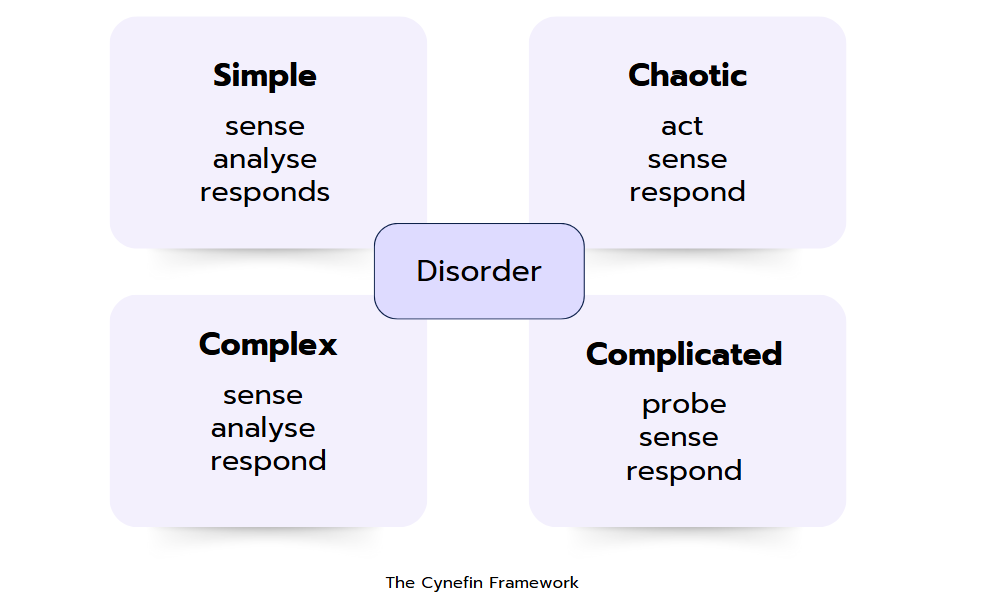
It helps consultants identify the appropriate management and decision-making approaches in five different contexts that result in four areas and a center unit:

  • Simple Domain: Best Practices and Standard Operating Procedures 
    In the Simple domain, problems are clear-cut, predictable, and easily resolved using established best practices and standard operating procedures. Consultants can rely on known solutions and established rules to address challenges within this domain.
  • Complicated Domain: Expertise and Analysis 
    The Complicated domain involves issues that require expertise and analysis to determine the most suitable solutions. There may be multiple valid approaches, but they require careful investigation, expert opinions, and data analysis to make informed decisions.
  • Complex Domain: Emergence and Adaptation 
    The Complex domain is characterized by uncertainty, ambiguity, and a lack of clear cause-and-effect relationships. Consultants must navigate this domain by probing, sensing, and responding to emergent patterns. Multiple perspectives, experimentation, and adaptive strategies are crucial in dealing with complex problems.
  • Chaotic Domain: Urgency and Rapid Response 
    The Chaotic domain represents situations of extreme uncertainty and urgency, where there is no apparent order. Consultants must act swiftly and decisively to establish stability and restore order. This may involve making quick decisions, containing crises, and stabilizing the situation.
  • Disorder: Transition and Uncertainty 
    The Disorder domain serves as a center unit and describes the transition state, representing a lack of clarity about which domain a problem falls into. It highlights the need for consultants to identify and understand the nature of the problem before determining an appropriate approach.
     
Diagram of the Cynefin Framework, showing five domains: Simple, Complicated, Complex, Chaotic, and Disorder, each with different decision-making approaches.


Applying the Cynefin Framework in the Consulting Industry

Let's consider a case where a consulting firm is working with a global manufacturing company facing a significant disruption in its supply chain:

  1. Simple: 
    The consulting team identifies that the supply chain disruption is due to a known issue—a breakdown in communication between departments. They can apply a predefined set of best practices and standard operating procedures to address the problem and restore communication channels.
  2. Complicated: 
    Upon further investigation, the consulting team discovers that the disruption is caused by a breakdown in a critical supplier relationship. They bring in experts and conduct a detailed analysis of alternative solutions, such as identifying new suppliers or renegotiating contracts, based on the company's specific requirements.
  3. Complex: 
    As the investigation deepens, the consulting team realizes that the disruption is a result of multiple interconnected factors, including geopolitical events and market volatility. They facilitate diverse perspectives and experimentation to explore adaptive strategies, such as diversifying the supplier base, implementing risk mitigation measures, and leveraging emerging technologies for real-time supply chain visibility.
  4. Chaotic: 
    In a worst-case scenario, if the disruption escalates into a chaotic situation, such as a natural disaster or political crisis, the consulting team's focus shifts to rapid response and containment. They assist the company in activating crisis management protocols, establishing alternative supply routes, and stabilizing the situation to restore order.


Mastering the Cynefin Framework

The Cynefin Framework is a leader's framework for decision making. It equips consultants with a powerful sense-making tool to navigate complexity and make informed decisions in different problem domains. By understanding the characteristics of the Simple, Complicated, Complex, and Chaotic domains, consultants can apply appropriate strategies and approaches to address diverse challenges.

As graduates embarking on a consulting career, mastering the Cynefin Framework will enable you to effectively analyze and solve complex problems, bringing value to clients in an ever-changing business landscape.

Let's Move On With the Next Articles:

Kotter Change Management Model
Useful Business Analysis Tools
As graduates venturing into the world of consulting, it is essential to equip ourselves with effective change management frameworks. One such model that holds significant importance is the 8-Step Kotter Change Model. Developed by renowned leadership expert John P. Kotter, it is a widely recognized framework that helps organizations navigate through periods of change. Originally introduced in 1995, this 8-Step Model has become one of the go-to methods for supporting employees and managers during times of transformation. In the world of consulting, where change is a constant, understanding and effectively utilizing this model is essential for success. Overview of the 8-Step Kotter Change ModelKotter's model is based on Kurt Lewin's field theory and draws insights from successful change projects in large organizations. It emphasizes the importance of people and effective communication in driving sustainable change within a company. By addressing resistance, creating a shared vision, and embedding new behaviors, the model aims to facilitate successful organizational transformations.The 8-Step Model serves as a roadmap to guide organizations through change initiatives. It comprises a sequence of steps that address various crucial elements of the change process.  Here is a brief overview of each step:Create a sense of urgency: This step involves creating awareness and a compelling reason for change, emphasizing the need for immediate action.Build a guiding coalition: Forming a dedicated team of influential individuals who share a common vision and have the capability to drive change is crucial for its successful implementation.Form a strategic vision and initiatives: Developing a clear and compelling vision for the future state of the organization, along with actionable initiatives, provides a roadmap for change.Enlist a volunteer army: Effective communication of the vision to all stakeholders helps foster understanding, alignment, and commitment towards the change effort.Enable action by removing barriers: Empowering employees to take ownership and initiative in driving the change process helps to overcome resistance and promotes a culture of collaboration.Generate short-term wins: Celebrating and showcasing early wins in the change journey boosts morale, builds momentum, and creates confidence in the change process.Sustain acceleration: Building upon the initial successes, it is crucial to sustain the momentum of change and drive further improvements to solidify the new ways of working.Institute change: To ensure the longevity of the change, embedding new behaviors and practices into the organizational culture is vital, fostering a sustainable transformation. Benefits of the 8-Step Kotter Change ModelThe Kotter Change Management Model offers several advantages for consultants:Structured approach: The model provides a systematic and well-defined framework to guide consultants through the complex process of change management, ensuring a methodical approach achieving desired outcomes.Stakeholder engagement: By involving key stakeholders at various stages, the model encourages collaboration, creates buy-in, and fosters a sense of ownership, which is essential for successful change implementation.Agility and flexibility: The model recognizes the importance of adaptability, enabling consultants to navigate unexpected challenges and adjust strategies based on feedback and evolving circumstances.Focus on short-term wins: The emphasis on generating early successes helps consultants gain credibility, build support, and maintain momentum throughout the change journey. Limitations and ConsiderationsSimplification: The model provides a simplified view of the change process, and real-world situations may involve additional complexities that need to be addressed.Contextual factors: The model does not explicitly address industry-specific or organizational context factors, which may require customization and adaptation of the steps. Importance of the Model for ConsultantsClient engagement: The model enables consultants to engage clients in a structured change management process, fostering trust and establishing their expertise in driving successful transformations.Change leadership: By applying the model, consultants can effectively lead change initiatives, align stakeholders, and guide organizations towards desired outcomes, establishing themselves as trusted advisors.Framework for analysis: The model provides a framework to analyze the current state of organizations, identify gaps and opportunities, and develop comprehensive change strategies, enhancing the value consultants bring to their clients. ConclusionAs aspiring consultants, mastering the 8-Step Kotter Change Model can significantly enhance our ability to drive successful change initiatives. Its structured approach, stakeholder engagement, and focus on short-term wins make it a valuable tool for guiding organizations through complex transformations. By understanding and applying this model, we can contribute to the success of our clients' change journeys and establish ourselves as effective change agents in the consulting industry.Further Reading:Download Kotter's 8-Steps Ebook here.
To the article
The Capability Maturity Model (CMM)
Useful Business Analysis Tools
A career in consulting requires a deep understanding of various methods and models that can help clients optimize their processes and maximize performance. One such model is the Capability Maturity Model (CMM), which can serve as a compass for organizations seeking to improve their project management and service capabilities.Developed by the Software Engineering Institute (SEI) at Carnegie Mellon University, the CMM, as well as its extension to the Capability Maturity Model Integration (CMMI), focuses on improving processes within an organization. The models provide a better view of process improvement within five levels (initial to optimized). Each level represents a different level of process maturity and guides an organization toward continuous process improvement.
To the article
The Competing Values Framework
Useful Business Analysis Tools
The Competing Values Framework (CVF) is a robust model that helps organizations better understand, assess, and ultimately transform their cultures.The Competing Values Framework was developed in the 1980s. It began with a research study by Robert Quinn, John Rohrbaugh, and other colleagues aimed at identifying key indicators of organizational effectiveness. They conducted a factor analysis of existing organizational assessments and identified two main dimensions that formed the basis for the framework: internal vs. external and flexibility vs. control.Quinn is co-founder of the Center for Positive Organizations at the Ross School of Business. His research has helped advance the concepts of positive organizational science, which focuses on strengthening and improving organizations by building positive attributes, rather than focusing only on fixing deficits. John Rohrbaugh is a professor in the Rockefeller College of Public Affairs and Policy at the University at Albany, State University of New York. His research interests are in strategic management, organizational behavior, and decision-making.Developed in the 1980s by Robert Quinn and John Rohrbaugh, the CVF has served as a prism for studying organizations.How Can the Competing Values Framework (CVF) Help to Transform Organisational Cultures?The CVF divides organizational cultures into four main quadrants: Clan, Adhocracy, Market, and Hierarchy. These quadrants reflect the tensions between internal and external factors, and between stability and control on the one hand and flexibility and change on the other.Clan (Collaboration) - "Doing things together" / Long-Term Development: Clan culture is characterized by strong internal focus and flexibility. It is characterized by collaboration, participation and communication. The clan quadrant is often described as an extended family where employees feel a high degree of loyalty and belonging. In this culture, the main activities are often focused on teamwork, consensus building, and internal harmony. The main purpose is to create a harmonious work environment where employees feel comfortable and can best utilize their skills. The typical type of employee in a Clan culture is team-oriented, more loyal, and maintains strong personal relationships in the workplace.Adhocracy (Creative) - "Doing things first" / Innovations:Adhocracy is characterized by a high degree of flexibility and external focus. In this culture, innovation is at the core and there is a dynamic and entrepreneurial atmosphere. Main activities in Adhocracies are experimentation, risk taking and adaptation to change. The purpose of such a culture is to achieve competitive advantage through innovation and creativity. The typical type of employee is creative, entrepreneurial, and willing to take risks.Market (Competition) - "Do things quickly" / Short-Term Performance:The Market focuses on external factors, with a high priority on stability and control. This culture emphasizes competitiveness, results orientation, and performance. The main activities in Market cultures focus on transactions, competition, and achieving market goals. The purpose of this culture is to achieve market dominance through superior performance. The typical type of employee in a Market culture is results-oriented, goal-oriented, and competitive.Hierarchy (Control) - "Doing things right" / Working incrementally:The Hierarchy culture emphasizes internal factors and values stability and control. Here, the emphasis is on order, rules, and uniform procedures. The main activities in Hierarchical cultures involve coordination, organization, and efficiency. The main purpose is to ensure smooth operations and reliable performance. The typical type of employee in a hierarchical culture values consistency, order, and structure.Benefits and Possible Applications for ConsultantsFor consultants, the CVF provides a precise tool for analyzing their clients' organizational culture. It helps them understand their clients' current strengths and weaknesses, plan relevant changes, and design effective interventions.Knowledge of organizational culture can also help consultants develop customized solutions that meet the organization's specific needs and priorities. By using the CVF, they can determine, for example, whether an organization is willing to take risks and embrace innovation, or whether it values stability and control more.In addition, consultants can use the CVF to assess the impact of change on the organization. They can predict how a change will affect the existing culture and how to shape the change initiative to meet the needs and priorities of the organization.Overall, the Competing Values Framework provides a comprehensive map of organizational culture. It provides consultants with a clear path to understand and navigate the often-nebulous aspects of culture, and it provides an effective framework for designing and implementing change. It is an indispensable tool to help consultants help their clients adapt to an ever-changing business environment.
To the article