When preparing for a case interview, especially under time constraints, working with an experienced coach can significantly enhance your chances of success.
💡 Pro Tip: PrepLounge offers access to over 800 (former) management consultants from top firms like McKinsey, BCG, and Bain, who are ready to help you perfect your interview technique.
What Are the Key Advantages of Practicing With a Coach?
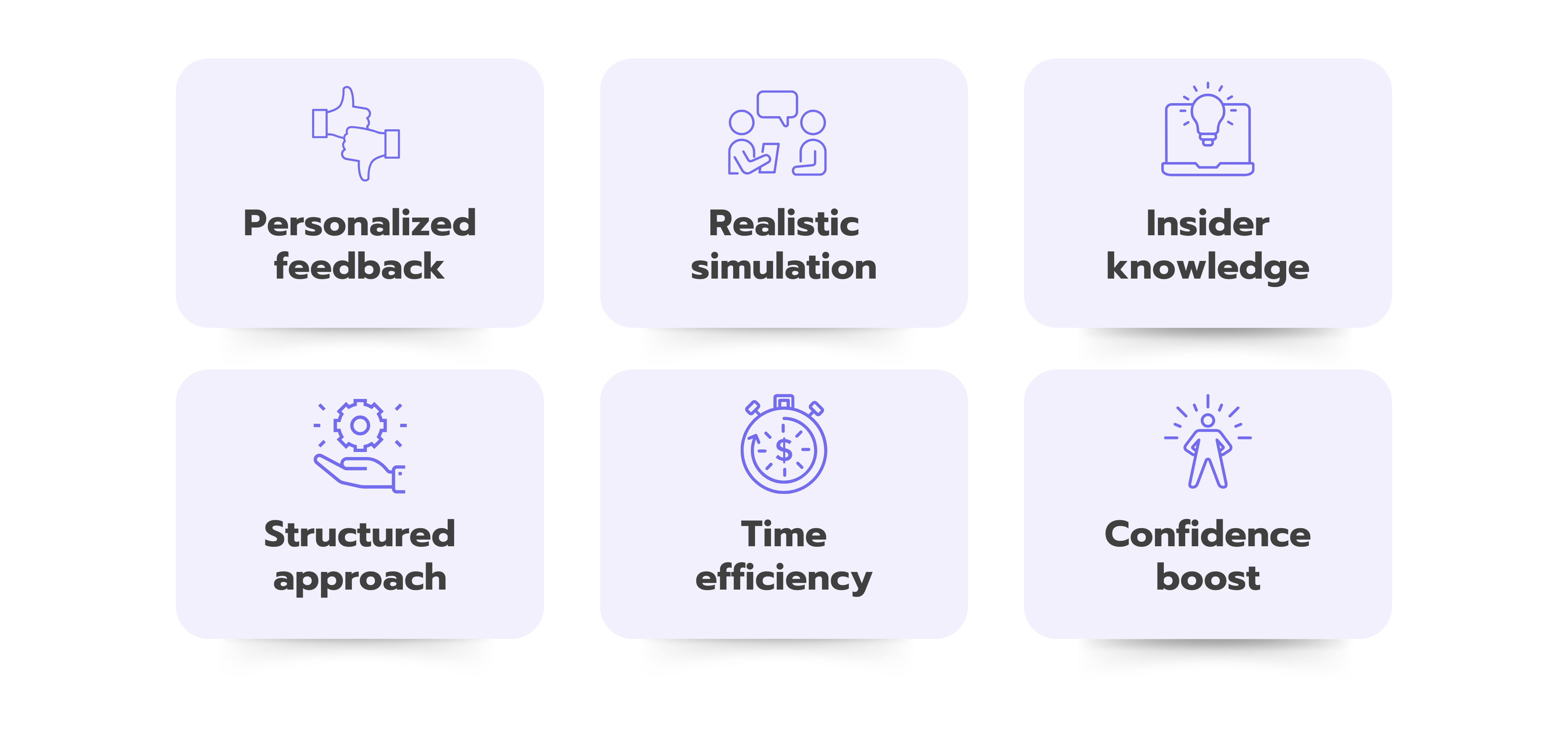
Personalized Feedback
One of the primary benefits of working with a case coach is receiving tailored feedback. Unlike general preparation methods, a coach can pinpoint your specific weaknesses and provide actionable advice to improve. This personalized approach ensures that your preparation is efficient and targeted, addressing your unique needs and challenges.
Realistic Simulation
Practicing with a coach allows you to experience a realistic interview setting. Coaches who have conducted numerous case interviews can replicate the pressure and dynamics of a real interview, helping you become more comfortable and confident. This experience is invaluable, as it prepares you to handle the stress and spontaneity of actual interviews.
Insider Knowledge
Experienced coaches often come from prestigious consulting backgrounds themselves. Their insider knowledge about what top firms are looking for can give you a significant edge. They can share insights about the interview process, common pitfalls, and the specific attributes that firms value, ensuring that you are well-prepared to meet these expectations.
Structured Approach
A coach can help you develop a structured approach to solving case problems. This structured thinking is crucial in case interviews, where clear, logical, and well-organized answers are highly valued. Coaches can teach you frameworks and methodologies that streamline your problem-solving process, making your responses more coherent and compelling.
Time Efficiency
For candidates with limited preparation time, coaching is a highly efficient way to get ready. Coaches can quickly identify areas that need improvement, helping you focus your efforts where they are most needed. This targeted preparation can save you time and help you progress faster than you would on your own.
Confidence Boost
Confidence plays a crucial role in interview performance. Regular practice with a coach can boost your confidence by familiarizing you with the interview format and helping you refine your answers. Knowing that you have prepared thoroughly with expert guidance can significantly reduce anxiety and improve your overall performance.
How PrepLounge Optimally Supports You With a Wide Range of Coaching Options
🚀 Flexibility and Convenience
PrepLounge offers a variety of coaching options to fit your needs and preferences. You can choose from individual sessions, CV reviews, or comprehensive coaching packages that include multiple sessions or focus on specific topics. Additionally, there are programs available that combine a premium membership with coaching credits, providing a cost-effective way to access top-notch coaching services.
📅 Workshops and Online Events
PrepLounge also regularly hosts workshops and online events led by experienced coaches. These sessions cover a range of topics and provide opportunities for interactive learning and direct feedback. Participating in these events can further enhance your preparation and keep you updated on the latest trends and techniques in case interviews.
How to Find the Perfect Coach to Suit Your Needs
To find the perfect coach for your case interview preparation, you can proceed in three steps within the coach overview:
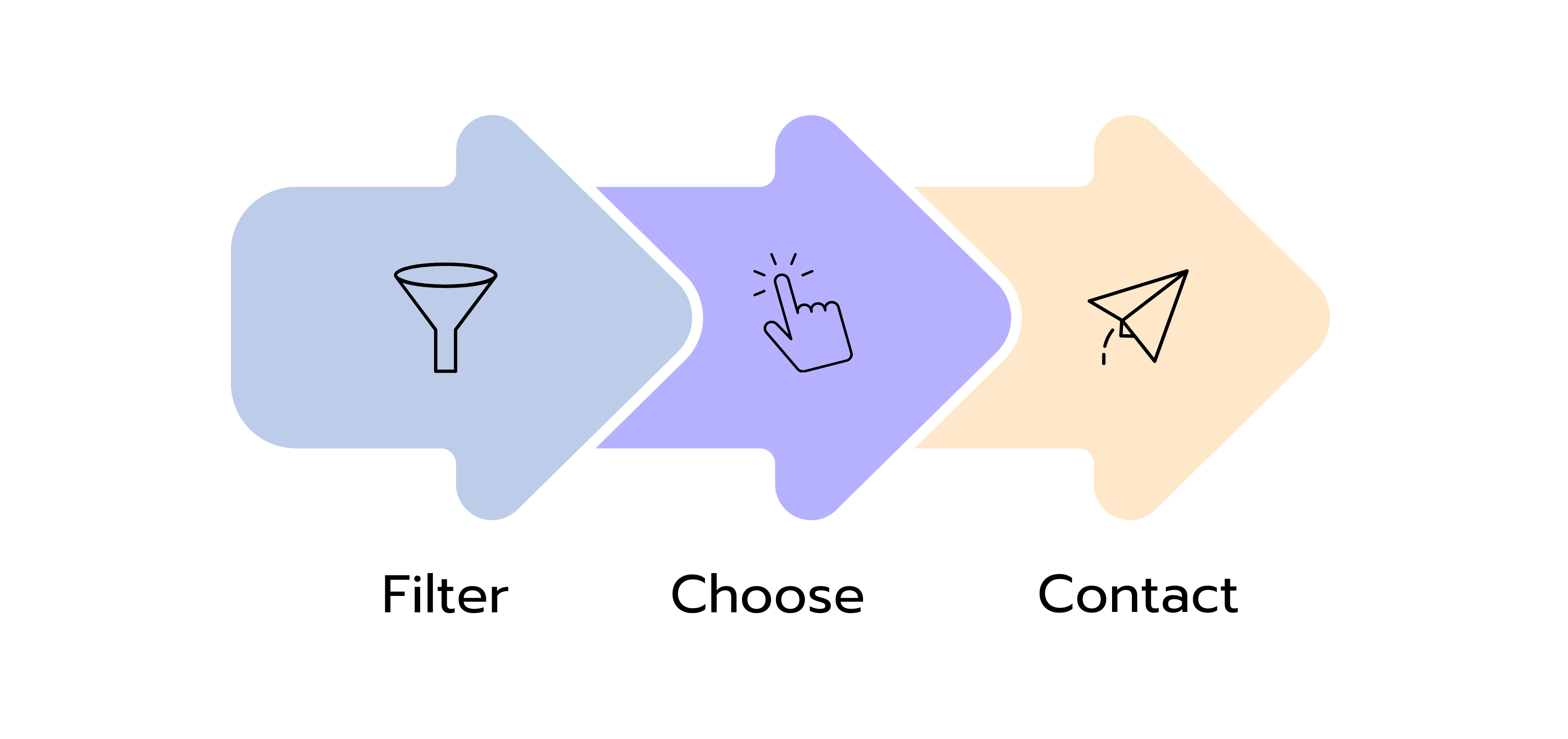
Filtering: Begin by filtering the coaches based on your most important criteria, such as price per coaching session, or employer.
Selection: Choose up to 10 coaches whose profiles, ratings, Q&A contributions, and PrepLounge awards you wish to explore further.
Contacting: Reach out to 2-3 coaches to address any potential questions or concerns about their coaching approach. Feel free to ask if they offer a free intro call.
What Makes a Good Coach?
Good coaches are characterized by the following features:
Customization: they tailor the coaching to your specific needs.
Good rapport: They make you feel comfortable and work well with them.
Transparency: They offer you full transparency about the coaching process on PrepLounge.
Final Thoughts on Working With a Coach
Practicing with a coach is a strategic investment in your case interview preparation. The personalized feedback, realistic simulation, insider knowledge, and confidence boost that coaches provide can make a significant difference in your performance. With the expert guidance available on PrepLounge, you can ensure that you are thoroughly prepared and ready to excel in your case interviews.
By leveraging the expertise of experienced case coaches and taking advantage of the diverse coaching options and events available on PrepLounge, you can maximize your preparation efficiency, build your confidence, and increase your chances of securing a position at a top consulting firm.
I'm sorry to hear it didn't go that well.
Though, sometimes candidates are harder on themselves than the interviewer might be. Maybe you get lucky and they give you another chance and take you to the next round. Otherwise, it might make sense for you to focus on other opportunities at this point, and to work on the casing skills you discovered could be improved.
Re how long it takes for them to update the status - that honestly varies, and I wouldn't read too much into the current silence. Hope you hear back from them soon.
Best of luck with the process going forward!
Cristian
Bain SEA written case — format and how to prepare (experienced hire, Consultant)
10 hrs ago
< 100
2
Best answer by
Cristian
Hi there!
Happy to provide a perspective on this since I've prepped multiple candidates for written cases.
First of all, do clarify with the recruiter whether you'll have a written case or not. Most firms don't use this format, so there's no need to invest time in preparing for it if you won't have to actually experience it.
The skills that you need to use are the same as for the live case. The big difference is that since you're being given time to think and digest the data, you are also provided with a much higher volume of data and the expectations are higher in terms of content, structure and presentation. Indeed, it would be useful to work with a coach on a simulation so you at least get a sense of what to expect and what to work on.
If you need any help, don't hesitate to drop me a line.
Best,
Cristian
For a 30 minute final round Deloitte partner interview, is it okay to reuse answers or will they typically ask questions that are unrelated to ones you were asked in previous rounds?
15 hrs ago
< 100
6
Best answer by
Tarek
Reuse the evidence, not a memorised script, and adapt it to the prompt.
In a short final-round conversation, a question may overlap with an earlier round or approach the same theme from a different angle. You do not need a completely new experience for every version of the question. You do need to make the answer fit the question you are actually asked.
Prepare a short card for each of your strongest examples: the situation, the decision or action you personally took, the result, and the lesson. Then add a second proof point for the same theme. This gives you material to reuse without sounding rehearsed.
For example, if you are asked about leadership after previously discussing the same project, focus on how you aligned people or made a difficult decision. If the question is about resilience, use the same project only if the real evidence is how you handled a setback. Do not force the old answer into a new prompt.
For a 30-minute conversation, prioritise a clear answer over a long catalogue of stories: state the point first, give the relevant evidence, and pause so the interviewer can probe. Prepare two or three thoughtful questions as well. That is more useful than trying to predict an exact question list.
How can I perform more consistently under pressure in case interviews?
20 hrs ago
200+
9
Best answer by
Carlos
Hi,
From what you describe, I would focus less on becoming faster and more on building confidence and control under pressure. The main issue seems to be that perceived pressure makes you rush, and rushing then creates avoidable mistakes.
I would work on four things:
1. Get comfortable taking a deliberate pause
A short silence usually feels much longer to you than to the interviewer. Before a chart, calculation or brainstorming question, take a moment and say something like: “Let me take a few seconds to structure my approach.”
The objective is to stop associating silence with “I’m performing badly”.
2. Use the same reset routine every time
When pressure increases, rely on a fixed sequence:
Pause → clarify the question → structure the approach → communicate
- For maths, state the equation before calculating.
- For charts, first identify what the chart shows, axes and units, then extract the insight.
- For brainstorming, define the buckets before generating ideas.
This gives you something stable to fall back on when the interviewer is challenging.
3. Build control through familiarity
Confidence comes from knowing how to react when things get uncomfortable. If you already know what to do when you misread a chart, get stuck on a calculation, receive pushback, cannot immediately find another idea or realise you made a mistake, the situation becomes much easier to manage.
The goal of practice is not just to solve more cases, but to build a playbook for the situations that can throw you off. Once those reactions become familiar, you feel much more in control, and pressure becomes easier to handle.
4. Practise the pressure itself
You should also simulate the exact situation that triggers you. Ask a coach or practice partner to be deliberately more challenging: poker face, interruptions, pushback, asking “why?” repeatedly or giving limited encouragement.
The goal is not to have a perfect case. The goal is to prove to yourself that you can still follow your process when the interviewer makes you uncomfortable.
One final point: don’t try to compensate for a non-business background by speaking faster. If something is unfamiliar, slow down, make a reasonable assumption, state it clearly and move forward.
The mindset I would keep is: Confidence comes from control. And control comes from knowing how to react, even when the case does not go exactly as planned.
If you want, feel free to reach out. I can also help you identify exactly which situations are currently breaking your confidence and work on those moments specifically.
Best,
Carlos
Hi,
It is still early for a formal follow-up and I would not read anything into the silence at this stage.
That said, if you have real pressure on your side, absolutely write to them and be transparent about it, about what your constraint is and why you need the feedback urgently. Managing calendars that cross with other selection processes is ordinary administration for a recruiting team, so there is nothing to worry about there.
Best,
Franco
I interviewed with McKinsey last year but did not receive an offer. I'm now reapplying and wanted to ask whether it's generally acceptable to reuse PEI stories that I shared during my previous interviews, assuming they're still my strongest examples. Thank you for the help!
20 hrs ago
100+
10
Best answer by
Franco
Hi,
Your interviewers will most likely be different ones, so reusing your strongest PEI stories is not a problem. Even if you got the same interviewers, I do not think they would remember which stories you told them.
So unless your stories were not strong enough, or you received negative feedback on them, I see no downside to reusing the same ones.
Best,
Franco
Hi! I would not force all four PEI stories to be professional, even as an experienced hire.
With 3.5 years of consulting experience, I would expect your overall story set to reflect who you are professionally today, so professional examples should probably be the default. But that does not mean every single story needs to come from work.
For me, the key question is: which story gives you the strongest evidence for that specific dimension?
A few practical rules I would use:
- Story strength matters more than story category. A strong academic or extracurricular example is better than a weak professional one.
- Recency still matters. The older the story is, the more distinctive and powerful it should be to justify using it.
- Your full set should still feel senior enough. If 3 out of 4 stories come from university despite several years of consulting experience, that could feel slightly unbalanced.
- Different contexts can actually help. A mix of consulting, university leadership and competitive sport can make your profile more memorable than four very similar client-project stories.
In your case, I could absolutely see the professional athlete example working well for Drive if it clearly shows ambitious goals, discipline, setbacks and persistence. Similarly, your master’s project could still work for Leadership if you genuinely led the team through difficult decisions, conflicting views or pressure.
I would probably aim for something like:
2–3 professional stories + 1–2 older but highly distinctive stories, rather than trying to make all four professional at any cost.
One more point: I would also prepare at least one backup story per dimension. In PEI, the exact wording of the question can make one example much easier to use than another.
So overall, professional examples should become the default, not an absolute rule.
Best,
Carlos
Hello, in addition to what's already been said, I would recommend to highlight stories and present yourself as a people person, trying to emphasize your ability to work in a team. Remember to smile when you tell your stories and answer their questions. In the end, what they want to know is if they would like to work with you, so be sure to make an human connection with your interviewer (of course, sometimes is not that easy, but generally at BCG everyone tends to be quite nice). All the best!!
Hi there,
1) Is this the same as the caseychat bot?
Yes.
2) Can I use a calculator during the test?
Yes.
If you want, you can find some prep material at the link below (full disclosure, I am the author):
▶ BCG Chatbot Software Simulation
If you have further questions about the test, please feel free to PM me.
Good luck!
Francesco
Questions about market size are frequently asked in case interviews in consulting because they require a blend of logic, mathematics, and common sense. They can be asked as standalone questions or as part of a larger case. Applicants who are familiar with market sizing questions can really perform here.
Market entry cases are one of the key issues in the consulting industry and present consultants and firms with unique challenges and opportunities. These cases require deep analysis and strategic planning to successfully enter new markets.
Brainteasers are a type of problem that focuses on a single issue rather than complex business cases. They require out-of-the-box thinking, logic or math skills and can take the form of riddles, word problems or visual puzzles. These tasks are designed to test your problem-solving skills, analytical thinking and ability to remain calm under pressure.
Typical problems cover everyday life's topics and might even include unrealistic assumptions. All necessary information is usually included in the question so that further assumptions are not necessary. This article explains in more detail why brainteasers are useful in case interview preparation and how to solve them.