







Topic Overview
Topic Overview
Back to overview

Economy of Scale and Economy of Scope

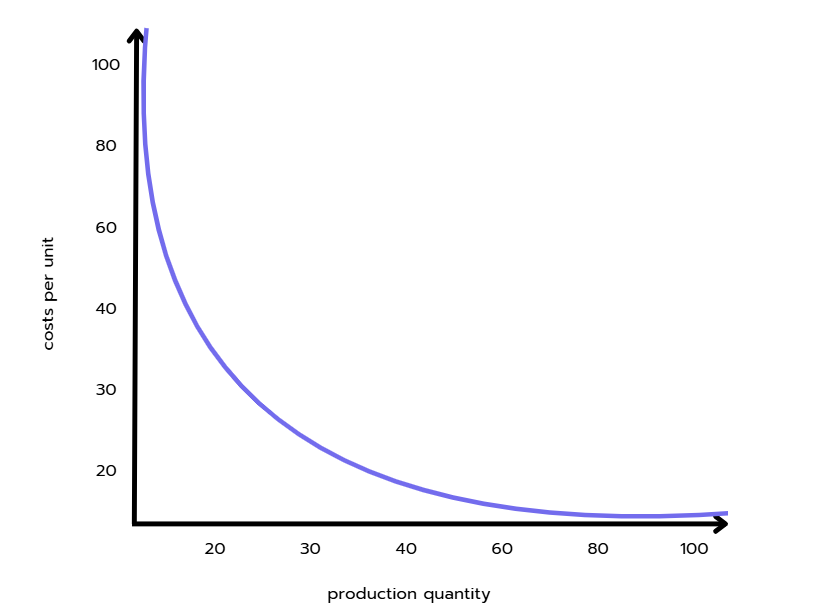
Economies of scale are cost advantages of a company due to its large size. Most companies and businesses can realize advantages of scale that are a result of two effects.

Fixed and Variable Costs

  • Fixed costs - spread across a large volume of units, decreasing the cost per unit

    Chart showing how unit costs decrease as production quantity increases, illustrating economies of scale.
  • Variable costs - low due to operational efficiencies and synergies
    • Larger production processes can be split into smaller, repetitive, and simpler tasks.
    • Larger sizes of raw materials and production technologies, resulting in bulk discounts.
    • Risks are distributed on a larger scale, leading to fewer demand peaks.
    • Cheap automatized production technologies become feasible.

Example:

A power supplier has high initial costs for setting up the infrastructure. Once the infrastructure is set up, the additional costs of providing their service to an additional household are very little. Fixed costs will be split into more households and sudden demand drops have less impact because other households still require sufficient energy levels.

Want to see a full case of how to apply the concept of Economies of Scale? Solve the Paper Print case:

Case by
PrepLounge
Paper Print
4.2
17.5k times solved
Difficulty: Intermediate
Interviewer-led
Mergers & Acquisition
A printing company is planning to take over another printing company with similar technology and printing machines. The(...)
A printing company is planning to take over another printing company with similar technology and printing machines. The candidate is supposed to evalu(...)

Economy of Scope: Cost Advantages Because of Similar Processes of Different Products

Economies of scope are conceptually similar to economies of scale. While economies of scale for a firm primarily refer to the reduction in the average cost per unit, economies of scope refer to lowering the average cost for a firm in producing two or more products that could share resources. These two effects lead to economies of scope:

  • Bundling effect: a single process serves the production of different products at the same time. Costs are distributed onto a larger product base.
  • Clustering: because of proximity, infrastructure (as an example) can be used by different companies without additional costs.

Let's Move On With the Next Articles:

The Tuckman Model
Common Terms of Business
At the core of comprehending team dynamics is the ingenious creation of Bruce Tuckman, the Tuckman Model. Bruce Tuckman, an eminent psychologist and researcher, introduced this model in 1965, and it has since been a fundamental framework for understanding team behavior and guiding team development.Tuckman, with his deep-rooted interest in group dynamics, recognized the evolution teams go through in their journey towards high performance. His model offered a lucid, linear path for this evolution, making it easily understandable and implementable in varied team environments.His ground-breaking work has led to profound shifts in how organizations manage their teams, promoting a more empathetic and result-oriented approach. Tuckman's model stands out as an insightful roadmap that helps navigate the complex maze of team development, and its utility spans multiple disciplines and industries.In a consultancy environment, the model is especially relevant due to the constant team reshuffling and the high value placed on effective teamwork. With consultants often stepping into pre-established teams, understanding the team's current developmental stage - whether it's forming, storming, norming, performing, or adjourning—is invaluable.By using Tuckman's model as a reference, consultants can quickly assess team dynamics, identify issues, and devise strategies to move the team towards the next stage. In essence, Tuckman's model provides a clear framework that can be used to maximize team effectiveness, making it a critical tool in the consultant's toolkit.
To the article
The Kanban Framework
Common Terms of Business
In your journey to becoming an efficient consultant, understanding various work management systems is crucial. One such system that has made a profound impact, particularly in the world of technology and services, is Kanban.Before we dive into the current applications of Kanban, it's important to acknowledge its origins. Kanban was born in the late 1940s within the walls of Toyota's manufacturing plant in Japan. Taiichi Ohno, an industrial engineer at Toyota, introduced Kanban to improve manufacturing efficiency. The word 'Kanban' translates to 'billboard' or 'signboard' in English, emphasizing the visual nature of the system. Ohno was inspired by the supermarket model of product replenishment, where stock is replaced as soon as it depletes. He applied the same principle to Toyota's production lines, effectively aligning inventory levels with actual parts of consumption. The implementation of Kanban led to significant improvements in Toyota's productivity and efficiency, setting the foundation for what we now call 'Lean Manufacturing'.Fast-forward to the present, Kanban has evolved beyond manufacturing and found its way into the technology and services industries. The system, still true to its origins, is designed to maximize efficiency, limit work in progress, and, most importantly, visualize your work. Derived from the Japanese word for 'visual signal', Kanban is an effective tool for making intangible or invisible work more understandable.By understanding the roots and evolution of Kanban, you, as a consultant, can better appreciate its applicability across industries and harness its principles to improve operational efficiency on diverse projects. It is also important to realize that Kanban is a process management system that aids decision-making in a collaborative manner.
To the article
The Blue Ocean Strategy
Common Terms of Business
The Blue Ocean Strategy, developed by W. Chan Kim and Renée Mauborgne in their book Blue Ocean Strategy (2005), turns traditional business thinking upside down. It focuses on tapping into undiscovered markets – the "blue oceans" – where companies can operate alone and avoid competition. The result? More growth and higher profits.In contrast, the "red ocean" refers to the already overcrowded market space where competition is fierce, and companies are constantly striving to outdo each other. This often leads to declining profits and limited growth. 🌊The Blue Ocean Strategy represents a shift away from this destructive competition towards a more constructive and creative form of market development. It encourages companies to go beyond the industry's conventional boundaries and create new markets, making competition irrelevant.
To the article