Interpersonal communicationrefers to the exchange of information, thoughts, feelings, and ideas between individuals. It includes both verbal and non-verbal communication and plays a crucial role in interpersonal relationships. This form of communication is fundamental for connection, understanding, and cooperation between people.
The following example will show the importance of interpersonal communication: When two friends talk about how their day was, they share not only facts but also emotions and perspectives that can deepen their relationship.
Importance in Interpersonal Relationships and Roles
Interpersonal communication is essential to build, maintain, and improve relationships. In romantic relationships, it fosters trust and intimacy; in friendships, it enables mutual understanding; and in professional relationships, it improves teamwork and efficiency. In various roles such as parenting, partnership, friendship, and work environments, it enables conflict resolution, information sharing, and the expression of empathy.
Specifically, successful interpersonal communication in a professional context can lead team members to work together more effectively by sharing clear expectations and providing constructive feedback.
Factors for Successful Communication
Successful interpersonal communication requires active listening to understand the speaker's message. In addition, understanding nonverbal signals such as body language and tone of voice is significant. Choosing the right words and considering the receiver's emotions are also critical. Openness, honesty, and empathy promote a good communication climate.
Challenges and Difficulties
Difficulties in interpersonal communication can arise from misunderstandings, cultural differences, unclear messages, or lack of empathy. Communication barriers such as distractions, prejudice and lack of openness can hinder understanding.
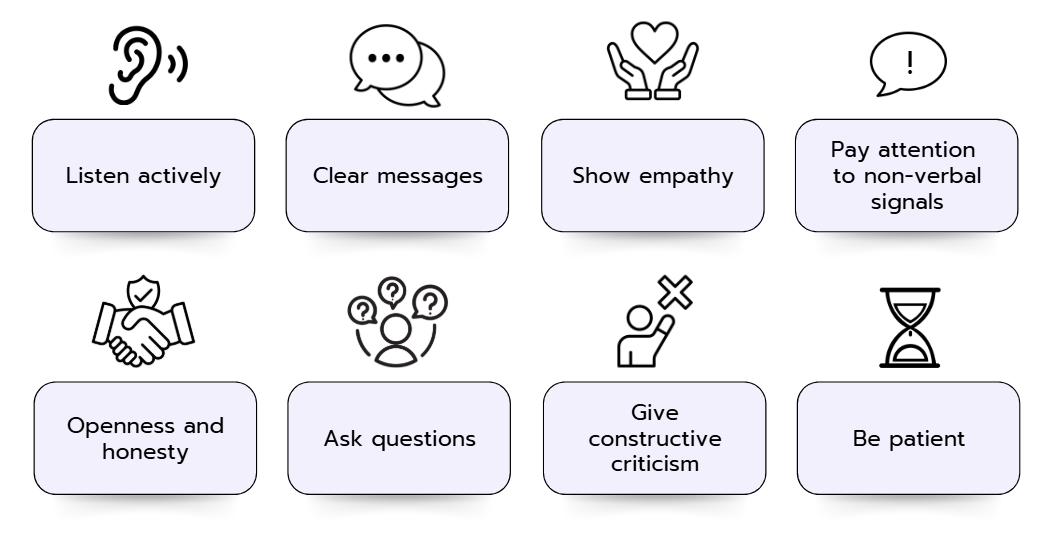
Checklist for Successful Communication
Listen actively: Show interest and focus on your communication partner.
Clear messages: Use clear and precise language to minimize misunderstandings.
Show empathy: Put yourself in the other person's shoes to promote understanding.
Pay attention to non-verbal signals: Pay attention to body language, facial expressions, and tone of voice.
Openness and honesty: Share relevant information and feelings openly.
Ask questions: Clarify ambiguities to promote understanding.
Give constructive criticism: Give feedback respectfully and constructively.
Be patient: give the other person time to express himself.
Interpersonal Communication in Management Consulting
In management consulting, successful interpersonal communication is critical to success. Consultants need to gather clear information from clients in order to understand their needs. At the same time, they must communicate solutions and recommendations clearly and persuasively to gain the trust of clients. Teamwork and the ability to communicate effectively with all parties involved are essential to successfully complete projects and build long-term relationships.
Let's Move On With the Next Articles:
Six Sigma
Common Terms of Business
In today's competitive business world, it's not just about delivering products and services. Companies are increasingly focusing on optimizing their processes, avoiding inefficiencies, and taking quality to the next level. This is where Six Sigma plays a crucial role. 💡
This data-driven methodology has proven to be highly effective in identifying and fixing errors, as well as improving the overall performance of business processes. It also promotes a culture of data-driven decision-making.
In the field of consulting, the hypothesis plays a central role in the analysis of problems, the development of solutions and the derivation of strategic recommendations. A hypothesis is a preliminary assumption or conjecture made on the basis of existing information and data. It serves as a starting point for investigations to gain empirically verifiable knowledge. This article explores the meaning, purpose, and application of hypotheses in the consulting context.
Inflation is an economic phenomenon that almost all of us have experienced at some point – and not just at the grocery store. Simply put, inflation means that the prices of goods and services rise, and your money becomes less valuable. For example, if you can buy something for 10 euros today, you might be able to buy less of it in a few months with the same amount. 😅
But how does inflation actually happen? It usually results from an imbalance between supply and demand. A common cause is demand-pull inflation: when the demand for goods and services exceeds the supply, companies can raise their prices because they know that customers are still willing to pay more.
Another frequent cause is cost-push inflation. When companies face rising production costs – for example, due to higher wages or increased raw material prices – they often raise their prices to cover those additional expenses.
[Demand-pull vs. cost-push inflation]