Back to overview

Break-Even Analysis

The break-even analysis helps you find the point at which a company’s total revenue equals its total costs. This analysis allows you to determine the number of product units that need to be sold to reach profitability, given the product’s price and costs.

🔎 In this article, we’ll show you how to tackle the break-even analysis in a case interview. Enjoy reading!


What is Break-Even Analysis?

A break-even analysis is crucial for assessing a company’s profitability. It illustrates the relationship between profit, revenue, and costs, helping to calculate the break-even point (BEP). It's essential to understand the concept of fixed and variable costs.

👉 Make sure to check out our article on fixed and variable costs!

The formula for calculating the break-even point is:
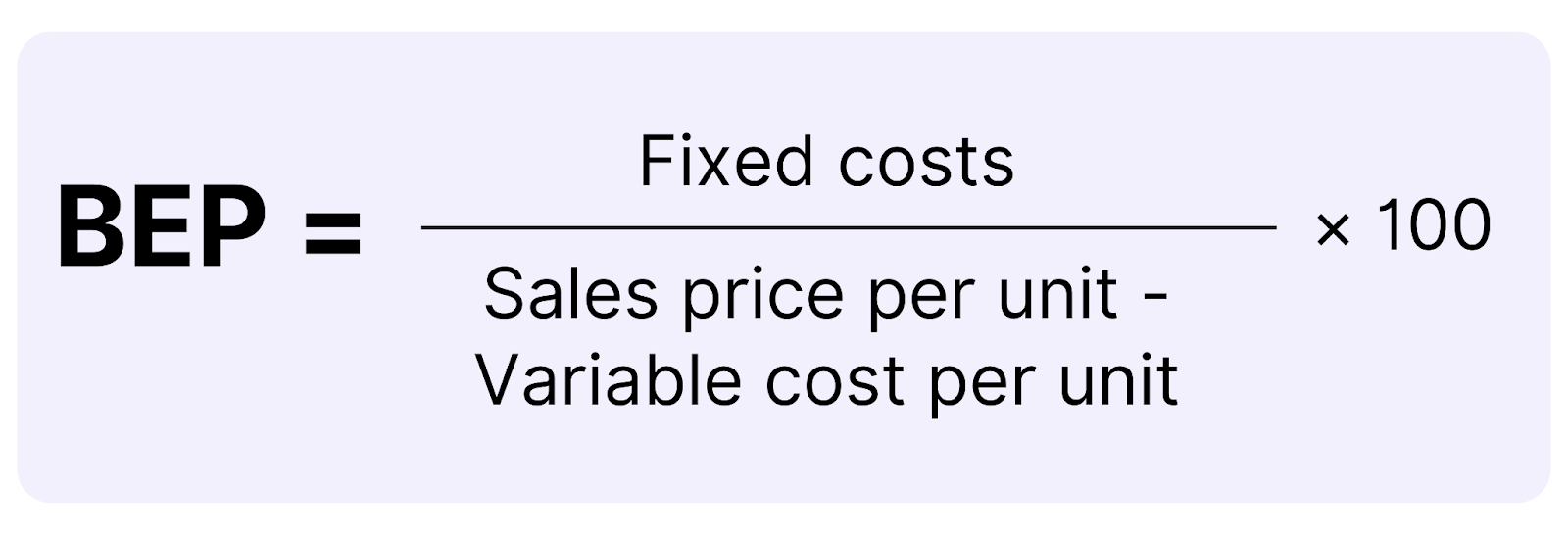
BEP = (Fixed costs divided by sales price per unit minus variable cost per unit) x 100

When fixed costs are greater than zero, it’s critical to have a positive contribution margin per unit (i.e., the price must be higher than variable costs) to reach a break-even point.


Using Break-Even Analysis in Case Interviews

In consulting, break-even analysis is often used to help clients make strategic decisions. Let’s say you’re assisting a company planning to launch a new product. You would analyze the product’s fixed and variable costs to determine the break-even point.


Here, You’ll Find Cases Related to New Products

Company case provided by Company case by
Mercedes-Benz Management Consulting
MBMC Case: Exploring the future of automotive mobility
As a consultant at Mercedes-Benz Management Consulting (MBMC), you are actively shaping the future of automotive mobility. While you are contributing to decisive projects that design the future of the world’s No.1 premium carmaker, you also develop your own career path, and you have the unique possibility to build your personal brand and cultivate relationships with the top management.Your client on your current project is the head of product strategy who reports directly to the CEO. She asks you to explore new profit pools and business opportunities regarding innovations and monetarization strategies.Initially, you shall structure and explore potential business models, and discuss necessary conditions and implications of these business models. In a next step, you shall quantitatively analyze possible options and prepare them for decision. And of course, the client is interested in your recommendation.
3.9
10.9k times solved
Difficulty: Intermediate
Interviewer-led
New product
Profitability analysis
Company case provided by Company case by
Roland Berger
Roland Berger Case: Sensorio Hightech GmbH
Sensorio Hightech GmbH is a leading manufacturer of technically advanced consumer electronics sensors based in Germany with EUR 500 m in revenues. It is a successfully growing affiliate with technically advanced consumer electronics sensors as its main business. Sensorio Hightech GmbH is looking at the smart home market for further growth. In addition, the company is aiming to tap into new regional markets. You are a member of a consulting team mandated by Sensorio Hightech GmbH to:assess possible new target segments in the smart home market(optional – if there’s time left: recommend go-to-market measures)The company is looking for a recommendation answering the following questions, taking into account Sensorio’s capabilities and current situation in various regions, the overall market environment, and smart home ecosystem:Smart home market segmentation & attractiveness analysis (qualitative & quantitative)What are relevant market segments of the smart home market?What are potential factors that determine the market segment's attractiveness for Sensorio Hightech GmbH?Which market segment(s) is/are most attractive for Sensorio Hightech GmbH to enter, and why?(Optional: Entry strategy (qualitative))How does the strategy to successfully entering the target segment(s) look like?What are the crucial factors Sensorio Hightech GmbH needs to get right?What parts of the value chain does Sensorio Hightech GmbH want to cover?
3.2
22.9k times solved
Difficulty: Intermediate
Candidate-led
Market analysis
Market entry
Company case provided by Company case by
BearingPoint Germany
BearingPoint Case: Nachhaltigkeit on the Road – Potenziale der Kreislaufwirtschaft für den Automobilhersteller
Der Automobilhersteller YourCars denkt zunehmend darüber nach, wie er seine Kosten senken und gleichzeitig seinen ökologischen Fußabdruck minimieren kann. Eine mögliche Lösung besteht darin, die Prinzipien der Kreislaufwirtschaft, insbesondere die „5Rs" – Refuse, Reduce, Reuse, Repurpose, Recycle – in seine Produktionsprozesse zu integrieren. Hauptziel dieser Überlegungen ist es, den Verbrauch und die Verschwendung von Ressourcen zu minimieren, die Lebensdauer von Produkten und Materialien zu maximieren und letztendlich einen nachhaltigeren und effizienteren Betrieb zu gewährleisten. Zu diesem Zweck beauftragt die Geschäftsführung eine Unternehmensberatung mit der Erarbeitung erster Ansätze.Du als Unternehmensberater:in sollst der Geschäftsführung die Chancen und Risiken des Kreislaufwirtschaftsansatzes erläutern. Darüber hinaus möchte die Geschäftsführung wissen, in welchen Bereichen Einsparpotenziale bestehen. Schlussendlich sollst du basierend auf der Analyse eine Empfehlung aussprechen.
4.3
9.5k times solved
Difficulty: Intermediate
Interviewer-led
Operations strategy
Profitability analysis
Company case provided by Company case by
thyssenkrupp Management Consulting
tkMC Case: Market entry strategy in the lithium materials trade market
Your client tk Commodity Trade (tk ComT) is a global materials trader - they buy and sell raw materials. tk ComT had stable EBITDA margins in recent years. They consider expanding their target market and entering the Lithium (electric vehicle battery grade) trade, due to the current high demand for electric cars and Lithium-ion batteries. The client is concerned about minimizing the cash spending and about improving the payback period for this market-entry campaign, due to corporate cash policy.As a consultant, you are expected to calculate the size of the Lithium market and to assess the payback periods for an organic market entry (with own resources) as well as for the acquisition of an established company. Finally, the client expects a proposal about the best market entry strategy and potential opportunities and risks.
4.0
26.4k times solved
Difficulty: Intermediate
Interviewer-led
Market entry
New product
Profitability analysis
Company case provided by Company case by
Forvis Mazars
Forvis Mazars Case: Prüfung der Carvermietungen GmbH
Sie sind Abschlussprüfer der CarVermietungen GmbH, einem deutschen Unternehmen, das geleaste Fahrzeuge europaweit an Privat- und Geschäftskunden weitervermietet.Im Rahmen der Prüfung führen Sie Interviews mit dem Management des Unternehmens durch. Dabei wecken insbesondere die langfristigen ökologischen und digitalen Herausforderungen der Firma Ihr Interesse. Sie erfahren unter anderem, dass die Hauptunterschiede zum üblichen Geschäft in einem Transformationsplan liegen und lassen sich vom CFO den Plan vorstellen.Die Finanzdirektorin teilt Ihnen stolz mit, dass die CarVermietungen GmbH in die Elektrifizierung der Fahrzeugflotte investiert. Die Anzahl der Elektroautos wird im Lagebericht veröffentlicht. Die CarVermietungen GmbH bietet ihren Kunden seit dem vierten Quartal eine Erweiterung zum bestehenden Bonusprogramm an. Die Kunden können ihre gesammelten Bonuspunkte am Jahresende auf ein Umweltprogramm übertragen, das vorwiegend in den Anbau von Bäumen und Wasseralgen investiert, um die klimafreundliche CO2-Bindung zu fördern. In diesem Zusammenhang hat das Unternehmen auch eine weitere Zielgruppe definiert und eine entsprechende Kundenliste erstellt. Darüber hinaus wurden im laufenden Geschäftsjahr durch den Zukauf von Daten über ein soziales Netzwerk zusätzlich neue Kunden hinzugewonnen.Die CarVermietungen GmbH hat im letzten Quartal außerdem in P2P-Carsharing investiert, da sich dieses neue Geschäftsmodell im Ausland bereits als vielversprechend erwiesen hat. Private Autobesitzer haben die Möglichkeit, ihr Fahrzeug über die Carsharing-Plattform anzubieten und die Vermietung gänzlich über eine App abzuwickeln. Die Mietwagengebühren betragen ein Drittel des Mietwertes und die CarVermietungen GmbH zahlt eine Versicherung, die jeden Kunden abdeckt. Die Versicherungsprämien für das Folgejahr wurden bereits ausgezahlt.
4.0
8.8k times solved
Difficulty: Intermediate
Interviewer-led
Audit
Valuation


Case Example: Market Entry Strategy in The Lithium Materials Trade Market

Imagine your client is a company entering the lithium material trade. They plan to offer lithium to the electronics industry and face the challenge of identifying profitable price points and associated costs. Your task is to conduct a break-even analysis to find out how many units must be sold to cover initial investments and operating costs.

  • The client faces high investment costs for machinery and infrastructure that will be significant in the first few years.
  • It’s also expected that the variable costs for raw materials and transport will significantly impact the price per unit.

Step 1: Calculate the Break-Even Point

To find the break-even point, we need the following data:

  • Fixed Costs (FC): €500,000 (e.g., rent, machinery costs, salaries)
  • Variable Costs per Unit (VC): €100 (e.g., raw material costs, transport)
  • Selling Price per Unit (P): €150 (the price at which lithium will be sold)

Step 2: Calculation

Now, let’s plug these values into the break-even formula:
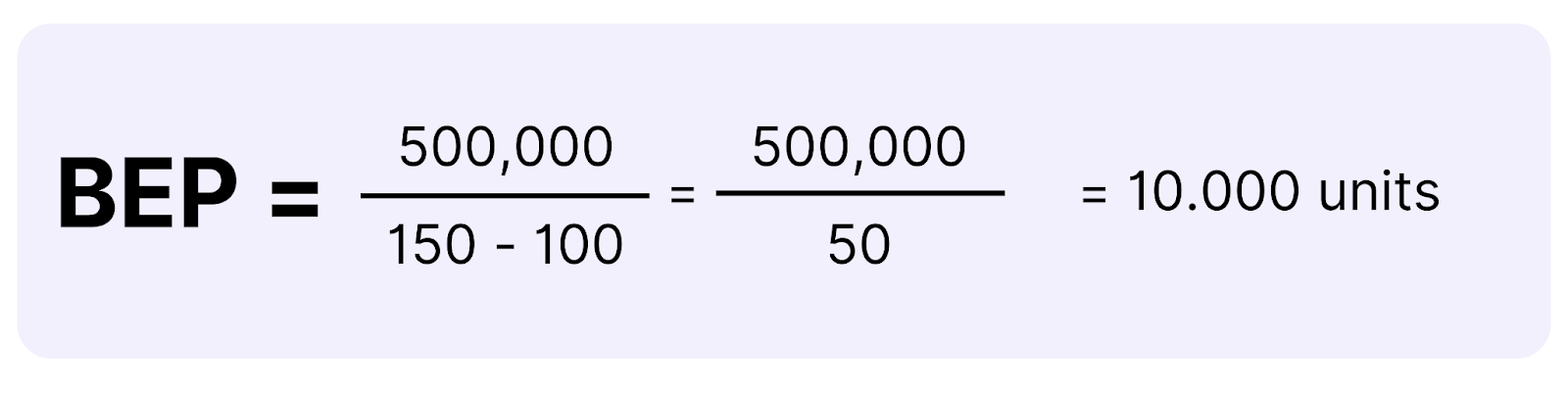
BEP = 500,000 divided by (150 minus 100) equals 500,000 divided by 50 equals 10,000 units.

This means the company needs to sell 10,000 units of lithium to cover its costs.

Step 3: Interpret the Results

  • Market Opportunities: Consider if the sales targets are realistic. Is there strong demand for lithium? Is the price competitive?
  • Strategic Decisions: If the break-even point is deemed too high, strategies like cost-cutting, price adjustments, or marketing initiatives could be developed to boost profitability.


By the Way, This Case is Part of Our Case Library

Company case provided by Company case by
thyssenkrupp Management Consulting
tkMC Case: Market entry strategy in the lithium materials trade market
Your client tk Commodity Trade (tk ComT) is a global materials trader - they buy and sell raw materials. tk ComT had stable EBITDA margins in recent years. They consider expanding their target market and entering the Lithium (electric vehicle battery grade) trade, due to the current high demand for electric cars and Lithium-ion batteries. The client is concerned about minimizing the cash spending and about improving the payback period for this market-entry campaign, due to corporate cash policy.As a consultant, you are expected to calculate the size of the Lithium market and to assess the payback periods for an organic market entry (with own resources) as well as for the acquisition of an established company. Finally, the client expects a proposal about the best market entry strategy and potential opportunities and risks.
4.0
26.4k times solved
Difficulty: Intermediate
Interviewer-led
Market entry
New product
Profitability analysis


Break-Even Analysis for Low Profitability

Another important use of break-even analysis is identifying causes of low profitability. Imagine your client is experiencing increasing losses, despite rising revenue. In such a case, the analysis could show that rising costs from a newly opened factory are the cause. If the additional fixed costs are higher than the revenue growth, it leads to losses. Before recommending marketing measures, you should check the break-even number of units sold. For the analysis, you’ll need the following info:

  • Annual Fixed Costs: €50 million
  • Average Variable Cost per Product: €1,000
  • Average Product Price: €1,500

The profit per product calculation would be:

Profit per product = 1,500 minus 1,000 equals 500 euros.

To find the break-even point, use:

500 × x units = 50,000,000 ⇒ x units = 100,000.

The company would need to produce and sell 100,000 units. If this isn’t feasible, you might recommend selling the new factory.


Key Takeaways 💡

The break-even analysis helps you understand your client’s profitability and make informed decisions. By carefully analyzing fixed and variable costs and determining the break-even point, you can develop strategies to boost revenue and minimize risk.

Remember, though, that every business is unique. It’s essential to adapt the analysis to each situation.

During a case interview, think about how to increase profitability and optimize the cost structure. Use the break-even analysis as your guiding tool to gain insights for your clients and help them overcome their business challenges successfully.

Find more key calculations like ROI and ROAS or balance sheet analysis that you can practice for your case interview on PrepLounge.


 

Let's Move On With the Next Articles:

Cost-Benefit Analysis
Case Math
The Cost-Benefit Analysis is not only a powerful decision-making tool in business, economics, and public policy, but it also plays a significant role in case interviews, especially in consulting and strategic management scenarios. The Analysis helps candidates and interviewers alike to evaluate different strategies by comparing the financial and non-financial costs against the anticipated benefits.🔍 The article deals with the application of cost-benefit analysis for decision-making, the consideration of quantitative and qualitative factors and the evaluation of the relative attractiveness of options. We also provide a specific application example.
To the article
Fixed & Variable Costs
Case Math
When preparing for case interviews, you'll quickly find that "fixed costs" and "variable costs" always come up. These concepts are important not only for financial analysis but also for strategic decision-making in companies. Let’s explore what these costs are and how you can skillfully use them in your cases. ✨
To the article
Opportunity Costs
Case Math
Opportunity costs are a fundamental concept in economics and play a key role in case interviews. Simply put, they refer to the cost of choosing one option and giving up the benefits of another. Sounds simple, right?But how exactly can you apply this concept in a case interview? 🤔 Let's break it down step by step, and by the end, we’ll show you an example of how it works in practice.
To the article