



Back to overview
Expert case by
Cristian

GlobalAccess Health – Funding the Next Million Diagnoses

Case Prompt:

GlobalAccess Health (GAH) is a UK-based international non-profit focused on tuberculosis (TB) and other infectious diseases. It develops and distributes low-cost diagnostic tests to public clinics, NGOs, and private laboratories in low- and middle-income countries.

Historically, GAH has been funded almost entirely by large foundations and bilateral donors. Donors now want GAH to become more financially sustainable and have set a target that, within 5 years, at least 60% of GAH’s annual operating budget should be covered by earned income (fees from tests and related services).

GAH’s annual operating budget covers staff, training, logistics, and overheads and is USD 25 million, independent of volume within the ranges discussed in this case. Assume that manufacturing and shipping costs for the tests themselves are covered by a separate restricted grant for the next 5 years; 

GAH has recently introduced modest prices for some partners, but earned income currently covers only about 40% of annual operating costs. Leadership is considering moving to a much more aggressive, tiered pricing and growth strategy, but is concerned about potentially undermining its mission to reach the poorest and most vulnerable populations.

GAH has hired your consulting team to advise whether and how it should pursue this more aggressive earned-income strategy while remaining true to its mission.

Overview of All Exhibits
Practice makes the difference
Practicing alone helps – with a partner it’s even better. Solve this case in a realistic mock interview.
Schedule on Meeting Board

Question 1: Framework

GAH’s board has asked:

“Should we pursue an aggressive earned-income strategy to reach 60% cost recovery in 5 years, and if so, under what conditions?”

How would you structure your approach to answering this question?

Show solution Hide solution

Question 2: Chart Interpretation

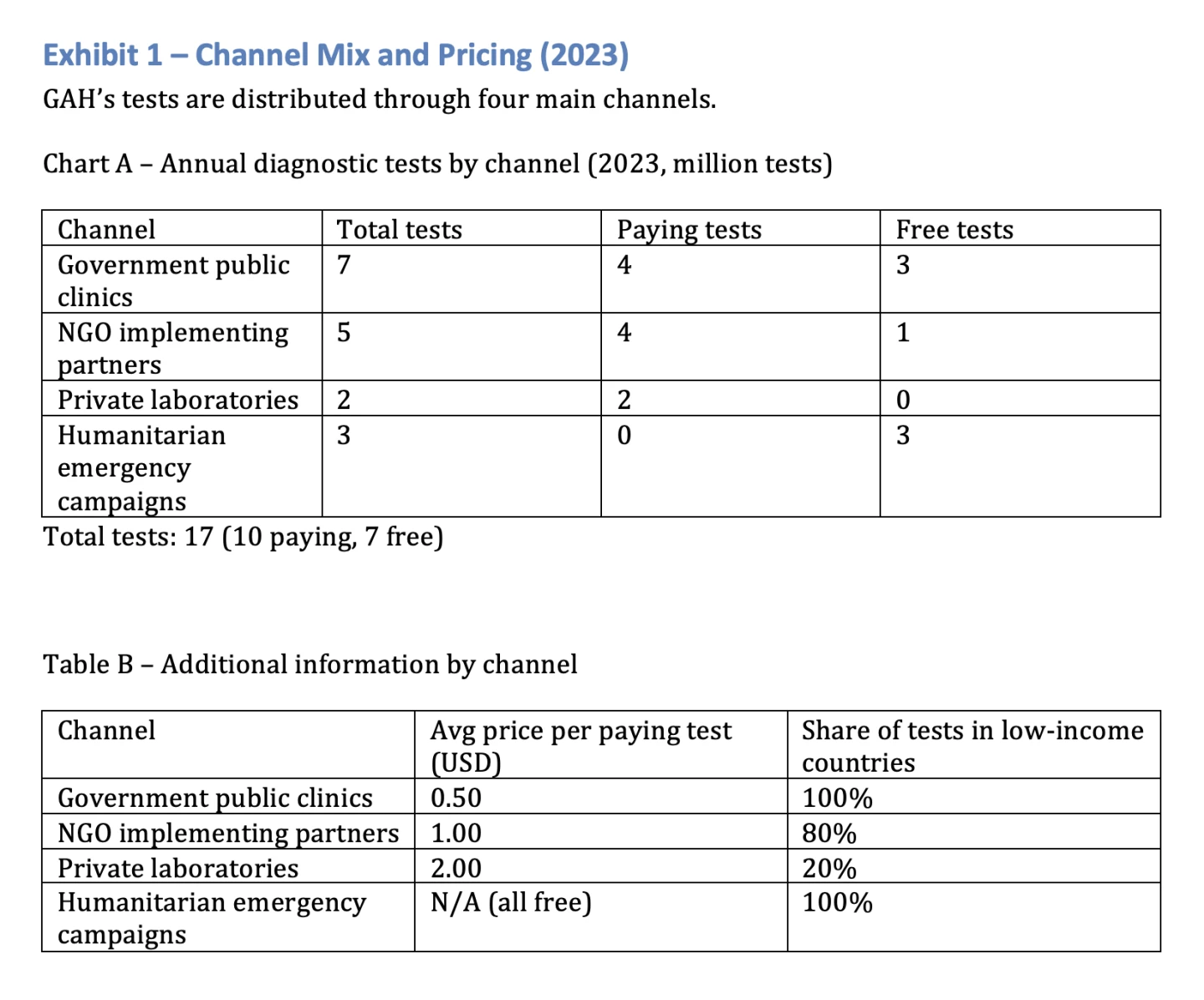
Looking at Exhibit 1, what are the main insights you can draw about GAH’s channel mix, pricing, and implications for a future earned-income strategy?

Show additional information Hide additional information
Show solution Hide solution

Question 3: Calculation

GAH’s annual operating budget (overheads, staff, training, logistics) is USD 25 million. Current earned income from paying tests is about USD 10 million, i.e. a 40% cost-recovery ratio.

Leadership wants to know whether a specific scenario could get them to the 60% cost-recovery target (USD 15 million) without changing prices for their most vulnerable clients.

Scenario for the next year:
- Government clinics: paying volume remains at 4 million tests, at $0.50/test.
- NGO partners: paying volume remains at 4 million tests, at $1.00/test.
- Private laboratories:
  - Price per test increases from $2.00 to $3.00.
  - Manufacturing and shipping continue to be fully funded by a restricted grant; the operating budget remains fixed at $25m.
  - Today, GAH sells 2 million tests per year to private labs.

Questions:
1. What private-lab volume is required (in million tests) to reach 60% cost recovery under this scenario?
2. By what percentage would private-lab volume need to increase vs. today?
Show your steps.

Show solution Hide solution

Question 4: Brainstorming

Several programme directors are worried that pushing too hard on earned income might undermine access for the poorest communities and damage GAH’s reputation as an equity-focused organisation.

What 3–4 major levers could GAH use to increase its earned income while preserving (or even strengthening) equitable access and mission impact?

Show solution Hide solution

Question 5: Recommendation

The CEO joins for a brief update and asks for your preliminary recommendation based on the analysis so far.

What would you recommend at this stage?

Show solution Hide solution
Practice This Case With Peers Who Are Currently Looking for Interview Partners.
Do you have questions on this case?
Ask our community and receive answers and tips directly from our experts.
Ask a question Ask a question
Related Case Interview Basics Articles
The Influence Model
Useful Business Analysis Tools
The McKinsey Influence Model was developed in the early 2000s and is the result of extensive research and practical experience by consultants. Originally designed to help companies tackle challenges, the model has now established itself as an indispensable framework in the field of consulting.
To the article
Pricing
Types of Cases
Pricing plays a crucial role in a company's profitability as it directly contributes to it. For this reason, establishing optimal prices for products or services is of great importance. Business consultants therefore assist their clients in developing pricing strategies.A case study on pricing is an analysis focusing on the pricing of a product or service. It can stand alone or be part of a broader case, such as entering a new market.

To the article
7S-Framework of McKinsey
Frameworks
If you're aiming for a career in consulting, learning about key frameworks is essential. One of the most popular and effective tools is the McKinsey 7S Framework. Created by McKinsey & Company, this framework helps you understand and evaluate how different parts of an organization work together to improve overall performance.In this post, we’ll explain the seven elements of the McKinsey 7S Framework and how you can use it in case interviews. Whether you're preparing for consulting roles or just want to boost your business knowledge, this framework is a valuable tool to have in your skillset!
To the article
McKinsey Growth Pyramid
Useful Business Analysis Tools
The McKinsey Growth Pyramid is a strategic tool that helps businesses systematically explore growth opportunities. As the name suggests, it was developed in the 1980s by the renowned management consulting firm McKinsey & Company. It prioritizes different approaches to expansion and offers a structured roadmap for companies to increase revenue, expand their market presence, and drive long-term sustainability. This framework is widely used in consulting, including in case interviews, as it provides a clear methodology to assess how companies can scale efficiently.
To the article
Practice makes the difference
Practicing alone helps – with a partner it’s even better. Solve this case in a realistic mock interview.
Add invitation
Do you have questions on this case?
Ask our community and receive answers and tips directly from our experts.
Ask a question Ask a question