Creativity is a crucial skill assessed during case interviews. While traditional case interview preparation often emphasizes analytical and quantitative abilities, creativity is equally important. This skill demonstrates a candidate's ability to think outside the box, develop a wide array of viable ideas, and propose innovative solutions. In this article, we will explore why creativity is vital in case interviews, how interviewers assess it, and strategies to ensure you never run out of creative ideas during your case-solving process.


The Importance of Creativity in Case Interviews

Creativity is not just about coming up with any ideas, but about generating a diverse set of sound and practical solutions. During case interviews, candidates are often faced with complex, open-ended questions that require more than just textbook knowledge. These scenarios test your ability to apply common sense, imagination, and innovative thinking to real-world business problems. Demonstrating creativity shows that you can navigate ambiguity and generate strategic insights that could give a company a competitive edge.

đź’ˇ Pro Tip: Use our Case Library to familiarize yourself with a variety of business problems and potential solutions. This will help you build a reservoir of ideas to draw from during your interviews.

Case by
PrepLounge
LBO Interview Questions for Finance
This set of questions is designed to help you master key concepts in Leveraged Buyouts (LBOs). The difficulty progresses from foundational questions about the mechanics of an LBO and the role of leverage, to more advanced concepts like financial statement adjustments, calculating debt capacity, and determining coverage ratios.In total, walking through this set in an interview would take approximately 35 minutes, making up around 70% of a typical 45-minute interview. Below, you’ll find model answers for each question, along with tips for the interviewer on what to look for in candidate responses.
5.0
300+ times solved
Difficulty: Beginner
Interviewer-led
Mergers & Acquisition
Valuation
Case by
PrepLounge
Restructuring & Distressed M&A Interview Questions for Finance
This set explores the fundamentals of restructuring and distressed M&A, focusing on valuation, capital structure, financing tools, and practical deal dynamics. It introduces the key differences between healthy-company M&A and distress situations, where speed, liquidity, and creditor negotiations often drive outcomes.Working through the set should take around 30-35 minutes, making it suitable for interviews in investment banking (restructuring groups), private equity (special situations, distressed investing), or credit advisory.
5.0
300+ times solved
Difficulty: Beginner
Interviewer-led
Mergers & Acquisition
Restructuring
Case by
PrepLounge
Debt & Credit Analysis – Interview Questions for Finance
This question set covers the fundamentals of debt instruments, credit metrics, and risk assessment. It mixes definitions, calculations, and case-style questions to prepare you for corporate finance and investment banking interviews.
5.0
100+ times solved
Difficulty: Intermediate
Interviewer-led
Non-conventional
Case by
PrepLounge
M&A Interview Case: Should SteelTech Buy BoltWerk?
A mid-sized European industrials company, SteelTech AG, is considering acquiring a smaller competitor, BoltWerk GmbH, to expand its product portfolio and gain market share. You are part of the M&A advisory team. The CEO asks you to do a quick assessment of whether the acquisition makes strategic and financial sense.
5.0
100+ times solved
Difficulty: Intermediate
Interviewer-led
Mergers & Acquisition
Case by
PrepLounge
Stripe IPO: Advanced Valuation Interview Questions for Finance
This set of questions focuses on IPO valuation using Stripe as an example. It tests your understanding of core valuation methods and your ability to apply them in realistic, interview-style scenarios.Set aside 30–35 minutes for the whole set. Each question includes a model answer to check your approach and improve your technicals.
5.0
300+ times solved
Difficulty: Advanced
Interviewer-led
Mergers & Acquisition
Valuation
Case by
PrepLounge
Enterprise & Equity Value Interview Questions for Finance
This set of questions is designed to help you master the fundamentals of Enterprise Value (EV) and Equity Value. The questions start with basic concepts, such as the difference between EV and Equity Value, and progress to key topics like calculating EV, the impact of diluted shares, and understanding the Treasury Stock Method.In total, walking through this set in an interview would take approximately 30 minutes, making up around 60% of a typical 45-minute interview. Below, you’ll find model answers for each question, along with tips for the interviewer on what to look for in candidate responses.
4.0
300+ times solved
Difficulty: Beginner
Interviewer-led
Valuation
Case by
PrepLounge
M&A Interview Questions for Finance
This set of questions is designed to help you master the fundamentals of mergers and acquisitions (M&A). The questions start with basic concepts, such as the difference between mergers and acquisitions, and progress to key topics like synergies, accretive and dilutive deals, and the merger model.In total, walking through this set in an interview would take approximately 30 minutes, making up around 60% of a typical 45-minute interview. Below, you’ll find model answers for each question, along with tips for the interviewer on what to look for in candidate responses.
5.0
400+ times solved
Difficulty: Beginner
Interviewer-led
Mergers & Acquisition
Case by
PrepLounge
IPO Interview Questions for Finance
An Initial Public Offering (IPO) is one of the most important events in a company’s lifecycle and a frequent topic in investment banking interviews. This case will test your understanding of IPO basics, process steps, valuation methods, and recent market dynamics.
5.0
200+ times solved
Difficulty: Beginner
Interviewer-led
Growth strategy
Valuation
Case by
PrepLounge
Derivatives & Hedging – Interview Questions for Finance
This question set explores how companies use forwards, swaps, and options in practice to manage risk. You’ll cover theory, applications, and calculations. The aim is to test not only technical knowledge but also structured reasoning when applying derivatives to real-world corporate finance situations.
5.0
< 100 times solved
Difficulty: Advanced
Interviewer-led
Mergers & Acquisition
Case by
PrepLounge
Intermediate Accounting Interview Questions for Finance
This set of questions is designed to help you master the core concepts around the three financial statements. The difficulty ranges from beginner to advanced, progressing from foundational questions to a multi-step scenario that tests your understanding of capital expenditures, debt financing, depreciation, interest, and asset write-downs. In total, walking through this set in an interview would take approximately 20 minutes, making up around 40% of a typical 45-minute interview. Below, you’ll find model answers for each question, including tips for the interviewer on what to look for in candidate answers. 
5.0
300+ times solved
Difficulty: Intermediate
Interviewer-led
Audit
Case by
PrepLounge
Practical LBO Interview Questions for Finance
This set of questions helps you apply key LBO concepts in practical, realistic interview scenarios. You'll explore how leveraged buyout logic is used to assess deal structures, compare financing options, and evaluate the impact of working capital changes, covenants, and dividend recapitalizations on investor returns.In total, walking through this set in an interview would take approximately 35 minutes, making up around 70% of a typical 45-minute interview. Below, you’ll find model answers for each question, along with tips for the interviewer on what to look for in candidate responses.
5.0
500+ times solved
Difficulty: Intermediate
Interviewer-led
Mergers & Acquisition
Valuation
Case by
PrepLounge
Advanced Accounting Interview Questions for Finance
This question set sharpens your understanding of advanced accounting topics essential for finance roles. It covers areas like stock-based compensation, deferred taxes, goodwill impairment, and working capital.Plan for 35–45 minutes to complete the set. Use the model answers to check your reasoning and improve how clearly you explain complex accounting concepts.
3.0
400+ times solved
Difficulty: Advanced
Interviewer-led
Audit
Case by
PrepLounge
Working Capital Forecasting at FreshHarvest AG
You’re advising FreshHarvest AG, a fast-growing food distribution company based in Germany. They operate on tight margins, high volumes, and have recently secured several new retail partners. The CFO wants to better understand how working capital decisions and seasonal dynamics impact their free cash flow profile and ultimately their valuation.Your task is to assess how working capital evolves over the forecast period, how payment term shifts affect cash flow, and how to reflect seasonality in a dynamic forecasting model.This case will test your analytical skills, cash flow understanding, and judgment around operational finance levers.
5.0
400+ times solved
Difficulty: Intermediate
Interviewer-led
Operations strategy
Valuation
Case by
PrepLounge
Intermediate Valuation Interview Questions for Finance
This question set helps you go beyond the basics of valuation by comparing key methodologies and exploring when and how to use each one effectively. You’ll review core approaches like DCF, comparables, and precedent transactions, and build on that with LBO analysis, liquidation valuation, and industry-specific multiples.You should expect to spend 30–40 minutes on the full set. Use the model answers to check your reasoning and refine your technical knowledge.
5.0
400+ times solved
Difficulty: Intermediate
Interviewer-led
Mergers & Acquisition
Valuation
Case by
PrepLounge
Basic Merger Model Interview Questions for Finance
This question set helps you build a solid foundation in M&amp;A modeling by covering the key drivers of accretion and dilution, deal structuring, and synergy analysis. You’ll review the mechanics of a basic merger model, explore how different financing methods impact EPS, and understand strategic considerations like purchase price allocation and debt capacity.You should expect to spend 30–40 minutes on the full set. Use the model answers to test your understanding, identify gaps, and sharpen your ability to communicate M&amp;A concepts clearly and confidently.
5.0
500+ times solved
Difficulty: Beginner
Interviewer-led
Mergers & Acquisition
Case by
PrepLounge
Intermediate Valuation & DCF Interview Questions for Finance
This intermediate-level question set covers key concepts in valuation, with a particular focus on the Discounted Cash Flow (DCF) method. You'll review the main valuation approaches, then work through the full DCF process – from calculating free cash flow to understanding discount rates, terminal value, and capital structure effects.Plan for about 30–35 minutes to complete the set. Model answers are included to help you check your logic and technical knowledge.
5.0
400+ times solved
Difficulty: Intermediate
Interviewer-led
Mergers & Acquisition
Valuation
Case by
PrepLounge
Advanced Valuation Interview Questions for Finance
This question set helps you strengthen your valuation fundamentals by covering core techniques used in public and private company valuation, tax asset treatment, and sector-specific approaches. You'll explore how to estimate acquisition premiums, work with Net Operating Losses, and understand how valuation frameworks shift for financial institutions and resource-based companies like oil &amp; gas firms.You should expect to spend 25–35 minutes on the full set. Use the model answers to check your understanding, refine your technical explanations, and practice communicating complex valuation topics clearly and confidently in interview settings.
5.0
300+ times solved
Difficulty: Intermediate
Interviewer-led
Mergers & Acquisition
Case by
PrepLounge
Basic Accounting Interview Questions for Finance
This set of questions is designed to help you master key concepts in accounting and financial analysis. The difficulty progresses from foundational questions about the Income Statement, Working Capital, and Deferred Revenue to more complex concepts like depreciation, accrual vs. cash-based accounting, and their impact on financial statements.In total, walking through this set in an interview would take approximately 30 minutes, making up around 60% of a typical 45-minute interview. Below, you’ll find model answers for each question, along with tips for the interviewer on what to look for in candidate responses.
5.0
300+ times solved
Difficulty: Beginner
Interviewer-led
Audit
Case by
PrepLounge
Advanced LBO Interview Questions for Finance
This question set helps you deepen your understanding of LBO modeling by covering key mechanics such as capital structure, debt repayment flows, purchase price allocation, and return calculations. You'll practice explaining value creation levers, modeling revolvers and PIK debt, and adjusting financial statements post-acquisition.Expect to spend around 25–35 minutes on the full set. Use the model answers to test your knowledge, and improve your structuring.
5.0
200+ times solved
Difficulty: Advanced
Interviewer-led
Mergers & Acquisition

How is Creativity Assessed in Case Interviews?

Interviewers typically assess creativity through open-ended questions that lack exhibits or starting information. These questions challenge candidates to think on their feet and come up with multiple solutions independently. For example, you might be asked how to increase a company's market share without being given specific data points or frameworks. The expectation is to generate a variety of ideas, usually aiming for at least five distinct concepts. This not only showcases your creativity, but also your ability to think deeply and broadly about a problem.

đź’ˇ Pro Tip: Check out our Brain Teaser Collection to sharpen your creative thinking skills and prepare for unexpected questions.

Demonstrating Creativity in Case Interviews Effectively

While creativity is important, maintaining structure in your answers is equally crucial. Here are some strategies to effectively showcase your creativity during a case interview:

  • Organize by themes: Instead of listing random ideas as they come to mind, group your thoughts into high-level themes. This approach demonstrates structured thinking and helps you cover different aspects of the problem comprehensively. For instance, if asked to improve customer satisfaction, you might categorize your ideas into themes like product quality, customer service, and marketing strategies.

đź’ˇ Pro Tip: Use our Structuring Drills to practice breaking down complex problems into manageable themes. This will help you organize your ideas logically during interviews.

  • Sense-check ideas: Ensure that your ideas are practical and can be implemented in the given context. It’s important to show that your creative solutions are not just imaginative, but also feasible. Discuss the potential impact and challenges of each idea briefly to indicate your practical understanding.
  • Differentiate between quick wins and long-term solutions: Highlighting a mix of immediate actions and strategic, long-term initiatives shows that you can think short-term and long-term. Quick wins might include small adjustments that can be implemented quickly with minimal resources, while long-term ideas might involve significant investments or strategic changes.
  • Summarize and wrap up: After brainstorming, summarize your ideas along the key themes and indicate how they inform your overall answer to the case. This step not only reinforces your structured approach but also helps the interviewer follow your thought process and the rationale behind your recommendations.


Avoiding Creative Blocks in Case Interviews

Running out of ideas can be a challenge during a case interview. Here are some tips to keep the creative juices flowing:

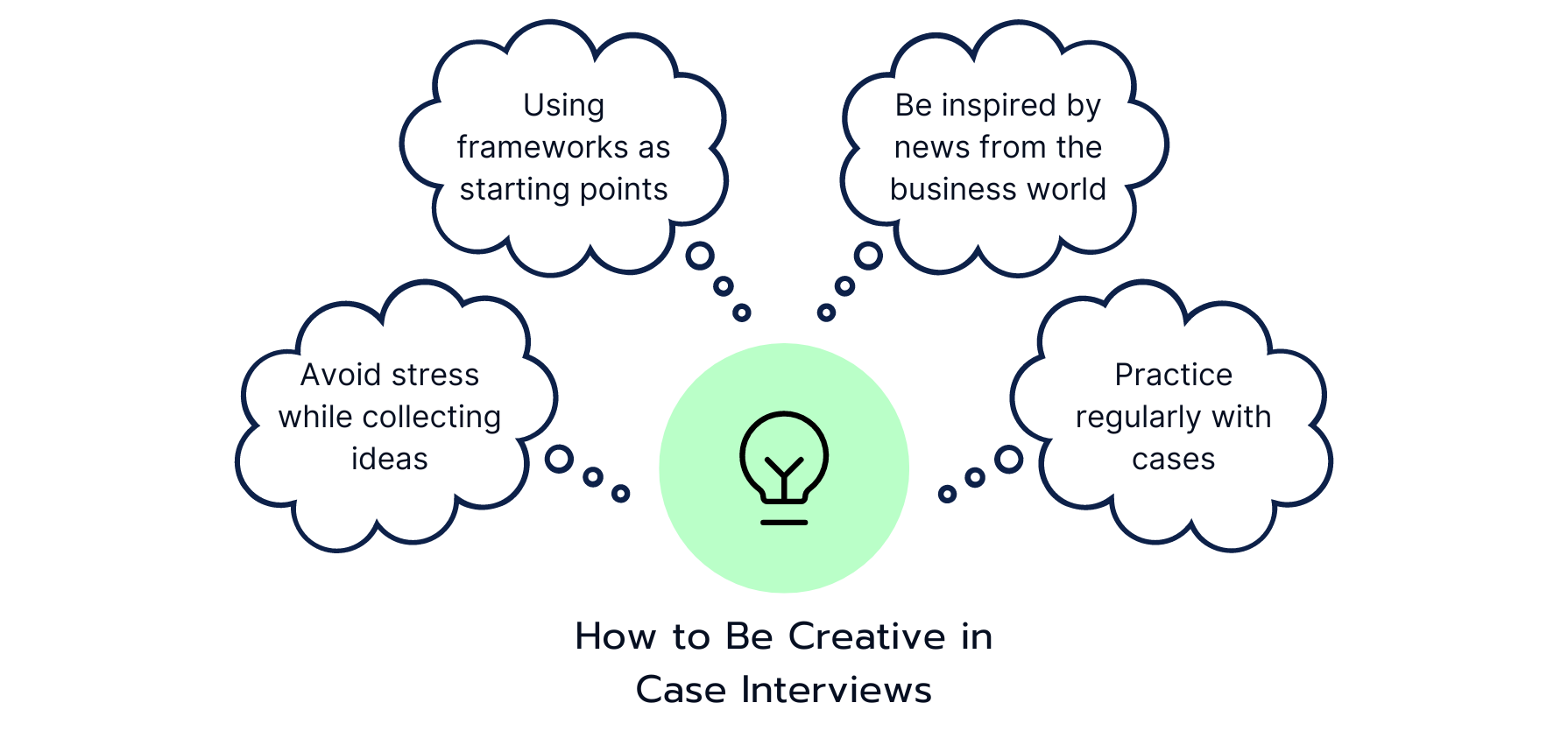
Mind map on how to be creative in Case Interviews with four tips: using frameworks as starting points, being inspired by business news, practicing regularly with cases, and avoiding stress while collecting ideas.

  • Preparation: Familiarize yourself with common business problems and innovative solutions. Reading case studies and business news can provide a wealth of ideas and inspiration.
  • Practice: Regularly practice with case scenarios to build your creative muscle. The more you practice, the easier it becomes to generate ideas on the spot.

👉 Participate in Mock Interviews on PrepLounge to simulate real interview conditions and receive feedback on your creative thinking.

  • Use frameworks: While creativity goes beyond traditional frameworks, they can serve as useful starting points to ensure you cover all bases. Customize and expand upon these frameworks with your unique insights.
  • Stay calm and positive: Stress can stifle creativity. Stay calm, take a deep breath, and approach each question with a positive mindset.

đź’ˇ Pro Tip: Use our Stress Question Tool to improve your ability to stay creative and focused under pressure.

Key Takeaways

Creativity is a vital component of case interview success, reflecting your ability to generate diverse, practical, and innovative solutions. By organizing your thoughts into high-level themes, ensuring the feasibility of your ideas, balancing quick wins with long-term strategies, and summarizing your key points, you can effectively showcase your creativity. Preparing thoroughly, practicing regularly, and maintaining a positive attitude will help you keep your ideas flowing. Embrace the creative challenges of case interviews, and you’ll be well on your way to impressing your interviewers and securing that coveted consulting role.

Let's Move On With the Next Articles:

Business Sense
Consulting Skills & Preparation
Business sense refers to the ability to quickly grasp economic dynamics and make decisions that are both strategically and commercially sound. In consulting, it’s not enough to repeat theories from your business degree. What matters is a deep understanding of how companies operate, what drives markets, and what different stakeholders are aiming to achieve.Consultants with strong business acumen can quickly adapt to new industries, understand client needs, and set priorities that make economic sense. They don’t just ask, “What is analytically correct?” – they also ask, “What truly benefits the company?” This mindset often makes the difference in a case interview. 
To the article
Presentation and Communication
Consulting Skills & Preparation
The majority and the most obvious part of preparation is, of course, the substantive preparation for your case interview. However, you also need to present what you have learned in a way that gives your interviewer an impression of your personality and character. This means that you must appear confident and communicate clearly and precisely. The best preparation is useless if you come across as closed-off and insecure. As a consultant, you must always appear trustworthy and confident when interacting with clients to be taken seriously and to enable you and your team to work in a solution-oriented manner. This is already tested in the case interview – albeit indirectly ;)
To the article
General Knowledge
Consulting Skills & Preparation
In case interviews, having solid general knowledge can make a big difference, especially in market sizing questions. Knowing basic facts about regions, population sizes, and economic indicators helps you build stronger arguments. It’s not just about the analysis itself but also about showing interviewers that you understand global trends and can quickly process key information — an important skill in consulting.In a case interview, quick and accurate estimates are essential. For example, if you're asked to evaluate the potential market for a product in a specific country, having solid data — like the population size — is crucial. Without this information, it can be challenging to make a meaningful calculation.In addition to national market data, it's important to know about key global markets. Being familiar with major economic regions like the U.S., China, and the EU is valuable because large consulting firms such as McKinsey and BCG operate extensively in these areas. A solid understanding of these regions shows that you can think about global factors and helps you stand out from other candidates. What Your Knowledge of Population, Economy & Geography Says About YouHaving strong general knowledge in specific areas not only shows that you are well-prepared, but also that you can quickly understand economic relationships—a crucial skill in consulting. When you have information like population sizes or a country's Gross Domestic Product (GDP) at your fingertips, you can quickly verify assumptions and make informed decisions, which is exactly what case interviews expect.Additionally, your knowledge of these topics demonstrates a genuine interest in world affairs and your ability to recognize and understand global trends. This insight is vital for evaluating how political, economic, and social changes affect businesses. It also highlights your capability to absorb and use complex data effectively.PopulationCountry/RegionPopulation (approx.)Worldwide8.05 billionChina1.426 billionIndia1.419 billionEurope (EU states)450 millionUSA335 millionIndonesia277 millionBrazil203 millionRussia143 millionJapan124 millionGermany83 millionUK68 millionGDP Forecast in USD for 2024Country/RegionGDP 2024 (approx. in trillions USD)Worldwide105 trillion USDUSA25 trillion USDChina18 trillion USDJapan4.3 trillion USDGermany4.5 trillion USDFrance3.0 trillion USDUK3.1 trillion USDIndia3.9 trillion USDItaly2.2 trillion USDBrazil2.1 trillion USDCanada2.2 trillion USD Key Data to Know for Your Case InterviewIn case interviews, making quick and accurate estimates is key. A good grasp of units, along with basic fraction and percentage calculations, is essential for working efficiently. Additionally, being comfortable with time units is important for making rough estimates and calculations. The table of larger and smaller time units below provides a handy overview of commonly needed values. These fundamental skills help you tackle tasks confidently and quickly.Overview of Time Conversions: Days, Weeks and HoursLarger UnitsSmaller UnitsDays/Year365 days (In leap years: 366 days)Days/3 Years1,095 daysDays/4 Years1,461 days (including 1 leap year)Weeks/Year52 weeksHours/Week168 hoursSeconds/Hour3,600 secondsConversion of Fractions to Percentages and Decimal ValuesFractionPercentageDecimal1/520%0.201/616.67%0.16671/714.29%0.14291/812.5%0.1251/911.11%0.11111/1010%0.101/119.09%0.09091/128.33%0.08331/137.69%0.07691/147.14%0.07141/156.67%0.06671/166.25%0.06251/175.88%0.05881/185.56%0.05561/195.26%0.05261/205%0.05Remember, it’s not enough to just memorize these numbers—you also need to be able to calculate with them effectively!Use our Mental Math Tool to specifically train your math skills and prepare for your next interview.

To the article