

Our client is Homeware Heaven. They are a homeware and appliance retailer that sells items such as kitchen appliances (fridges, ovens), kitchenware, lighting, bedding and bath products, home decor etc. They have 100 stores in the top 20 cities in the US. Their stores are large stand-alone stores located outside of the city centre. Over the last 3 years, business has not been going well for our client. Their revenue has been declining year over year and they have had fewer unique shoppers in their stores. They have hired McKinsey to help them turnaround the situation
Case Prompt:
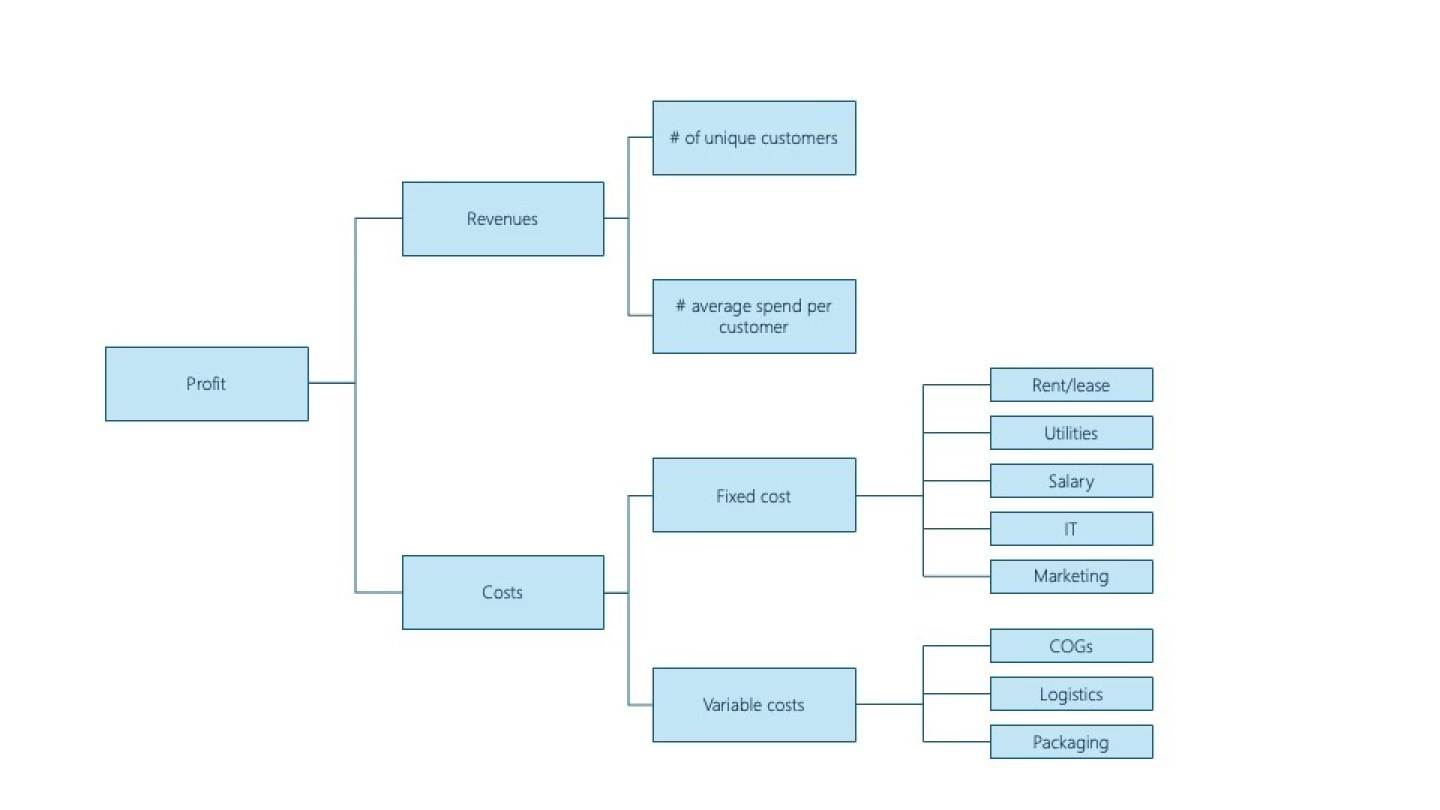
Sample Structure
A good candidate should be able to develop a MECE framework that breaks down the profitability of the client in a relevant way, as shown in the sample framework image.
A good candidate should be able to elaborate on the framework with a logic that is aligned to the specifics of the question (whether or not the store format is causing the drop in profitability). For example:
- Revenue: "We would need to understand whether or not the store-format is causing our client to lose unique customers or causing our customers to spend less"
A strong candidate should be able to generate specific hypotheses on the drivers that demonstrate business judgment and logical thinking. For example:
- Costs: "perhaps the rental/leasing costs have increased in the out-of-town areas our client is present in, therefore driving up the cost significantly especially due to the large store sizes"
A strong candidate should prioritize and show some business judgment on which drivers are not as relevant to the specifics of the question, which is in this instance the location of the stores
- E.g. drivers like packaging and arguably salaries (if these are fixed headquarter/admin staff their salaries are likely to be pegged to the city/state they are in even if they have to commute for work)
One common pitfall candidates make is that they generate a framework based on revenue (because it was mentioned in the prompt), instead of paying attention to detail on the immediate question which is actually about profitability. If this happens, remind the candidate what the question is focused on
Another common pitfall candidates make here is the failure to ensure a consistent logic when explaining the framework. Oftentimes candidates will elaborate on the profit drivers in an unrelated and irrelevant way
- e.g. "potentially our clients IT costs have increased because they upgraded their system, so we should investigate this further -> this is not relevant as the question revolves around the store format as the source of the problem
Further clarifying information, if asked by the candidate before coming up with the framework:
- Clients objective is to boost sales and profitability, but no specific target is given
- There are no further limitations or constraints as mentioned by the client so far
Question 2: How can Homeware Heaven increase their revenue by specialized events?
Let's take it that indeed the store locations being far away from the city is causing customers to visit the stores less frequently, especially with the presence of online retailers now. The client has heard that a recent trend in retailers is to launch specialized events in their store locations to boost sales and wonder if this can be a potential solution
- Increase # of unique customers
- Host events to attract customer segments that have churned
- Host events to attract new customer segments
- Increase frequency of visits
- Launch one-off events to attract greater frequency
- Launch recurring events to attract greater frequency
- Increase average spend per unique visitor per visit
- Product/promotion: link events to a specific product (e.g. cooking class that educates and promotes a new special frying pan)
- Placement: optimize store product placement to encourage event participants or foot traffic to make more purchases
- Price: Offer special discounts for event attendees
There are multiple ways to answer this brainstorming question, what is key is that the candidate does not give an unstructured laundry list of ideas.
A good candidate should be able to come up with a structure to generate ideas. In addition to the sample solution, another framework that could be used here would be the sales funnel e.g. "Awareness, Interest, Consideration, Purchase" or something of the likes.
A strong candidate should be able to give specific ideas/hypotheses using the framework or structure they have used. There are multiple right answers here, as long as it makes sense, it is acceptable. E.g. some examples of recurring events like home decor workshops or one-off festival/seasonal events could work.
Question 3: Which type of event should Homeware Heaven launch?
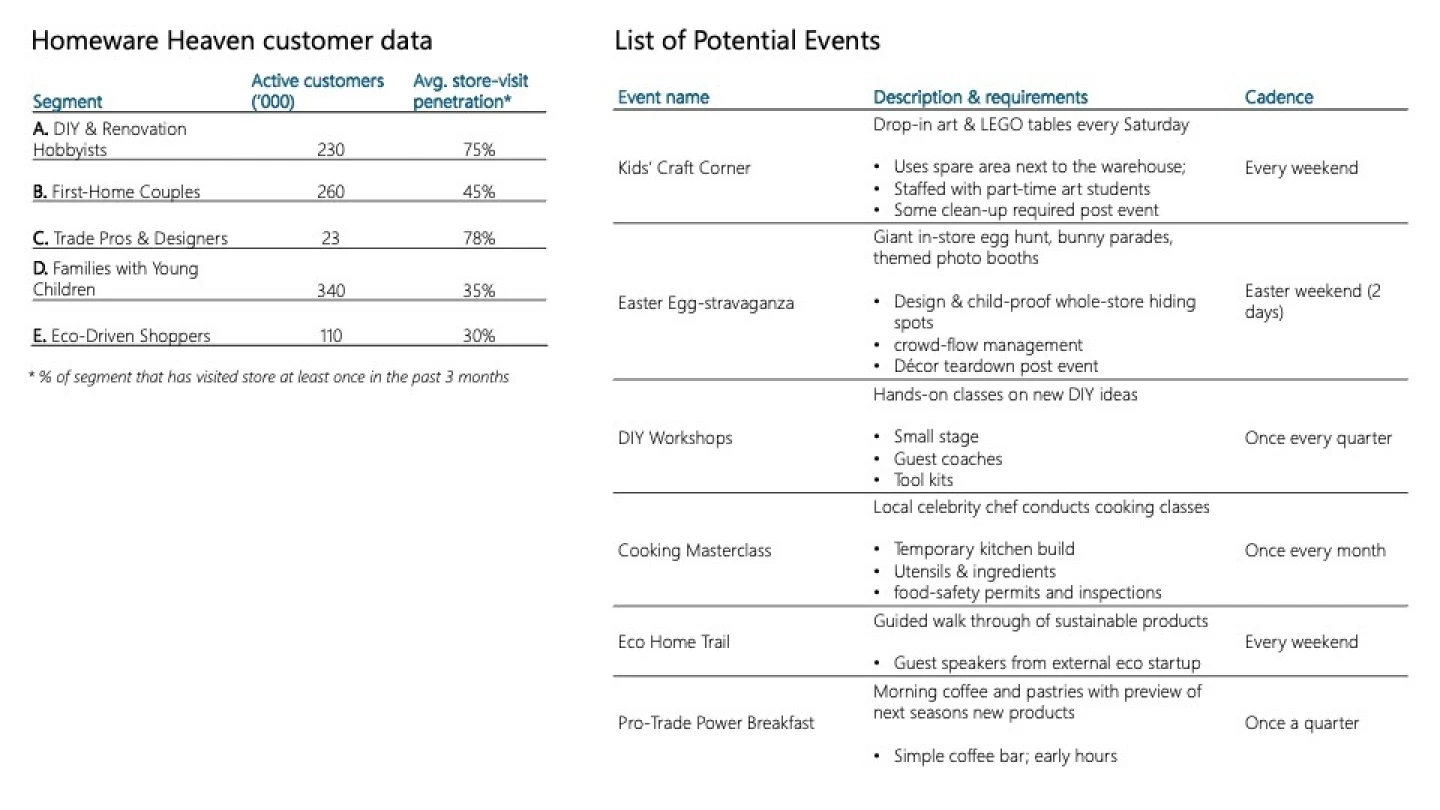
Show Exhibit 1
The suggested most efficient way of thinking through these tables is as follows:
Figure out the most attractive segment based on size and penetration rate
- The most attractive segment is Segment D: Families with Young Children
- This segment has the largest customer base (340K) and low store visit penetration (35%). This means that 221K customers in this segment have not visited the store in the last 3 months
- The next most attractive segment would be Segment B: First Home Couples
- 2nd largest customer base (260K) and still relatively under penetrated (45%). 143K customers in this segment have not visited the store in the last 3 months
- The rest of the segments are less attractive
- Segment A DIY & Renovation Hobbyists -> large segment size but already highly penetrated
- Segment C Trade Pros & Designers -> very small, not worth focusing on
- Segment E Eco Driven Shoppers -> low penetration but size of segment is 2nd smallest
Identify events in the List of Potential Events that are relevant for the most attractive customer segments
- Events that are potentially relevant for Segment D
- Kid's Craft Corner -> most directly relevant
- Easter Egg-stravaganza -> most directly relevant
- Cooking Masterclass
- Events that are potentially relevant for Segment B
- Cooking Masterclass
- DIY Workshops
Compare relevant potential events and shortlist the most attractive one
- Kid's Craft Corner seems to be the most attractive for Segment D
- Requirements are less operationally complex versus Easter event
- Eastern event requires planning and adjusting the whole-store to make sure the hiding spots are safe for kids and there are no risk of safety issues as kids are running around the location
- Crowd-flow management signals additional complexity of footfall and additional manpower
- Recurring event encourages higher frequency and time in store vs Easter event and Cooking Masterclass
- Requirements are less operationally complex versus Easter event
A strong candidate will also note that this information presented is still relatively qualitative and is just a hypothesis, and further analysis and information would be needed to have a better answer on which is the best event, e.g.
- Average purchase value for each customer segment
- For each event, we need to understand the potential incremental sales and also costs to implement
If asked, clarify the following:
- First-Home Couples
- These are couples who have just purchased their first home. Assume that these couples do not yet have children
- Each customer refers to a unique 'couple', i.e. there are 260K unique couples
- Families with Young Children
- Each "Family" refers to a unique parent 'couple' and this number does not include children.
- i.e. there are 340K unique families (parents)
- Avg. store-visit penetration -> clarified already in the footnote under the table
This is a suggested solution, if the candidate proposes another reasoning and justifies it well and is reasonable you may accept it as well
Question 4: How much additional profit can Homeware Heaven expect from the following event schedule?
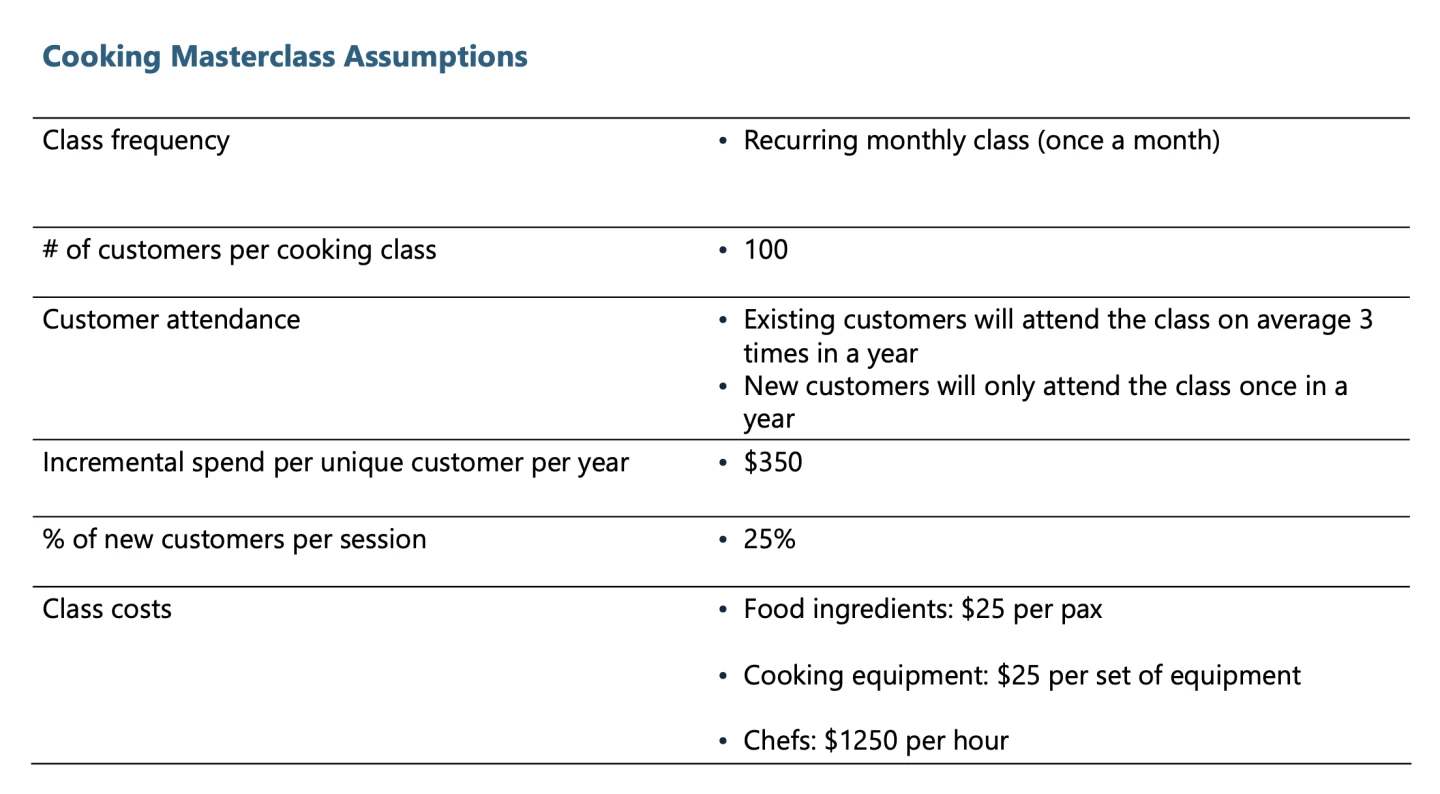
Our client decides to explore the option of the Cooking Masterclass as they believe it has potential with some tweaks. They share the following assumptions with you.
When asked, clarify that the client plans to launch this masterclass in all of their 100 stores. If the candidate does not ask this and goes ahead with the calculation, ask the candidate to check what 'base' he is calculating the revenue for.
A strong and sharp candidate is also going to realize that an average profit margin needs to be applied to the incremental revenue, since in effect the client incurs some cost to buy these goods. If the candidate only considers the revenue (from incremental spend) and the costs of the event, they are missing out the costs of the goods sold. If the interviewee does not realize this, give them a hint
Further clarifying information, if requested
- The incremental spend per unique customer refers to additional spending on goods / products in the store
- Assume the costs in the data table are all the costs that the client needs to incur for this event type
- You only need 1 chef per class/session
- Each session is 2 hours
- Cooking equipment can be reused for an entire year before it has to be changed
- Food ingredients - cost of $25 refers to ingredients needed per class/session
- Average Gross Profit Margin for our client is 43%. For the purposes of this exercise, we will only be looking at Gross Profit Margin
Total Additional Profit = Additional Profit from Incremental Spend - Additional Cost incurred (from event)
A good candidate will breakdown Additional Profit from Incremental Spend further, therefore the formula should look like:
Total Additional Profit = [Additional Revenue * average Gross Profit Margin] - Additional cost incurred (from event)
Note that the candidate may also choose to frame or calculate this formula differently in the following ways:
1. [Addition Profit from Incremental Spend] is calculated by subtracting the cost of goods sold - this is also perfectly acceptable, but direct them to calculate on GPM instead
2. Framing the Costs together, i.e. Total Cost = Cost of events + Cost of Goods Sold
Additional Revenue Per Year = [# of unique customers per year per store ] * [average incremental spend per unique customer per year] * [# of stores]
We have to realize that the 100 customers that are attending each class is a mix of customers who are already customers of Homeware Heaven (existing customers), and new customers who are attracted to come down to the store because of this class.
Because each existing customer attends the classes on average 3 times in a year, we cannot simply take 100 (# of customers per class) and multiply it by 12 months and say that there are 1200 unique customers per store per year. We have to disaggregate the 1200 and find out how many unique customers there are from NEW customers and from EXISTING customers.
Therefore:
# of NEW unique customers per year per store = 25% * 1200 = 300
# of EXISTING unique customers per year per store = [1200-300] / 3 = 300
# of unique customers per year per store = 300 (new) + 300 (old) = 600
Revenue per year per store = 600 * $350 = $210K
Total additional revenue per year for 100 stores = $210K * 100 = $21M
As a recap, Additional Profit from Incremental Spend = [Additional Revenue * average Gross Profit Margin]
$21M * 43% = ~$9M
Total cost per year = [Food cost per store] + [Equipment cost per store] + [Chef Cost per store] * [100 stores]
Food cost per store = $25 * 100 customers * 12 classes = $30K
Equipment cost per store = $25 * 100 customers = $2500
Chef cost per store = $1250 * 2 hours * 12 classes = $30K
Total cost per year = [$30K + $2.5K + $30K] * 100 = $6.25M
Total Additional Profit = Additional Profit from Incremental Spend - Additional Cost incurred (from event)
Total Additional Profit = $9M - $6.25M = $2.75M
A strong candidate may ask to refer back to the table (if they do not remember the details of it) and should note the implications of running this monthly instead of half annually. Initially the plan was to hold this class once every half a year. But given it is run monthly now, will the client have to setup and take down the temporary kitchen build each time? Probably better to find a dedicated space that they can run this smoothly every month.
Further implications would be to ensure that this monthly class does not have an impact on customer experience for other customers (e.g. cooking smells, smoke)
There is more than 1 way of structuring and solving this problem. E.g. candidates can also choose to calculate the profit per store and then multiply that by total # of stores.
As long as it is logical and gets to the correct final number it is fine.
Candidates that struggle here often struggle with the concept of unique customers. Because the incremental spend data is given on the basis of a unique customer, this means that we need to account for "repeat" attendances given existing customers will attend a class more than once in a year. If a candidate is struggling here, remind them to think about whether or not 100 customers per class/session means 100 unique customers.
In addition, as mentioned in the earlier note, candidates may often forget to consider the Cost of Goods Sold / Gross Profit Margin. They will only take the revenue and subtract the event costs, which will give a 'event level profitability' -> this is sometimes used in marketing to judge whether an activation or event makes sense, but for the purpose of this advanced case push the candidate to consider the need to account for the fact that the products that customers are spending more on also costs money to purchase in the first place.
Question 5: We are going to meet the client now. Can you summarize the findings for our client?
You have requested us to help turnaround Homeware Heaven's declining profitability. Through our analysis, we have identified that the store format is one of the key reasons contributing to the problem, namely because customers are less willing to travel outside the city area.
We have identified store events as a way of attracting customers back to the store and potentially increasing sales and profitability. Specifically, we recommend launching a weekly Kid's Craft Corner and Cooking Masterclass to attract the top 2 largest and most under-penetrated segments (Families with Young Children and First Home Couples) back to the store.
- Our initial analysis suggests that Cooking Masterclass can add an incremental $2.75M in profit annually if we roll it out successfully across all 100 stores
As a next step, we'd like to look into calculating the profit potential of the Kid's Craft Corner, as well as assess the implications and risks of launching these events on the store's operations and customer experience.
McKinsey Round 1: Homeware Heaven
i