
Your client is a Franchisee of a popular Steakhouse-chain in Germany. The Franchisee currently owns 2 Steakhouse-restaurants and wants you to investigate how well these perform and if there is any way for improvement?
Case Prompt:
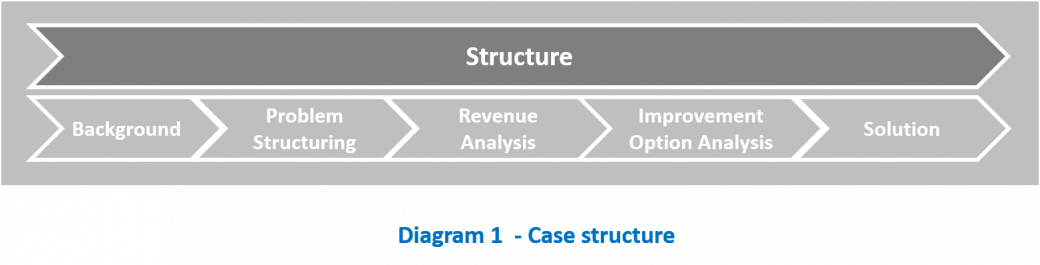
Sample Structure
Once the interviewee has clarified terms and the objective of the case and explained their structure you can share with them Diagram 1 assuming their structure is not the same as outlined in Diagram 1 to help the interviewee start off correctly.
Information to be revealed to the interviewee upon request:
- The client objective is to maximize the combined annual revenue of the 2 restaurants.
- The restaurants are located in Düsseldorf (Dus) and Hamburg (Ham).
- The annual revenue for the restaurant in Dus is 10.752m€.
- The annual revenue for the restaurant in Ham is 16.128m€.
- Dus has a population of 600k.
- Ham has a population of 1.8m.
- A franchisee is someone who has purchased the rights from a franchisor to a particular franchise.
II. Revenue Analysis
You should ask the candidate to break down the revenue for a typical steakhouse by describing it with an equation like this:
Daily Revenue = Number of Customers per Day x Average Spending per Customer.
Number of Customers per Day = Average Occupancy x #Seats x (Opening hours) / (Average Mealtime per Customer).
=> Daily Revenue = Average Occupancy x #Seats x (Opening Hours) / (Average Mealtime per Customer) x Average Spending per Customer.
If the candidate struggles to come up with the full equation you can provide some hints and guidance.
You can now provide information to each of the factors in the equation upon request:
- For Dus:
- #Seats = 50.
- Opening hours = 12h.
- Av. mealtime per customer = 30min.
- Av. spending per customer = 35€.
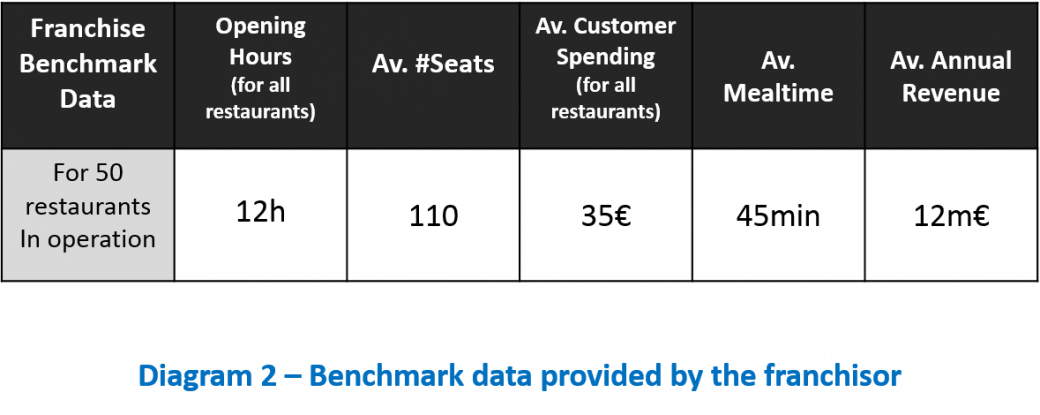
Do not give the candidate the data for both restaurants straight away. Wait for the candidate to decide which restaurant they want to get data on first and reveal only that. Then point out that you have average data for all franchisees as a benchmark in Diagram 2.
Share Diagram 2 with the interviewee.
Now you can share with the interviewee the data on Ham verbally if they asked for Dus data first:
- For Ham:
- #Seats = 150.
- Opening hours = 12h.
- Av. mealtime per customer = 1h.
- Av. spending per customer = 35€.
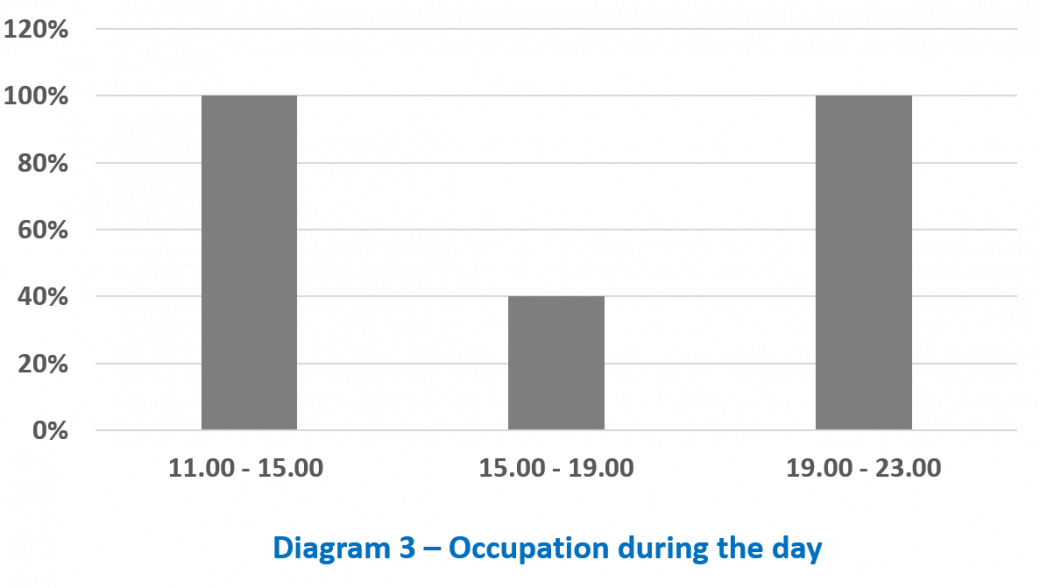
To help the interviewee calculate the average occupancy for Ham and Dus you can now reveal Diagram 3. Ask the interviewee to come up with a reasonable hypothesis for the underlying reason for the fluctuation in the occupancy. The answer is that during lunch and dinner time occupancy is highest and in between it is lowest.
1) Ask the interviewee to summarize what they learned from Diagrams 2 and 3 and to indicate which factors for each restaurant could be improved based on a comparison between the restaurants and the franchise average.
2) Ask the interviewee if there are any factors amongst the 5 factors that influence revenue that cannot be influenced by the client and why that might be the case.
3) Ask the interviewee to list all improvement options they consider worth investigating. The interviewee should come up with only the 2 listed above based on the data provided so far.
Insights for Diagram 2 and 3 as well as the data on Dus and Ham:
- Dus has a lower than average #Seats which lowers its relative revenue.
- Dus has a lower than average mealtime per customer which increases its relative revenue compared to the average revenue.
- The revenue of Dus is close to the franchise average.
=> Increasing the number of seats to the franchise average might increase revenue if enough demand exists to fill those seats.
- Ham has a higher than average #seats which increases its relative revenue.
- Ham has a higher than average mealtime per customer which lowers its relative revenue compared to the average revenue.
- The revenue of Ham is above to the franchise average.
=> Decreasing the average mealtime per customer to the franchise average might increase revenue if enough demand exists to fill those seats at a higher rate.
1) The first part of the client objective was to determine how well both restaurants perform. We can conclude that the restaurant in Dus has an annual revenue very close to the franchise average which means its performance is average. Ham has an annual revenue above the franchise average, so it performs above average. We will now need to investigate if the performance of either of those restaurants can be improved.
2) Looking back at the 5 factors that determine revenue: occupancy, #seats, opening hours, mealtime and customer spending which were listed on Diagram 2 we can see that opening hours and customer spending is fixed for all restaurants of the franchise. Opening hours are dictated by the franchisor so this factor cannot be changed to improve revenue performance. The average spending per customer can also not be changed as pricing policy as well as any marketing decisions are made by the franchisor so the only factors a franchisee can influence are #seats of the location they chose for their restaurant and the average mealtime per customer.
This narrows our optimization considerations down significantly:
For Dus, we could potentially improve #seats as it is below the industry average. Improving the average mealtime seems unlikely though as we are significantly below the average already. Dus has, in fact, the lowest mealtime of all restaurants within the franchise.
For Ham, we could potentially improve the average mealtime as it is above the industry average and improving the #seats seems unlikely as we are significantly above the average already.
Now that we have isolated our options we need to investigate which of these options are viable or not:
III. Improvement Option Analysis: Improving the Revenue of Dus
Ask the interviewee to structure the approach they would use to identify if any of the 2 proposed improvement options are viable. Ask them to investigate the improvement option for Dus first and then continue with the option for Ham.
To help the interviewee determine if the option for Dus is viable you may reveal the following information upon request:
For factor 1, Enough Demand:
- During the peak times (lunch and dinner), the occupancy is at 100 % and there is a queue of on average 15 customers waiting for a seat.
- During the off-peak time, the occupancy is 40 % so additional seats will not help bring in more customers. (This should be straightforward).
Ask the interviewee to interpret this information. The interpretation should be similar to the paragraph below in the solution.
For factor 2, Increasing #Seats is Possible:
- The seating plan for the building is very efficient, no more seats and tables can be fit in without impeding the quality of the service.
- The building is under monumental protection so increasing space through renovations or changes to the exterior of the building is impossible to get a permit for.
- The patio/terrace immediately outside the restaurant is also maxed out with seats within the legal borders of the property so increasing #seats outside the restaurant is impossible too. (Even if it was possible it would only be a seasonal increase for the #seats which is weather dependent and thus not very reliable).
- The restaurant is located at a public square so any area outside the borders of the property is public property that cannot be bought.
The best option is to increase the #seats factor. We can see if this will generate more revenue by considering 2 factors:
- Is there enough demand to fill the additional seats without losing average occupancy?
- Is it possible to increase the number of seats given the infrastructure of the restaurant?
In other words, we are trying to determine if doing it will actually help and if we are even able to do it in the first place. Both must be true for this option to be viable!
=> Increasing the #seats will allow us to serve more customers during peak times which will increase the total number of customers served daily. During off-peak times the occupancy will be slightly less as additional seats without additional customers decrease the occupancy. However, this effect of lowered occupancy only affects a short part of the total opening hours so the decrease in average occupancy will be offset by a larger increase in the #seats causing a net increase in customers served per day. If we increase #seats by 15 to serve the customers that would be queuing during peak times we can maintain 100% occupancy during peak times.
=> Even though increasing the #seats during peak times will increase the revenue of the restaurant it is impossible to increase the number of seats for 3 reasons:
- The current seating plan is already at its maximum #seats. You cannot fit more seats into the building.
- The building is under monumental protection, so you cannot make it bigger to fit more seats.
- Even the exterior of the restaurant is maxed out with seats.
So the #seats cannot be increased therefore the performance of the restaurant in Dus is already maximized and cannot be improved further by the client.
III. Improvement Option Analysis: Improving the revenue of Ham
To help the interviewee determine if the option for Dus is viable you may reveal the following information upon request:
For factor 1, Enough Demand:
- During the peak times (lunch and dinner), the occupancy is at 100 % and there is a queue of on average 30 customers waiting for a seat.
- During the off-peak time, the occupancy is 40 % so a shorter mealtime per customer will not help bring in more customers. (This should be straightforward).
Ask the interviewee to interpret this information. The interpretation should be similar to the paragraph in the solution.
Factor 2: Why is the mealtime of Ham so slow? For this you may tell the interviewee the following upon request:
- The waiters of Ham are as good and fast as in the rest of the franchise.
- The guests of Ham are comparable to the guest at all other locations the franchise operates in.
- Drinks are prepared by waiters in this franchise so there is no bar that could operate slowly.
- The difference between Ham and the rest of the franchise is the way the kitchen operates. Orders are filled in the order they come in. In the Dus restaurant, which has the lowest mealtimes in the franchise, orders are grouped by their preparation times and distributed to individual chefs who work only on either starters, main courses, or desert/salads to maximize efficiency and minimize the waiting time for customers until they are served their food.
- The chefs are equally skilled in Dus and Ham. The way they work through orders is the only difference between the kitchen teams.
- The ordering system used by the Dus restaurant can be adopted in the Ham restaurant at negligible cost and the chefs in Ham can be grouped to focus only on one kind of dish to match what the chefs in Dus are doing without any training cost etc.
- Adopting the kitchen system in Ham is estimated to decrease average mealtimes down to 36min which is a reduction of 40 %. That is because the Ham kitchen is 3 times as big and has 3 times as many chefs as the Dus kitchen. That is because the Ham restaurant has 150 seats and the Dus restaurant only has 50 seats.
A good interviewee will identify that the service can only be slow for one of three reasons:
- The waiters are slow.
- The guests are slow.
- The kitchen is slow.
The information above is sufficient to identify that the issue lies with the kitchen alone and what exactly is going wrong there. If the interviewee struggles to structure this part of the case ask them to think about what people are involved in the service to get them started.
The best option is to decrease the average mealtime per customer. We can see if this will generate more revenue by considering 2 factors:
- Is there enough demand to fill the seats at a higher rate if we can serve customers faster from beginning to end without losing average occupancy?
- Why is our mealtime so slow in comparison to the franchise average? Once we identify the root cause can we do something to fix it?
In other words, we are again trying to determine if doing it will actually help serve more customers and if we are even able to do it in the first place. Both must be true for this option to be viable!
=> Decreasing the average mealtime will allow us to serve more customers during peak times which will increase the total number of customers served daily. During off-peak times the occupancy will be slightly less as the same number of customers will be served in a shorter time interval which decreases the occupancy, however, this effect of lowered occupancy only affects a short part of the total opening hours so the decrease in average occupancy will be offset by a net increase in customers served during peak times per day. If we decrease the average mealtime per customer by 1/6 which is roughly 17 % we can serve 20% more customers.
=> Decreasing the mealtime by 17% will allow the restaurant in Ham to serve an additional 30 customers per hour during peak times so 240 additional customers per day (8h peak time x 30 additional customers per hour = 240 additional daily customers). This would generate additional daily revenue of 8400€ (240 additional daily customers x 35€ av. spending per customer = 8400€ additional daily revenue) and would thus result in annual additional revenue of 2.016m€ (8400€ additional daily revenue x 320 days of operation per year = 2.016m€ additional annual revenue) which would be an increase of 12.5% of the current annual revenue so by decreasing the average mealtime per customer the performance of the restaurant in Ham can be improved.
Next, we need to see if we can realize a 17% reduction of the mealtime in Ham so we will now move on to factor 2 to test that and find a way to achieve that reduction if there is one.
=> The reason for the slower than average service speed is the kitchen of the Ham restaurant. The restaurant does not split up the workload between chefs who only focus on making a single type of dish. Instead, every chef makes every dish simply in the order the orders come in which is very inefficient. The kitchen system of Dus can be copied for the Ham kitchen without any cost or training necessary to immediately decrease the average mealtime per customer by 40% which is more than enough to prevent queues from forming during peak times and increase annual revenue by 12.5 %.
IV. Solution / Conclusion
The Dus restaurant is working at maximum efficiency and its performance cannot be improved by the client. The annual revenue performance of the Ham restaurant can be improved by 12.5 % if the kitchen team of Ham copies the way the Dus team handles orders. The following 3 reasons support this conclusion:
1) The performance of the Dus restaurant can only be improved by increasing the #seats available as it is already the restaurant with the fastest service in this franchise. Increasing #seats is impossible due to the fact that the location the restaurant is at is under monumental protection.
2) The current kitchen service of the Ham restaurant is very inefficient. Adopting the same approach to handling orders as the Dus kitchen team will allow a mealtime reduction per customer of 24min which will result in a 20% increase in the number of customers being served per hour during peak times which in turn increases annual revenue performance by 12.5%.
3) As the kitchen teams of Dus and Ham are comparable in terms of skill no retraining is necessary to decrease the mealtime for customers of the Ham restaurant. The change can be implemented easily, immediately, and cheaply.
VI. Next steps
To find additional ways to raise the revenue of both restaurants further than the 12.5% for Ham only we could take a step back from the revenue analysis and look at the restaurants more holistically by considering 2 points:
1) Can we provide any service or entertainment for customers in the queues to prevent them from choosing another restaurant if the queue gets too long such as for example a drink on the house for every 15min spent waiting in the queue etc? This way we might be able to retain more customers and thus increase revenue. For this, we need to see how many customers leave the queue before being seated on average and if there is a way to retain those.
2) Are we located at the best possible locations for restaurants in Ham and Dus? If not, can we improve the demand and the #seats by reopening the restaurants at better locations within those cities? Maybe a relocation of the restaurants can improve performance more than any improvements we could do to the restaurants at their current locations.
Further Questions
- Think about the inflow of customers to a restaurant and how that is influenced by the length of a queue given a fixed outflow. What will it look like as a function of time? The inflow rate will oscillate sinusoidally. So will the queue length. The inflow rate will oscillate about the fixed outflow rate while the queue length will oscillate about the average queue length. (Bonus question for the maths-savvy: will the queue length oscillation be in phase or out of phase with the inflow rate oscillations?) Try answering all these questions without using calculus but only using logic and common-sense assumptions.
- If you have skipped the calculation of why the mealtime for Ham needs to be reduced by 1/6 try to do it now to practice approximating tough problems with simple solutions.
- Think about the inflow of customers to a restaurant and how that is influenced by the length of a queue given a fixed outflow. What will it look like as a function of time? The inflow rate will oscillate sinusoidally. So will the queue length. The inflow rate will oscillate about the fixed outflow rate while the queue length will oscillate about the average queue length. (Bonus question for the maths-savvy: will the queue length oscillation be in phase or out of phase with the inflow rate oscillations?) Try answering all these questions without using calculus but only using logic and common-sense assumptions.
- If you have skipped the calculation of why the mealtime for Ham needs to be reduced by 1/6 try to do it now to practice approximating tough problems with simple solutions.
Make Steakhouse Great Again!
i