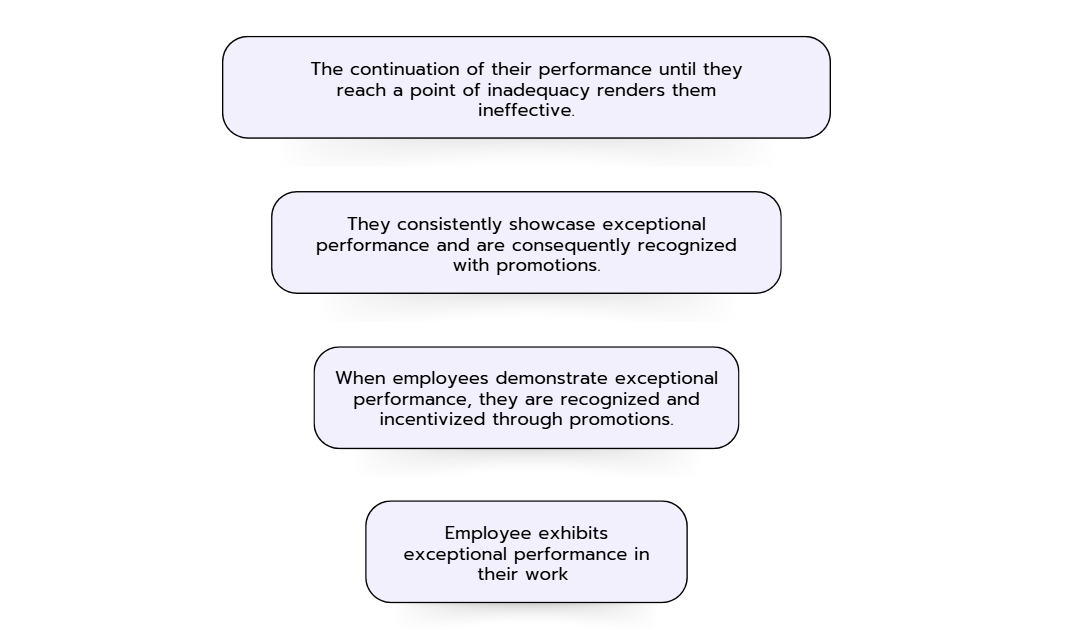
In today's business world, competition is tougher than ever. Companies are looking for ways to differentiate themselves from the competition and succeed. In this quest for success, however, there is a phenomenon that can affect the performance and effectiveness of organizations - the Peter Principle. This principle, formulated by Laurence J. Peter, states that employees in hierarchies tend to rise to their level of incompetence. This article explores the Peter Principle in more detail and explains how it can impact the management consulting industry.
The Outline of the Peter Principle
The Peter Principle was first introduced in 1969 by Laurence J. Peter and Raymond Hull in their book, The Peter Principle. It describes a phenomenon in which employees are promoted in a hierarchy based on their past performance until they reach a position in which they are no longer successful and are often even overworked. In other words, people are rewarded based on their competence, but their promotions occur beyond the limits of their actual abilities. The result is an organization in which many employees are working at a level for which they are unsuited.
Peter Principle in Management Consulting
The management consulting industry is known for its challenging projects and the need to solve complex problems. To be successful, you need a high level of expertise, analytical skills, and strategic thinking. The Peter Principle can have an impact here as well.
Consultants are often promoted based on their past successes. An employee who has done an excellent job in one area may be promoted to team leader or even management. But this promotion does not automatically mean that he or she has the necessary skills and knowledge for the new position. Being confronted with new tasks that are outside the previous area of expertise, such as managing a team, acquiring new customers or business development, can mean unexpected challenges and excessive demands. As a result, the performance of the entire team can be affected if the leader does not have sufficient knowledge or skills.
It is important to note that the Peter Principle does not mean that all promoted employees are incompetent. Rather, it means that their previous skills and competencies are not necessarily transferable to the new tasks. A first-class consultant does not necessarily have to be successful at management level. The skills that made someone successful in their original field are not necessarily the same skills that will make them successful in a management position.
Avoiding the Pitfalls of the Peter Principle
To minimize the negative effects of the Peter Principle in management consulting, there are some proven strategies that companies can use.
Promotions should not be based solely on past performance but should also take into account skills and suitability for the new tasks. It is important that employees* be evaluated for their leadership skills and potential before they are promoted to a position of greater responsibility.
Companies should implement leadership development programs to ensure that employees who advance to higher positions acquire the necessary skills and knowledge. Training in team management, communication, and strategic thinking can help bridge the gap between previous skills and the requirements of the new position.
To avoid overwhelming yourself and creating a stressful situation, it's especially important to address a few things ahead of time in a promotion process. Here, you should ask yourself to what extent the new tasks seem familiar to you and also solvable, or which skills you should still acquire in the process or even in advance of the promotion. Particularly in the case of internal promotions, job descriptions are often not very specific. A conversation with colleagues who are already on the next promotion level can bring clarity. Looking for programs or further training can also be a useful preparation for a relaxed transition to the new position.
Significance for Companies and Employees
The Peter Principle, which states that people tend to advance to their level of incompetence, also has implications for the management consulting industry. Promotions based on past performance alone can lead to employees being placed in positions for which they are unsuited. All stakeholders should therefore carefully consider whether the necessary skills and aptitudes for new roles are already in place.
Implementing leadership development programs and addressing leadership skills can minimize the negative effects of the Peter Principle. Only in this way can companies ensure that their employees are able to successfully complete their tasks. Self-confident and relaxed employees not only contribute to the long-term success of the company, but also to a good working atmosphere.
Let's Move On With the Next Articles:
Emotional Intelligence
Common Terms of Business
Emotional intelligence means being aware of, understanding, and managing your own emotions – while also accurately interpreting the emotions of others and responding appropriately. It helps you handle stressful situations, strengthen relationships, and communicate more effectively. Especially in consulting, where you work closely with clients and teams, it can be a real advantage. 💡🌟
Information Technology Infrastructure Library (ITIL)
Common Terms of Business
The Information Technology Infrastructure Library (ITIL) is a globally recognized set of best practices designed to support the delivery of high-quality information technology (IT) services. Developed during the 1980s by the United Kingdom's Central Computer and Telecommunications Agency (CCTA), ITIL was born out of the recognition that organizations increasingly relied on IT, yet there was a lack of established practices to maximize IT's effectiveness.
The CCTA, tasked with developing methods for more efficient and cost-effective use of IT resources, initially launched ITIL as a series of books, each one covering a specific practice within IT service management. Over time, the library expanded and was updated to keep pace with the fast-evolving world of IT, eventually becoming a comprehensive framework that outlines a set of detailed, interlinked processes for managing all aspects of IT infrastructure, development, and operations.
The first version of ITIL, known as ITIL V1, was published in the late 1980s and early 1990s. It was followed by ITIL V2 in 2000, which brought a more process-oriented approach. In 2007, ITIL V3 introduced the service lifecycle concept. The most recent version, ITIL 4, released in 2019, expanded to include practices that align with modern digital businesses, including Agile, DevOps, and Lean.
Today, ITIL is owned by AXELOS. It continues to provide a robust and adaptable framework for managing IT services, enabling organizations to navigate the complexities of the digital age worldwide. Its enduring success attests to its effectiveness in enhancing IT service management across various industries worldwide.
Synonyms: While ITIL is the most recognized term for this framework, it is also occasionally referred to as "IT Service Management" or "ITSM."
DevOps is an innovative software development strategy conceived around 2008. This paradigm arose from the need for more effective collaboration between project managers, developers, and operations staff to align with business objectives more efficiently. The term itself is a portmanteau of 'development' and 'operations.'
The primary aim of DevOps is to enhance the speed, efficiency, and quality of software delivery. It achieves this by integrating traditionally siloed departments — development and operations — fostering a collaborative work environment instead of working in isolation. This synergistic approach propels faster and more efficient product release cycles, thereby reducing the time-to-market.
One of the distinct features of DevOps is that it promotes shorter, controllable iterations of software development and delivery. This is possible through a shift in the organizational mindset, enhancement of practices and procedures, and an extensive emphasis on automation and technology. The continuous feedback loop in the DevOps model allows for the early detection and rectification of errors, ensuring a high standard of quality in the final product.
In the modern technical environment, the presence of a dedicated DevOps team is becoming increasingly crucial. With rapid advancements in technology and dynamic market demands, businesses are under immense pressure to deliver high-quality products quickly. A dedicated DevOps team can ensure streamlined communication and collaboration, quick problem-solving, and efficient product delivery, aligning with the market pace and customer expectations.
Synonyms: DevSecOps (when security practices are integrated), BizDevOps (when business stakeholders are heavily involved)