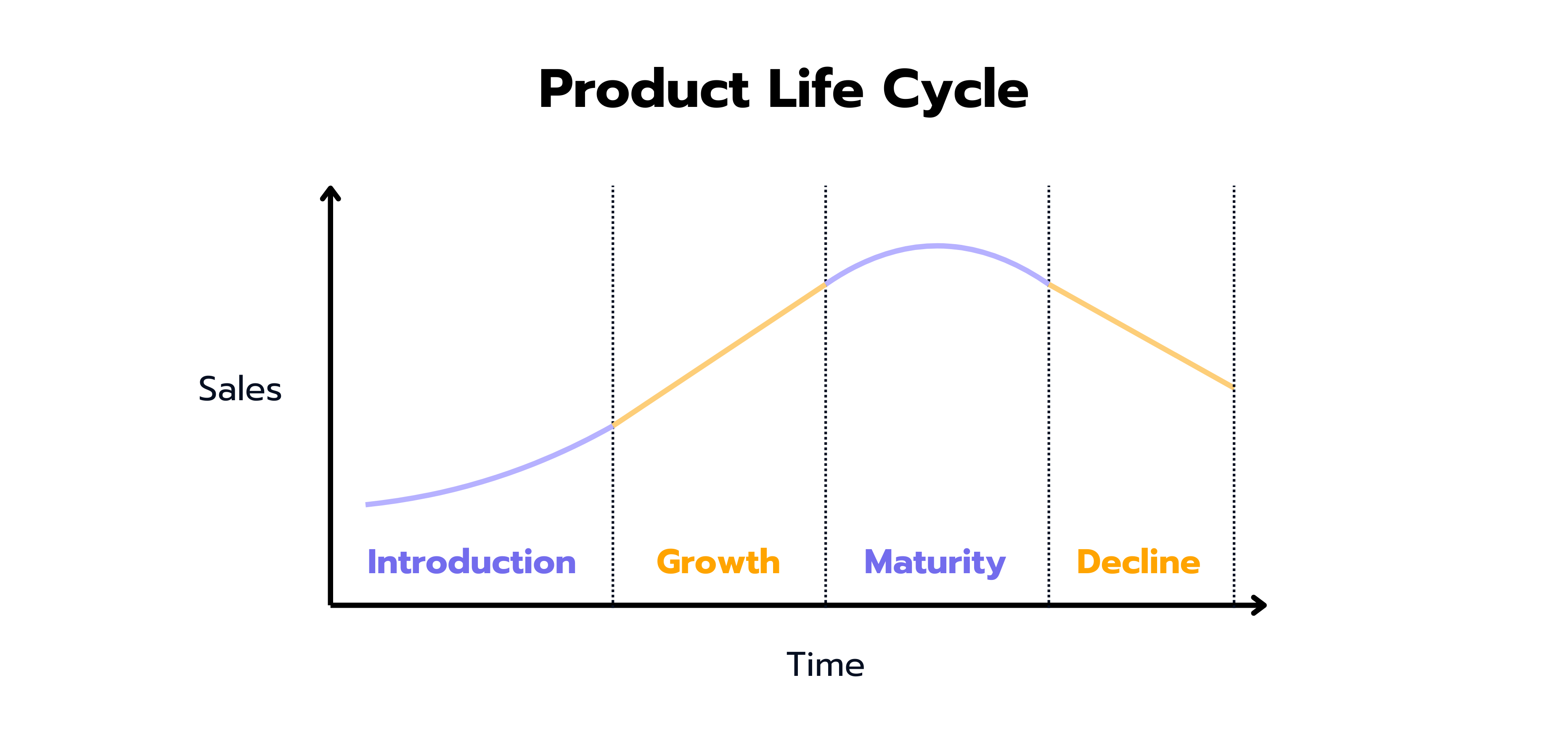
The product life cycle is a way to map the common stages a product undergoes throughout its lifespan. The product life cycle is typically divided into 5 different stages, each having specific strategic decisions affecting profits and revenues.
(1) Development: In the development phase, the product has just been finished and the most important facts and figures have been determined. As no profits are made here, this phase is not shown in the curve diagram.
(2) Introduction: In the first phase, the product is introduced. Normally, at this stage, there are a few competitors and customers. Therefore, sales and profit are low and the risk that the product will not succeed is high. In order to boost sales, the focus lies heavily on promotion activities.
(3) Growth: Products that succeed in addressing customer’s needs will lead to an increase in sales. Advertisement is still a key component to promote further growth.
(4) Maturity: At this stage, the product can be seen as well established and widely accepted within the targeted customer group. Profits are high and risks are low. Typically, in this phase, competition increases. To keep the market position and expand this phase, companies often employ strategies such as the introduction of complementary or updated products or simply invest in marketing activities.
(5) Decline: At this point, the product may not fulfill the current needs of the customers, and sales start to decline. The important decision at this stage is deciding when to take the product off market, such that the client optimizes financial gains and minimizes losses due to time and investment.
Meaning of the Product-Life-Cycle in Case Interviews
The product life cycle is a key concept in case interviews, especially when dealing with market entry, competitive strategy, or growth opportunities. Candidates should be familiar with the different stages and be able to derive strategic decisions accordingly.
A common case question might be:"A company is planning to launch a new product. What factors should be analyzed to maximize success in the introduction phase?" A structured approach should consider aspects such as market demand, competitive landscape, pricing strategy, and marketing efforts. Similarly, cases related to the maturity or decline phase could focus on whether a product should be further developed or phased out.
Solve Cases to Topics Like Market Entry or New Product
DHL aims to create a new E-Commerce business model that combines:
- A DHL-owned online marketplace.
- Participation limited to local retailers.
- Same-day parcel delivery services by DHL.
The strategic goal is to strengthen the stationary retail sector as an important customer group. The DHL Consulting team is tasked by the DHL Business Unit "Post & Parcel Germany" (P&P) with identifying a suitable German city for a pilot project and estimating the potential revenue in that city.
Mercedes‑AMG stands for uncompromising performance, engineering excellence, and emotional driving experiences. Yet recently, AMG’s top management has become concerned that while the product itself continues to exceed customer expectations, the moment of purchase no longer does.
The trigger for this case was a concrete incident: a highly affluent customer configured an AMG top‑end vehicle in detail, was technically convinced, but ultimately decided against the purchase, stating: “It’s a fantastic car – but it didn’t feel special.” For the CEO of Mercedes‑AMG, this statement raises a critical question. In the luxury and performance segment, emotional differentiation at the point of decision is as important as horsepower or technology.
Against this backdrop, AMG is exploring new ways to elevate the buying experience for its most valuable customers. One idea under discussion is the introduction of AMG Individualization Hubs – exclusive physical spaces where customers would finalize their vehicle together with AMG experts in a highly personalized and immersive setting.
The management now asks you and your Consulting Team to assess this idea holistically:
How can AMG strengthen emotional differentiation during the purchase decision, and do Individualization Hubs represent a strategically sound and economically viable solution? The objective is to develop a clear recommendation that balances brand impact, customer experience, and profitability.
Our client is Sierra Springs, a top 3 spring water producer in the U.S. The company owns the entire bottled-water production supply chain, including water sourcing, production of water-based products, bottling and packaging and distribution to retail outlets. Sierra Springs also leads its own brand design, marketing and sales efforts.
Sierra Springs has several brands across still and sparkling water drinks, 3 large bottling plants throughout the country and distribution agreements with most major retailers.
Sierra Springs is evaluating the launch of a new product, a flavored sparkling bottled water called Berry Fizz. The company’s Chief Marketing Office has asked us to help analyze the major factors surrounding the launch of Berry Fizz and its own internal capabilities to support the effort.
The product life cycle describes the 5 phases a product goes through.
These phases can be divided into Development, Introduction, Growth, Maturity, and Decline.
Each phase has an impact on profit, sales, and the company’s strategic decisions.
Let's Move On With the Next Articles:
Benchmarking
Useful Business Analysis Tools
Benchmarking, as a strategic process, involves organizations analyzing their performance, products, services, or processes in comparison to those of industry leaders. This process, serving as a mirror, allows organizations to recognize their position in the competitive landscape. It plays a vital role in defining performance standards and identifying areas of improvement, thereby offering avenues to emulate best practices and enhance overall performance.
The execution of benchmarking, requires the utilization of certain tools that allow for systematic data collection, analysis, and interpretation. The methodical approach empowers organizations to close performance gaps, implement industry-leading practices, and strive for superior performance, positioning themselves favorably in their industry.
Synonyms: Performance Comparison, Competitive Analysis, Peer Comparison
A core competency is a skill or a capability of a company that delivers the highest value for the customer compared to its other activities. The concept is related to value chain, as core competencies are a sub-category of the primary activities, depicting the most crucial processes. In addition, a process is considered a core competency if the activity delivers higher value compared to processes of the same category from its competitors.
A core competency usually features the following three characteristics:
- Challenging to be replicated by competitors because it is a result of an extensive learning period.
- Delivers unique value to the customers.
- Can be applied to the majority of products and markets of the company.
Use the Strategic Advantages of Core Competencies to Set Up a Strategy
Core competencies are an opposite approach to Porter’s five forces, which focus on the external environment as a key factor, which drives decisions. The core competency concept uses companies’ internal capabilities as drivers for strategic choices.
Knowing the core competencies of a company in a case interview will help you to understand:
- Where to focus in terms of introducing and developing new products, one dimension of the Ansoff Matrix.
- What processes to outsource.
- How to build a competitive edge in terms of cost or quality.
- How to create new markets or enter emerging high growth markets
Apple’s Approach (Example)
Apple's core competencies:
- Design: Life-style design
- Technology: Product differentiation through innovation
- Marketing:
- Viral marketing
- Superior brand with matching price and placement
- Secrecy about new products
Apple's focus on areas where it can deliver the best value has resulted in a set of very loyal customers, and it is unlikely to convince Apple customers to switch to a competitor's product.
Hence, it is crucial for a company to have a core competency and leverage this strength to be successful.
The 5 Cs of the credit framework are used to estimate the potential risk of a credit to a certain borrower. The 5 Cs of credit concept does not have to be applied very often in consulting interviews in its pure-play form. Even if it is not one of the "must-have" skills, it is still worth looking at this concept. Especially if you are from a finance background or if you're applying at a consultancy with a strong financial services focus.
We will now go over these 5 factors in more detail – while you probably won’t need to learn all the factors by heart, knowing just the names of the 5 factors is probably the 80/20 way to go here.
[Visual representation of the 5 Cs of Credit: Character, Capacity, Capital, Collateral, and Conditions]