







Topic Overview
Topic Overview
Back to overview

Situational Leadership

In the dynamic world of leadership and management, one concept has consistently proven its effectiveness - Situational Leadership. This adaptable approach has gained widespread recognition for its capacity to address the diverse challenges that arise in different scenarios. Whether in corporate boardrooms or educational settings, Situational Leadership provides leaders with a powerful framework to guide their teams toward success.


Understanding Situational Leadership

Situational Leadership, developed by Paul Hersey and Ken Blanchard in the late 1960s, is a leadership theory that underscores the importance of flexibility in leadership styles. At its core, Situational Leadership acknowledges that a one-size-fits-all approach to leadership is inadequate. Instead, effective leaders must adapt their approach to suit the unique needs of their team members and the circumstances they face.

The foundation of Situational Leadership rests on the belief that there is no universally optimal leadership style. Rather, leaders should assess their team member's readiness and competence and tailor their leadership style accordingly.

This adaptability is achieved by combining two crucial dimensions:

  • task behavior (which involves directing and guiding)
  • relationship behavior (focused on supporting and nurturing)

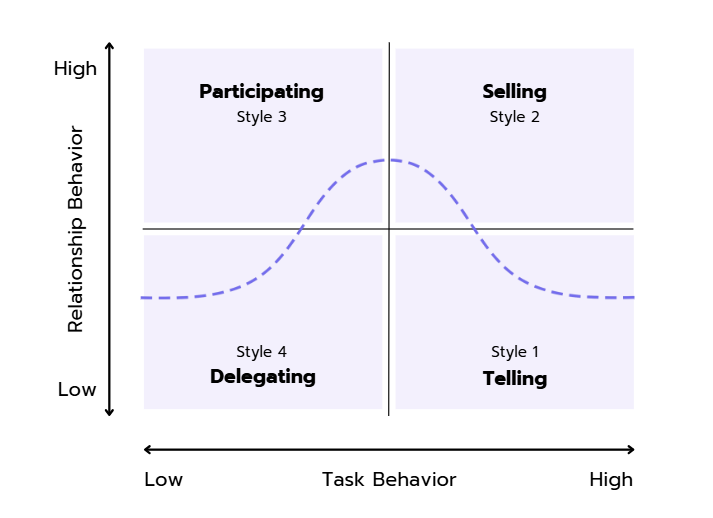
These dimensions give rise to four distinct leadership styles:

Diagram of the Situational Leadership Model showing four styles: Telling, Selling, Participating, and Delegating based on task and relationship behavior.
  1. Telling: 
    In this style, leaders offer explicit instructions and closely supervise their team members, especially when they are inexperienced or lack the required skills.
  2. Selling: 
    When team members possess some competence but lack confidence or motivation, leaders adopt a selling style. They not only provide guidance but also seek to persuade and motivate their team.
  3. Participating: 
    As team members become more competent and confident, leaders can transition into a participating style. Here, leaders encourage collaboration and decision-making within the team, offering support as needed.
  4. Delegating: 
    When team members are highly competent and motivated, leaders can delegate most responsibilities and focus on a supportive role (e.g. Servant Leadership), allowing team members to take the lead.

Real-World Applications

Situational Leadership finds applications in various fields, spanning from business to education and healthcare. Let's explore how this adaptable approach can be beneficial in different contexts:

  1. Business Leadership: 
    In the corporate world, market conditions and employee skills often change rapidly in this VUCA-world. Situational Leadership allows leaders to adjust their management style to accommodate these fluctuations, ensuring teams remain productive and engaged.
  2. Education: 
    Educators employing Situational Leadership can cater to the diverse learning needs of their students. They can switch between instructive teaching for beginners and facilitating independent learning for advanced students.
  3. Healthcare: 
    Healthcare professionals can use Situational Leadership to adapt their communication and decision-making styles when dealing with patients, depending on their health literacy and emotional state.
  4. Project Management: 
    Project managers can benefit from Situational Leadership by tailoring their approach to the project team's expertise and the complexity of the tasks involved.

The Future of Situational Leadership

In a world characterized by constant change and unpredictability, leadership cannot be a one-size-fits-all endeavor. Situational Leadership offers a valuable framework that empowers leaders to adapt their approach to the unique needs of their team members and the context in which they operate. By combining task behavior and relationship behavior in a flexible manner, leaders can inspire trust, maximize productivity, and foster the growth and development of their teams. As we continue to navigate the complexities of leadership in the 21st century, Situational Leadership remains a timeless, lean and indispensable tool for success.

Let's Move On With the Next Articles:

Theory of Constraints
Common Terms of Business
Theory of Constraints (TOC), also known as Bottleneck theory, was developed by Israeli physicist and entrepreneur Eliyahu M. Goldratt. This theory is a management approach that aims to improve organizational performance by focusing on identifying and eliminating bottlenecks. A bottleneck is a part of the production process or a resource that limits a company's production capacity and thus affects overall performance. Similar to a bottleneck that reduces the flow of a liquid, creating a bottleneck, certain factors in organizations create bottlenecks that can slow, limit or prevent operations.
To the article
Income Statement
Common Terms of Business
The income statement, also known as the profit and loss statement (P&L), provides a summary of a company's annual revenues, costs, and profits/losses. It is one of the three key financial documents, alongside the balance sheet and cash flow statement.The income statement records revenues and expenses at the time they are incurred (accrual accounting). For example, an invoice appears in a company's income statement on the day it is generated, regardless of when the payment is made. In contrast, in the cash flow statement, an expense is recorded only when the payment is actually made.Example:Suppose a company sells products worth €100,000 and receives a bill for material costs of €40,000. In the income statement, the revenue of €100,000 is recorded at the time of the sale, and the material costs of €40,000 appear simultaneously.
To the article
Herzbergs 2-Factor Theory
Common Terms of Business
The Herzberg 2-factor-theory, also known as the two-factor theory or motivation-hygiene theory, was developed in the 1950s by Frederick Herzberg. Herzberg was an American industrial scientist and psychologist who taught as a professor at various universities. His research interests focused on what makes people satisfied at work.His theory aims at explaining and influencing motivation and satisfaction at work. It postulates that there are two distinct groups of factors that influence job satisfaction and dissatisfaction, and they have different effects on employees.Herzberg's research findings are also more relevant than ever in today's work environment, especially in light of the shortage of skilled workers, burnout, and in the debate about a 4-day work week.
To the article