The Stacey Matrix is an important tool for navigating complexity in project management, developed by Ralph Douglas Stacey in the 1990s.
In this article, we’ll break down how the matrix works, explore different project types, and discuss its relevance in consulting and case interviews. Plus, we’ll dive into its strengths and limitations in project management. Let’s get started!
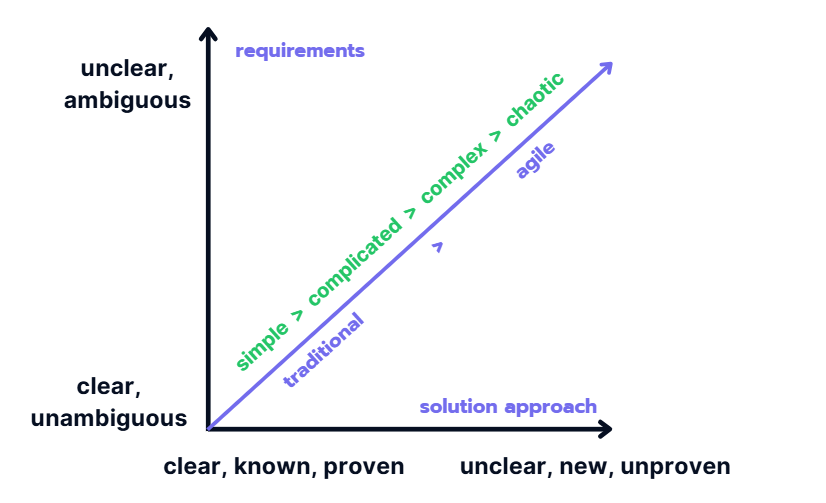
The Stacey Matrix is a tool for representing and managing complexity in projects. It helps teams navigate uncertainty and align on the most suitable approach for project execution. It consists of two axes: Requirements (y-axis) and Approach (x-axis). Requirements represent “what” needs to be developed, while the Approach represents the 'how'. It is commonly used in software development and IT consulting to determine the complexity of a project or task. 🚀
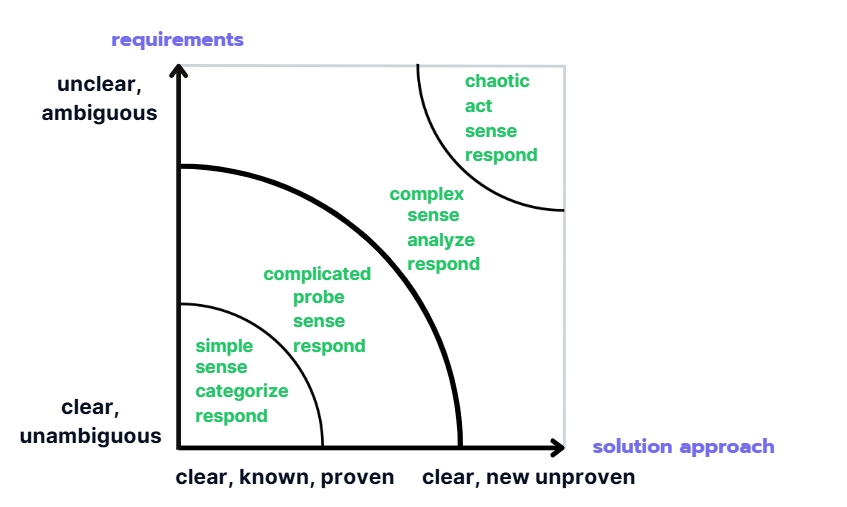
Within the axes, there are four areas:
Simple
Complicated
Complex
Chaotic
The character of a project is defined along its bisecting line. Closer proximity to the axes' intersection denotes simplicity, with clear goals and established approaches. Moving away leads to increasingly complex areas, culminating in ambiguity where goals and approaches are entirely unknown. In the IT sector, this scenario is commonly termed "agile," relying on agile frameworks for problem-solving.
The following diagram represents the Stacey Matrix, with the Y-axis indicating the clarity of requirements (from unclear to clear) and the X-axis representing the solution approach (from clear and proven to new and unproven). Projects are categorized into four types: simple, complicated, complex, and chaotic, based on the clarity of requirements and the approach to solutions.
Four Examples of Classification Into Individual Project Types
The structure of the Stacey Matrix becomes clearer when we illustrate the four areas of the individual project types using examples.
➡️ Simple Projects
A simple project is characterized by clearly defined requirementsand a known approach. For example, using a familiar technology to fulfill well-established requirements qualifies as a "simple" or "trivial" project, where the solution is straightforward. In such cases, the traditional waterfall model is suitable for project management, as it involves working through predetermined steps without the need for extensive adaptation or iteration.
➡️ Complicated Projects
However, when either or both of these factors change, projects become more complex. For example, in IT, this might mean using a new technology that the team isn't fully proficient with, or implementing new requirements that haven't been addressed previously. In such cases, more time is needed for upfront planning and exploration, as the team is venturing into unfamiliar territory. Examples include adopting a new JavaScript library, entering a new market, or integrating a new invoicing system.
➡️ Chaotic Projects
It goes even further when both the solution approach (or technology) and the requirements are completely unknown - "chaotic". The question arises, how does one plan a project when neither the requirements nor the approaches to be used are partly unknown? The answer is simple: one can't. Chaos can't be planned.
This is also the reason why, especially in IT, agile frameworks like Scrum or Kanban are used in this case. When neither the requirements or the approaches are known, one must gradually approach the supposed goal.
The current most famous examples of Chaotic problems in consulting are the economic crisis, a pandemic like COVID-19, or wars.
➡️ Complex Projects
However, between the complicated and the chaotic area lies another area called "complex". In a complex system or project, the boundary conditions - requirements and approaches - can be set and left unchanged so that the system can self-organize within these boundaries.
A consulting example for this is the development of a new business model or the introduction of a new product.
The Problem Statement in the Case Interview
The Stacey Matrix is a tool for decision-making that helps identify problems in case interviews. It considers the chosen solution approach and the team's familiarity with methods to determine the implementation strategy and the type of case.
By using the Stacey Matrix for the case at hand or the respective project, clarity is created for the upcoming tasks. By first determining the 'What' requirements on the Y-axis and then defining the 'How' on the X-axis, the solution path and implementation can be derived.
Advantages and Disadvantages of Using The Stacey Matrix in Consulting
The use of the Stacey Matrix in consulting primarily serves to visualize the problem at hand. This results in advantages and disadvantages of using it in a case interview, with the client or within projects:
Advantages:
The Stacey Matrix is quickly drawn by hand on a flip chart or paper to explain the situation to stakeholders.
All stakeholders can evaluate projects upfront, identifying potential frustrations early.
It uncovers challenges and responsibilities early, influencing personnel decisions.
The division into 'What' and 'How' clarifies argumentation and approach structuring.
Disadvantages:
In practice, 'What' is typically decided by higher management, not 'How', making complete classification challenging.
The Matrix doesn't suggest approaches to the problem. Participants with varying experience levels may assess projects differently.
It's a model and doesn't consider real-world factors like project environment, resources, and time constraints.
Depending on how it's used, the Stacey Matrix can be manipulated to fit one's agenda, potentially shaping the project to fit a predetermined approach rather than adjusting the approach to fit the project.
Conclusion on the Stacey Matrix
Especially in agile or digital transformation projects, the Stacey Matrix is a frequently used tool to determine the complexity of corporate structures, processes, and projects. Specifically in the area of decision-making in complex or chaotic situations, it can help to find a suitable project management approach as quickly as possible.
💡 Depending on experience, however, one should be careful that the actual purpose of the Matrix is not subordinated to one's own interests, for example, to select a specific, familiar solution approach (Waterfall, Lean, Agile).
Practice Cases with the Stacey Matrix
Why not apply the Stacey Matrix in realistic case studies! We've compiled three fitting cases for you. Don’t forget: The more you practice, the better you get! 💪
As a consultant at Mercedes-Benz Management Consulting (MBMC), you are actively shaping the future of automotive mobility. While you are contributing to decisive projects that design the future of the world’s No.1 premium carmaker, you also develop your own career path, and you have the unique possibility to build your personal brand and cultivate relationships with the top management.
Your client on your current project is the head of product strategy who reports directly to the CEO. She asks you to explore new profit pools and business opportunities regarding innovations and monetarization strategies.
Initially, you shall structure and explore potential business models, and discuss necessary conditions and implications of these business models. In a next step, you shall quantitatively analyze possible options and prepare them for decision. And of course, the client is interested in your recommendation.
Our client is Green Life, a digital challenger bank based in Europe. The bank operates solely online and offers its clients a variety of current accounts, insurance, and financial products. Green Life currently operates in 10 different EU countries and employs approximately 500 people.
Due to its impressive regional growth, which amounted to €200m in profits last year, the company has recently considered expanding into Asia and introducing a new customer service training programme. This programme will be offered to new customer service representatives in the Asian division of the bank, but will also be expanded to Europe to upskill and retrain our existing staff.
The client has requested your assistance in implementing this project. The senior project manager will be your primary point of contact throughout the engagement.
Your client is a pharmaceutical company which is worried about the portfolio optimization of their R&D projects.
They hired us to investigate it and help them make the most return of their R&D investments in the short and mid-term (without totally forgetting the long-term horizon).
How would you go about it and what would you recommend the client to do?
The McKinsey Influence Model was developed in the early 2000s and is the result of extensive research and practical experience by consultants. Originally designed to help companies tackle challenges, the model has now established itself as an indispensable framework in the field of consulting.
The ADKAR Model, developed by Jeff Hiatt, founder of Prosci, is a practical change management framework. It's designed to help organizations to successfully implement change and increase employee acceptance. As one of the most popular models for change management, ADKAR highlights an often overlooked fact: changes can only be successful if employees are actively involved.
🔎 In this article, we'll introduce you to the components of the ADKAR Model and how it can be applied to challenges within organizations.
The McKinsey Growth Pyramid is a strategic tool that helps businesses systematically explore growth opportunities. As the name suggests, it was developed in the 1980s by the renowned management consulting firm McKinsey & Company. It prioritizes different approaches to expansion and offers a structured roadmap for companies to increase revenue, expand their market presence, and drive long-term sustainability. This framework is widely used in consulting, including in case interviews, as it provides a clear methodology to assess how companies can scale efficiently.