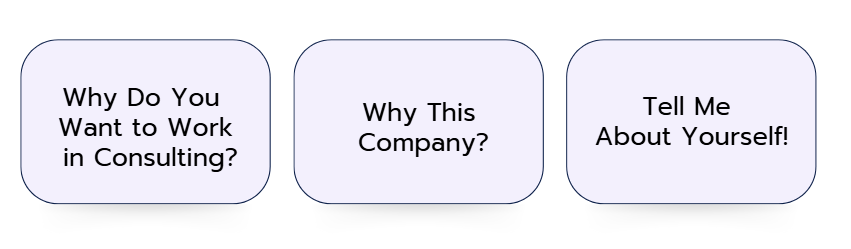
Consulting interviews are not just about your skills and knowledge — companies also want to see how well you align with their culture and values, often called "personal fit". This part of the interview is your chance to show you’re a natural addition to the team.
Here’s a look at three common personal fit questions and some tips on how to answer them confidently and thoughtfully.
One of the classic questions in any job interview is, "Why do you want to be a consultant?" Many candidates respond with generic answers, such as the chance to work on exciting projects across various industries, the opportunity to travel, or the potential for continuous personal growth. However, these answers often fall flat.
Instead, aim to articulate your response more precisely and highlight personal motivations:
Identify Your Areas of Personal Development. Focus on specific development areas that are crucial for consulting and reflect your personal motivations. For instance, you might mention that you value leadership and teamwork in multicultural environments, emphasizing how international projects allow you to enhance your skills in engaging with diverse cultures and backgrounds. You could also express your enthusiasm for tackling complex challenges: explain how you view these projects as valuable opportunities to sharpen your analytical and structured thinking skills.
Share Personal Experiences. Talk about concrete experiences that demonstrate your ability to apply these skills successfully. If, for example, you led a multicultural team in a past project or overcame a challenge in a new field, relate those experiences to your goals in consulting. This approach shows not only your capability but also your readiness to thrive in the consulting environment.
Highlight Specific Learning Goals in Consulting. Emphasize what you hope to learn or which skills you would like to deepen in your consulting career, and explain why consulting offers you the best opportunities to achieve those development goals. This connection shows how your interests align with the demands of the consulting profession.
👉 Curious how the PrepLounge community would tackle the question "Why consulting?" Check out the discussion in our Consulting Q&A.
How to Answer "Why Consulting?" in Interviews
on Feb 16, 2026
142.8k
16
Best answer by
Matthew
I would recommend spending about 1 - 2 minutes on each question. You have a lot to get to in the interview. Less than a minute will make you seem rehearsed and shallow and more than 2 minutes for each will take up too much of the interview time.
WHY CONSULTING?
For the “Why consulting” question, interviewers ask this question to make sure that you really want to be a consultant and all that comes with it. There are two types of firm recruiters - consultants and non-consultants. The recruiting consultant leaders are everyday partners that also have responsibility for overseeing different aspects of recruiting (e.g., Leader of Harvard Business School Recruiting, Leader of Paris Office Recruiting, Leader of Operations Practice Experienced Hire Recruiting). These leaders have 2 goals.
- Meet the needs of their constituents (i.e., the hiring demands of the office/practice)
- Hire candidates that have the potential to become a Partner in the Firm
By asking “Why consulting”, the interviewer can get a sense of whether you are in consulting for the long haul or just to get a stamp on your resume and then parlay the name brand into another job after two years. There are many ways to answer this question depending on your particular situation but here are a few.
- I want to work in an environment where I receive a great deal of mentorship and feedback regularly
- I want to be exposed to work in several different industries and across many different functions
- From speaking to other current consultants, the mix of client interaction, team problem solving, partner mentoring, and analytics is something that excites me
- I’m looking to learn in an environment where my skills are developed more rapidly (in “dog years”) than in other environments
- I want to work in an environment where I am constantly challenged by new types of problems
- I have spoken to other consulting partners and the type of day-to-day work they do (e.g., client work, consultant training, internal knowledge development, practice leadership, etc..) sounds very enticing
WHY MBB?
Recruiting leaders do a lot of post-recruiting analysis and the “accept rate” gains a lot of attention. Therefore, the interviewers are keen on knowing why you want to join their specific firm. Have you done research? Have you talked to the recruiters? Have you attended events? Have you spoken to firm members? Do you have friends at the firm?
This is your chance to show off all of the hard work you have put into learning about the specific firm. Interviewers are a little smug at times and are SURE that their firm is the BEST and they like to hear it. They even like to hear their firm contrasted to others, but don’t overdo it. Here are a few examples.
- Unlike X, Y has 3x more global offices and I would like to consider moving internationally at some point later in my career
- I like the innovation focus of BCG, evidenced by your launch of BCG Digital Ventures
- From my conversations with current consultants and Bain, BCG, and McKinsey, consultants at X seem to enjoy their experience more and have much more diverse problems and clients, which is attractive to me
- While I don’t want to go into Private Equity, I am interested in X because of the significant amount of PE due diligence and 100-day plan work you do
- I really want to join X because of your emphasis on business research
- During my conversations about culture with current Bain, BCG, and McKinsey, consultants, I find that X consultants describe the culture at X to be closer to one that I am seeking than Y and Z
There are certain things that you should NOT say when answering “Why MBB?”, including:
- Your firm has a great brand name, which is attractive to me
- Tells interviewer you are going to use the firms brand as a resume enhancer
- X is known for dealing with the C-Suite and in particular, CEOs, which is where I want to gain experience
- That’s true and not true of all 3 MBB firms. And, very, very few Associates or Managers talk to CEOs or any CxOs. That’s a myth. This tells the interviewer you are going to be high maintenance and is an almost immediate ding
- I really like the young, laid back culture of firm Y
- Tells the interviewer you are less than serious and want to have a good time
Another common question in a personal fit interview is, "Why do you want to work for this particular consulting firm?" Here, it’s crucial to show that you’ve done more than just skim the surface of the company. While many large consulting firms have similar structures, the real difference often lies in their corporate culture.
Refer to the company's values and explain how they resonate with your own beliefs and goals. Share personal experiences that illustrate why this firm feels like the right fit for you. Perhaps you had an insightful conversation with a consultant from the firm that left a lasting impression, or you are interested in specific development programs that the company offers.
A possible response could be:
"I was particularly impressed by the open and team-oriented culture at [Company Name]. After speaking with one of your consultants, I realized that it's not just about technical excellence; personal development and collaboration are also highly valued. These principles align perfectly with my vision of an ideal work environment."
👉 For more insights on how to answer “Why this Company?”, browse through the following threads in our Consulting Q&A.
Why firm X?
on Jun 29, 2021
5.3k
6
Best answer by
Ian
Hi there,
You're actually going about it wrong! (Feel free to PM me for more help/clarify)
A cover letter is much more why should you want me than why I like you guys. Think about it, are they interested in hearing about how great they are, or how great you are?
Make sure your cover letter focuses on you....and you can premise it as "I value how your company is x. I am also x. Here is why"
Here are some general tips:
- Step 1 - Figure out the topics for your key paragraphs. These need to be based on what consulting companies are looking for. I recommend any of the following
- Quantitative + qualitative analytical skills
- Communication (written + verbal)
- Client managment skills/experience
- Leadership
- Teamwork
- Diversity (can be working with diverse clients, teams, etc.)
- Curiosity / passion for learning
- Step 2 - Once you've picked 3-5 of these, write your paragraphs
- Make them succinct (3-5 sentences)
- Make sure they lead with e.g. "x company values y, and I do too"
- Make sure they focus on your achievements. You have to sell yourself here
- Step 3 - For any given company cover letter, find out what the company cares most about. Then slot in 3 of the paragraphs that fit best (again, ideally you have 5 to choose from)
- Step 4 - Tweak the language of each paragraph to fit the company's website, application posting, etc. I.e. Curiosity might become passion for learning.
Then, of course, you need an intro paragraph summarizing your interest + reasons why as well as a closing paragraph doing the same with new language.
What always helps when you're trying to answer this question is to refer back to some conversations you've had with people from BCG.
This shows that you've done your research and it can also help you mention something that is genuinely different and other people have not spoken about.
Best,
Cristian
What is the difference between McK, BCG and Bain – so called “MBB” firms?
on Apr 14, 2025
134.2k
17
Best answer by
Dolf
For perspective, I worked 5.5 years at BCG in Germany and Japan, and did projects all over the globe. I have multiple friends at both McK and Bain. The following are my personal views, and your statement "from different online sources, I am getting different ideas" also holds in "real life" :)
Important:
(1) The differences between all three firms (and even other top managment consultancies) are negligible compared to non-consulting firms/jobs.
(2) All three firms have grown so much, they compete on all levels and no longer specialize in certain topics or industries. Basically, if one of the firms pitch for a certain project, the others could do it equally well.
On to the differences:
- In Europe, there is still a difference between McK/BCG and Bain, which is a bit smaller. So, while any competitive pitch where McK is invited also has BCG pitching (and vice versa), Bain is not always present.
- McK tends to have a more top-down, slightly harsher approach (maybe rooted from operations/cost cutting experience). BCG has a bit more cooperative approach, building support bottom-up together with the client's organization/middle management. Bain is somewhere in the middle.
- I found the smartest/most intelligent people to be at McK, intellectually a tiny notch above the other firms. BCG I found to be a bit more creative/out of the box.
Again, all of this is highly subjective. If you receive an offer from any of the firms, congratulations, that's amazing! :) If you end up getting more than one offer, I would choose the one which feels the best to you personally. I loved BCG, but one of my friends did not like the atmosphere and they somehow didn't connect -- he is now super successful and happy at Bain. During the interview process, you get to know 5-10 consultants over 2 rounds in a professional context. And keep in mind -- they don't just interview, but also try to make a good impression on you! The interview process is actually quite revealing about how working there would be, so going with your gut feel is probably the best way to go.
Good luck and all the best!
When the interviewer asks you to tell something about yourself, avoid simply reciting your resume. This question is your chance to add a personal touch to the conversation and leave a lasting impression.
Instead of explaining your career path, think about a few unique qualities or experiences that highlight who you are and how you think. One effective approach is to choose three adjectives that describe you and support them with brief examples or anecdotes.
Here’s an example of how your response could sound:
"I would describe myself as solution-oriented, communicative, and curious. In my last role, I successfully handled a challenging situation within my team by bringing everyone’s needs to the table. I believe communication is key to success, especially in complex projects. Additionally, I have a strong willingness to learn — I love learning about new topics, which is one of the reasons I find consulting so interesting."
How to Prepare for Personal Fit Questions in Consulting
Personal fit interviews give you the opportunity to showcase not only your technical skills but also your personality. To answer fit questions successfully, keep the following points in mind:
Research the Company: Familiarize yourself with the company’s culture, values, and unique characteristics. If possible, connect with consultants from the firm or explore their career page. Attending recruiting events is also a great way to engage with potential employers.
Be Authentic: Stand out by sharing personal stories and answer questions honestly and concisely.
Practice Your Responses: The best way to prepare is to practice your answers to personal fit questions with friends or colleagues. This will help you build confidence and present yourself more effectively in the interview.
With these tips, you’ll be well-equipped to impress in your personal fit interview and take a significant step closer to landing your dream job in consulting.
👉 Prepare for more personal fit questions with our Stress Question Tool.
Stress Questions
Be prepared for your personal fit interview and stay calm under pressure.
Every case interview has a certain structure. An important factor on how your case interview is going to proceed is if the interview is interviewer-led or candidate-led.
We’d like to explain the two interview formats – candidate-led cases and interviewer-led cases – highlight their differences, and provide you with tips on how to excel in each of them.
Behavioral or personal fit interview questions may sound simple, but they can be quite nerve-wrecking. They force you to think of your relevant past experiences on the spot which can get you rumbling and throw you off balance. That's why most people utilize the STAR method to articulate their responses. ⭐
If mastered well, it can help you answer those behavioral questions in a way that pulls interviewers emotionally and makes your story memorable. Read on to learn what the STAR method is and how you can use it to succeed in your personal fit interviews.
If you want to enter the consulting field, you probably already know how selective the industry is and that it only chooses the best and most outstanding candidates. Therefore, the application process is quite intensive and demanding. Case interviews are significantly different from traditional job interviews due to their complexity and specific requirements, as they simulate real business scenarios.
To succeed in case interviews, certain skills are essential. These need to be improved and refreshed before the interview to ensure optimal performance. Below, we provide a brief summary of the essential skills you should master to excel in case interviews and differentiate yourself from the competition.