1. Blog
  2. Consulting
  3. Beratungen
  4. Oliver Wyman Case Interview Guide: Process, Questions, and Preparation

Oliver Wyman Case Interview Guide: Process, Questions, and Preparation

Key Takeaways

  • The case interview is the key success factor: It carries the most weight in the process, so strong preparation and structured thinking are essential to move forward.
  • Oliver Wyman looks beyond pure analytics: Initiative, intuition, creativity, and problem-solving are just as important as quantitative skills.
  • Practice and structure make the difference: A clear, MECE-driven approach combined with consistent case practice significantly improves your chances of success.

You are planning to apply for a job at Oliver Wyman? In this article you will learn more about the consultancy, what kind of candidates they are looking for and what is important to them. You will also find out how the application process is structured and what types of interviews you can expect.

Oliver Wyman Overview: Firm, Reputation, and Key Facts

Oliver Wyman is an American consulting firm founded in New York in 1984. They currently operate in over 60 countries worldwide, employing over 5000 people and earning revenues of $2.1bn. They are a highly reputable strategy firm, often competing against McKinsey, Bain and BCG.

The firm is part of the Marsh & McLennan group, one of the largest professional service companies in the world and part of the S&P 500. The group provides insurance, risk, reinsurance, talent management and investment advisory services alongside the Oliver Wyman consulting practice.

Every year Oliver Wyman receive thousands of applicants to their open job roles and the case interview is the main interview mechanism they use to assess candidates. It is a business problem that candidates are expected to work through with their interviewer to find an appropriate solution.
 

What Oliver Wyman Looks for in Candidates

Oliver Wyman have recently shifted their focus to being impact-driven and encouraging entrepreneurial people to lead their work. They have characterized what they are looking for in a candidate in four characteristics:

Initiative

With intense workloads and imperfect information, consulting requires all levels of staff to make decisions and be proactive in their work. For junior consultants, this means anticipating what needs to be done next and not relying on a manager to completely dictate your task list.

Intuition

Oliver Wyman expects their consultants to be comfortable making decisions with imperfect information. Whilst grounding decisions in data and logic is important, certain decisions will have to be made with assumptions and being able to rely on previous knowledge to make intuitive decisions is sometimes the only way to maintain momentum in a project.

Creativity

The ability to be creative is often overlooked by aspiring consultants. Creativity in the business world is to be original and find new ways of finding answers, unlocking value for clients or getting work done. Clients are looking for new insights and methods that will give them an advantage over their competitors.

Problem-solving

Every client commitment is focused around a problem they are facing and have not faced before. They are looking for a team of problem solvers that can provide a logical and structured answer to the problem. 

Data and Analytical Skills

Increasingly, Oliver Wyman also expects candidates to be comfortable working with data and using analytical tools efficiently. While you are not required to be a technical expert, the ability to interpret data, draw insights, and support your reasoning with quantitative analysis is becoming more important.

Sichere dir deinen Top-Job mit PrepLounge!
Melde dich jetzt kostenlos an und erhalte Zugang zu unserem Q&A, Top-Coaches, Tools und vielem mehr.

Application Process: Step-by-Step Guide

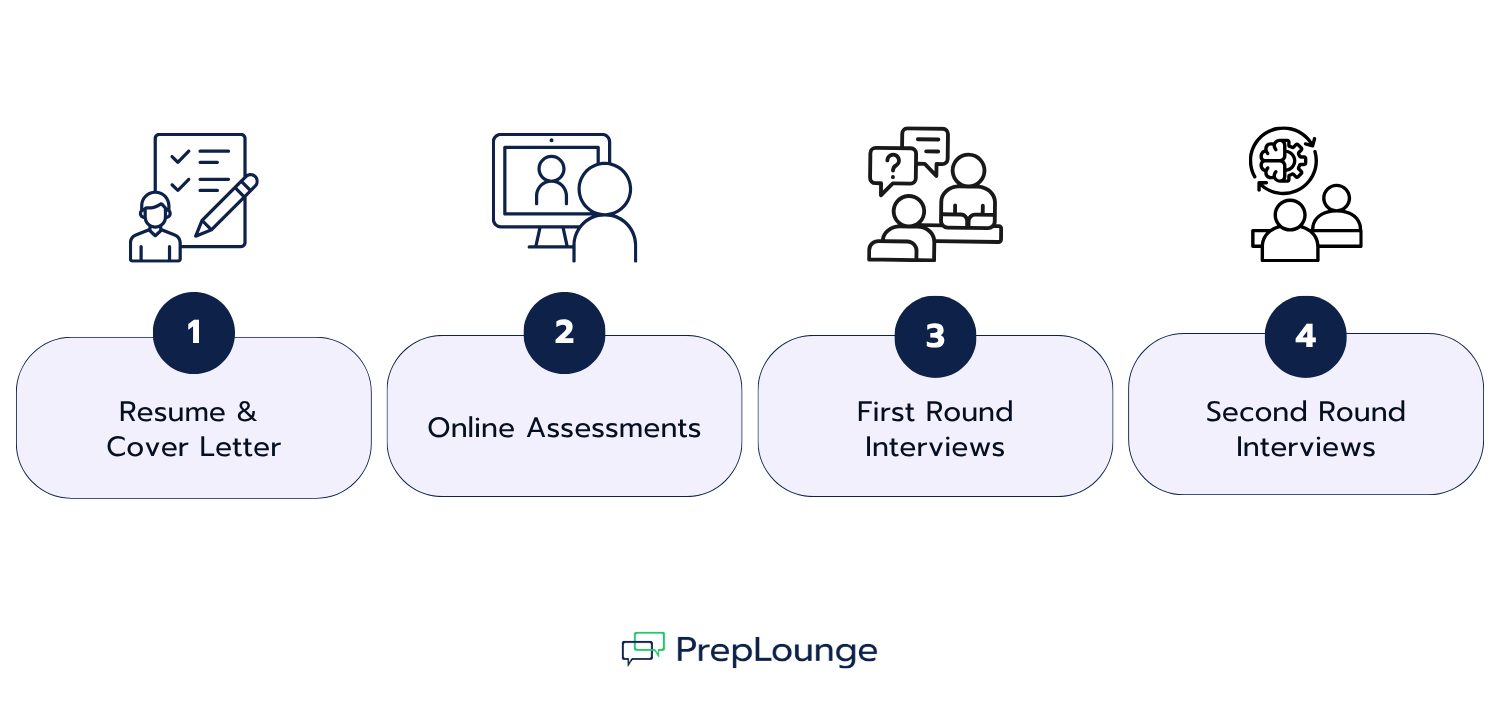
There are four stages to the Oliver Wyman application process:

Application Process

The interview process at Oliver Wyman begins with a resume and cover letter submission online. Their typical recruitment cycle is in the Autumn each year, but they do sometimes hire off-cycle, especially at smaller network firms. They are looking for candidates that reflect their four traits in their applications, along with strong academic records and relevant experience.

The online assessment typically includes a numerical reasoning test designed to evaluate your analytical and problem-solving skills. The exact format may vary depending on the role and location, but it usually involves quantitative questions under time pressure. Practicing numerical reasoning and mental math in advance can significantly improve your performance.

Candidates that pass the online assessment are invited to first round interviews that are typically conducted by junior consultants and involve 15 minutes of a fit interview followed by a case interview question. There are two interviews in the first round.

The second round interviews are conducted by senior consultants (partners and directors) and follow the same format as the first round interviews. Following the second round interviews, candidates will be either given feedback or a job offer.
 

Interview Types: Fit and Case Interviews Explained
 

Oliver Wyman uses two main interview formats across its network: a conversational interview and a case interview. The case interview carries the most weight, so thorough preparation is essential. Candidates who are not well prepared for this part typically do not progress to the final round.
 

Conversational interview

The conversational interview is conducted separately to the case interview and is looking to assess four areas of your prior experience and education:

  • Interest and understanding of business
  • Professional, personal and academic accomplishments
  • Interests outside of academia and work
  • Career objectives

The combination of these four topics will build a picture for the interviewer of your motivation to work at Oliver Wyman, suitability to the work, and how you will fit in to Oliver Wyman’s culture.
 

Case interview

The case interview’s that Oliver Wyman use are all based on real life client examples. The interviewers are encouraged to use their own client engagements for their case interview questions because they know them well and will be able to provide data and context easily. This format is the most common interview format used by Oliver Wyman because it is the closest resemblance to the work required on the job and allows the interviewer to answer the question ‘Can this person do the work of an Oliver Wyman consultant?’

They assess candidates over a number of different attributes during a case interview:

Scoring well across all these attributes will result in being progressed to the next stage or, ultimately, a job offer. For further information on how to demonstrate these skills, see our full case interview guide here.

Oliver Wyman vary their Case Interviews between data heavy questions and abstract questions such as ‘how much would you sell Dubai for?’ The variation in questions enables them to test your quantitative skills and communication skills separately.
 

Oliver Wyman Case Interview: Format, Structure, and Example
 

Case Interview

The consulting case interview is the cornerstone of every strategy consulting firm’s interview process due to the ability to replicate the problems and challenges of the work they do.

To score well in an Oliver Wyman case interview, you must meet the criteria laid out above, and you can do this following a structured approach to case interviews. The structure of an Oliver Wyman case interview is as follows:

  1. Situation and problem
  2. Hypothesis validation
  3. Framework development
  4. Root cause analysis
  5. Mathematical calculation (sometimes)
  6. Creativity test (sometimes)
  7. Recommendation

At the start of the case, the interviewer will outline the context and the problem to be explored.


An example might be:

“A high street retailer wants to cut costs by 30% in response to declining revenue, how would you approach this?”


You would then be expected to put forward an initial hypothesis on what the answer might be and explain your intention to prove or disprove it.

From there, you will be expected to develop a framework to conduct your analysis and test it with the interviewer.If your framework is MECE and you explore it correctly, then you will find the root cause of the issue for the client (in this case where costs can be reduced) and begin calculations if relevant.

The creativity test is when the interviewer asks you for an alternative to your findings or recommendation, e.g. “Okay, the client says they do not want to shut stores, how else can they reduce cost?” They may ask this more than once, and it tests the candidate's ability to think of alternatives, even if their answer is appropriate.

Finally, you will be asked to provide a recommendation, whereby you need to synthesize your findings and give a clear and concise proposal. For more information on how to approach and solve case interviews, read our full guidance here.
 

Interview Tips: How to Prepare and Succeed

Fast math

Case interviews are pressurized situations where your anxiety levels are heightened, and you don’t have the safety net of notes or the internet to fall back on.

For in-person interviews, it is common that one of the questions will have a mathematical element or be a market sizing question included. These require long math calculations without a calculator. If you haven’t practiced long addition, multiplication, division or subtraction recently then it is a good idea to do so. Being quick at math shows your competent quantitative skills and reduces unnecessary pressure during the interview, increasing your overall performance.

Practice

As with the math, practicing case interviews is the best way to improve your performance. Through practice, you will begin to develop a robust approach that satisfies the structure and framework components of the case, and you will recognize how to navigate the case successfully.

If you are applying to Oliver Wyman then you are probably applying to other strategy consulting firms too, this practice will be relevant to all the firms you apply to as they all use case interviews in their application process.

Apply structure to everything

The key requirement of a candidate in a case interview is the application of structure, specifically with a MECE approach. As mentioned above, you can even apply structure to the FIT questions, and it is recommended you do so.

An example answer to the question ‘walk me through your CV’ would be to segment your experience into:

1) Experience relevant to consulting, 
2) Experience not relevant to consulting, and then briefly cover the experience you have in each bucket. 

This shows you understand what consulting is and what is relevant, and also a key skill of a consultantstructured thinking.

If you can demonstrate robust structured thinking in your interview, you will score highly.
 

Conclusion: How to Succeed in Oliver Wyman Case Interviews

Landing an offer at Oliver Wyman requires more than just strong analytical skills. The firm looks for candidates who combine structured thinking with creativity, intuition, and the ability to work effectively under pressure. This is reflected throughout the entire interview process, from the initial application to the final case interviews.

To succeed, you need to be particularly strong in case interviews, as they are the most important evaluation tool. A clear and structured approach, the ability to interpret data, and strong communication skills are essential. At the same time, demonstrating initiative and business intuition can help you stand out from other candidates.

Consistent practice is key. By working through real case examples, improving your mental math, and refining your structured thinking, you can significantly increase your performance. If you manage to combine structure, clarity, and creativity in your answers, you will be well positioned to succeed in Oliver Wyman interviews and secure an offer.


FAQ: Oliver Wyman Case Interview & Application Process

The case interview is the most important part of the process and largely determines whether you progress to the next round or receive an offer.

You can expect a conversational (fit) interview and a case interview, with a stronger focus on the case component.

They value initiative, intuition, creativity, and strong problem-solving skills, alongside structured thinking and communication.

Focus on practicing real case interviews, improving your mental math, and developing a structured, hypothesis-driven approach.

They are similar in structure but often based on real client engagements and may include both data-heavy and more abstract questions.

Continue to Learn

Using Social Media in Your Graduate Job Search
13. Jan. 2026
5 Min.
Get to know the different possibilities!
Zum Artikel
8 Tips to Crush the Oliver Wyman Numerical Reasoning Test
29. Okt. 2025
8 Min.
Here are some tips & tricks and the best possible preparation for the Oliver Wyman Online Test!
Zum Artikel
How to Get a Job in Consulting During an Economic Downturn
17. Sept. 2023
7 Min.
Get insider tips from a top consultant!
Zum Artikel