


Want to work for Revolut? Then you’ll probably encounter their problem‑solving interview: a significant and demanding part of the hiring process.
In this article, Coach Mariana will walk you through exactly how the interview works, what skills it tests, and how you can prepare to stand out. Whether you're new to case-style interviews or just want to sharpen your skills, her goal is to help you approach Revolut’s process with confidence and clarity.
Revolut is a UK-based fintech company founded in 2015. It offers digital banking services such as current accounts, international transfers, cards, and investment options, and is now active in more than 35 countries.
At Revolut, the problem-solving interview is a core step in the hiring process. You’ll be asked to tackle a real or realistic business situation in 30–40 minutes, working through it live with your interviewer.
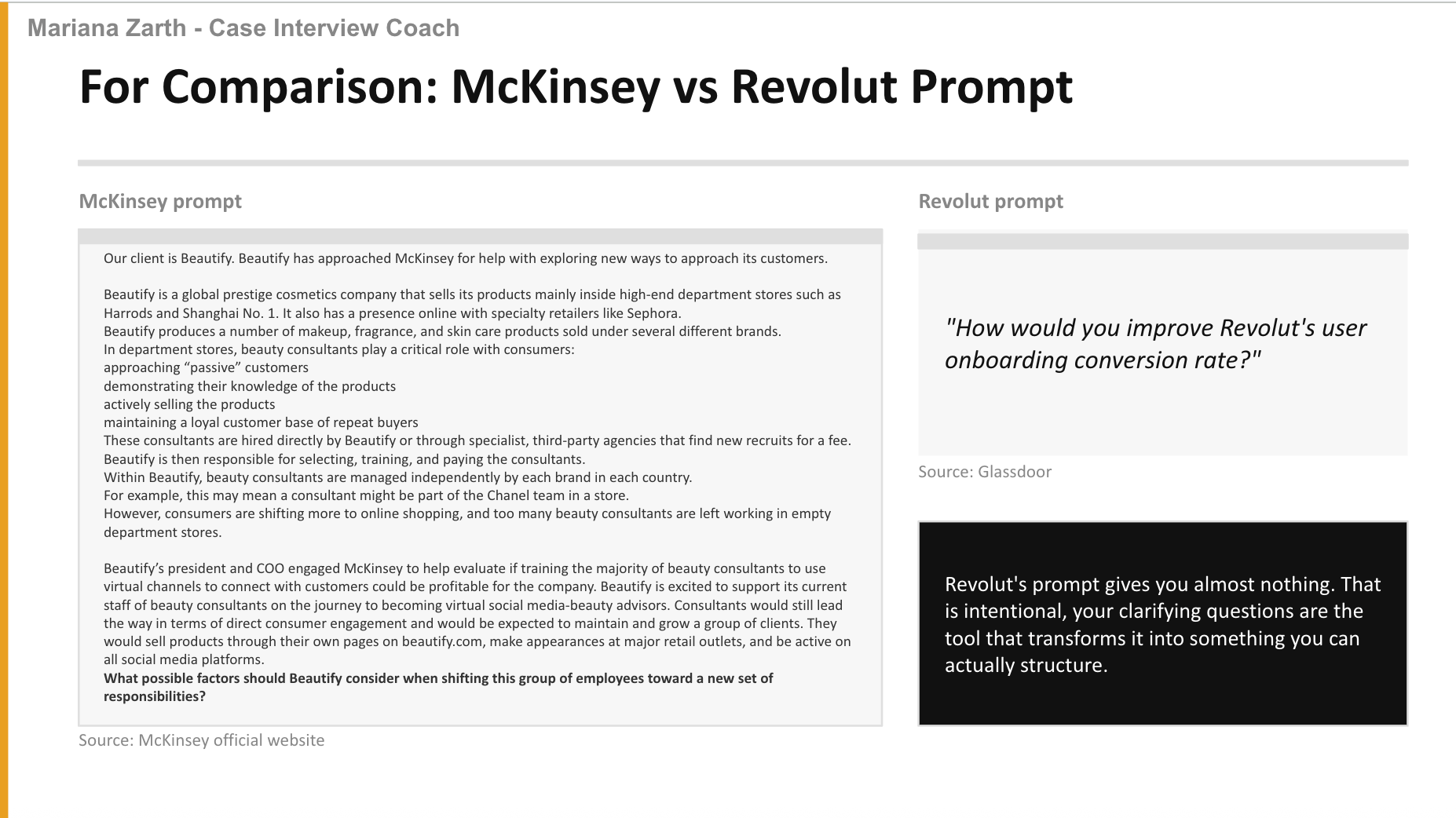
The purpose isn’t to see whether you know the “right answer.” In most cases, there isn’t one. Instead, the focus is on how you think: can you bring structure to an ambiguous question, work with data, do the math, make reasonable assumptions, brainstorm solutions, and communicate clearly?
I know this sounds a bit conceptual right now, but don’t worry! I’ll break it down for you in a moment! 🙂
Land your top job with PrepLounge!
Sign up now for free and get access to our Q&A, top coaches, preparation tools and much more.
What Will Revolut’s Problem-Solving Interview Assess?
The Revolut problem-solving interview usually covers six main areas:
Structuring – Breaking down a broad problem into clear, logical components while being MECE.
Chart Reading – Interpreting data exhibits to extract relevant insights connected to the case objective.
Case Math – Performing calculations to support arguments. Don’t worry about mental math; so far 100% of my clients were allowed to use calculators or Excel, just confirm this with your HR point of contact. 😉
Brainstorming – Generating creative yet practical ideas within a structured MECE framework.
Communication – Explaining your thought process in a clear, confident, top-down way.
Breaking Down Each Component of Revolut’s Problem-Solving Interview
Let us now take a look at each component of Revolut’s problem-solving interview:
Structuring
What it means: Turning a broad question into an organized, step-by-step plan (MECE).
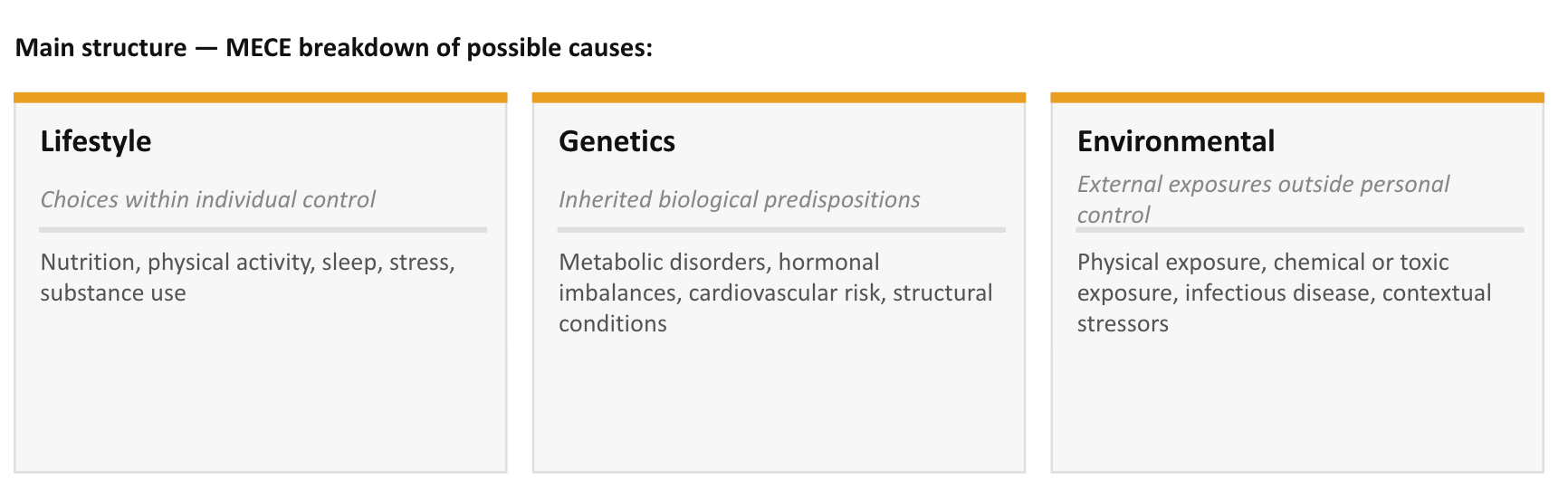
MECE stands for Mutually Exclusive and Collectively Exhaustive. It means your breakdown should have no overlaps and should cover all relevant points.
A basic example could be: Internal factors vs. External factors. (Just to illustrate the concept, don’t use it blindly without context!)
Typical questions include:
“Why might Revolut’s card transactions be declining in one market?”
“How could Revolut grow its revenues next year?”
“How could we improve the onboarding process of new clients?”
Step-by-step method
Repeat the prompt to confirm you understood it correctly, even if it’s simple.
Clarify the scope and success criteria, as you would in a real project. Think like an executive who needs clear boundaries and high-level context.
Draft 3–4 broad categories that are MECE.
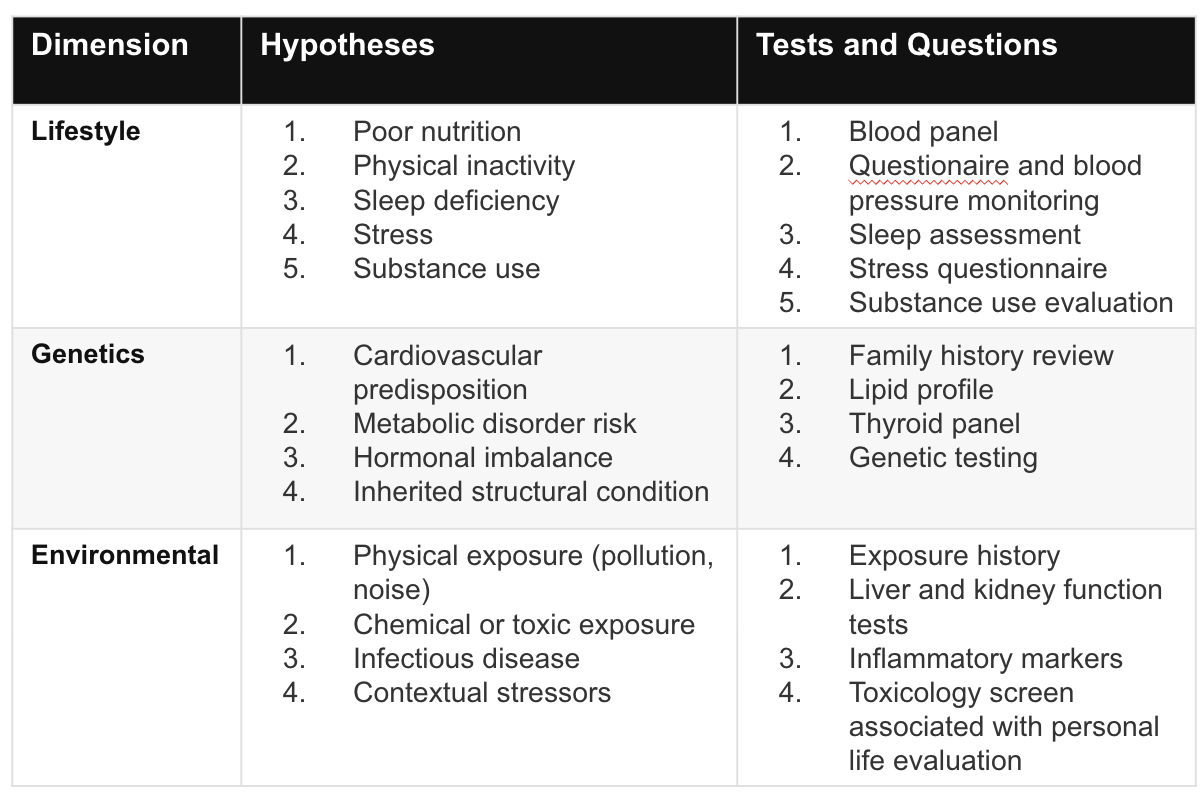
Add sub-categories under each to guide your analysis.
Explain your structure out loud, linking your rationale back to the case objective.
State explicitly what your next step will be, that’s what makes it a candidate-led interview.
Use your structure as the roadmap for the rest of the case.
Why it makes sense
Imagine you lost your wallet at home. A MECE approach would be to search room by room until you’ve covered the entire house. That way, you know the wallet must be found within that scope.
Prioritization then comes into play: if you just walked in, the most likely places are the entryway or living room. If you have a playful baby (like I do), you might check unusual spots, like the washing machine! 😉
Applied to a business case related to profitability in a tech company:
If profits are down, breaking the problem into revenues and costs guarantees you’ll find the answer, because the issue must lie within that scope.
Chart Reading
What it means: Extracting insights from data exhibits like tables, bar charts, or line graphs.
Typical questions:
“Here’s a breakdown of revenues by product line. What stands out?”
“This chart shows churn by age group. What do you observe?”
Step-by-step method
Take 15–20 seconds to read silently, then confirm your understanding with the interviewer.
Look for trends, outliers, and comparisons. Don’t narrate line by line.
Identify key insights connected to the case objective. (Remember: you’re solving for the “wallet,” not random objects.)
State the findings clearly, avoiding a full narration of every number.
Link insights back to your structure, then say what your next step will be.
To exercise this skill, I recommend you to take a look into McKinsey and Bainarticles in their official websites. There are plenty of exhibits for you to interpret. Make sure to not take a peek into their main insights described in the article before trying to figure them out by yourself.
Case Math
What it means: Doing calculations to size a problem, test scenarios, or evaluate options.
Typical questions:
“If Revolut launches a premium product, how would you calculate annual revenue?”
“How many customers would Revolut need for this feature to break even?”
“What’s the market size for fintechs in Germany?”
Step-by-step method
Repeat the prompt and given numbers.
Write out the formula before plugging in numbers, confirm your logic first.
Perform the math step by step. Use a calculator/Excel if allowed and share your screen.
Round where it makes sense (say it explicitly).
Check if the result seems realistic.
Always ask: “So what?” → link the number back to the case objective.
Brainstorming
What it means: Coming up with a structured list of ideas to solve a challenge, often after analyzing data.
Typical questions:
“What strategies could Revolut use to increase user engagement?”
“What options could Revolut explore to reduce fraud?”
Step-by-step method
Pause and set a structure before listing ideas.
You can use contrasts (internal vs. external), processes (customer journey), or frameworks (Ansoff, 4Ps, BCG) depending on the case.
Generate ideas within each category. Cover obvious options first, then push for creative ones.
Explain why each idea could matter.
Prioritize based on rationale (context, feasibility, impact).
Example:
“You’re advising a restaurant that wants to increase revenue without changing its business model. What ideas do you have?”
Communication
Even the best analysis fails without clear communication.
Tips to keep in mind:
Speak in short, structured points.
Use signposting (“There are three reasons. Reason 1…”).
Summarize frequently.
End with a confident recommendation.
Example – Non Top-Down:
“So, the company has been facing revenue issues. Region A dropped by 15% and we don't know why, Region B actually grew, but its impact is irrelevant. Marketing spend increased $10M but unclear ROI so far, definitely need to check further. Retention also fell by 5%. So overall, there are a lot of moving parts.”
Example – Top-Down:
“The company’s profitability problem stems from 3 main factors:
Sales dropped 15% in Region A.
Marketing spend increased $10M with no clear ROI.
Customer retention fell 5%.
Since Region A’s decline represents 40% of the impact, I suggest we focus there first. As a next step, I’d like to understand…”
In short: stay structured, stay top-down, and remember: your interviewer wants to follow your thinking, not solve a riddle. 🙂
Revolut’s Candidate-Led Interviews: Taking the Driver’s Seat
Revolut uses a candidate-led format. The interviewer won’t guide you step by step (though they may nudge you in a direction).
How to handle it:
Start strong with a clear structure.
Be proactive in asking for data.
Always connect findings back to the case objective.
Drive the discussion forward, don’t wait for hints.
Summarize progress regularly so the interviewer can follow your logic.
👉 Practice candidate-led interviews with our wide selection of practice cases in our Case Library. You can easily filter between candidate-led and interviewer-led formats!
Your client tk Commodity Trade (tk ComT) is a global materials trader - they buy and sell raw materials. tk ComT had stable EBITDA margins in recent years. They consider expanding their target market and entering the Lithium (electric vehicle battery grade) trade, due to the current high demand for electric cars and Lithium-ion batteries. The client is concerned about minimizing the cash spending and about improving the payback period for this market-entry campaign, due to corporate cash policy.As a consultant, you are expected to calculate the size of the Lithium market and to assess the payback periods for an organic market entry (with own resources) as well as for the acquisition of an established company. Finally, the client expects a proposal about the best market entry strategy and potential opportunities and risks.
Der Klient, OSEKA, ist ein profitabler Möbelhersteller aus Spanien. Bisher liefert er seine - in Spanien hergestellten - Möbel auch nur nach Spanien. Kürzlich melden aber einige Möbelhäuser aus Deutschland Interesse an, die Möbel auch verkaufen zu wollen. Der CEO des Unternehmens fragt dich, ob es gut wäre dann auch einen Produktionsstandort in Deutschland zu eröffnen.
This question set covers the fundamentals of debt instruments, credit metrics, and risk assessment. It mixes definitions, calculations, and case-style questions to prepare you for corporate finance and investment banking interviews.
Your client is a chewing gum manufacturer in the United Kingdom and you’re currently at the airport waiting for your flight. In the time that you have, you’re thinking about how big the annual chewing gum market is in the UK in terms of market value.
Your client is a D2C (direct to customer) online fashion business in a developing country. It is a new brand, launched about 2 years ago and founded by ex-investment bankers. Their brand focuses on trendy, edgy design that is less main-stream (versus big brands like H&M, Uniqlo, Zara etc) for adult men. While they have been growing fast, they want to understand how they can further improve their sales.
Your client American Airlinks has seen its inflight revenues stagnate for the past 3 years. The CEO offers the possibility of doing a partnership with Balzac Coffee and of selling Balzac Coffee in the future, instead of handing out the current non-brand coffee for free.Advise the CEO if AA should either do this partnership or put a price on the current, non-brand coffee that is currently given out for free.
Your client, ACR, is a chain of medical laboratories. They provide patients with MRI and CT scans as well as other major tests.They have expensive testing equipment in their inventory and run about 250 labs. Usually doctors refer their patients to one of the labs.Because ACR is worried about a decrease in profits, they have hired us to evaluate the market.
Your client is the CEO of a publishing company that publishes an educational magazine and a women's magazine.Although both businesses are profitable, they are not growing fast enough. Thus, the CEO is thinking about starting a third monthly magazine that is targeted towards 30 to 60-year-old men in the US. He wants to know whether he can reach his first-year goal of $15 million in revenue.
A local sandwich place has a shop located in a busy business district. The business district is filled with large head-offices of major corporations, a train station & a university. The sandwich place only sells one type of sandwich priced at $5.00. This is a cold-cut salmon sandwich with bread, smoked salmon, salad, cheese & sauce. The sandwiches are freshly made and only prepared after the order is placed, so no pre-packaged sandwiches. The shop has 3 employees who all service customers and it is a take-away without any seating.Try to estimate the total revenue this shop can generate in one month. Costs are no factor here. Try to base your estimation on logical & reasonable assumptions that would be common for a sandwich place as described here.
You are part of the Strategy & Operations team at Revolut.Revolut has had significant growth over the past couple of years, with customer base growing 20-30% per year. Our apps have also been highly rated in the various app stores - be it GooglePlay or on the Apple store.Revolut's current customer strategy is to segment customers based on their subscription tiers/plans. Standard: FreePlus: $3.99/mthPremium: $7.99/mthMetal: $14.99/mthUltra: Ultra $55/mthKey differentiation between the plans are in the pricing and features. Namely, the more expensive tiers like Metal and Ultra have additional features such as personalized and premium card design, free access to lifestyle apps (e.g. Financial Times, Class Pass etc), better FX rates and priority customer support.It's great that Revolut has been expanding rapidly, but we are starting to see some stresses on our existing operations and processes. One key area of concern is in customer service, our satisfaction scores have started to trend down and call center headcounts and costs have been increasing in recent years, but we are struggling to handle the load of incoming requests and tickets.You have been tasked to lead a project to solve this problem without ballooning costs.
Our client is an electronics holding called Chip’n’Chip.They want to invest in a Printed Circuit Board (PCB) manufacturer called OnBoard, and asked you whether it’s going to be a good investment.How would you help them?
This question set helps you build a solid foundation in M&A modeling by covering the key drivers of accretion and dilution, deal structuring, and synergy analysis. You’ll review the mechanics of a basic merger model, explore how different financing methods impact EPS, and understand strategic considerations like purchase price allocation and debt capacity.You should expect to spend 30–40 minutes on the full set. Use the model answers to test your understanding, identify gaps, and sharpen your ability to communicate M&A concepts clearly and confidently.
Your client is a leading retail coffee chain. They are present in several countries globally and are a popular brand in most of the markets that they operate in, with several thousands stores in operation.A key focus of the company currently is diversity & inclusion. In their biggest market which is the US, 1 in 4 people have some sort of disability. One realization the client has had is that their retail stores are not as inclusive to individuals with disabilities. McKinsey has been brought on to help them design more inclusive spaces in their retail stores.
Ein Automobilhersteller hat zu einer Strategiekonferenz mit dem Vorstand eingeladen. Es soll die zukünftige Positionierung des Unternehmens diskutiert werden. Sie sind als Speaker in der Konferenz eingeplant und sollen einige Fragestellungen beantworten, die Sie vom Vorstand erhalten haben.Grundsätzlich kommt es dem Unternehmen darauf an, mit der strategischen Ausrichtung einen mittel- bis langfristigen Wettbewerbsvorteil auf dem Markt zu erlangen.
The European Union pursues the target of lowering the CO₂ emissions of their residents. Therefore, the EU introduced a CO₂ tax to create incentives for consumers to switch to more climate friendly alternatives and stabilize carbon dioxide emissions. Accordingly, and as E.ON’s strategy focuses on creating a better tomorrow for its customers, E.ON is investing significantly to grow its ‘Customer solutions’ area with climate-friendly solutions, including its heating solutions business. You have recently joined E.ON Inhouse Consulting and E.ON’s Head of Heating Solutions has hired you to conduct an analysis concerning the European CO₂ tax. Specifically, you are asked to assess whether the EU uses the right tool to steer consumers towards more climate-friendly heating systems.
Salty Boy Inc. is an underground salt mine in Texas whose new leadership are supporters of the circular economy. Circular economy provides a pathway towards more sustainable production and consumption patterns – CE introduces circularity to many areas of production cycles and encourages using renewable, regenerative inputs (e.g., energy) and minimizing systematic leakage (e.g., waste).After decades of extracting salt form the earth, Salty Boy’s new leadership find themselves in possession of a network of empty, temperature and moisture stable tunnels located conveniently near major fiberglass waste sources and logistics networks. As a result, Salty Boy sees the potential for an alternative revenue stream. Their rationale is that they have ample and well-located storage capacities in their tunnels that they could use to position themselves well for an emerging recycling trend that could turn fiberglass waste into an eco-friendly and valuable raw material. Salty Boy is looking for your help to assess this potential opportunity.
Your client is a Franchisee of a popular Steakhouse-chain in Germany. The Franchisee currently owns 2 Steakhouse-restaurants and wants you to investigate how well these perform and if there is any way for improvement?
Du befindest Dich derzeit in einem strategischen Projekteinsatz bei der Northern Retail Bank (NRB), die vor drei Jahren von einem Finanzinvestor übernommen wurde. Während des Mittagessens lädt Dich der CEO zu einem Espresso in sein Büro ein. Dort erläutert er, dass der Finanzinvestor bestrebt ist, den Unternehmenswert der Bank zu steigern – möglicherweise für einen künftigen Verkauf oder Börsengang, weitere Details stehen zum jetzigen Zeitpunkt noch nicht fest. Gemeinsam mit Deinem Projektteam sollst Du nun Maßnahmen entwickeln, um die Profitabilität der Bank zu verbessern. Angesichts der Ergebnisse des letzten Geschäftsjahres und des intensiven Wettbewerbsdrucks sieht der CEO hier dringenden Handlungsbedarf.Der CEO bittet Dich darum, in 30–45 Minuten in sein Büro zurückzukommen, um Deine fachkundige Einschätzung für erste konkrete Stellhebel zu diskutieren.
Your client is the Government of Indonesia, specifically a joint committee formed between a few key ministries including the Ministry of Marine Affairs & Fisheries, Ministry of Tourism and Ministry of Environment & Forestry. Indonesia is one of the largest developing countries in the world, with a population of about 285M people and an average monthly income of only USD 500. Located in Southeast Asia, Indonesia is actually a vast archipelago comprised of 17,000 islands, giving it one of the longest and most complex coastlines in the world. It is also part of the Coral Triangle, an area demarcated by scientists as the global epicenter of marine diversity. Your client tells you that Indonesia's once pristine coral reefs have seen a rapid decline over the past decade. They have come to you for help and want to figure out what is causing the problem.
The Revolut problem-solving interview is demanding but highly learnable. By practicing each of the 5 components, structuring, chart reading, math, brainstorming, and communication, you’ll be ready to handle ambiguity and pressure.
Approach each question step by step, stay MECE in your thinking, and keep your communication top-down and crisp. That’s how you show Revolut you can think and act like one of their strategists from day one.
If you have come this far, congratulations!
👉 Want to put these methods into practice? Book a case session with me and let’s work through real Revolut-style problems together.
#1 coach for Revolut | ex Mckinsey ex Nubank | Consulting & Fintech | Clients hired by Revolut, McKinsey, Kearney & more
Case coach with over 200+ sessions experience
Personal Storytelling and Behavioral Interview/PEI Prep
Languages: English, Portuguese
Mariana is a case interview coach on PrepLounge and a former McKinsey consultant. She supports candidates throughout the consulting recruiting process – from crafting impactful CVs to mastering fit and case interviews – with a strong focus on structure, communication, and confidence.