



Jan 19, 2026
5 min
Nail your post-interview follow-up with a strong thank-you email. We show you how to do it professionally.

If you're preparing for a problem-solving interview at Revolut, you've probably noticed that most of the material out there is either too generic, based on consulting interviews, or too shallow. This article is different. It breaks down exactly what the interview tests, how to approach each component, and what separates candidates who pass from candidates who don't.
Revolut's PS interview is a 30–40 minute live case. You'll be given a real or realistic business problem and asked to work through it with your interviewer: structuring the problem, analysing data, doing math, generating solutions, defining implementation and monitoring.
There is no single right answer. What Revolut is evaluating is how you think: whether you can bring structure to an ambiguous situation, prioritise based on evidence, show a bias to action and communicate clearly under pressure.
The format is candidate-led. Your interviewer won't guide you step by step as in some consulting interviews. You are expected to drive the conversation, ask for the data you need, and move the case forward on your own initiative.
That's one of the main differences from consulting prep.
Revolut's prompts are usually very short and need additional data for the assignment to be fully comprehended. See this example below where I compare real prompts from McKinsey and Revolut.
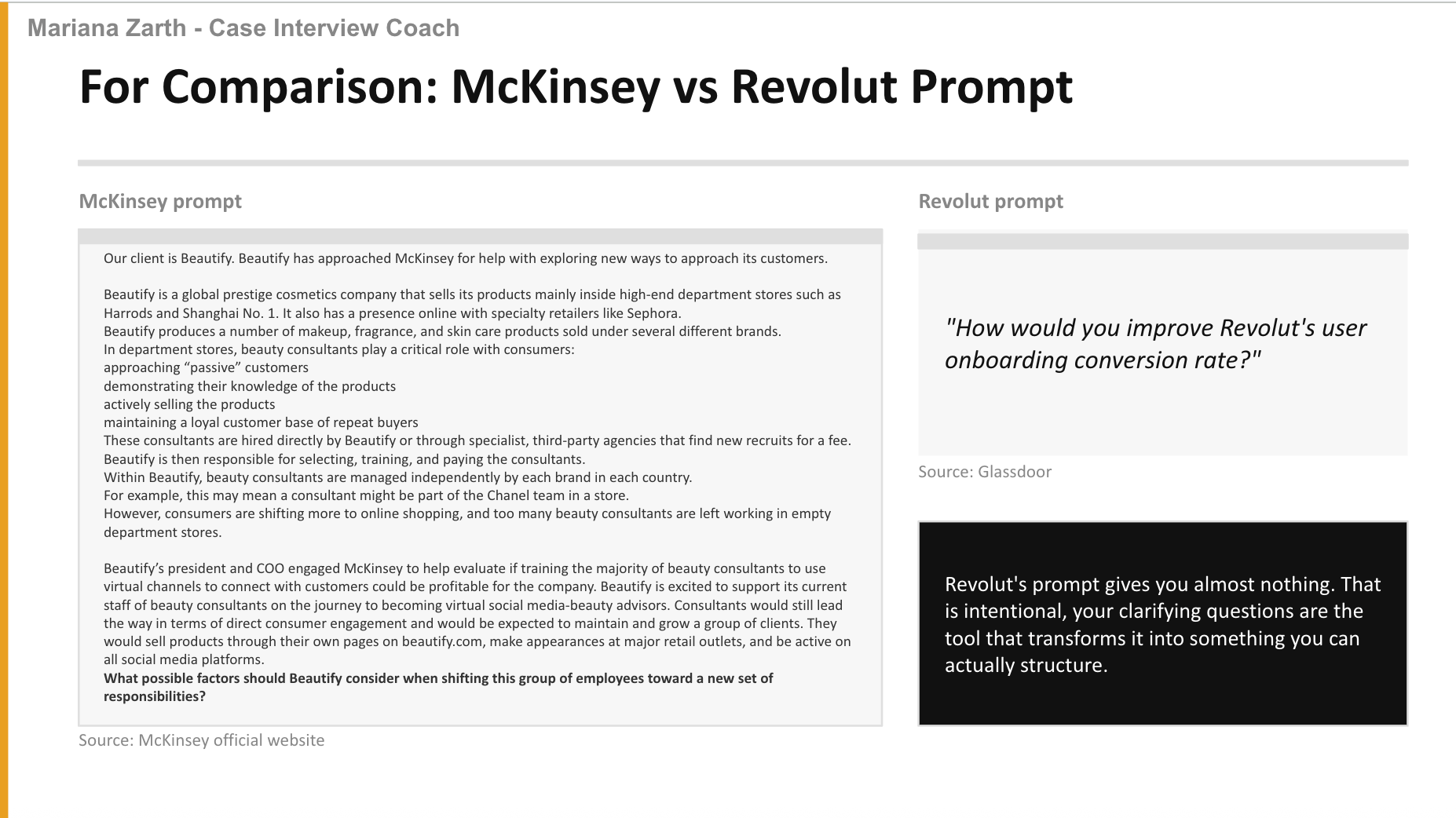
Considering this, before touching the problem, a strong candidate asks questions to better define the problem.
Clarifying questions serve a specific purpose: they establish what the problem actually is, what success looks like, and where the analysis should focus. Without them, you risk building a beautiful structure around the wrong problem.
There are four dimensions worth covering in every case:
The data you collect here is not just for orientation. It directly shapes your structure, telling you which branches to go deep on and which to deprioritise before you even start building and also guide you later in the case, during the brainstorm session.
Structure is what turns an ambiguous question into a solvable problem. The goal is to build an issue tree: a breakdown of the problem into mutually exclusive, collectively exhaustive (MECE) components, each of which can be confirmed or ruled out with data.
Think of it like a doctor diagnosing a patient. When someone presents with unexplained weight gain, a good doctor doesn't guess, they break the problem down logically. See one example of how to breakdown this problem below:
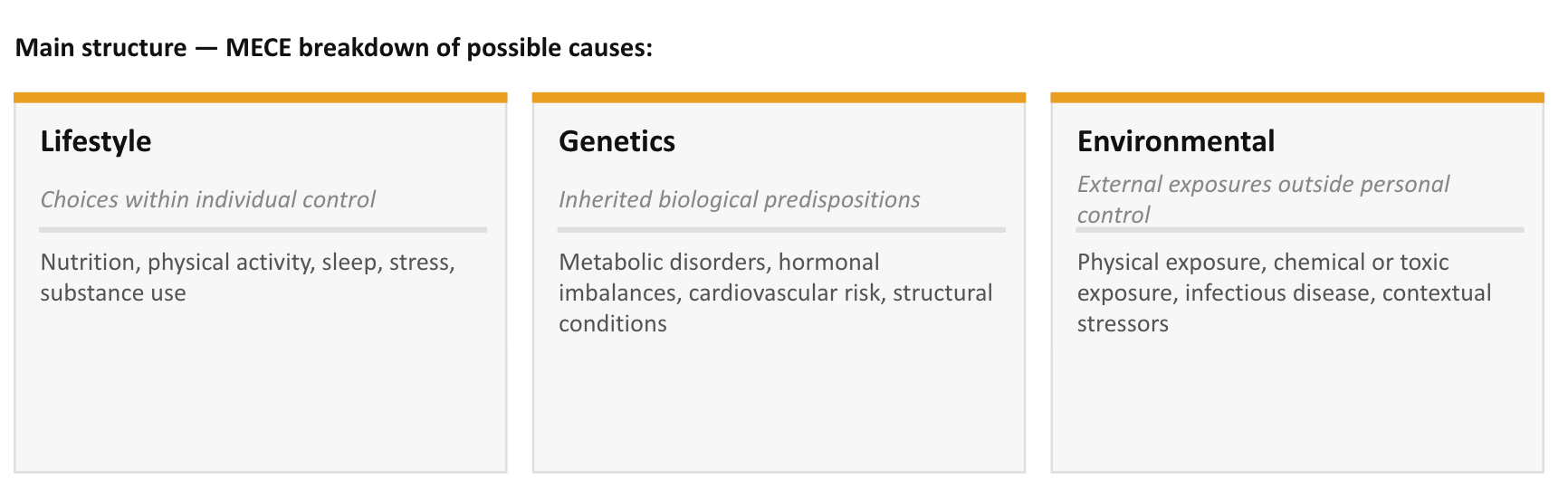
Each branch is independent. Together they cover all possible explanations. The doctor then prioritises based on what's most likely given the patient's profile and consultation (the clarifying questions), goes deep on that branch first, and only expands if needed.
After defining how you would break down the structure, you will fill it with hypotheses of what may contribute to the problem. These hypotheses must be testable, which means you need to ask for data to either confirm them or rule them out. See below one example of hypotheses and their corresponding data requests.
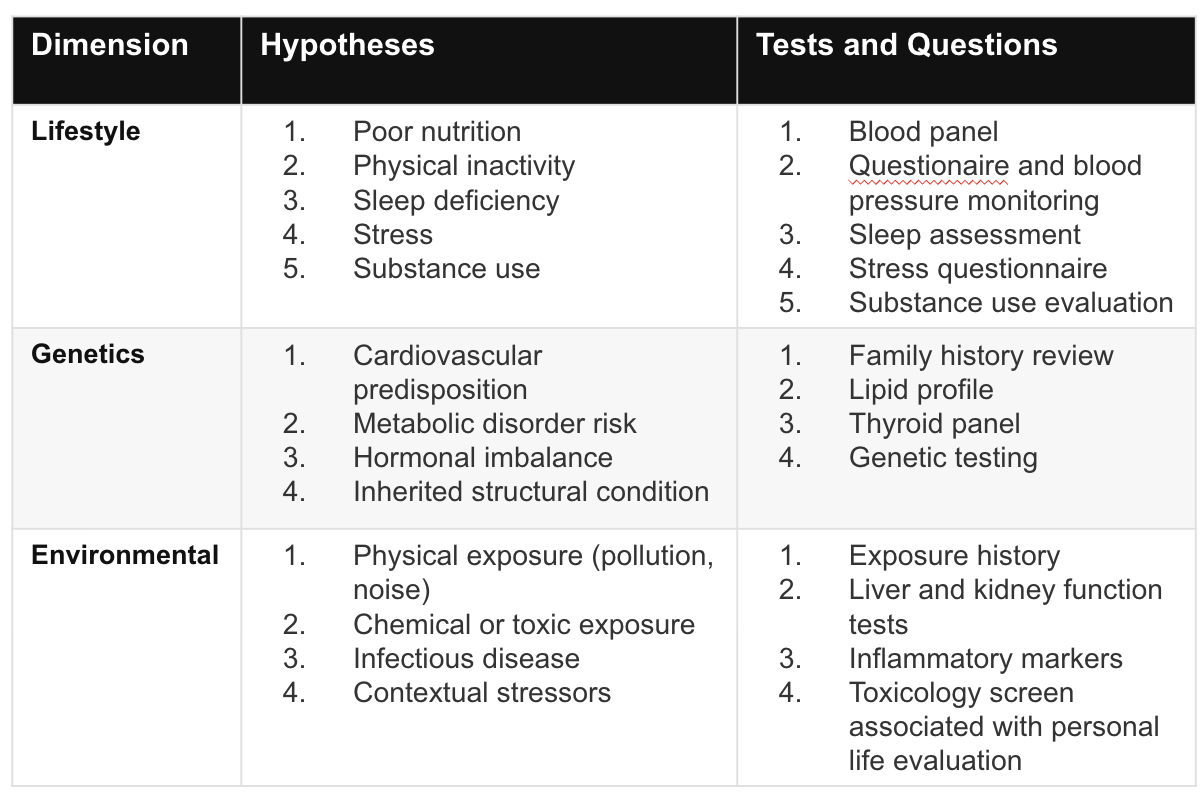
There are three types of issue trees you'll need:
Logic-based: Used when the problem requires causal reasoning. Why is something happening? Each branch represents a distinct logical possibility. Example: churn is increasing either because users are choosing to leave, or because they're being forced out.
Quantitative (equation-based): Used when the metric can be expressed as a meaningful equation. Profit = Revenue − Costs. If profit has declined, the cause must be in one of those two variables, and the equation tells you exactly where to look and prioritize after deep diving the first layer.
Flow-based (process or funnel): Used when the problem sits within a sequential process. Usually found in ops or product problems. If conversion of a particular operational process is low, for example, the problem may be concentrated at specific stages. The data will tell you which one.
See that prioritization is required for you to have an efficient structure that will allow you to solve the case on time.
A common mistake is building a perfectly symmetrical tree, equal depth on every branch, regardless of what the data says. That signals a lack of judgement. A strong candidate deliberately prioritises branches that the clarifying questions have already signed as the ones that may be hiding the problem, and explains why.
Math in the PS interview is not about mental arithmetic, you'll be allowed to use a calculator and in some cases, even excel (make sure to ask your interviewer about it). It's about knowing when a calculation is needed, structuring it correctly, and using the result to make a decision.
Math problems typically appear after a root cause or potential solution has been identified. The question being answered is almost always one of: how significant is this? or is this worth solving?
A repeatable 5-step approach:
The fifth step is where most candidates lose points. A number without an interpretation is not an insight. Always connect the result back to the case objective: does this close the gap? Is it large enough to prioritise?
Once a root cause is confirmed and sized, the case moves to solutions. Most candidates revert to free brainstorming here, listing whatever comes to mind. This produces generic ideas that are hard to prioritise and often don't address the actual root cause.
A strong candidate structures their ideas before generating them, organizing them in common themes or full structures.
Regardless of the structure, two additional steps are essential:
Prioritisation and validation: Not all ideas are equal. Rank your top ones based on potential impact relative to the constraints established during clarifying questions. Always check with your interviewer if that initiative is valid and bring risks and potential constraints before going deep on any single idea, treating them as hypotheses.
Implementation: That's one step that Revolut really values, as they want to see if you're able to take an idea out of the paper and make it happen. Before closing the case, a strong candidate moves beyond the 'what to do' and addresses the 'how to do it', naming the team or function responsible, the concrete action plan, and a realistic timeline given the constraints already established. For example, if one of the solutions prioritised to improve conversion rate of a product is to place its widget on the front page, you may say: “[Considering we have a green light to move with this initiative] I would recommend running a two-week A/B test with a valid sample size, half seeing the widget on the front page, half in its current position. If CTR improves in a statistically significant way, we have sufficient evidence to roll out to the full base.”
KPIs: For each prioritised solution, define at least one primary KPI (does this achieve the goal and is sustainable in the long term?) This signals that you're thinking beyond the immediate fix.
After coaching dozens of candidates, these are by far the most common mistakes that prevent some to move forward the process:
The PS interview is highly learnable. The frameworks are not complex, but applying them consistently under pressure, with real data, in a candidate-led format, requires deliberate practice.
However, most candidates preparing for Revolut face the same challenge: very limited preparation time, little to no role-specific material, and uncertainty about what interviewers actually expect.
If you want a structured, efficient end-to-end preparation resource built specifically for Revolut's PS process covering clarifying questions, the most common types of issue trees, math problem types, and solution generation with worked exercises, find a full Revolut course here:
👉 Revolut Problem-Solving Interview — Complete Preparation Course
If you'd prefer personalised guidance, I also offer 1:1 coaching sessions tailored to your specific profile, target role, and current level.
Written by Mariana, former McKinsey consultant and Nubank Senior Product Ops Manager.
#1 Revolut PS interview coach on PrepLounge, with a Problem Solving pass rate 4X higher than the UK benchmark.









Mariana is a case interview coach on PrepLounge and a former McKinsey consultant. She supports candidates throughout the consulting recruiting process – from crafting impactful CVs to mastering fit and case interviews – with a strong focus on structure, communication, and confidence.