



Investment Banks in Dubai 2025: Your Complete Career Guide
Dubai is attracting growing interest from aspiring and experienced investment bankers alike and it’s easy to see why. With tax-free salaries, international deal flow, and a vibrant expat lifestyle, the city offers some real advantages. But behind the skyline views and beach weekends, the market is tough, competitive, and selective.
Breaking into investment banking in Dubai takes more than ambition. Roles at top firms are limited, and expectations around hours, output, and experience are just as demanding as in New York or London.
In this guide, we weigh the upsides and downsides of pursuing a banking career in Dubai. You’ll get a clear overview of the most important banks operating in the region, work culture, deals, exit opportunities, and what compensation typically looks like.
To help you take action, we’ve included a step-by-step career plan to improve your chances of landing an investment banking job in Dubai. By the end, you'll have a realistic and structured view of the market and a clear sense of whether this path fits your long-term goals.
Dubai’s investment banking market is growing fast and setting itself apart on the global stage. In 2024, deal volume reached $92.3 billion, up 7% year-over-year, even as global markets declined. With 701 deals, Dubai accounted for 5–10% of Asia-Pacific’s deal flow, putting it on par with Canada's entire IB market. The UAE now commands 40% of regional investment banking fees, with Dubai firmly established as the core hub.
Three sectors are driving this momentum:
Technology leads in deal count, contributing 23% of total volume, boosted by initiatives like the city’s expanding AI Campus.
Insurance took the spotlight in 2024, making up 34% of total deal value—reflecting a surge in strategic M&A activity.
Energy remains a core driver, accounting for 37% of domestic deals, including several high-value infrastructure transactions.
Policy support continues to fuel growth. The Dubai Economic Agenda D33 targets a AED 32 trillion economy by 2033. Meanwhile, the Dubai International Financial Centre (DIFC) hosts 6,920 companies, with total revenue up 37% year-on-year to AED 1.78 billion.
Recruiters describe 2025 as a “bonkers” hiring year. After the post-pandemic slowdown, banks are aggressively expanding lean teams. The result? Faster career progression. At bulge bracket banks in Dubai, promotion to VP typically takes 5.5 years. This is a full year faster than the norm in traditional markets like London or New York.

Land your top job with PrepLounge!
Sign up now for free and get access to our Q&A, top coaches, preparation tools and much more.
The Dubai Advantage: 5 Proven Upsides with Real Numbers
Dubai has rapidly established itself as a serious alternative to more traditional financial hubs. From unmatched tax benefits to accelerated career progression, the city offers measurable advantages that directly impact both compensation and professional growth.
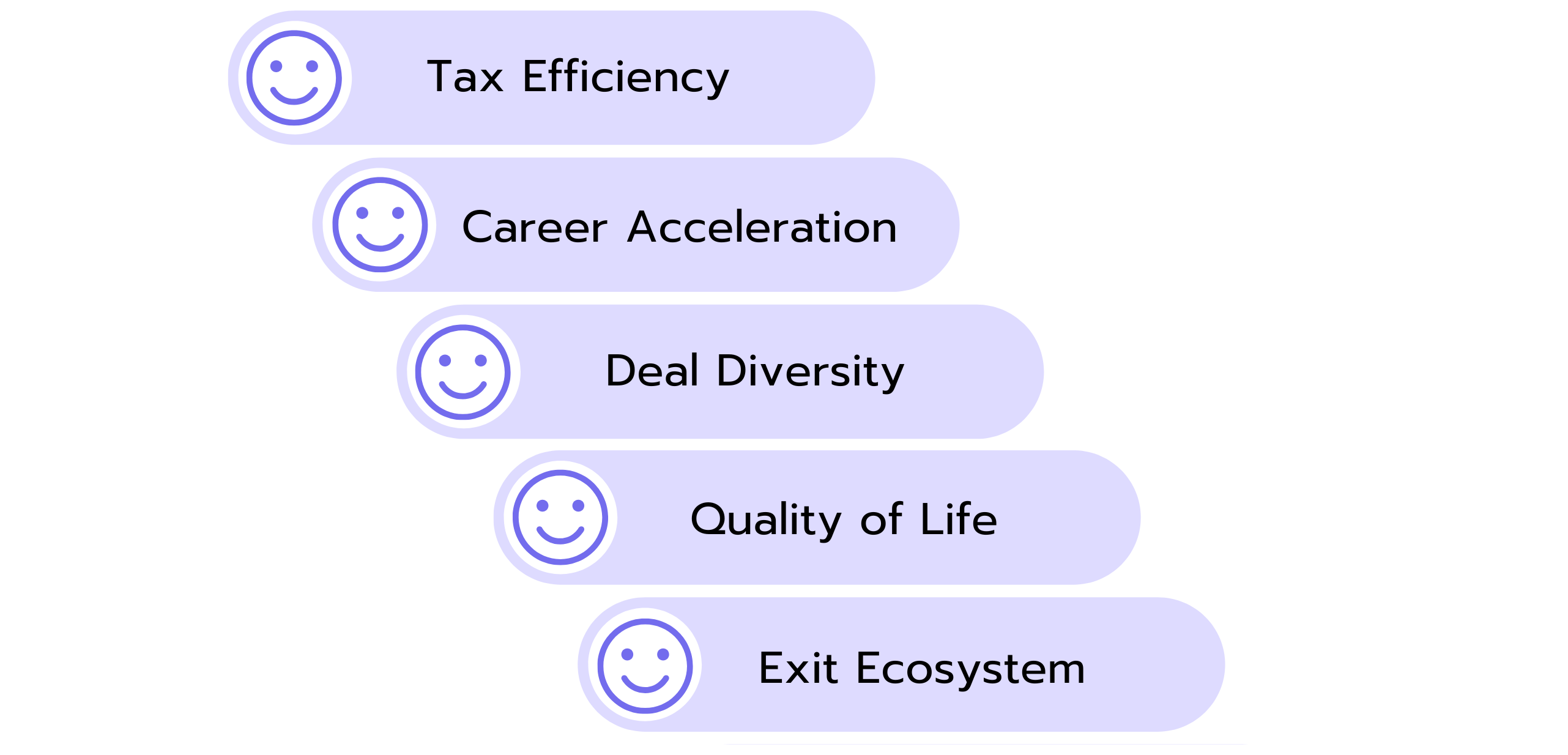
Dubai's Tax Efficiency
Zero personal income tax transforms compensation packages. An analyst earning $90,000 saves approximately $45,000 annually compared to London peers. Associates save $65,000, VPs save $120,000, and MDs can save $400,000+ depending on total compensation.
Career Acceleration in Dubai
Dubai promotes VPs in 5.5 years on average versus 6.5 years in major financial centers. Bank of America, Barclays, and UBS consistently demonstrate faster advancement timelines. Smaller team sizes mean high performers gain visibility and become indispensable faster.
Dubai's Deal Diversity
Regional exposure spans 15+ countries with unique transaction types. Dubai bankers work on sovereign wealth fund deals, government infrastructure projects, and cross-border M&As. These involve entities like ADIA, PIF, and Mubadala that colleagues in traditional centers rarely see.
Quality of Life
Dubai ranks among the world's safest cities with exceptional infrastructure. Sunny all year, this strategic travel hub connects 2.5 billion people in four hours. With over 90% expatriates, it fosters a global professional atmosphere.
Exit Ecosystem
The region now hosts 150+ private equity firms, 75 hedge funds in DIFC, and major sovereign wealth funds actively hiring ex-bankers. Buy-side opportunities grew a lot. Institutions like ADIA, which manages $993 billion, are hiring professionals trained in Dubai.
Risk Dashboard: 5 Hard Truths You Must Navigate in Dubai's IB
For all its upsides, Dubai banking comes with real challenges. Market limitations, an intense working culture, and regulatory hurdles shape the environment. Professionals must weigh these factors carefully before making the move.
Dubai's Market Size Reality
MENA's $50-100 billion annual M&A volume equals just 5-10% of Asia-Pacific activity. Fewer large-cap deals mean limited product variety and less frequent transactions. The largest MENA deal in 2024 would be routine in New York but represents a rare mega-transaction regionally.
Work Culture Intensity
Expect 70-80 hour standard weeks with 100+ hour surges during live mandates. Regional clients sometimes require more guidance throughout the deal process compared to clients in more mature markets. Teams run lean, so junior bankers shoulder heavy workloads without backup.
Entry Bottleneck in Dubai
Across all banks in Dubai, only a few dozen analyst roles open up each year. JPMorgan might hire 2-3 analysts, Goldman Sachs 1-2, compared to 100+ person analyst classes in New York. Most positions fill through off-cycle processes rather than structured recruiting.
Dubai's Regulatory Complexity
Banks navigate four UAE regulators: DFSA, FSRA, SCA, and Central Bank. The Dubai Financial Services Authority issued over $2.5 million in fines in 2024, demonstrating strict enforcement. Compliance costs exceed single-jurisdiction markets.
Perception Discount
UK and US recruiters sometimes discount Dubai experience when candidates seek to return to traditional centers. While unfair, this bias makes mobility harder. Mitigation requires maintaining global connections and highlighting transferable skills from sovereign wealth fund transactions.
Other things to think about are August heat reaching 45°C, weekend sync shifts, and changing expat social dynamics.
Top Investment Banks in Dubai
Dubai’s investment banking scene is shaped by a mix of global giants, elite boutiques, regional champions, and emerging players. Understanding where each bank sits in the market, and what they focus on, can help you prioritize your applications and tailor your preparation.
Global Powerhouses (Market Leaders)
These are the dominant players in Dubai’s M&A and capital markets landscape. They handle the region’s largest and most complex transactions.

J.P. Morgan
J.P. Morgan consistently tops MENA M&A league tables, having closed more than 20 deals in 2023. The Dubai office hires just 2–4 analysts annually, making the process one of the most competitive in the region.

Goldman Sachs operates from Level 7 in the DIFC and has been rebuilding its presence in the Gulf following the resolution of legacy compliance issues. The firm is especially active in equity capital markets and lean deal teams mean early exposure for junior bankers.
Morgan Stanley expanded its regional footprint with a new Abu Dhabi office in early 2024, complementing its Dubai-based team. The firm covers clients across energy, infrastructure, and sovereign wealth.
Bank of America is gaining momentum in the region, jumping from 11th to 5th place in MENA investment banking rankings. Its team, based in Brookfield Place, has been actively hiring VPs and analysts to support growing deal flow.
Citigroup brings over 60 years of experience in the UAE and operates out of its DIFC headquarters. Known for strong capabilities in structured finance, Citi remains a key player in both public and private transactions across the region.
Boutique banks in Dubai offer smaller teams, faster responsibility, and direct involvement in high-profile transactions.
Rothschild & Co
Rothschild & Co leads the boutique segment with more than 175 MENA transactions worth over $100 billion since 2010. The firm is known for full in-house execution and strong analyst development.

Moelis & Company
Moelis & Company maintains a robust regional presence, having advised on landmark deals such as the Aramco IPO. It offers full execution capabilities in-house and is known for offering top-quartile bonuses.
Lazard
Lazard is active in Dubai through selective mandates, especially in infrastructure and energy transition sectors. While much of its regional coverage is led from London, its Dubai team has been growing steadily.

Houlihan Lokey is a restructuring powerhouse in the region. The firm is especially active in mid-market transactions and special situations, with strong coverage across the GCC.
Regional Champions in Dubai (Local Advantage)
These banks leverage local connections, regulatory familiarity, and long-term government relationships to stay competitive.
First Abu Dhabi Bank
First Abu Dhabi Bank (FAB) is the largest financial institution in the UAE and dominates local bond markets. It plays a leading role in syndicated lending and fixed-income issuance.
Emirates NBD Capital
Emirates NBD Capital has earned recognition as the “Best Investment Bank in the UAE,” according to Euromoney. It is particularly strong in debt capital markets and project finance.
Dubai's Emerging Players
While newer to the Dubai scene, these firms are expanding their presence and offer opportunities in specific market segments.

CICC
CICC opened its DIFC branch in May 2025 and is targeting China–Gulf corridor transactions. It focuses on cross-border advisory and outbound M&A, especially with Chinese state-owned clients.

BNP Paribas
BNP Paribas maintains a stable presence in the region with a focus on trade finance, structured lending, and treasury services.
Standard Chartered leverages its deep roots in emerging markets to serve clients across the Middle East, Africa, and South Asia. In Dubai, the bank focuses primarily on trade finance and debt advisory, with selective involvement in strategic transactions.

Investment Banking in Dubai: Compensation Overview
Entry-level base salaries for analysts in Dubai typically range from AED 240,000 to 420,000 per year, depending on the bank’s tier and the role’s specific focus (e.g., M&A vs. coverage). In addition to base pay, analysts usually receive an annual bonus of 50–70%, with high performers at elite boutiques occasionally exceeding that range.
Elite boutiques like Rothschild and Moelis tend to offer higher total compensation than bulge brackets, often 10–15% more, due to their leaner teams and performance-linked reward structures. At these firms, analysts can also expect earlier exposure to deal execution and direct client work, which adds long-term value to their career trajectory.
Bulge bracket banks offer more standardized compensation structures, along with larger benefits packages, including housing support, relocation allowances, and medical coverage. While bonuses are sometimes slightly lower than those at boutiques, the brand name, training, and global mobility options can add significant non-monetary value.
Mid-level professionals (e.g., Associates and VPs) see meaningful jumps in compensation. Associates typically earn AED 550,000 to 750,000 base, with bonuses pushing total comp well into the seven-figure AED range. VPs and Directors in high-performing teams can earn AED 1.2M+ annually, depending on the platform and deal flow.
Dubai Investment Banking Entry Guide: Your 5-Stage Action Plan
Breaking into Dubai’s investment banking market takes more than strong credentials. With limited graduate roles and high competition, a focused and strategic approach is key. Here’s a clear five-stage framework to help you position yourself effectively and build long-term success in the region.
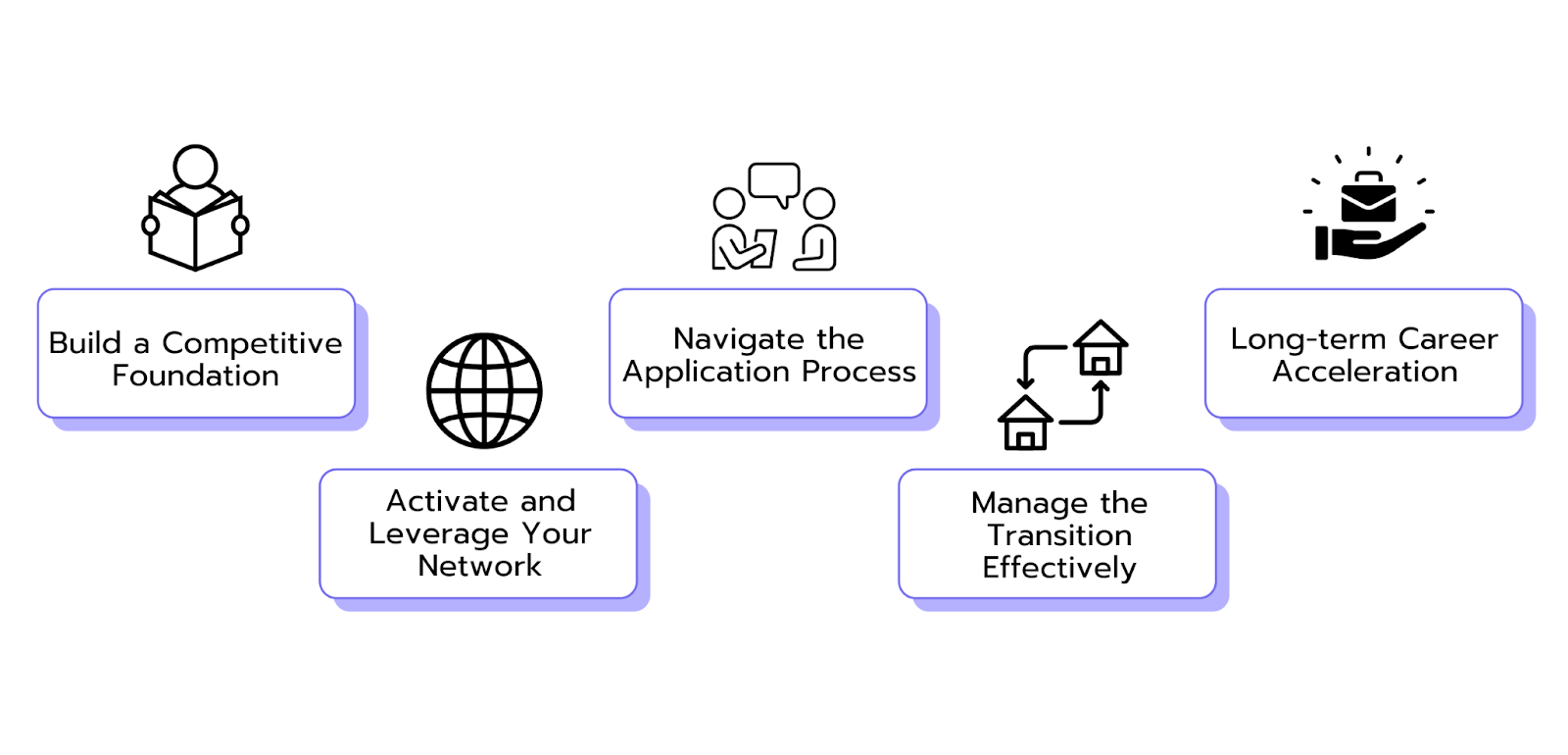
Stage 1: Build a Competitive Foundation
Strong academic credentials are essential. Target top-tier institutions such as the Ivy League, Oxbridge, or respected regional alternatives like London Business School’s Dubai campus. Beyond academics, focus on technical preparation.
Use targeted resources to sharpen your modeling skills and case interview performance, especially with Dubai-specific deal examples. Understanding local business etiquette and cultural dynamics is also crucial. While English is the main working language, basic Arabic skills can provide a useful edge in client interactions.
Stage 2: Activate and Leverage Your Network
Dubai’s compact geography and tight-knit business environment make in-person networking unusually effective. Attend events at DIFC, join finance communities, and schedule informal coffee chats.
Alumni from your university or past employers are particularly valuable, as Gulf markets are highly relationship-driven. Practice mock interviews with peers who are also targeting Dubai to sharpen your pitch.
Recruiting in Dubai often happens off-cycle, with openings appearing suddenly and closing within days. Regularly check bank career portals and be ready to submit high-quality applications at short notice. Interviews in Dubai tend to be rigorous.
Expect case-style technical questions, 90-minute modeling tests, and detailed market discussions. If graduate roles prove difficult to access directly, consider building 1–2 years of experience elsewhere, then applying for a lateral transfer.
👉 Want to stand out in your interview? Choose from a variety of cases to practice from our case library!

Sie wurden vom Vorstand der Global Plastics AG beauftragt, die wirtschaftliche Performance der Unternehmens-Gruppe im Rahmen eines Independent Business Review (IBR) zu analysieren und das Management zu beraten. Das Unternehmen ist seit dem 1. Januar 2019 durch eine Kontokorrentlinie i.H.v. € 150,0 Mio. finanziert. Darüber hinaus gibt es keine weiteren Verbindlichkeiten gegenüber Kreditinstituten. Das finanzierende Bankenkonsortium hat aufgrund schlechter Quartalszahlen und einer angespannten Marktlage eine Validierung der Mittelfristplanung angefordert.
Die Global Plastics AG produziert weltweit in 5 Werken Kunststoffbauteile für Fahrzeuginnenräume in den Anwendungsbereichen PKW (PT-Segment), LKW (CT-Segment) sowie Land- (AG-Segment) und Baumaschinen (CON-Segment). Global Plastics beliefert primär deutsche Premium-OEMs und gilt als Qualitätsführer im Interior-Markt. Das Unternehmen nutzt dabei patentierte Technologien in den Bereichen Spritzguss, Kunststoffgalvanik sowie Heißprägung. Der Interior-Markt ist zunehmend von einem Preisdruck durch asiatische Wettbewerber geprägt, die den Qualitätsansprüchen europäischer Kunden immer besser entsprechen.
Die Global Plastics AG hat Ihnen zur Analyse ihre GuV und Bilanz zur Verfügung gestellt. Dort sind die Ergebnisse der Geschäftsjahre 2019 bis 2021 sowie der Forecast des Geschäftsjahres 2022 enthalten.
Bitte lösen Sie die unten aufgeführten Aufgaben.
Cruise company German Sea Tours (GST) is a successful operator of international cruises. GST currently offers several cruise trips, lasting between 5 and 24 days. Additional services can be booked on board (e.g. excursions at each destination, onboard leisure activities). Customers tend to book their tickets several months in advance. GST has had a long history of revenue growth, but in the past five years, it showed lower growth rates. Board members are not sure whether the market, in general, saw lower growth or whether the problem is specific to GST. GST recognizes that winning new customers and stimulating existing customers to book their vacations with GST is crucial for future growth and therefore has always focused on keeping a close relationship with its (potential) cruise-trip bookers. GST’s chief commercial officer (CCO) Ms. Brown has hired Simon-Kucher & Partners to assess the market environment and competitive positioning for cruise ships and to conduct a subsequent evaluation of potential growth options.
TrainCo is a manufacturer of rolling stock, or trains, with production sites in three European countries. The company has seen declining profitability over the past years; however, they are currently in a very good position to bid for and win a big contract for regional trains for a Swiss national rail company. They have asked you advise to them on whether they should place a bid for the contract.
A leading online real estate marketplace in Germany – your-new-home.com – is struggling with stagnating sales after many years of high growth rates. In a preliminary project with EY-Parthenon, the market environment has already been examined in detail – competitors, new entrants, customer needs, etc.
As a result, you are asked to identify growth areas and quantify the potential sales uplift for the management.
A major juice producer sells packaged fruit juice to retail outlets. Normally, the juice is packed and sold in 16-ounce carton containers, but recently the producer added a new machine that packages the juice in 32-ounce plastic containers. So he was selling both the 16-ounce & the 32-ounce products. This allowed the business to grow 18% per year, but as sales continued to rise, profits kept falling.
The producer hired us to figure out why profits are falling despite higher revenues.
The CIO of a major insurance company needs your support to renew the company's IT landscape as a starting point for their digital transformation.
The IT landscape of the client is highly fragmented and integrated. Most IT applications are "legacy" monolithic custom developments (running on Mainframe) and are hosted on-premise.
There are issues with stability and scalability of applications plus IT costs are ever increasing "Time-to-market" to release new functionalities is too high, due to constraints of current architecture.
You are asked to quickly assess the status quo, identify main areas of intervention and measures to address the pain points and renew the IT landscape.
Note: This case is interviewer-led. The cases in our interviews are more candidate-led. In this case, you take the lead and manage the entire case from start to finish. So be prepared for this when you apply to us.
Du befindest Dich derzeit in einem strategischen Projekteinsatz bei der Northern Retail Bank (NRB), die vor drei Jahren von einem Finanzinvestor übernommen wurde. Während des Mittagessens lädt Dich der CEO zu einem Espresso in sein Büro ein.
Dort erläutert er, dass der Finanzinvestor bestrebt ist, den Unternehmenswert der Bank zu steigern – möglicherweise für einen künftigen Verkauf oder Börsengang, weitere Details stehen zum jetzigen Zeitpunkt noch nicht fest. Gemeinsam mit Deinem Projektteam sollst Du nun Maßnahmen entwickeln, um die Profitabilität der Bank zu verbessern. Angesichts der Ergebnisse des letzten Geschäftsjahres und des intensiven Wettbewerbsdrucks sieht der CEO hier dringenden Handlungsbedarf.
Der CEO bittet Dich darum, in 30–45 Minuten in sein Büro zurückzukommen, um Deine fachkundige Einschätzung für erste konkrete Stellhebel zu diskutieren.
You are part of the Strategy & Operations team at Revolut.
Revolut has had significant growth over the past couple of years, with customer base growing 20-30% per year. Our apps have also been highly rated in the various app stores - be it GooglePlay or on the Apple store.
Revolut's current customer strategy is to segment customers based on their subscription tiers/plans.
- Standard: Free
- Plus: $3.99/mth
- Premium: $7.99/mth
- Metal: $14.99/mth
- Ultra: Ultra $55/mth
Key differentiation between the plans are in the pricing and features. Namely, the more expensive tiers like Metal and Ultra have additional features such as personalized and premium card design, free access to lifestyle apps (e.g. Financial Times, Class Pass etc), better FX rates and priority customer support.
It's great that Revolut has been expanding rapidly, but we are starting to see some stresses on our existing operations and processes. One key area of concern is in customer service, our satisfaction scores have started to trend down and call center headcounts and costs have been increasing in recent years, but we are struggling to handle the load of incoming requests and tickets.
You have been tasked to lead a project to solve this problem without ballooning costs.
[PLEASE NOTE: This is a technically difficult case and should only be completed by those coming in as a Technology specialist, i.e. recruiting for McKinsey Digital, BCG Platinion, etc.]
Our client is a multinational oil and gas company. While they are vertically integrated and have upstream, midstream, and downstream divisions, they have recently been experiencing competitivity issues in the upstream gas division, which brings in $1B in profits annually.
Our client’s upstream division has offices in Australia and Indonesia. Their work is highly dependent on their IT systems, as they have to constantly monitor wells and pipes (pressure, hydrocarbon count, fluid makeup, etc.)
The upstream division has two large legacies of IT systems that are primarily used for downstream operations but have been modified for upstream purposes.
These systems are managed by a central team in the US which is responsible for all IT issues across the business. They triage issues/enhancements and then manage development teams in India and Finland who complete the work.
Climate change has become one of the biggest challenges in the 21st century, and with roughly 75% of all CO₂ emissions coming from energy, this sector plays a key role in the transition to a reduced carbon footprint. E.ON has taken up on the challenge to promote more sustainable and efficient energy solutions throughout its whole customer spectrum. Correspondingly, a shift towards more sustainable energy consumption is noticed across the globe with many cities having set themselves ambitious climate targets, among those are:
- Copenhagen -100% CO₂ emissions by 2025
- Amsterdam -60% CO₂ emission by 2030
- New York -40% CO₂ emissions by 2030
With E.ON focusing entirely on the “new” energy world, we have become the partner of choice for solutions propelling the energy transitions. Mr. Jensen, the mayor of Essen has come to E.ON requesting our help to accelerate the transition for his city.
Essen is a city with about 600,000 inhabitants and prides itself as a forward-thinking one with lots of ambitions to become green itself. The economy is well and with his freshly won election the mayor looks forward to put its promised big initiatives into real projects.
Fast Dish, a publicly traded Quick Service Restaurant (Franchise) company with over €20 billion in revenue and more than 20.000 restaurants globally, has recently faced major challenges with regards to supply chain management and sustainability.
The client's top management has engaged the SCM and procurement specialized consultancy Inverto to advise the company in this critical situation.
"FemVest" is a venture-backed fintech aiming to launch a mobile neobroker in Germany in 2026. The company believes that women are structurally underserved in the area of retail investing: women are less likely to hold a securities account, invest smaller amounts on average, and enter the market later than men. At the same time, the financial relevance of women is growing — driven by rising incomes, demographic shifts, and inheritances.
FemVest has already secured regulatory approval as well as a custodian bank and execution partner. However, key strategic decisions remain open: the target segment has not been finalized, the product and service offering is not yet defined, the business model has not been established, and the go-to-market strategy has not yet been developed.
The board is asking you, as a consultant, to analyze the market potential, develop an initial business case, and derive concrete strategic recommendations for market entry.
Your client is the Government of Indonesia, specifically a joint committee formed between a few key ministries including the Ministry of Marine Affairs & Fisheries, Ministry of Tourism and Ministry of Environment & Forestry.
Indonesia is one of the largest developing countries in the world, with a population of about 285M people and an average monthly income of only USD 500. Located in Southeast Asia, Indonesia is actually a vast archipelago comprised of 17,000 islands, giving it one of the longest and most complex coastlines in the world. It is also part of the Coral Triangle, an area demarcated by scientists as the global epicenter of marine diversity.
Your client tells you that Indonesia's once pristine coral reefs have seen a rapid decline over the past decade. They have come to you for help and want to figure out what is causing the problem.
Our client is a national US fitness chain with roughly 200 clubs and around $600m in annual revenue. Over the last three years revenue has grown steadily, but profit has remained broadly flat over the same period.
The board has asked one question: why has the revenue growth not translated into higher profit, and what should the client do about it?
This set of questions is designed to help you prepare for the most common valuation topics in finance interviews. It covers the basics (like DCF, comparables, and multiples) but also includes practical scenarios that test whether you can apply these concepts in context.
Set aside about 30–35 minutes to go through everything. For each question, you’ll find a clear model answer to check your reasoning and deepen your technical knowledge.
Our client is a college that plans to add an inter-collegiate football team to its athletic program.
They have approached us in order to determine if that is a good idea.
A large natural gas field is unexpectedly discovered on the Mediterranean island of Corsica. The gas can be accessed and produced relatively easily and is of good quality. Europe, and especially Germany as the largest gas consumer in the EU, is looking for alternative gas suppliers to reduce its one-sided dependence on Russia. An initial market study has shown that stable demand in Western Europe would allow for around 10 billion cubic meters (bcm) of natural gas per year from the new gas field to be sold on the European market for the next 25 years.
To achieve this, however, the gas must be transported to the important Western European gas hub Baumgarten in Austria. Several large oil and gas companies sense a business opportunity here and are now asking themselves whether it is economically feasible to build a corresponding gas pipeline from Corsica to Austria.
One of these companies has approached you as a consultant to provide your assessment.
Our client is Multifit, a producer of vitamin pills.
Their primary customers are health stores and pharmacies. Right now they are considering entering the health foods and beverages market.
Your task is to give them a recommendation on what they should do.
Your client, large automotive OEM WyCar, has developed its first fully electric vehicle (EV) and introduced it as a pilot on the Austrian market last year. However, sales have been far below the expected numbers. The management has engaged you to support them in understanding the reasons and advise them on how to adjust the product offering.
This question set sharpens your understanding of advanced accounting topics essential for finance roles. It covers areas like stock-based compensation, deferred taxes, goodwill impairment, and working capital.
Plan for 35–45 minutes to complete the set. Use the model answers to check your reasoning and improve how clearly you explain complex accounting concepts.
Once you secure an offer, start preparing early for the logistics. Employment visas, housing arrangements, and setting up local banking can take time, especially if you're relocating from abroad. Discuss internal performance expectations during onboarding, as review timelines and promotion paths may differ from those in London or New York. If you're moving within a global bank, clarify regional mobility options upfront.
Stage 5: Long-term Career Acceleration
Career growth in Dubai depends on more than technical skill. In lean teams, standing out means building strong client relationships, sourcing deals, and taking ownership early. Focus on developing connections with sovereign wealth funds and family offices, which play a key role in the region’s deal flow. At the same time, keep an eye on longer-term mobility options through internal transfer programs.
Key Takeaways
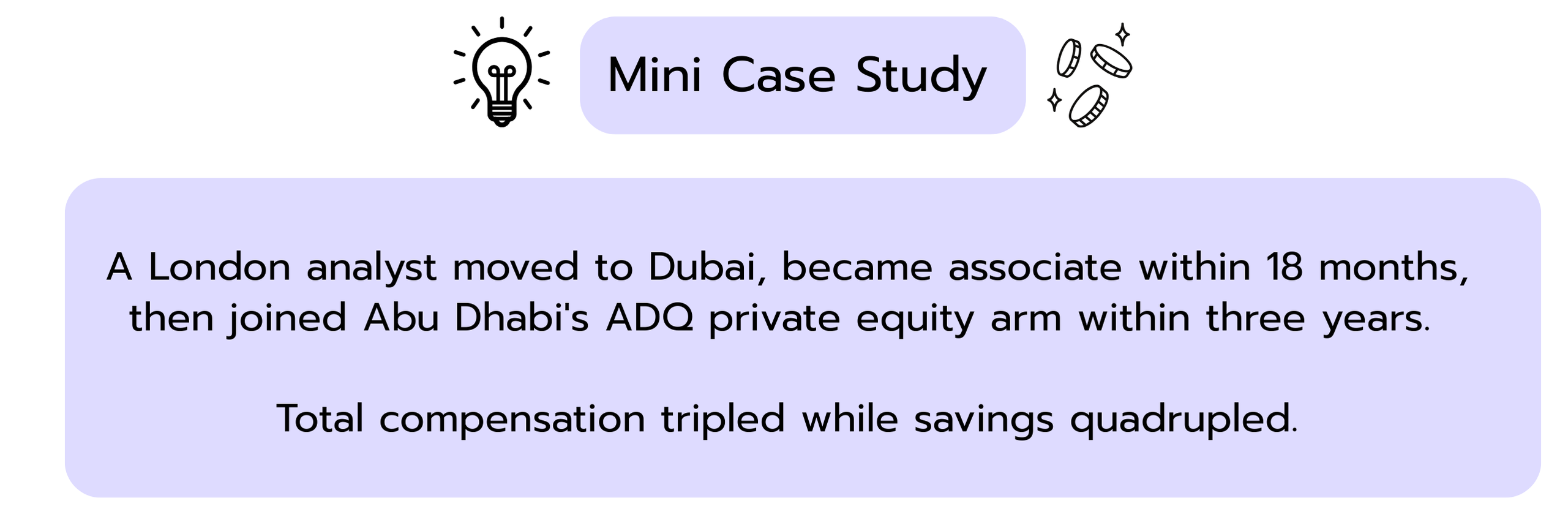
A move to Dubai can pay off: tax savings for Vice Presidents often exceed $120,000 per year, adding up to $600,000+ over five years. Combined with faster promotions and regional exits, the upside is clear.
Fit matters though. Dubai suits mid-career bankers (with 3-10 years of experience) aiming to maximize earnings, gain international exposure, and work with sovereign and family office clients. It’s less ideal for new grads without a network, those focused on work-life balance, or anyone planning a quick return to Western markets.
For many, the best path is to build experience in London or New York first, then lateral to Dubai once you have a stronger foundation.