Strong entry-level pay in Singapore: Investment banking analysts earn base salaries of SGD 100K to 150K, with total compensation around SGD 190K including bonuses.
Bulge-bracket banks pay the most: Large international firms lead on compensation, while elite boutiques can be competitive and local banks generally pay less.
Pay rises quickly with experience: Salaries increase significantly over time, with managing directors earning SGD 500K or more per year.
Are you curious about how much investment bankers are paid in Singapore? Generally, IB analysts earn an average basic pay of $100K - $150K per year. The total compensation can reach $190,000 or more when bonuses are added.
However, the exact salary that an investment banker takes home can vary depending on various factors like the firm, experience, and job rank. Read on to discover everything you need to know about IB salaries in Singapore, and make informed decisions about your finance career.
How Is the Salary Structured in Investment Banking?
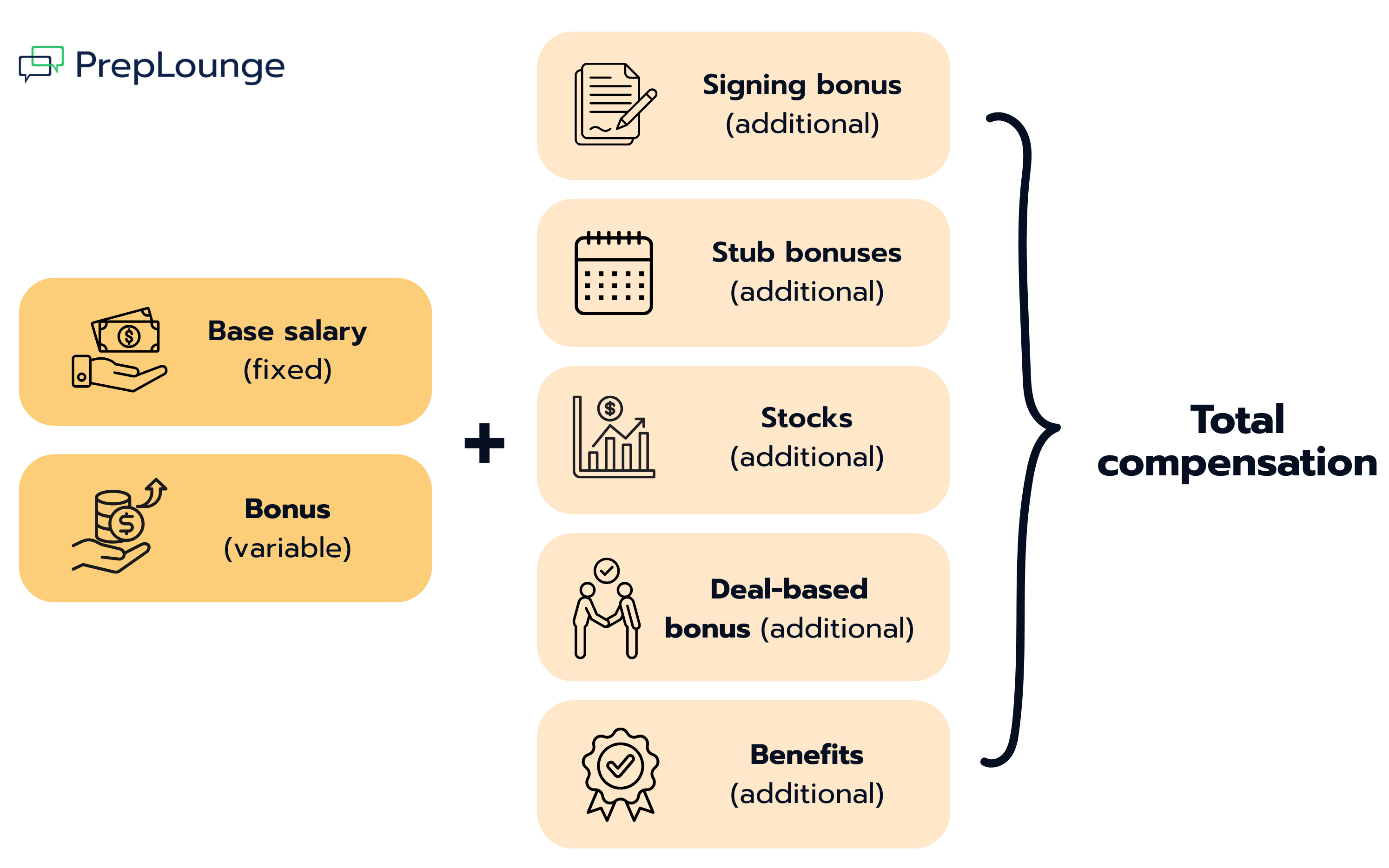
An investment banker's salary in Singapore consists of two main components:
Base salary: This is a fixed amount paid regularly, usually monthly or bi-weekly. Each firm maintains a standardized base pay range for every job rank with summer analysts on the lower end and directors receiving the highest salaries.
Bonus: This is a variable component that makes a significant portion of an investment banker's total compensation. Bonuses are based on the bank's performance, individual or team performance, and the success of specific deals. Just like with base pay, most banks have standardized bonus percentages for each job role.
Depending on the firm, you can also receive other forms of additional pay beyond the yearly bonuses. These include:
Signing bonus: New hires can get a signing bonus when the firm extends a job offer. This is a one-time payment awarded for accepting the offer, and often has conditions attached to it if you want to receive the full amount.
Stub bonuses: Instead of a full end-year bonus, new hires who join the bank at some point of the year get a stub bonus. It's a standardized amount that's based on the number of months worked.
Stocks: Some publicly-traded investment banking firms have the option of getting part of the additional pay as the bank's stock.
Deal-based bonus: Exceptional performers in investment banking, especially in the higher ranks might receive bonuses tied to the successful completion of specific deals or projects. The percentages vary depending on the complexity and profitability of the dealL
Benefits packages: In addition to basic pay and bonuses, banks also offer other perks including health insurance and retirement plans.
Sichere dir deinen Top-Job mit PrepLounge!
Melde dich jetzt kostenlos an und erhalte Zugang zu unserem Q&A, Top-Coaches, Tools und vielem mehr.
Which Factors Influence Your Salary in Investment Banking?
We mentioned earlier that investment banking salaries in Singapore vary based on different factors. Let's take a closer look at these determinants that can influence the amount you're paid.
Experience and Job Rank
If you have a proven track record in high-value deals or specialized areas, you'll often earn more than your peers. The salary increases every year with a third year analyst getting paid more than a first and second year investment banker.
Your pay will also increase as you move up the ladder from analyst to associate to more senior positions.
Education and Qualifications
Having advanced degrees or certifications, like an MBA or Chartered Financial Analyst (CFA), can also lead to higher starting salaries. They're an indication of specialized knowledge and skills which gives you room to negotiate for better pay.
Location
Singapore is a financial hub which means competitive pay for bankers. However, an analyst's pay starts at around SGD 100K, which is lower than in major financial centers like New York or London. The location affects pay due to the competition for top talent among financial institutions and the cost of living.
👉 If you want to know more about investment banking salaries in general, read our article about investment banking salaries and how much you can really earn.
Individual and Group Performance
Since the investment banking industry is primarily about performance, your individual and team achievements can result in higher bonuses and salary increases.
Your division or group can also affect your bonuses as it impacts the type of work you'll handle. Generally, M&A groups earn higher, especially in times of billion dollars deals. However, high profile M&A deals in Singapore aren't common, so your bonuses in the mergers group might not be as high as in other regions.
The Firm You Work For
The firm you work for heavily influences your salary as an investment banker. Each bank has standardizedbase pays and bonus ranges for each job rank. This is often a result of the bank's market share and revenue in the region. We'll give you a better overview of the average salaries you can expect from the top banks in Singapore later in this guide.
Your bank's profitability on any given year highly depends on the overall market conditions. And the fluctuations in economic activity can affect the amount of bonuses the firm can afford to give. So, it's common for banks to reduce the bonus percentages during times of economic difficulties due to reduced deal flow and revenue.
Negotiation Skills
You might not have much room for negotiation if you're just from college without years of industry experience. But if the firm offers you a lower than average pay, you can negotiate based on research-backed benchmarks.
On the other hand, if you have advanced degrees, more deal exposure, or any other proven track record, you have a basis for negotiating a competitive package.
What Are the Top Paying Investment Banking Firms in Singapore?
Singapore is a major hub for investment banking in Asia, hosting a wide range of global and regional players. Below, we break down the compensation structures at the leading investment banks, starting with bulge-bracket firms and followed by middle-market and elite boutiques.
Bulge-Bracket Investment Banking Firms in Singapore
As shown in the table above, the large international banks have a significant presence in Singapore just like in other regions. The base salaries for IB analysts among the largest banks range from $100K to $160K, with some exceptions. HSBC seems to offer the highest base pay range ($150K - $166K) while Barclays has the lowest ($79K - $110K).
Most bulge bracket firms offer decent performance bonuses, ranging from $8K to $130K. Citigroup has the highest potential bonus of $70K - $100K.
When it comes to the total compensation packages among the bulge bracket firms in Singapore, they fall between $165K and $215K. Citigroup, BofA Securities, and UBS investment banking analysts make the highest total compensation at $200K or above.
Middle-Market & Elite Boutique Investment Banks in Singapore
Most of the elite boutiques and middle-market banks in Singapore pay lower compared to the bulge-bracket firms. Evercore and Rothschild are the exceptions as they offer competitive packages similar to some of the BB firms.
Local banks, like DBS and OCBC, in particular give lower compensation compared to international banks in the boutique category. However, they still provide significant bonuses relative to their base salaries.
Base salaries for analysts vary widely, from as low as $32K to as high as $181K. Evercore offers the highest base salary range ($169K - $181K) while OCBC has the lowest starting amount at $32K.
The bonus structures are also quite different across these banks with Rothschild offering the highest potential bonus of $48K - $52K.
As for the total packages, the typical range is from $76K to $175K. Evercore pays the highest total compensation at $175K while OCBC has the lowest total compensation at $76K.
How Do Investment Banking Salaries Progress with Experience?
Job Rank
Average Salary Range (SGD)
Summer analyst
$65K - $135K
Analyst
$100K - $150K
Associate
$132K - $260K
Vice president
$250K - $320K
Director
$300K - $450K+
Managing director
$461K - $500K+
If you start as an analyst in Singaporean investment banks, you will make a base salary of $100K to $150K. The average total compensation can rise up to SGD190K with bonuses.
As you move to the associate level, the base pay can increase to $260K on the higher end.
For the senior investment banking positions in Singapore, a vice president earns around $250K to $320K while a director gets $300K to $450K or more. The managing directors typically make $461K to $500K+, and the amounts can go even higher with additional compensation.
Investment Banking Salaries in Comparison to Other Industries
Profession
Average Base Salary
Investment banking analyst
$100K - $150K
Tax accountant
$36K - $72K
Consultant
$48K - $72K
Chief financial officer
$36K - $350K
Lawyer
$60K - $132K
Actuary
$100K - $132K
Marketing director
$132K - $250K
Data scientists
$72K - $108K
Cybersecurity specialist
$60K - $84K
Software engineer
$60K - $84K
Investment banking has one of the highest starting salaries among entry-level positions in the Singaporean market, ranging from $100K to $150K.
When comparing investment banking analyst salaries to other finance-related roles and industries in Singapore, the pattern remains. Within finance, tax accountants earn significantly less, while chief financial officers have the potential to out-earn IB analysts but likely require more experience. Actuaries get comparable salaries to analysts.
In other industries, consultants, lawyers, data scientists, cybersecurity specialists, and software engineers generally earn less than IB analysts, despite the prestige of these roles. Marketing directors have a higher upper range but represent a more senior position.
Interestingly, tech roles like data scientists and software engineers, which are often highly paid in many markets, seem to offer lower compensation in Singapore compared to finance roles.
Conclusion
Bulge-bracket investment banking firms in Singapore generally offer higher compensation for IB analysts than boutique banks. At large international firms, total compensation can reach up to $200K, while boutique banks typically remain below this level. Although Singapore serves as a key financial hub for Southeast Asia, its investment banking market is still smaller compared to major centers such as the UK or the USA.
On average, base salaries for investment banking analysts in Singapore range between SGD 100K and 150K, with total compensation including bonuses averaging around $190K. As professionals progress up the investment banking ladder and gain experience, compensation increases significantly, with top performers in senior roles such as managing directors earning more than $500K per year.
Differences in pay across the market are driven by factors such as seniority, experience, employer, performance bonuses, qualifications, market conditions, and individual negotiation skills. Overall, investment banking analysts in Singapore tend to earn more than other entry-level professionals in high-paying fields like consulting, law, marketing, or software engineering.
How Ready Are You for Your Finance Interview?
AI is changing the skills Finance candidates need, but strong fundamentals in areas like Accounting, Valuation and Financial Modeling still matter. Want to find out how prepared you already are?
Answer a few quick questions and get your personal Finance Interview Readiness Score after signing up for free.
Investment banking analysts in Singapore earn an average base salary of SGD 100,000 to 150,000 per year. When performance bonuses are included, total compensation typically reaches around SGD 190,000. Salaries vary by firm, team, and individual performance. Bulge-bracket banks usually offer higher total packages than boutique firms.
Bulge-bracket banks such as Citigroup, BofA Securities, UBS, and J.P. Morgan are among the top-paying investment banks in Singapore. Total compensation at these firms can reach SGD 200,000 or more for analysts. Some elite boutiques like Evercore and Rothschild also offer competitive pay. Local banks generally pay less than international firms.
Investment banking salaries in Singapore are generally lower than in major financial hubs like New York or London. While base salaries for analysts start at around SGD 100,000, compensation in the US and UK is often higher due to larger deal volumes. However, Singapore remains attractive due to its role as a regional hub and lower tax rates. The market is smaller but still highly competitive.
Compensation increases significantly as bankers gain experience and move up the hierarchy. Analysts typically earn up to SGD 190,000 in total pay, while associates can reach SGD 260,000 or more. Senior roles such as vice president, director, and managing director can earn between SGD 300,000 and over SGD 500,000 annually. Performance and deal exposure play a major role in these increases.