


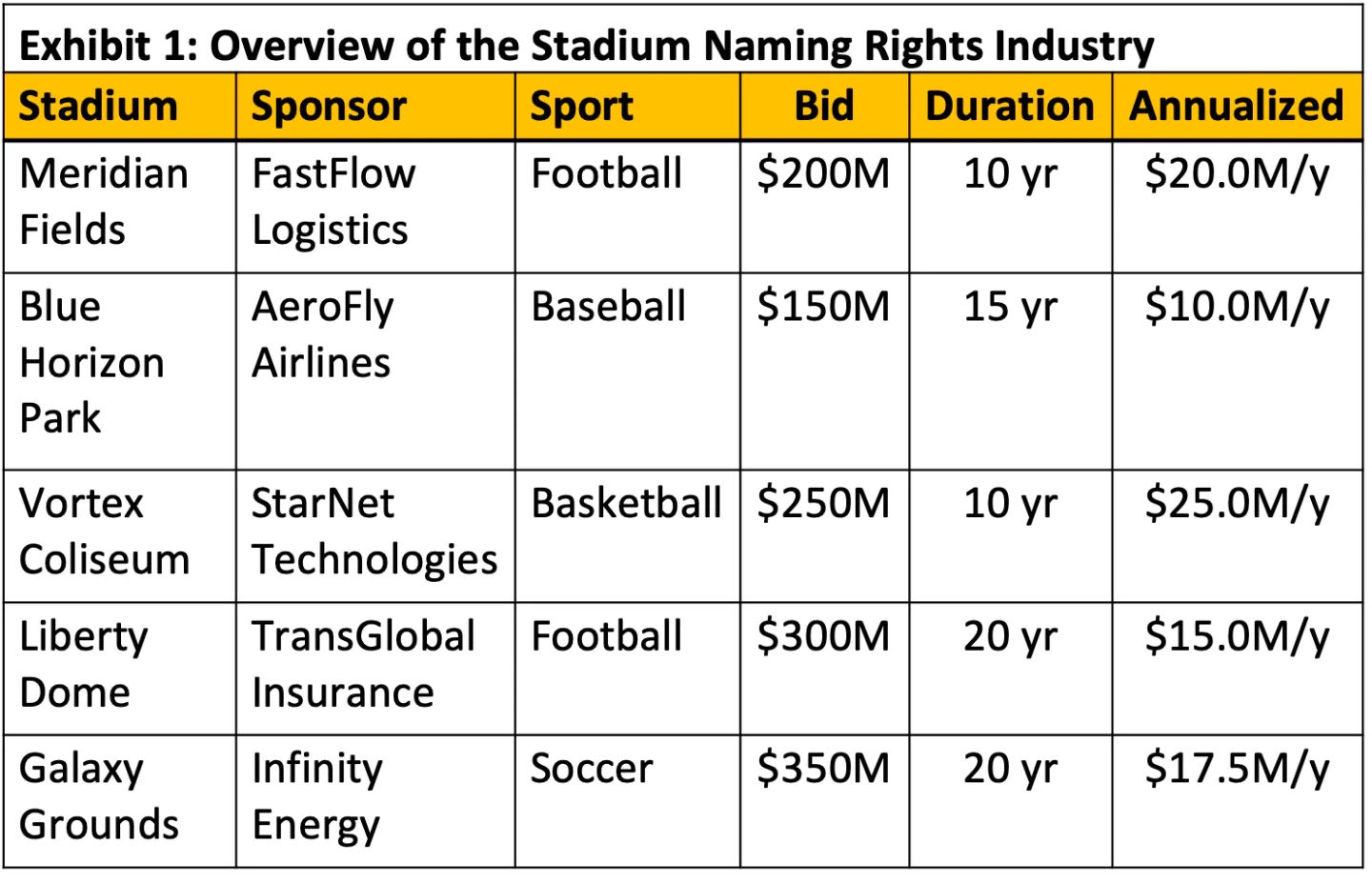
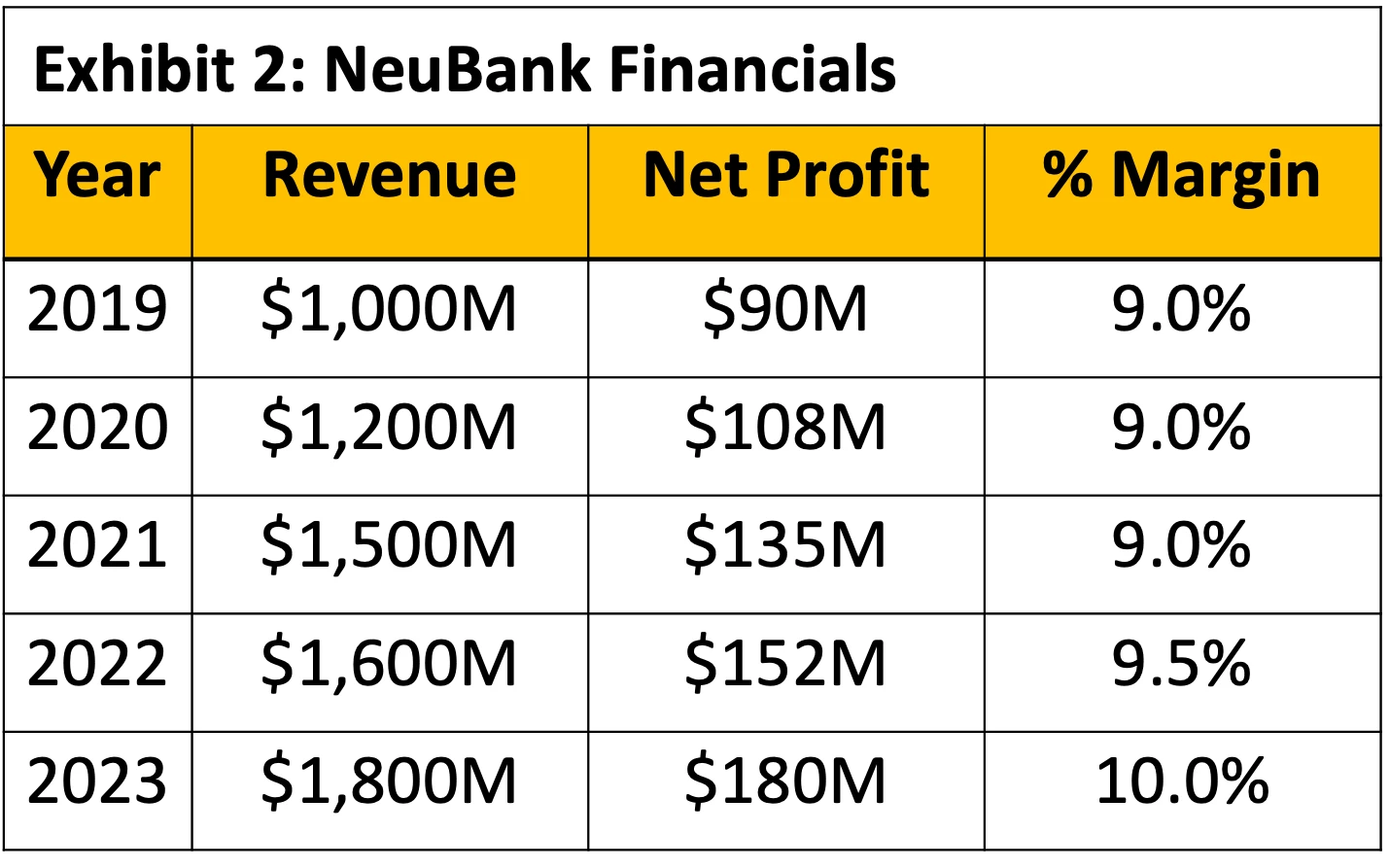
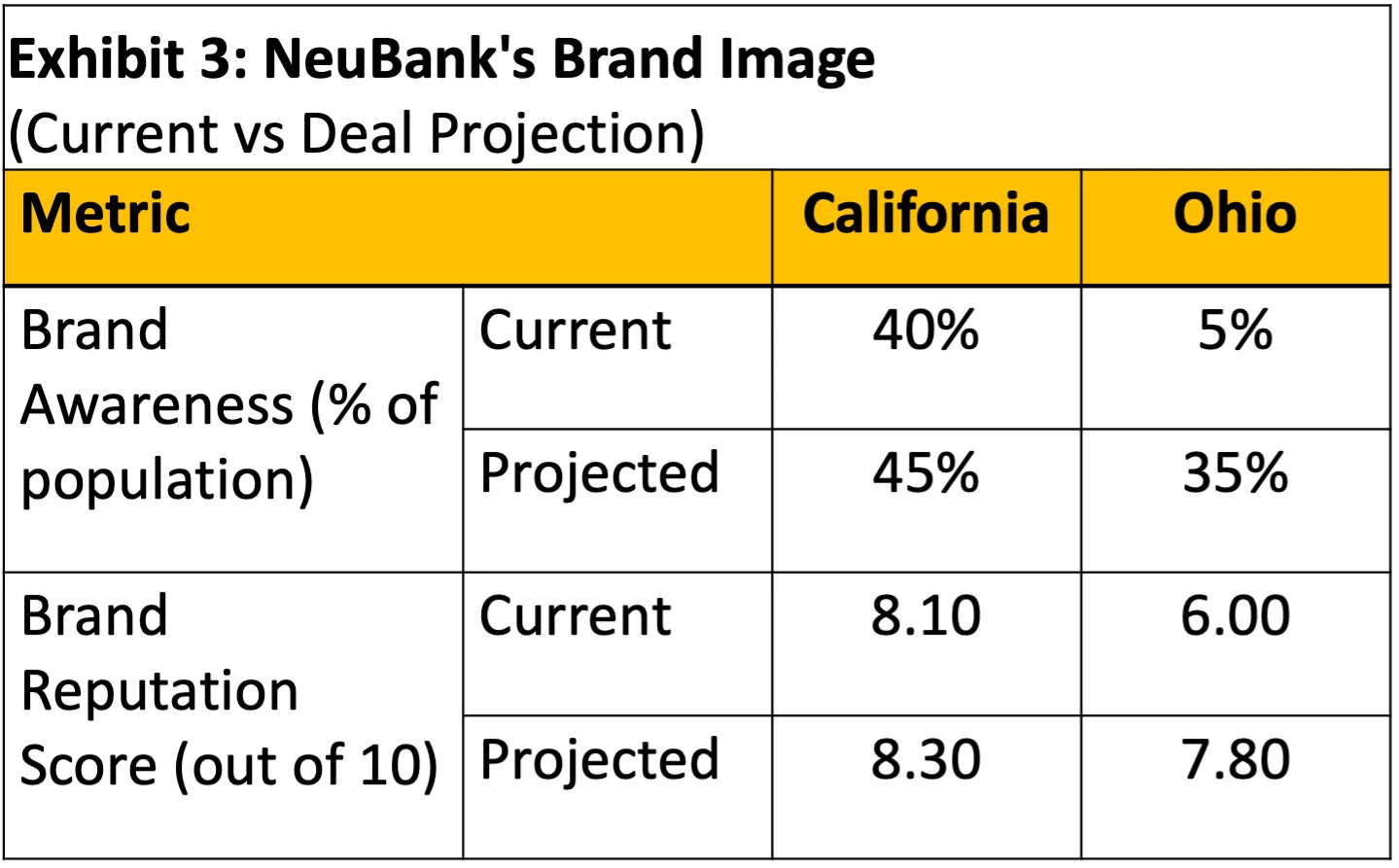
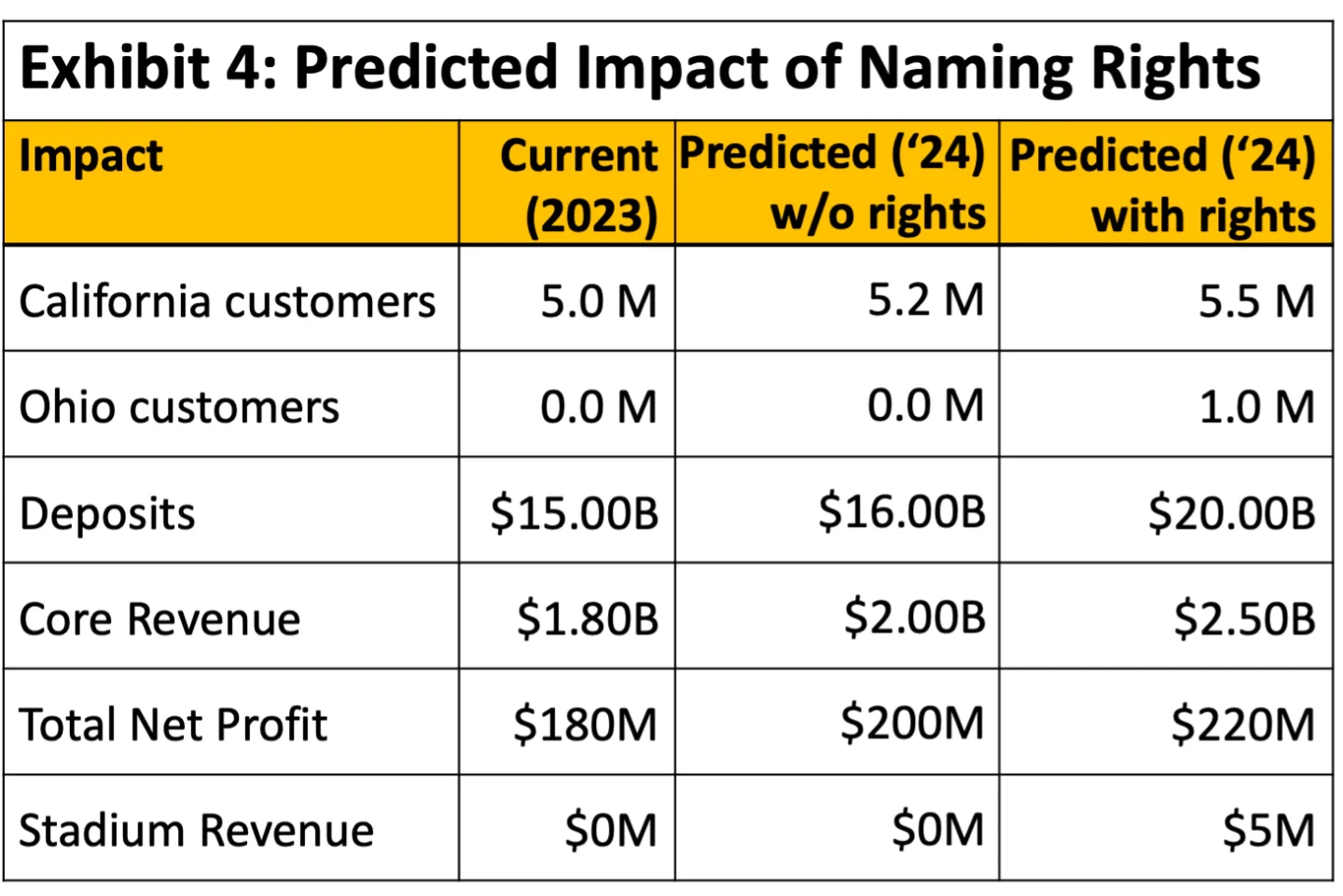




Expert case by
Agrim

BCG Final Round: Stadium Naming Rights

Case Prompt:

Our client is NeuBank, a neobank in the US. A soccer stadium in Ohio is offering exclusive naming rights, and NeuBank is considering bidding for them. The client wants to understand the following:

  1. If this is a good idea?
  2. How much they should bid?
  3. How to make the deal a win-win?

NOTE that this case is very long and is meant for learning casing skills. If you intend to use it for mock practice then focus on very specific segments to complete it in time.

Also check out the video solution at the bottom of this page for a step-by-step work-along and detailed explanantion

Overview of All Exhibits
Practice makes the difference
Practicing alone helps – with a partner it’s even better. Solve this case in a realistic mock interview.
Schedule on Meeting Board

Section 1: Clarifying Questions

  • The key situation in the case is that NeuBank is looking to acquire naming rights to a stadium, and we need to address several business decisions so naturally we need to establish a solid foundation for the case
  • The clarifying questions help set the foundation for the entire case. The candidate is being evaluated on their ability to clarify the situation and ask relevant questions. It's important for the candidate to understand the case at hand, the client's objectives, and the industry context. The recommended approach is to use a blend of commonly known basic frameworks (such as 4Ps and 3Cs) with customized questions specific to the case. These are well-structured frameworks that help ensure all critical aspects are covered and also shows the interviewer that you're taking a systematic approach.
  • Note that asking good questions can help in creating a more effective solution. Do not hesitate is asking very silly questions upfront - that is always ok. Do not assume any specific things without confirming with the interviewer

Pause yourself here, write down your own questions for 30-seconds and come back

Show solution Hide solution
Show additional information Hide additional information

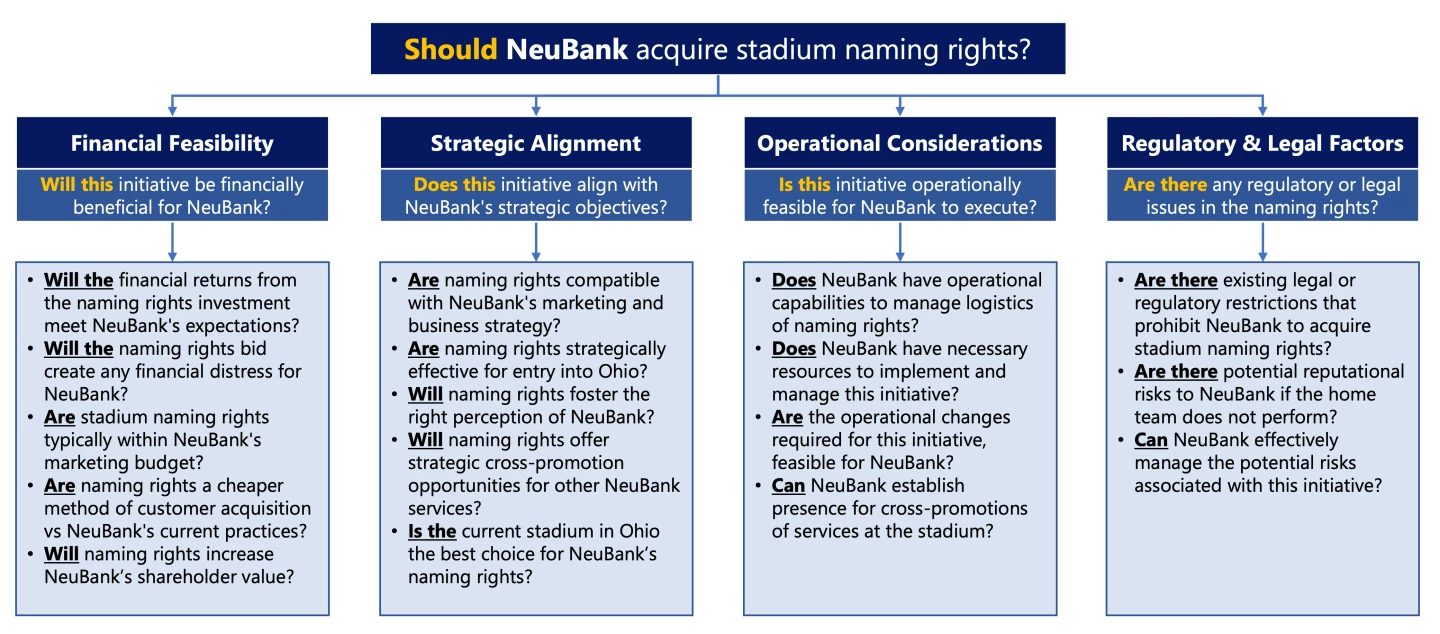
Sample Structure

Instructions: Please take a time of 2-3 minutes to draw out your structure/framework. Once you have completed, take another 2 minutes to say it out aloud as if you were explaining it to the interviewer. These time limits are aligned with the expectations during an actual interview. Once you complete this exercise, proceed forward to see a sample framework solution. Your solution does not need to 100% match the sample solution – there is no right/wrong answer. Study the sample and see how you can improve you own solution

Show solution Hide solution
Show sample structure Hide sample structure

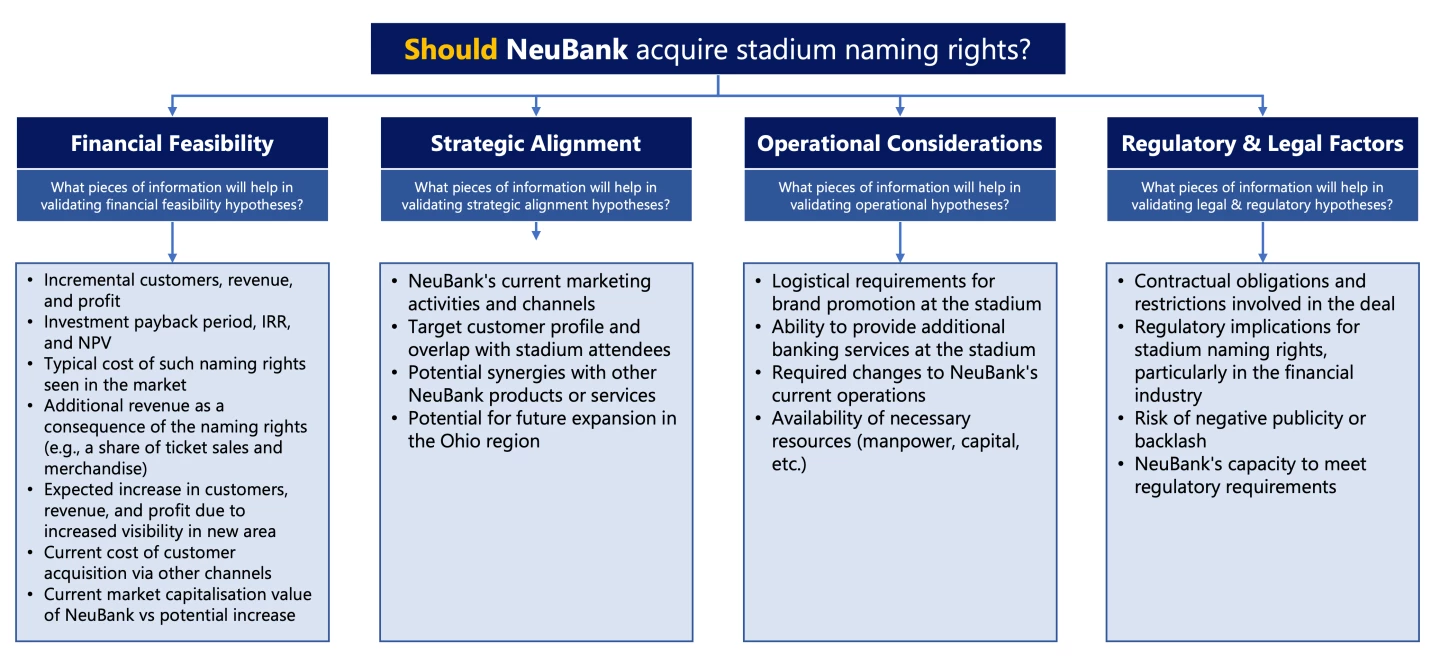
Section 3: Evaluation of the naming rights opportunity

Note: For a candidate-led experience, simply reveal only as many exhibits/information as specifically asked by the candidate and let the candidate explore the information and proceed forward

Show additional information Hide additional information
Show solution Hide solution

Section 4: Estimating the bid

Instructions: Take 1 minute to collect your thoughts and write down the approach for estimating the bid. Once you have a firm idea, come back to the case and resume.

Show solution Hide solution

Section 5: Brainstorming for a win-win deal

Instructions: Take 1-2 minutes to come up with ideas that will make this deal a win-win. Then come back and resume from here.

Show solution Hide solution

Wrapping-up

Instructions: Take 1-2 minutes to come up with your own conclusion

Show solution Hide solution

Further Questions

Question 1: How do you think the duration of the deal might affect its value for NeuBank?

Show solution Hide solution

Question 2: What are your thoughts on termination and renewal clauses?

Show solution Hide solution

Question 3: How should NeuBank approach branding guidelines within the deal?

Show solution Hide solution

Question 4: What are your thoughts on performance-based incentives?

Show solution Hide solution

Question 5: How would you consider the question of exclusivity in the deal?

Show solution Hide solution

Question 6: How might changes in the economic environment affect the deal?

Show solution Hide solution

Question 7: What are the potential implications of the sports team's performance on the deal?

Show solution Hide solution

Question 8: What should be some other non-financial considerations that NeuBank can discuss with the stadium and add into the deal?

Show solution Hide solution

Question 9: How can NeuBank convert this stadium naming rights initiative into a long-term strategic competitive advantage?

Show solution Hide solution

Question 10: What can be some cool first-time unique USPs of this naming rights deal?

Show solution Hide solution

Question 11: What are the various ways (besides increased customer base) through which NeuBank can monetize the initiative?

Show solution Hide solution

Question 12: What are some ways (negotiation points and key terms in the deal) through which NeuBank can lower the bid price?

Show solution Hide solution
Video Solution
Would you like to see the Video Gallery of this company?

Without your consent we cannot embed YouTube videos. Click the button below and accept the marketing cookies to allow YouTube videos to be embedded.

By allowing this service, you consent, in accordance with article 49 paragraph 1 sentence 1 lit. a GDPR, to your data being processed in the USA. The USA is not considered to have adequate data protection legislation. Your data could be accessed by law enforcement without prior public trial in court. You can change your settings regarding consent to external services at any time in our Cookie and Privacy Settings.

Practice This Case With Peers Who Are Currently Looking for Interview Partners.
Do you have questions on this case?
Ask our community and receive answers and tips directly from our experts.
Ask a question Ask a question
Related Case Interview Basics Articles
Herzbergs 2-Factor Theory
Common Terms of Business
The Herzberg 2-factor-theory, also known as the two-factor theory or motivation-hygiene theory, was developed in the 1950s by Frederick Herzberg. Herzberg was an American industrial scientist and psychologist who taught as a professor at various universities. His research interests focused on what makes people satisfied at work.His theory aims at explaining and influencing motivation and satisfaction at work. It postulates that there are two distinct groups of factors that influence job satisfaction and dissatisfaction, and they have different effects on employees.Herzberg's research findings are also more relevant than ever in today's work environment, especially in light of the shortage of skilled workers, burnout, and in the debate about a 4-day work week.
To the article
Servant Leadership
Common Terms of Business
The term Servant Leadership may sound unusual at first. Typically, when we think of leaders, we imagine individuals who give orders and set the direction. However, this approach flips that notion upside down: a leader is not someone who dictates what needs to be done, but rather someone who asks how they can best support their team to ensure its success. What Does Servant Leadership Mean?Servant Leadership is about focusing on empowering the team, removing obstacles, and providing the necessary support. A servant leader ensures that employees have the right tools, feel valued, and have opportunities for both personal and professional growth. The goal? To create an environment where employees can perform at their best. When the team thrives, so does the company: engaged, motivated, and satisfied employees are more creative, productive, and deliver better results. 😊 The Origins of the ConceptThe term Servant Leadership was coined by Robert K. Greenleaf in his 1970 essay The Servant as Leader. Greenleaf spent many years working at AT&T, where he had the opportunity to observe numerous leaders. He noticed that the most successful and inspiring leaders were those who genuinely served their employees rather than simply giving orders. Servant Leadership vs. Other Leadership StylesServant Leadership is often compared to two other leadership styles: authoritarian leadership and transformational leadership.Authoritarian Leadership: In this style, leaders give direct orders, and employees are expected to follow them. Decisions are made hierarchically, with little room for creativity or employee involvement.Transformational Leadership: Here, the leader acts as an inspirational figure who pursues a vision and motivates the team to achieve it. However, the primary focus is on fulfilling the leader’s vision. In contrast, Servant Leadership prioritizes the well-being and growth of employees—under the belief that this, in turn, benefits the company. The 10 Characteristics of a Servant LeaderLarry C. Spears, a leading expert on Servant Leadership, identified ten key characteristics of this leadership style:Listening: Servant leaders actively listen to understand employees' needs and concerns.Empathy: They show genuine compassion and try to see things from their employees' perspectives.Healing: A servant leader creates a supportive environment where employees feel comfortable discussing challenges.Self-awareness: They reflect on their own behavior and understand how it impacts others.Persuasion: Instead of leading through authority, servant leaders influence through dialogue and consensus.Foresight: They anticipate future developments and make decisions accordingly.Stewardship: They take responsibility for the company and its long-term success.Commitment to Employee Growth: Servant leaders foster both personal and professional development.Building Community: They promote teamwork and create a sense of belonging.Community Awareness: A servant leader considers the impact of decisions on society as a whole.These characteristics help cultivate a work environment where employees can reach their full potential. However, not every leader needs to master all ten traits, what matters most is a balanced and situationally appropriate leadership approach. How Servant Leadership Can Improve Business PerformanceImplementing Servant Leadership can positively transform workplace culture and enhance performance. Here are some practical steps to introduce this leadership style:Raising Awareness: Leaders should familiarize themselves with the concept through workshops or coaching.Leading by Example: Leaders must embody the principles of Servant Leadership, such as active listening and employee empowerment.Collecting Employee Feedback: A continuous feedback system helps understand employees' needs and address them effectively.Encouraging Growth: Providing ongoing training and mentoring supports employee development.✨ The benefits of this leadership style are extensive: it increases employee satisfaction, strengthens team cohesion, and fosters innovation. Employees feel valued and motivated, which boosts productivity and creativity. Challenges in Implementing Servant LeadershipOf course, there are challenges to consider:Time Investment: The cultural shift towards Servant Leadership requires patience and long-term commitment.Misinterpretations: Some may perceive this approach as a sign of weakness or lack of authority.Finding the Right Balance: In high-pressure situations, it can be challenging to balance serving employees with making quick decisions when necessary. When is Servant Leadership a Good Fit?Servant Leadership is particularly beneficial when:A company seeks cultural change, such as fostering more collaboration and innovation.Employee engagement and satisfaction need improvement.Teamwork and cohesion should be strengthened.By prioritizing the well-being and growth of employees, Servant Leadership creates a workplace where people feel empowered to contribute their best - leading to long-term success for both individuals and the organization. 
To the article
The Tuckman Model
Common Terms of Business
At the core of comprehending team dynamics is the ingenious creation of Bruce Tuckman, the Tuckman Model. Bruce Tuckman, an eminent psychologist and researcher, introduced this model in 1965, and it has since been a fundamental framework for understanding team behavior and guiding team development.Tuckman, with his deep-rooted interest in group dynamics, recognized the evolution teams go through in their journey towards high performance. His model offered a lucid, linear path for this evolution, making it easily understandable and implementable in varied team environments.His ground-breaking work has led to profound shifts in how organizations manage their teams, promoting a more empathetic and result-oriented approach. Tuckman's model stands out as an insightful roadmap that helps navigate the complex maze of team development, and its utility spans multiple disciplines and industries.In a consultancy environment, the model is especially relevant due to the constant team reshuffling and the high value placed on effective teamwork. With consultants often stepping into pre-established teams, understanding the team's current developmental stage - whether it's forming, storming, norming, performing, or adjourning—is invaluable.By using Tuckman's model as a reference, consultants can quickly assess team dynamics, identify issues, and devise strategies to move the team towards the next stage. In essence, Tuckman's model provides a clear framework that can be used to maximize team effectiveness, making it a critical tool in the consultant's toolkit.
To the article
McKinsey Growth Pyramid
Useful Business Analysis Tools
The McKinsey Growth Pyramid is a strategic tool that helps businesses systematically explore growth opportunities. As the name suggests, it was developed in the 1980s by the renowned management consulting firm McKinsey & Company. It prioritizes different approaches to expansion and offers a structured roadmap for companies to increase revenue, expand their market presence, and drive long-term sustainability. This framework is widely used in consulting, including in case interviews, as it provides a clear methodology to assess how companies can scale efficiently.
To the article
Interpersonal Communication
Common Terms of Business
Interpersonal communication refers to the exchange of information, thoughts, feelings, and ideas between individuals. It includes both verbal and non-verbal communication and plays a crucial role in interpersonal relationships. This form of communication is fundamental for connection, understanding, and cooperation between people.The following example will show the importance of interpersonal communication: When two friends talk about how their day was, they share not only facts but also emotions and perspectives that can deepen their relationship. Importance in Interpersonal Relationships and RolesInterpersonal communication is essential to build, maintain, and improve relationships. In romantic relationships, it fosters trust and intimacy; in friendships, it enables mutual understanding; and in professional relationships, it improves teamwork and efficiency. In various roles such as parenting, partnership, friendship, and work environments, it enables conflict resolution, information sharing, and the expression of empathy.Specifically, successful interpersonal communication in a professional context can lead team members to work together more effectively by sharing clear expectations and providing constructive feedback. Factors for Successful CommunicationSuccessful interpersonal communication requires active listening to understand the speaker's message. In addition, understanding nonverbal signals such as body language and tone of voice is significant. Choosing the right words and considering the receiver's emotions are also critical. Openness, honesty, and empathy promote a good communication climate. Challenges and DifficultiesDifficulties in interpersonal communication can arise from misunderstandings, cultural differences, unclear messages, or lack of empathy. Communication barriers such as distractions, prejudice and lack of openness can hinder understanding. Checklist for Successful CommunicationListen actively: Show interest and focus on your communication partner.Clear messages: Use clear and precise language to minimize misunderstandings.Show empathy: Put yourself in the other person's shoes to promote understanding.Pay attention to non-verbal signals: Pay attention to body language, facial expressions, and tone of voice.Openness and honesty: Share relevant information and feelings openly.Ask questions: Clarify ambiguities to promote understanding.Give constructive criticism: Give feedback respectfully and constructively.Be patient: give the other person time to express himself. Interpersonal Communication in Management ConsultingIn management consulting, successful interpersonal communication is critical to success. Consultants need to gather clear information from clients in order to understand their needs. At the same time, they must communicate solutions and recommendations clearly and persuasively to gain the trust of clients. Teamwork and the ability to communicate effectively with all parties involved are essential to successfully complete projects and build long-term relationships.

To the article
Practice makes the difference
Practicing alone helps – with a partner it’s even better. Solve this case in a realistic mock interview.
Add invitation
Do you have questions on this case?
Ask our community and receive answers and tips directly from our experts.
Ask a question Ask a question