Aspiring applicants are often intrigued about this practice area despite this practive area sometimes having a notorious reputation. This article will explain Private Equity Consulting to help you understand whether this is a potential area of interest for you, whether you are an applicant or already in consulting.
Most generalist, global firms have an industry or practice area that is focused on Private Equity, though there exists smaller boutique firms that specialize in this field. Within MBB, each firm brands this practice slightly differently:
McKinsey: PEPI (Private Equity & Principal Investors)
For the sake of clarity, from this point in the article onwards I will use BCG’s terminology of Principal Investors & Private Equity (PIPE) to describe the practice area, so as to make a distinction between the specific client type (Private Equity) and the industry/practice focus which is broader than just PE clients.
Land your top job with PrepLounge!
Sign up now for free and get access to our Q&A, top coaches, preparation tools and much more.
Who Are Typical Private Equity Consulting Clients?
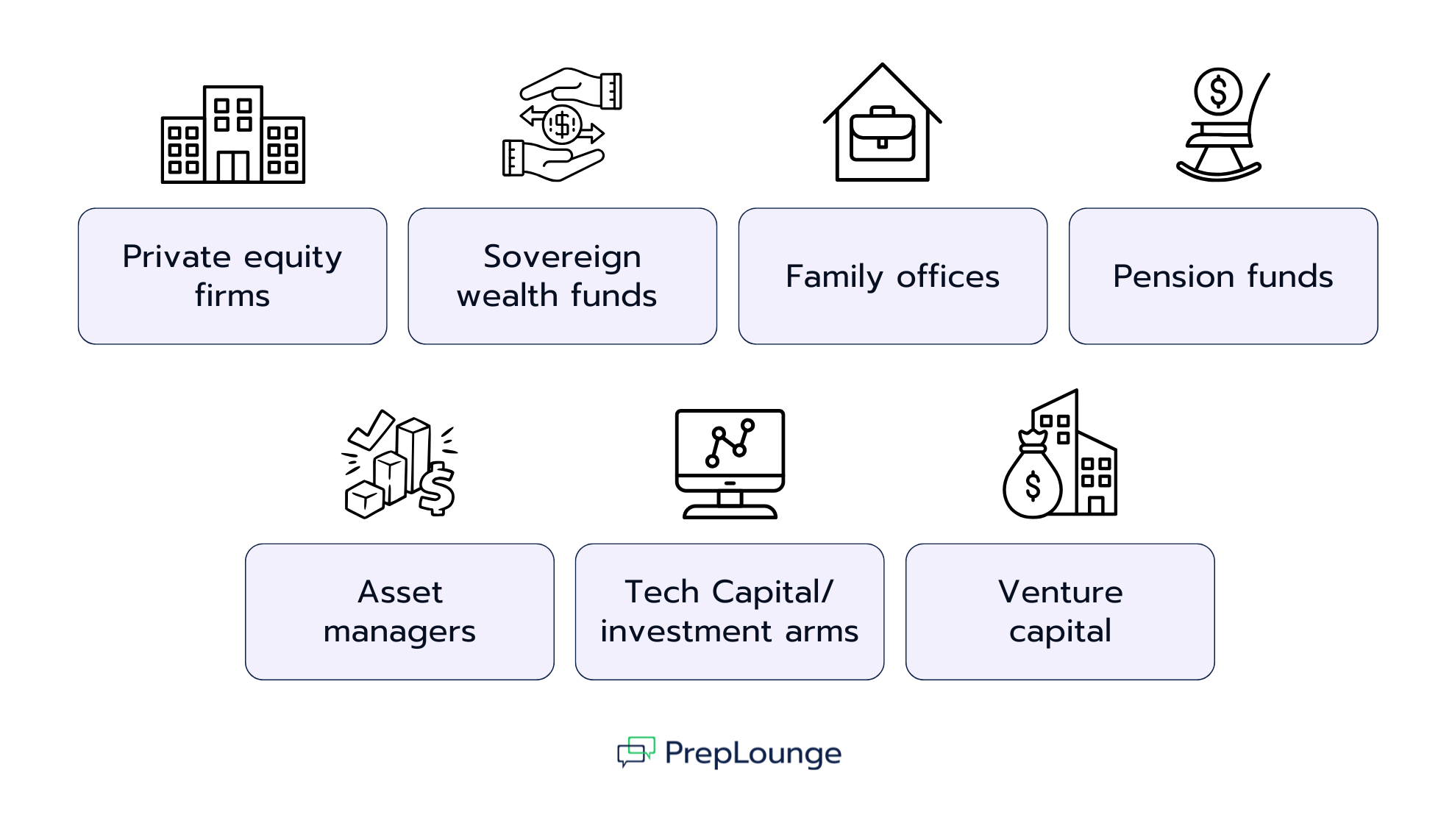
Although commonly referred to Private Equity Consulting, it is actually a broad term that refers to the work done for investor clients, including:
Private Equity firms: Invest in established companies with the goal of improving operations and selling them at a higher value after several years.
Sovereign wealth funds: State-owned investment funds that manage national wealth and invest globally across asset classes.
Family offices: Private entities that manage the investments and finances of wealthy families or individuals.
Pension funds: Institutional investors that manage retirement savings and allocate capital to generate long-term, stable returns.
Asset managers: Firms that invest and manage pooled capital from clients across a range of financial instruments and sectors.
Tech capital or investment arms (e.g., SoftBank Vision Fund, Google Capital): Corporate venture entities that invest in innovative technologies or strategic business opportunities.
Venture capital firms: Focus on funding early-stage or high-growth startups with strong potential for future expansion.
Depending on the context, sometimes PIPE teams are also brought in to support ‘industry’ clients who have a project that is investment related (e.g. a large corporate wants to conduct an M&A)
A large proportion of work is still focused on Private Equity clients and Sovereign Wealth funds, but there has been a growing demand from Family offices and Tech Capital.
In addition, as the PE market becomes more crowded, an interesting trend is seeing PE firms moving more towards Venture Capital/Growth Capital territory – further blurring the lines between a PE/VC.
What is The “Ringfence” and How Does It Work?
In several firms, including MBB, PIPE often operates on a “ringfence” model. A “ringfence” refers to a dedicated pool of consultants staffed exclusively on PIPE work for a fixed duration.
Here’s how it works:
You are removed from the general staffing pool and allocated only to PIPE projects
Staffing decisions are made by the PIPE team’s leadership, allowing for tighter control over project timelines, team composition, and skillset alignment
The duration of a ringfence rotation varies from 6 months to 2 years depending on firm, geography and your career development track
After the ringfence commitment/rotation is over, you are returned to the generalist pool of consultants where you are eligible to be staffed on any project
Joining the ringfence is often opt-in, but it's not automatically granted. PIPE teams are highly selective due to the highly demanding nature of the projects and clients. Entry into the ringfences can often require strong prior performance, a demonstrated analytical skillset, and prior experience in fast-turnaround cases or deal settings.
As firms continue to expand their PIPE practice areas, there has also been an increasing trend of hiring lateral hires or experienced hires directly into the PIPE teams. Experience in transactions or CDDs from boutique firms (LEK, Roland Berger, EY Parthenon) or Big 4 advisory can often be an attractive profile for MBB firms.
What Are the Typical Project Types in Private Equity Consulting?
Given PE clients form a sizeable chunk of the client base in PIPE practices, the most common type of work PIPE teams do is the Commercial Due Diligence (CDD), or also known as a Buy-Side Due Diligence. This is a 2–4 week sprint where consultants evaluate a target company on behalf of a potential investor who wants to buy or invest in a target. The goal is to validate or challenge the investment thesis by assessing the following:
Another common type of DD done by consulting firms is the Vendor Due Diligence, or VDD. This is the opposite of the CDD, whereby the diligence is done from the perspective of the Seller. The aim of the VDD is to create a comprehensive assessment of the business that sellers can bring to potential buyers or investors
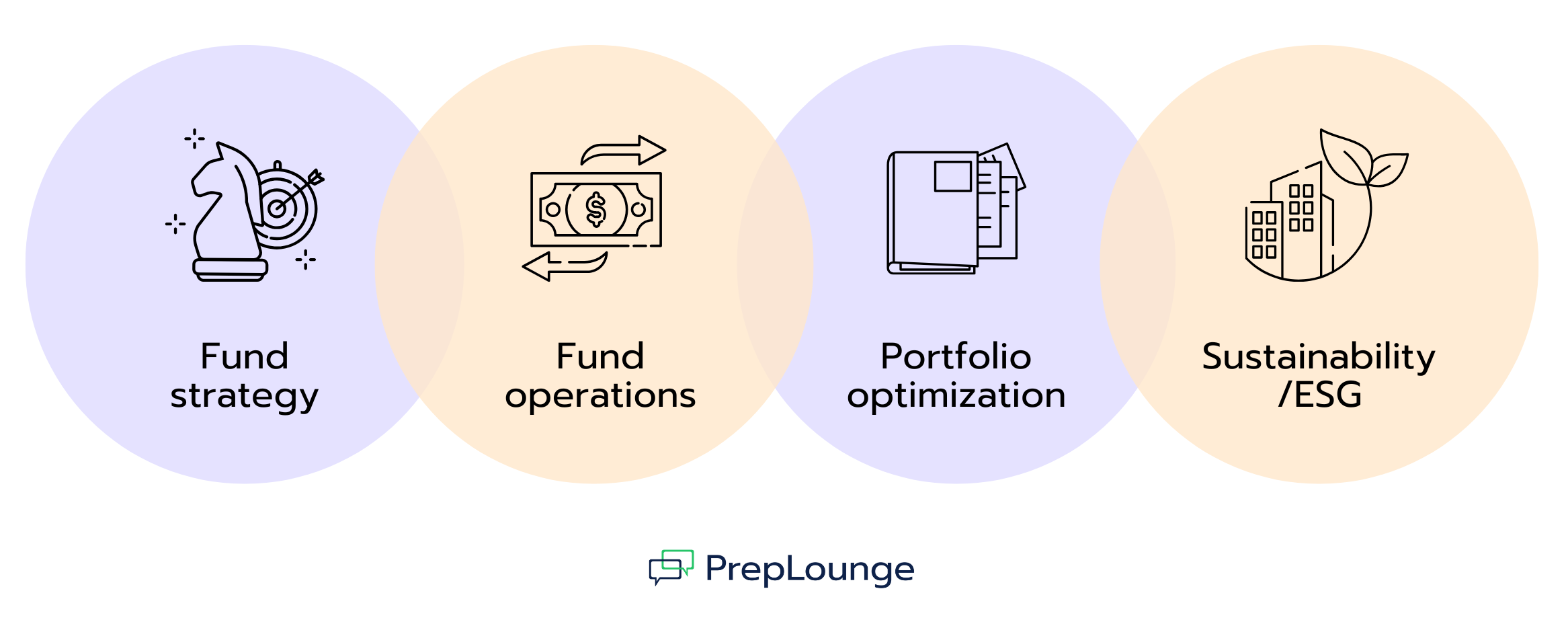
In addition to DDs, PIPE teams also help clients with the following types of work:
Fund strategy projects: Helping an investor define or refine their investment themes, geographic focus, or operational playbooks
Fund operations enablement: Improving the internal processes of the PE firm itself, such as deal sourcing models, portfolio monitoring tools, or exit strategies.
Portfolio optimization: Helping to improve PE investor’s portfolio companies both on the topline and bottomline
Sustainability/ESG: A relatively new but trending topic. Work here involves integrating sustainability considerations at various stages of the investment life cycle (e.g. sector scans for sustainability related investments)
What Skills Are Required to Succeed in Private Equity Consulting?
PIPE work places a premium on speed, structure, and output quality. The typical skill set required includes:
Analytical problem solving: You’re expected to break down ambiguous questions, formulate clear hypotheses, and drive toward insights
Quantitative analysis: The work often involves a high volume of Excel-based analysis and modelling (e.g. business model, market sizing, financial projections)
Written communication: Slides are the primary output, and teams are expected to produce clear and impactful slides that can be read independently by investor clients
Process effectiveness: Given the short durations of the typical projects in this area, it is extremely important to be effective and practical in the process.
Most PIPE projects however have a much lower client interaction, compared to transformation or strategy work.
Why Has Private Equity Consulting This Notorious Reputation?
PIPE work has a reputation for being intense and this reputation isn’t unfounded. Just to give a sense of the challenge, a typical CDD project can have ~150-200 slides in the course of 3-4 weeks. You might produce the same amount of slides for a strategy project that is done over 3-6 months, and potentially produce even less slides on a long transformation project (that is more focused on implementation work).
Investor clients tend to hold very high standards. Many are former investment bankers or sometimes former consultants themselves. Their decisions often involve large sums of capital and strict deal timelines. This creates a work environment that is:
Time-pressured: Deliverables are expected in days, not weeks
High-stakes: A missed insight or poorly substantiated recommendation could derail an investment decision.
Demanding on hours: Depending on the project and scope, working 60–90 hours per week is not unusual—especially in the final days of a due diligence
Of course, as with all things in consulting, the experience tends to be team dependent – there will exist some PIPE teams are highly experienced, organized and manage timelines well, which can make the experience more sustainable.
Exit Opportunities in Private Equity Consulting
A career in Private Equity Consulting opens up plenty of doors for your next step – although some transitions are more common than others. Here are the most typical paths:
Private Equity – Investment Team
This move is possible but relatively rare. If you’re aiming for it, it’s best to make the switch early, ideally before reaching Manager level. Most investment teams look for candidates with a strong finance or deal background, often from investment banking. Without that experience, the transition can be quite challenging.
Private Equity – Value Creation Team
This is a much more common and accessible path. You can join at various levels – from Analyst to Principal. The work is closer to traditional consulting since it focuses on operational improvement, strategy, and performance optimization within portfolio companies. That’s why PE firms are often keen to hire former consultants.
Sovereign Wealth Funds (SWFs)
As sovereign funds become increasingly active investors, they are hiring more consultants – both for deal teams and value creation teams.
Corporate M&A
Your PIPE experience is highly relevant for Corporate M&A or Corporate Development teams. These teams identify and execute mergers, acquisitions, or strategic investments – essentially the same type of work you’ve done in due diligence projects.
Corporate Strategy
Even though PIPE work doesn’t give you deep industry expertise like a sector-focused consulting track (e.g. banking or retail), your analytical skills, business model understanding, and structured thinking make you a great fit for any role that requires strategic or data-driven decision-making.
Final Thoughts: Is Private Equity Consulting For You?
PIPE work is not easy, and it’s notorious reputation is understandable. Why would someone still choose to take it up?
Diverse and rapid exposure to businesses: Working in this space offers the opportunity to quickly dive deep into a wide range of industries and business models. Each project requires building a solid understanding of a new market or company within a compressed time frame. If you enjoy uncovering what drives a business and breaking down business dynamics, this is a perfect area for you
Learn to think like an investor: You’ll regularly be challenged to adopt an investor’s mindset—assessing theses, validating value creation potential, and pressure-testing assumptions. This is particularly valuable if you’re interested in private equity, venture capital, or M&A, as you’ll gain firsthand exposure to leading investors that are evaluating and shaping the business landscape globally
Sharpen analytical and problem-solving fundamental: Few environments train analytical thinking as rigorously as PIPE. The work requires developing clear hypotheses, working through data quickly, and drawing insights under time pressure. It’s a highly effective environment to build structured problem-solving habits, business judgment, and comfort with complexity
PIPE consulting is not for everyone. But if you thrive in fast-paced, analytical environments and enjoy thinking critically about what makes businesses succeed or fail, PIPE can be an incredibly rewarding experience.
Private Equity Consulting focuses on helping investor clients such as private equity firms, sovereign wealth funds, and venture capital firms make informed investment decisions. Typical projects include commercial due diligence, portfolio optimization, and fund strategy. Consultants analyze markets, assess business models, and identify value-creation opportunities throughout the investment lifecycle.
Success in this field requires strong analytical and quantitative abilities, as projects often involve complex Excel modeling, financial projections, and data interpretation. Consultants must also communicate findings clearly through concise, impactful slides. Because of the fast pace and high expectations, efficiency, structure, and the ability to thrive under pressure are equally important.
Clients range from traditional private equity firms and sovereign wealth funds to family offices, pension funds, and corporate investment arms like Google Capital or SoftBank Vision Fund. Venture capital firms are also frequent clients, especially as the lines between private equity and growth investing continue to blur. Consultants may occasionally support large corporations on M&A-related projects as well.
Projects in this field are typically short, high-stakes, and highly analytical. Consultants often produce hundreds of slides within just a few weeks to inform multi-million-dollar investment decisions. The fast turnaround times, demanding clients, and constant need for accuracy make the workload intense but also highly rewarding for those who enjoy pressure and pace.
Experience in PIPE or Private Equity Consulting opens doors to attractive post-consulting careers. Many professionals transition to value-creation teams within PE firms, corporate M&A roles, or strategy positions in large corporations. Others move into venture capital or sovereign wealth funds, leveraging their investment mindset and deal experience gained in consulting.
Ex-BCG Principal | 8+ years consulting experience in SEA | BCG top interviewer & top performer
Benjamin has >8 years of consulting experience, starting off at Kearney SEA and he joined BCG as an experienced hire, where left as a Principal. At BCG, Benjamin was fast promoted twice (Consultant to PL; PL to Principal) and was also selected to be a CEO Ambassador (internal secondment). Benjamin has a wealth of case experience across multiple functions (Strategy, Operations, Transformation, Due diligence) and industries (PE, TMT, Public Sector, Consumer, Tech). While focused on SEA, Benjamin has also done cases in the Middle East, North Asia as well as South Asia.
At BCG, Benjamin had ~5 years of experience as an interviewer. Having come from a non-traditional background himself, Benjamin can offer practical tips for experienced hires and non-traditional candidates.
Benjamin graduated with a B.A. (First Class Honours) in History from the National University of Singapore.