







Zurück zur Übersicht
Company-Case bereitgestellt von
Mercedes-Benz Management Consulting

MBMC Case: AMG | Turning the most affluent prospects into loyal clients

Schwierigkeitsgrad: Fortgeschritten
Interviewer-led
0,0
0 Bewertungen
14,5k mal gelöst

Case-Frage:

Mercedes‑AMG stands for uncompromising performance, engineering excellence, and emotional driving experiences. Yet recently, AMG’s top management has become concerned that while the product itself continues to exceed customer expectations, the moment of purchase no longer does.

The trigger for this case was a concrete incident: a highly affluent customer configured an AMG top‑end vehicle in detail, was technically convinced, but ultimately decided against the purchase, stating: “It’s a fantastic car – but it didn’t feel special.” For the CEO of Mercedes‑AMG, this statement raises a critical question. In the luxury and performance segment, emotional differentiation at the point of decision is as important as horsepower or technology.

Against this backdrop, AMG is exploring new ways to elevate the buying experience for its most valuable customers. One idea under discussion is the introduction of AMG Individualization Hubs – exclusive physical spaces where customers would finalize their vehicle together with AMG experts in a highly personalized and immersive setting.

The management now asks you and your Consulting Team to assess this idea holistically:
How can AMG strengthen emotional differentiation during the purchase decision, and do Individualization Hubs represent a strategically sound and economically viable solution? The objective is to develop a clear recommendation that balances brand impact, customer experience, and profitability.

Übersicht aller Grafiken
Beispielcases sind die perfekte Vorbereitung.
Melde dich jetzt an und löse deinen ersten Case, entweder alleine oder gemeinsam mit anderen Kandidat:innen.
Übung macht den Unterschied
Alleine üben hilft – zu zweit ist es noch besser. Löse diesen Case im realistischen Mock-Interview.
Auf dem Meeting-Board verabreden

Strukturvorschlag

Strukturvorschlag einblenden Strukturvorschlag ausblenden

Part #1: Structuring & Exploring

You are joining our MBMC project team supporting the CEO of Mercedes‑AMG. The trigger: A highly affluent customer configured an AMG top-end vehicle, loved the product, but walked away saying: ‘Fantastic car — but it didn’t feel special.’ The CEO believes the key issue is not the car, but the purchase decision moment. To structure our work, let’s start with the end-to-end customer journey (B2C).

Exercise #1.1: From your perspective, what are the key phases of a top-end customer journey for Mercedes‑AMG?

Zusätzliche Informationen einblenden Zusätzliche Informationen ausblenden
Lösung einblenden Lösung ausblenden

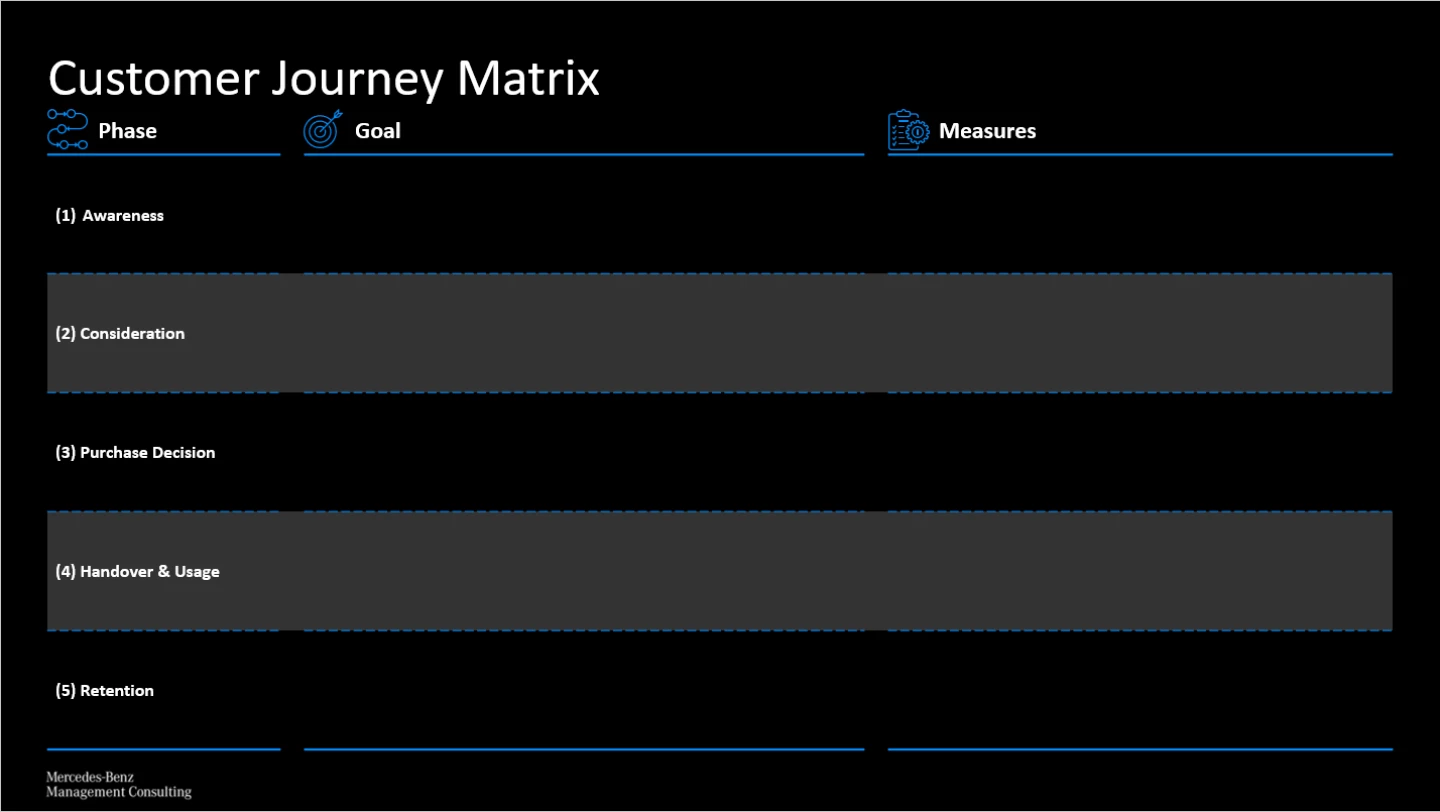
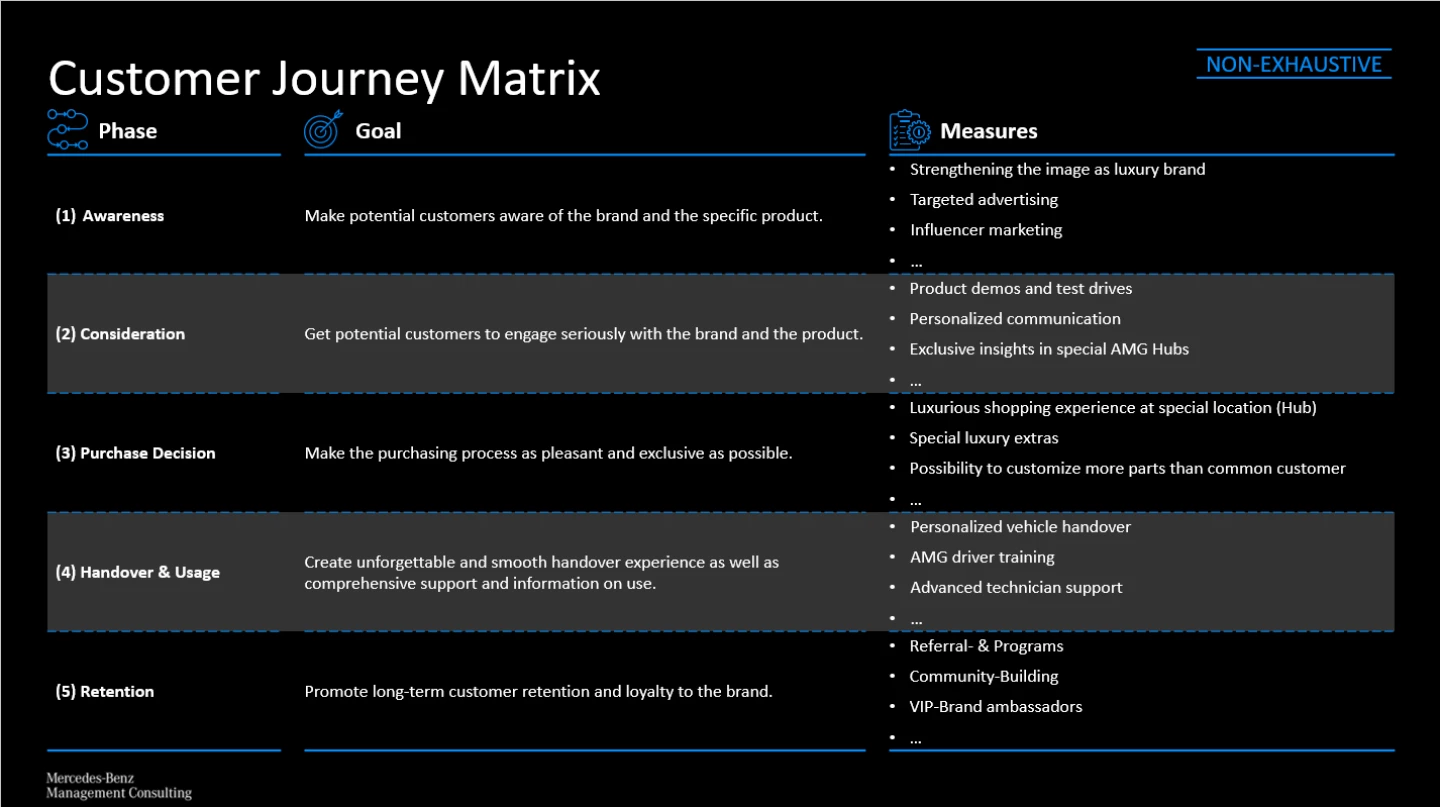
Exercise #1.2: For each phase of the customer journey, what would you define as the main goal from AMG’s perspective, and which concrete measures could support that goal?

Now that we have a common understanding of the end‑to‑end customer journey, the CEO asks us to go one step deeper. His question is not only how customers move through the journey, but what AMG is actually trying to achieve in each phase — and how this can be influenced.

Zusätzliche Informationen einblenden Zusätzliche Informationen ausblenden
Lösung einblenden Lösung ausblenden

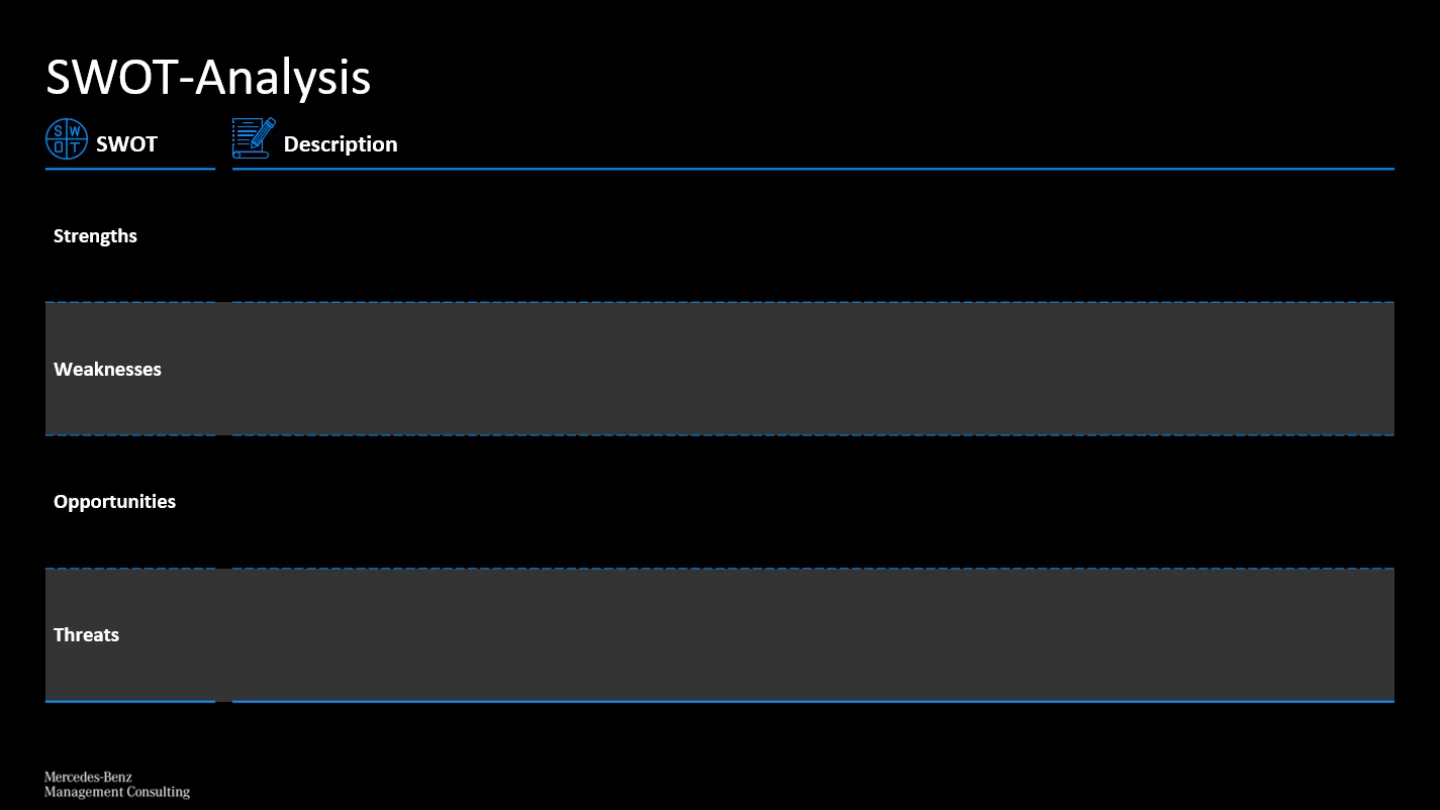
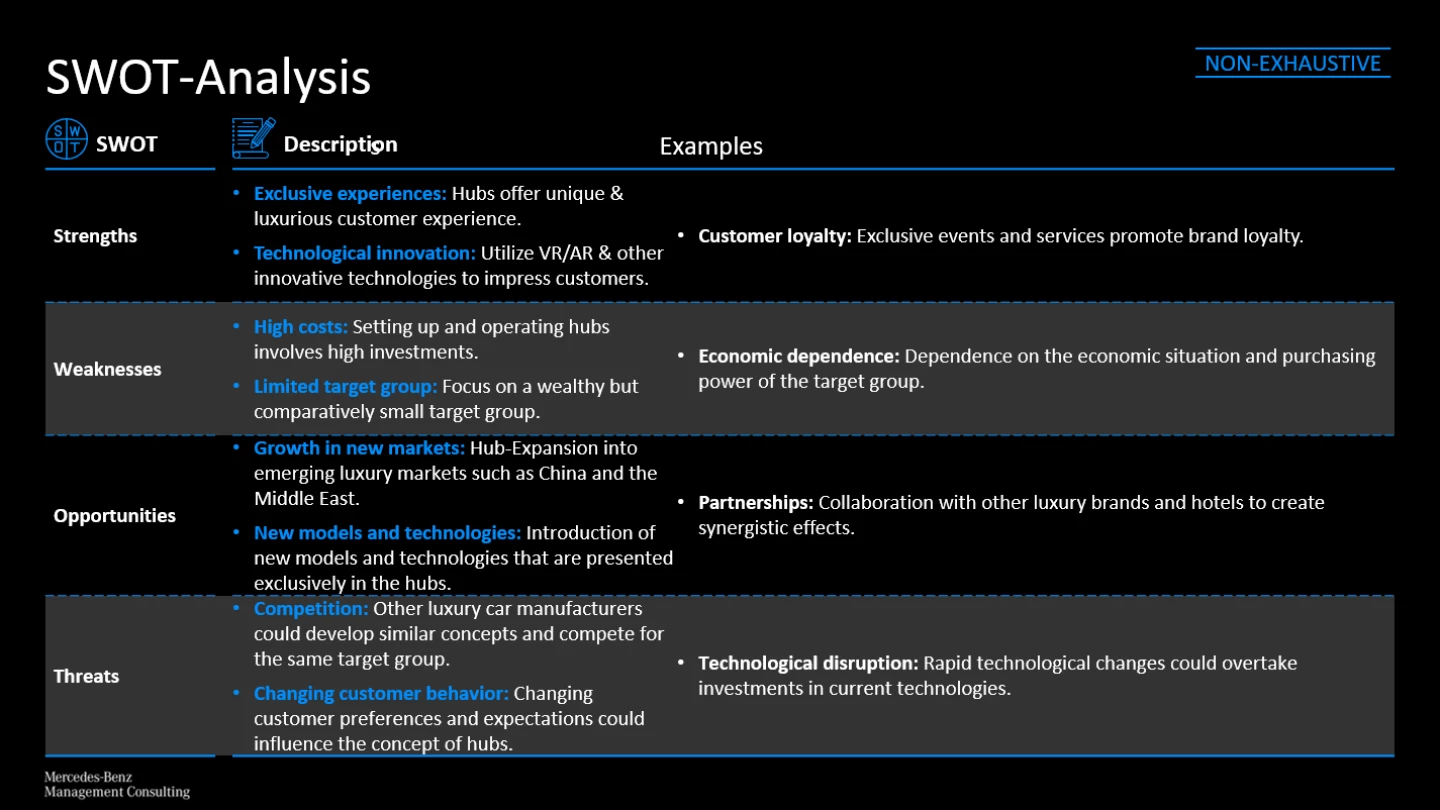
Exercise #1.3: How would you evaluate the idea of AMG Individualization Hubs? Please use a suitable framework and walk me through the key opportunities and risks.

Based on our discussion so far, the CEO would like to explore one concrete idea in more depth: AMG Individualization Hubs. Before we look at any numbers, he wants to understand whether this concept makes sense from a strategic and qualitative perspective.

Zusätzliche Informationen einblenden Zusätzliche Informationen ausblenden
Lösung einblenden Lösung ausblenden

Part #2: Quantitative Analysis

The CEO likes the idea of AMG Individualization Hubs from a brand perspective. However, the CFO is clear: the Board will only approve the concept if it makes economic sense. Before looking at any numbers, he asks a simple question: What do we actually need to calculate profitability?

Exercise #2.1: What information is required to assess the profitability of AMG Individualization Hubs?

Zusätzliche Informationen einblenden Zusätzliche Informationen ausblenden
Lösung einblenden Lösung ausblenden

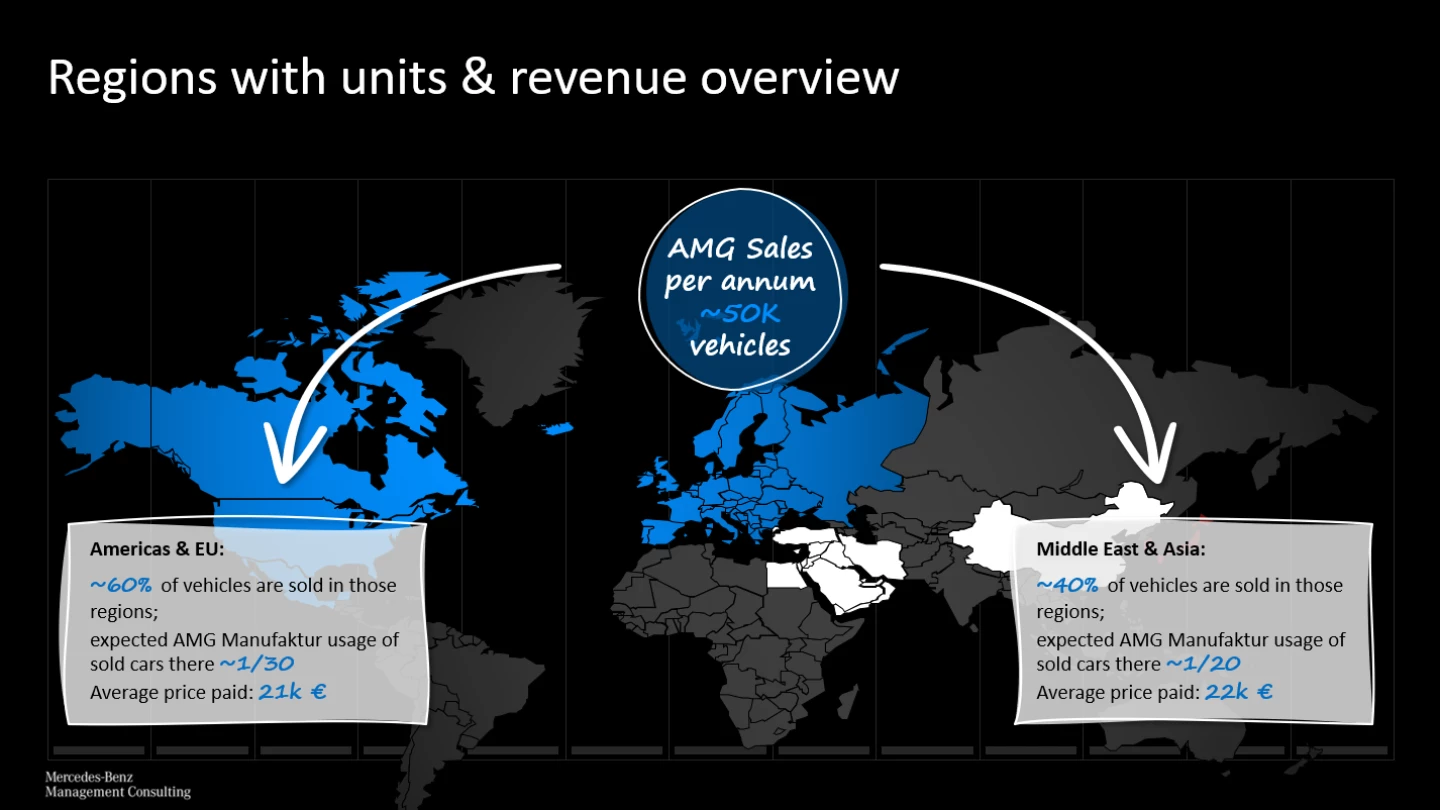
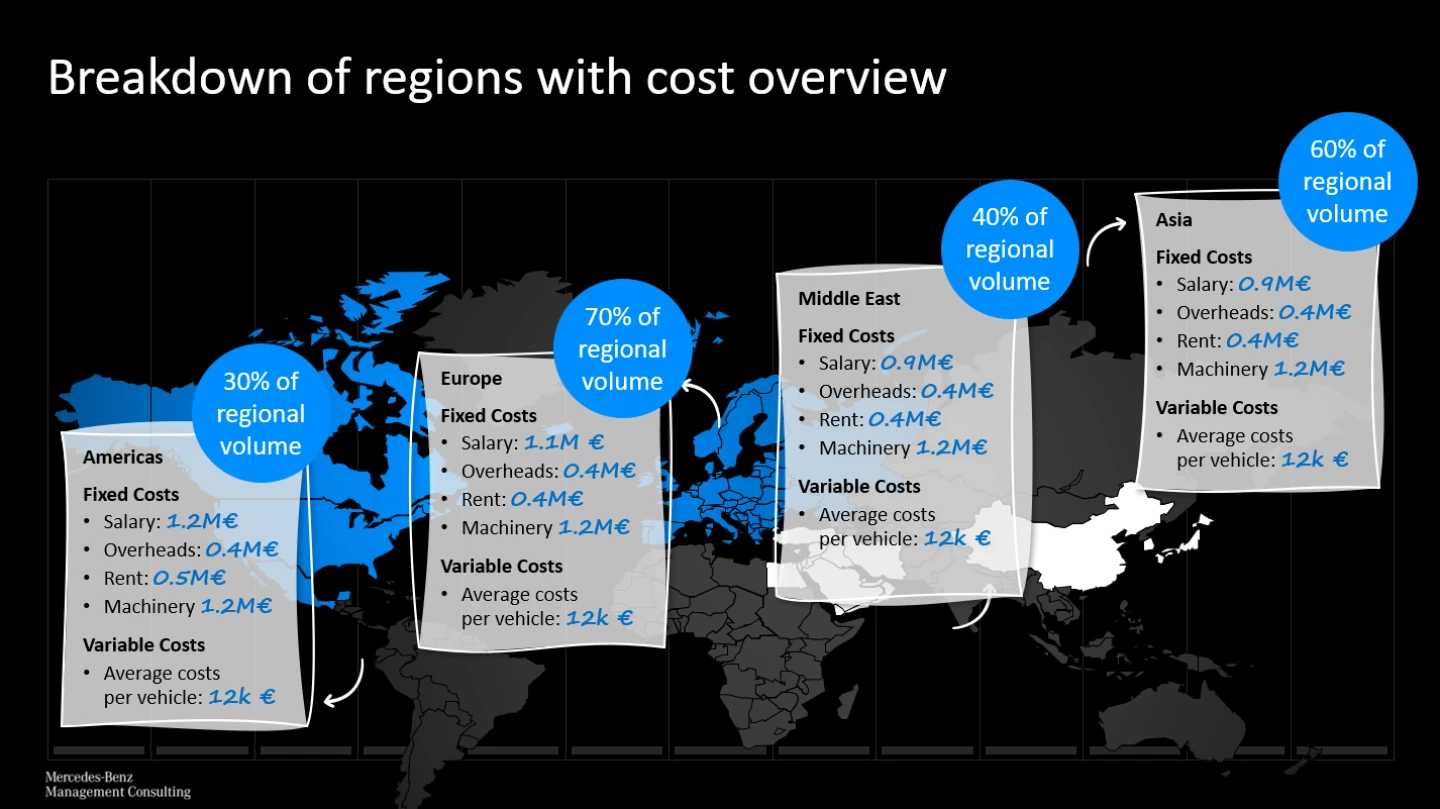
Exercise #2.2: What is the profitability (total return) for all regions and the overall profitability (total return and return on sales) worldwide?

To make this discussion concrete, the CFO asks us to quantify the business case. We will deliberately keep the model simple: one hub per region, annual view, and a classic contribution logic. But, these hubs are not mass‑market facilities. They are capacity‑constrained by highly specialized AMG engineers, designers, and craftsmen. At the same time, not every customer is willing to pay for the full individualization experience.

Zusätzliche Informationen einblenden Zusätzliche Informationen ausblenden
Lösung einblenden Lösung ausblenden

Exercise #2.3: Calculate and find measures to reach the needed adjustment.

Your manager is not excited about the profitability. He asks for the smallest possible adjustment that would make one unattractive region acceptable.

Lösung einblenden Lösung ausblenden

Part #3: Conclusion & Recommendation

You will be meeting the CEO of Mercedes-Benz with your manager later. On the car ride there you discuss your findings.

Exercise #3.1: What is your final recommendation?

Do you suggest investing in the hub structure in general? Justify & evaluate your recommendation!

Zusätzliche Informationen einblenden Zusätzliche Informationen ausblenden
Lösung einblenden Lösung ausblenden
Übe diesen Case mit Peers, die gerade auf der Suche nach Interview-Partner:innen sind.
Hast du eine Frage zu diesem Case?
Dann stelle sie der Community und erhalte Antworten und Tipps direkt von unseren Expert:innen.
Stelle eine Frage Stelle deine Frage
Weitere Cases von Mercedes-Benz Management Consulting
Verwandte Case-Interview-Basics Artikel
Blue-Ocean-Strategie
Grundlegende Business-Begriffe
Die Blue-Ocean-Strategie, entwickelt von W. Chan Kim und Renée Mauborgne in ihrem Buch "Blue Ocean Strategy" (2005), stellt das traditionelle Geschäftsdenken auf den Kopf. Sie zielt darauf ab, unentdeckte Märkte zu erschließen – die "blauen Ozeane" – in denen Unternehmen allein agieren und so den Wettbewerb vermeiden. Das Ergebnis? Mehr Wachstum und höhere Gewinne.Im Gegensatz dazu steht der "rote Ozean" – der bereits überfüllte Marktraum, in dem der Wettbewerb hart ist und Unternehmen ständig versuchen, ihre Konkurrent:innen zu übertreffen. Das führt oft zu sinkenden Gewinnen und begrenztem Wachstum. 🌊Die Blue-Ocean-Strategie bedeutet daher eine Abkehr von diesem destruktiven Wettbewerb hin zu einer konstruktiveren, kreativen Form der Marktentwicklung. Sie ermutigt Unternehmen, über die bekannten Grenzen der Branche hinauszugehen und neue Märkte zu schaffen, wodurch der Wettbewerb irrelevant wird.
Zum Artikel
Das GROW-Modell
Nützliche Tools zur Geschäftsanalyse
Das GROW-Modell, ein Akronym für Ziel, Realität, Optionen und Wille, wurde in den späten 1980er Jahren von Sir John Whitmore und seinen Kollegen Graham Alexander und Alan Fine entwickelt. Es entstand aus der Erkenntnis, dass traditionelle Trainingsmethoden oft nicht ausreichten, um nachhaltige Leistungsverbesserungen zu erzielen. Whitmore, ein ehemaliger Rennfahrer und ein Pionier im Bereich des Executive Coaching, war maßgeblich daran beteiligt, das Modell zu popularisieren und es als eine Methode zur Leistungssteigerung in der Geschäftswelt zu etablieren.
Zum Artikel
Wachstumsstrategie
Case-Typen
In Case-Interviews wirst du häufig mit der Aufgabe konfrontiert, Strategien zur Umsatzsteigerung für ein Unternehmen zu entwickeln. Dabei ist es entscheidend, eine systematische Analyse vorzunehmen, um fundierte und umsetzbare Empfehlungen geben zu können.Im Folgenden erfährst du, welche wesentlichen Faktoren du berücksichtigen solltest und wie du deine Antwort klar und präzise strukturieren kannst. In diesem Guide zeigen wir dir, wie du Case-Interviews erfolgreich meisterst und überzeugende Wachstumsstrategien entwickeln kannst.
Zum Artikel
Übung macht den Unterschied
Alleine üben hilft – zu zweit ist es noch besser. Löse diesen Case im realistischen Mock-Interview.
Einladung hinzufügen
Hast du eine Frage zu diesem Case?
Dann stelle sie der Community und erhalte Antworten und Tipps direkt von unseren Expert:innen.
Stelle eine Frage Stelle deine Frage
Weitere Cases von Mercedes-Benz Management Consulting