



Expert case by
Cristian

Hara Coffee Co's innovative coffee subscription model

Difficulty: Intermediate
Interviewer-led
< 100 Ratings
Times solved: 1.6k

Case Prompt:

Our client, Hara Coffee Company, is a large coffee chain with over 200 locations in the United Kingdom. They import beans from numerous regions and batch-roast them in the UK, offering customers a vast selection of premium blends. In addition to serving delicious coffee, our client offers freshly made sandwiches, pastries, and salads of the highest quality. Hara Coffee Co. is also one of the most socially and environmentally responsible coffee brands in the United Kingdom, and their value proposition heavily relies on customers paying a premium for delicious products that do not compromise on sustainability metrics.

The rising cost of living has significantly reduced the revenue of coffee chains throughout the United Kingdom over the past year. People are increasingly choosing to brew their own coffee at home, with beans delivered by subscription. The CEO of Hara Coffee Company is intrigued by the expansion of coffee subscription models in the UK.  They requested that our team investigate whether their chain could also introduce a coffee subscription model, in which customers pay a fixed monthly fee and receive a certain number of coffees throughout the month. 

Overview of All Exhibits
Practice makes the difference
Practicing alone helps – with a partner it’s even better. Solve this case in a realistic mock interview.
Schedule on Meeting Board

Question 1:

What factors would you evaluate to determine whether it is a good idea for our client to implement a coffee subscription model?

Show additional information Hide additional information
Show solution Hide solution

Question 2:

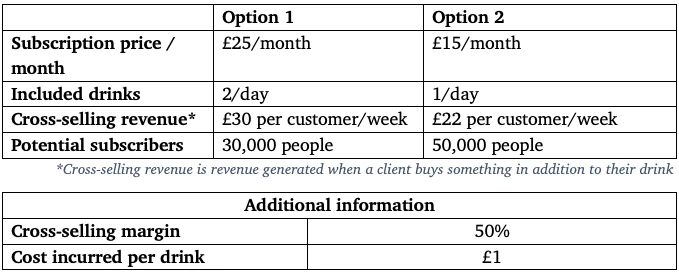
The client would now like your help in deciding how to price the subscription. They have done some market research and have identified two possible options, as illustrated in Exhibit 1. How would you decide between these two options, and which one would you choose? 

Show additional information Hide additional information
Show solution Hide solution

Question 3:

The client appreciated your analysis and is considering implementing the £15/month subscription option. What additional revenue streams could they implement to maximise cross-selling revenue? Second, what are some additional ideas for revenue growth that do not necessarily involve cross-selling?

Show solution Hide solution

Question 4:

The client likes your ideas and they are considering adding smoothies to their product mix and even offering them as part of the subscription that we were discussing. Your colleagues came up with the following estimates to help you make sense of this opportunity: 

  • Smoothies are a higher margin item for us, but they are also more expensive, at a cost of £2 per drink vs £1 for coffees
  • The number of subscribers is expected to increase by 30% from the 50k we previously estimated
  • Cross-selling profits will increase from £44 per month (£22/week x 4 weeks x 50%) to £50 per month

If we introduce smoothies, we anticipate that our customer base will order a smoothie 1/3 of the times on average. Assuming we continue to charge £15 per month for the subscription, does it still make sense to include smoothies?

Show additional information Hide additional information
Show solution Hide solution

Question 5:

What would you recommend to the client in light of everything we have analysed?

Show solution Hide solution
Practice This Case With Peers Who Are Currently Looking for Interview Partners.
Do you have questions on this case?
Ask our community and receive answers and tips directly from our experts.
Ask a question Ask a question
Related Case Interview Basics Articles
7S-Framework of McKinsey
Frameworks
If you're aiming for a career in consulting, learning about key frameworks is essential. One of the most popular and effective tools is the McKinsey 7S Framework. Created by McKinsey & Company, this framework helps you understand and evaluate how different parts of an organization work together to improve overall performance.In this post, we’ll explain the seven elements of the McKinsey 7S Framework and how you can use it in case interviews. Whether you're preparing for consulting roles or just want to boost your business knowledge, this framework is a valuable tool to have in your skillset!
To the article
The Capability Maturity Model (CMM)
Useful Business Analysis Tools
A career in consulting requires a deep understanding of various methods and models that can help clients optimize their processes and maximize performance. One such model is the Capability Maturity Model (CMM), which can serve as a compass for organizations seeking to improve their project management and service capabilities.Developed by the Software Engineering Institute (SEI) at Carnegie Mellon University, the CMM, as well as its extension to the Capability Maturity Model Integration (CMMI), focuses on improving processes within an organization. The models provide a better view of process improvement within five levels (initial to optimized). Each level represents a different level of process maturity and guides an organization toward continuous process improvement.
To the article
The Cynefin Framework
Useful Business Analysis Tools
For graduates aspiring to embark on a career in consulting, understanding and effectively navigating complex situations is essential. The Cynefin Framework (pronounced: Kin-ev-in) provides a powerful tool for consultants to make sense of different problem domains and determine appropriate approaches.In this article, we will explore the Cynefin Framework, its sections - Simple, Complicated, Complex, and Chaotic and the Disorder domain. Additionally, we will provide an example of how the framework can be applied in the consulting industry.
To the article
ADKAR Model
Useful Business Analysis Tools
The ADKAR Model, developed by Jeff Hiatt, founder of Prosci, is a practical change management framework. It's designed to help organizations to successfully implement change and increase employee acceptance. As one of the most popular models for change management, ADKAR highlights an often overlooked fact: changes can only be successful if employees are actively involved.🔎 In this article, we'll introduce you to the components of the ADKAR Model and how it can be applied to challenges within organizations. 

To the article
The Kanban Framework
Common Terms of Business
In your journey to becoming an efficient consultant, understanding various work management systems is crucial. One such system that has made a profound impact, particularly in the world of technology and services, is Kanban.Before we dive into the current applications of Kanban, it's important to acknowledge its origins. Kanban was born in the late 1940s within the walls of Toyota's manufacturing plant in Japan. Taiichi Ohno, an industrial engineer at Toyota, introduced Kanban to improve manufacturing efficiency. The word 'Kanban' translates to 'billboard' or 'signboard' in English, emphasizing the visual nature of the system. Ohno was inspired by the supermarket model of product replenishment, where stock is replaced as soon as it depletes. He applied the same principle to Toyota's production lines, effectively aligning inventory levels with actual parts of consumption. The implementation of Kanban led to significant improvements in Toyota's productivity and efficiency, setting the foundation for what we now call 'Lean Manufacturing'.Fast-forward to the present, Kanban has evolved beyond manufacturing and found its way into the technology and services industries. The system, still true to its origins, is designed to maximize efficiency, limit work in progress, and, most importantly, visualize your work. Derived from the Japanese word for 'visual signal', Kanban is an effective tool for making intangible or invisible work more understandable.By understanding the roots and evolution of Kanban, you, as a consultant, can better appreciate its applicability across industries and harness its principles to improve operational efficiency on diverse projects. It is also important to realize that Kanban is a process management system that aids decision-making in a collaborative manner.
To the article
Practice makes the difference
Practicing alone helps – with a partner it’s even better. Solve this case in a realistic mock interview.
Add invitation
Do you have questions on this case?
Ask our community and receive answers and tips directly from our experts.
Ask a question Ask a question