




Expert case by
Casper

Merger of two beer manufacturers

Case Prompt:

Our clients are two beer manufacturers from a well-developed country who just decided to merge. We can call them Company A and Company B. The decision about the merger has already been taken and our clients are certain it will soon be approved by regulators.

What is expected from you is to help them with two objectives: Firstly, they would like you to help them decrease the costs of their post-merger operations. Secondly, they would like you to help them develop a new marketing strategy.

How would you like to go about helping our clients?

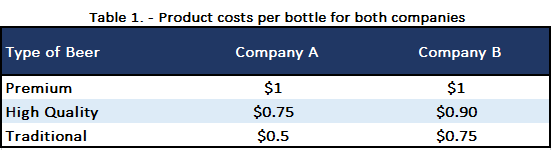
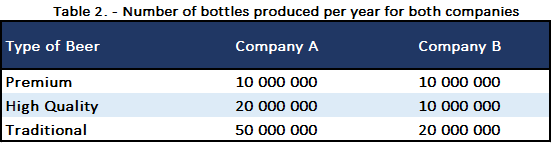
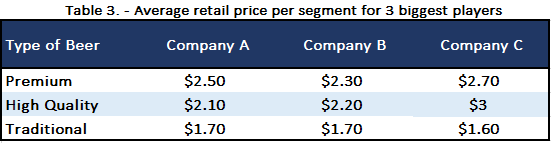
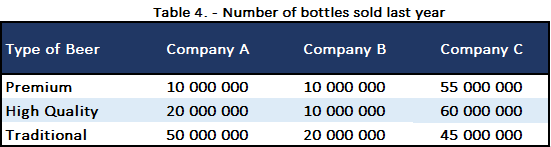
Overview of All Exhibits
Practice makes the difference
Practicing alone helps – with a partner it’s even better. Solve this case in a realistic mock interview.
Schedule on Meeting Board

I. CASE OPENING

Show additional information Hide additional information
Show solution Hide solution

II. STRUCTURE

Show solution Hide solution

III. CASE ANALYSIS – Bucket 1 - Cost-cutting

Show additional information Hide additional information
Show solution Hide solution

III. CASE ANALYSIS – Bucket 2 - Marketing strategy

Current marketing strategies

Show additional information Hide additional information
Show solution Hide solution

III. CASE ANALYSIS – Bucket 3 - Customers

Show additional information Hide additional information

IV. RECOMMENDATIONS

Show additional information Hide additional information
Show solution Hide solution

RISKS AND NEXT STEPS

Show solution Hide solution
Practice This Case With Peers Who Are Currently Looking for Interview Partners.
Do you have questions on this case?
Ask our community and receive answers and tips directly from our experts.
Ask a question Ask a question
Related Case Interview Basics Articles
The Stacey Matrix
Useful Business Analysis Tools
The Stacey Matrix is an important tool for navigating complexity in project management, developed by Ralph Douglas Stacey in the 1990s.In this article, we’ll break down how the matrix works, explore different project types, and discuss its relevance in consulting and case interviews. Plus, we’ll dive into its strengths and limitations in project management. Let’s get started!
To the article
The Blue Ocean Strategy
Common Terms of Business
The Blue Ocean Strategy, developed by W. Chan Kim and Renée Mauborgne in their book Blue Ocean Strategy (2005), turns traditional business thinking upside down. It focuses on tapping into undiscovered markets – the "blue oceans" – where companies can operate alone and avoid competition. The result? More growth and higher profits.In contrast, the "red ocean" refers to the already overcrowded market space where competition is fierce, and companies are constantly striving to outdo each other. This often leads to declining profits and limited growth. 🌊The Blue Ocean Strategy represents a shift away from this destructive competition towards a more constructive and creative form of market development. It encourages companies to go beyond the industry's conventional boundaries and create new markets, making competition irrelevant.
To the article
Competitive Response
Types of Cases
Competitive response cases are a special type of case you might encounter in your case interview. In these cases, you either have to analyze how your client should respond to a competitor's strategy or predict how competitors will react to your client's strategy. This type of case helps you understand competitive dynamics better and develop effective strategies for competitive responses. 
To the article
Pricing
Types of Cases
Pricing plays a crucial role in a company's profitability as it directly contributes to it. For this reason, establishing optimal prices for products or services is of great importance. Business consultants therefore assist their clients in developing pricing strategies.A case study on pricing is an analysis focusing on the pricing of a product or service. It can stand alone or be part of a broader case, such as entering a new market.
To the article
How to Build a Good Structure
Case Structuring
Poor structure, or sometimes no structure at all is one of the main reasons why candidates fail in case interviews. Why? Because case interviews are designed to simulate real-life consulting scenarios. And in the real consulting world, you need to structure problems all day long. If you cannot clearly demonstrate this skill during your interview, you probably won’t be able to apply it on the job and therefore not succeed in a consulting career. But let’s stay positive: Structuring skills can be learned. With some basic principles in mind and lots of practice afterwards, you will be able to excel in this consulting-crucial discipline.
To the article
Practice makes the difference
Practicing alone helps – with a partner it’s even better. Solve this case in a realistic mock interview.
Add invitation
Do you have questions on this case?
Ask our community and receive answers and tips directly from our experts.
Ask a question Ask a question