Who Can Refer You?
Any investment banker within your target firm’s hierarchy can submit a referral on your behalf. This includes:
- Analysts (1st–3rd year junior bankers)
- Associates (Post-MBA or promoted analysts)
- Vice Presidents (VPs) (Mid-level team managers)
- Directors / Senior Vice Presidents (SVPs) (Senior deal leaders)
- Managing Directors (MDs) (Senior executives & key decision-makers)
Junior Bankers (Analysts & Associates)
Junior bankers are the most accessible contacts for candidates. While they rarely have final hiring authority, they frequently screen resumes and conduct first-round technical interviews. A referral from an analyst or associate typically ensures your application bypasses automated filters and reaches a recruiter's desk.
Mid-Level and Senior Bankers (VPs, Directors, & MDs)
A direct recommendation from a mid-level or senior banker carries more weight than that of junior bankers. However, senior executives are rarely responsive to cold outreach due to their schedules. Referral requests at this level are most successful when junior bankers introduce you to them.
So, start your IB networking with analysts and associates who are alumni of your school or with whom you share something like a background or sector interest. Build solid relationships with them first, and let warm introductions to senior bankers happen naturally as those connections grow.
When Is the Right Time to Ask for a Referral?
The ideal time to ask for an investment banking referral is 1 to 2 weeks before official application deadlines, or right when a bank opens its recruitment portal. That timing ensures your contact remembers you when the talent acquisition teams are actively working on applications and candidate lists.
Since IB recruiting, especially for Summer Analyst roles, now happens 12 to 18 months in advance, you should begin executing your investment banking networking strategy two to three semesters before applications open. If you start reaching out the same semester applications go live, you won't have enough time to build a genuine relationship and earn a referral.
Giving a referral typically means the banker thinks you’re a solid candidate, and they can’t tell that if you’ve not had an ongoing exchange that demonstrates your character, competence, and preparation. You can tell you've reached the right time to ask when you see green light signals such as:
- The banker explicitly says, "Let me know when you apply," “Send me an updated copy of your resume” or "Keep me posted on your application status."
- The banker offers explicit advice on navigating the firm's upcoming hiring process, suggests reviewing your resume, or offers to introduce you to colleagues in other product or coverage groups.
- You have completed a strong 15–20 minute networking call where the banker responded warmly to your background, drive, and industry knowledge.
How to Earn an Investment Banking Referral Step-by-Step
To reach the point where asking for a referral feels natural, follow this typical relationship-building sequence:
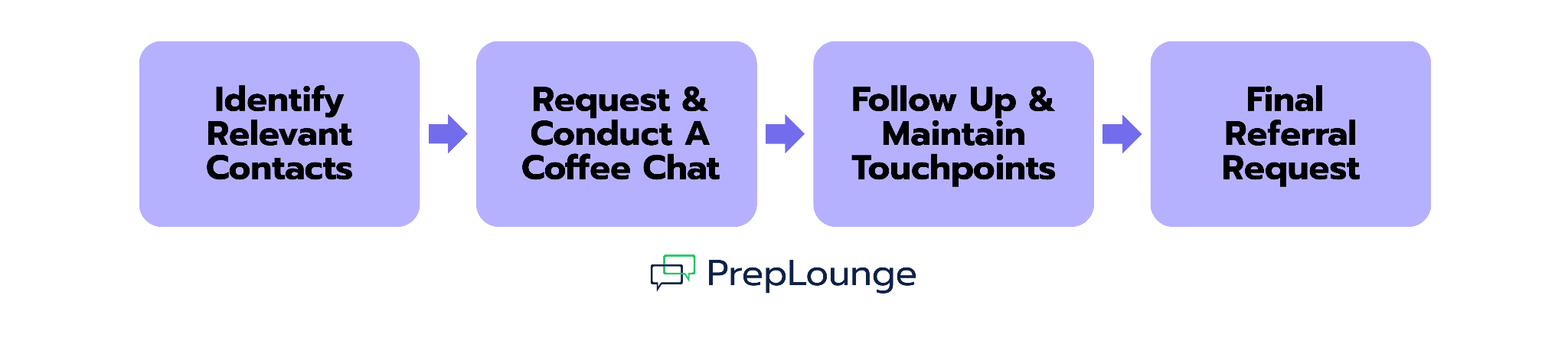
- Identify Relevant Contacts: Search alumni databases, LinkedIn, or your university career center to find Analysts and Associates at your target banks.
- Request and Conduct a Coffee Chat: Start cold emailing investment banking professionals on your list to ask for a brief 15-minute networking call. Find something about them that shows you have genuine interest in the person, like something they wrote, so they can have compelling reasons to respond. Then craft investment banking coffee chat questions that leave no doubt about your genuine interest in the person, firm, and role/sector. Watch for conversation cues to know if you can make a small ask, such as tips or advice regarding the application process, before wrapping up.
- Follow Up & Maintain Touchpoints: Send a tailored thank-you note within 24 hours mentioning specific takeaways. Over the following weeks and months, keep the relationship warm with brief updates, such as sharing relevant deal news or milestone achievements.
- Make the Final Referral Request: When recruiting officially opens and trust has been established, send a concise email asking if they would be open to submitting your resume internally or referring you to their campus recruiter.
How to Ask for a Referral in Investment Banking Professionally
The most effective strategy for asking for a referral in investment banking is the mini-ask vs real ask strategy, which breaks your request into two low-pressure stages.
Stage 1: The Mini-Ask
At the end of your initial coffee chat, make a small, low-friction request to test the connection based on your observations. For instance, you can say:
"Thank you so much for your time today. Before we wrap up, do you have any quick advice on how I can strengthen my application, or is there anyone else on your team you think I should connect with?"
If the banker responds warmly or introduces you to a colleague, you have validated the connection.
Stage 2: The Real Ask
After your initial networking call, find effective ways to stay in touch with the banker over the following weeks or months. Then send a concise email asking if they would be comfortable passing your resume along to recruiting once the application officially opens. The rapport you’ve built beforehand will make this feel like a natural next step rather than an out-of-nowhere demand.
Make it effortless for the banker by including:
- A Clean PDF Resume: Formatted as Firstname_Lastname_Resume.pdf.
- A 2–3 Sentence Forwardable Summary: Highlight your school, GPA, relevant experience, and target Requisition ID.
This blurb allows the banker to copy-paste your qualifications directly to internal recruiters without extra effort.
Referral Message Templates (Example)
Below are examples of investment banking referral email templates you can use once you have conducted a coffee chat, stayed in touch with brief updates, and are ready to request an internal referral as recruiting opens.
Investment Banking Referral Message Template for Post-Coffee Chat
Use this when formal applications open for a bank where you previously had a solid networking call.
Subject: Quick Update + Applied to [Bank Name] [Role Title, e.g., 2027 Summer Analyst] — [Your Name]
Hi [Banker Name],
Hope you are having a great week!
I wanted to quickly follow up on our previous coffee chat and let you know that I just submitted my application for the [Role Title] position at [Bank Name] (Requisition ID: [ID Number]).
Thank you again for sharing your insights about the [Specific Group Name, e.g., Healthcare M&A] team. Our conversation confirmed that [Bank Name] is my top choice.
If you feel comfortable, would you be open to passing my resume along internally to the recruiting team? For your convenience, here is a short summary:
- Candidate: [Your Name] ([University Name], Class of [Year])
- GPA / Focus: [GPA, e.g., 3.8/4.0] | Finance & Economics
- Background: [Brief 1-sentence note, e.g., Incoming Boutique IB Intern / PE Spring Analyst]
I’ve attached my single-page PDF resume to this email as well. I truly appreciate all your guidance throughout my recruiting process!
Best regards,
[Your Name]
[Your Phone Number] | [Link to LinkedIn]
Investment Banking Referral Email Template When They Offered to Help Earlier
Use this when a banker explicitly offered during your call or follow up: "Let me know when you apply and I'll pass your resume along."
Subject: Submitted Application for [Role Title] — [Your Name]
Hi [Banker Name],
I hope you're doing well!
Following up on our conversation from [Month], the application portal for the [Role Title, e.g., 2027 Investment Banking Analyst] position at [Bank Name] officially opened, and I submitted my materials this morning.
You mentioned during our call that you might be able to put in an internal referral or forward my resume to the hiring team once I applied. If you are still open to doing so, I would be deeply grateful!
I’ve attached my updated PDF resume to this email for quick reference. Thank you again for all your support as I navigate the recruiting process!
Best,
[Your Name]
[Your Phone Number] | [Link to LinkedIn]
Common Mistakes to Avoid When Asking for a Referral
Asking and securing a referral when networking in IB can transform your recruiting outcomes. But simple missteps in your overall investment banking networking strategy or in the ask itself can alienate potential advocates. Avoid these four common pitfalls:
1. Asking Too Early
The investment bankers you’ll reach out to for a networking call know the end goal, but that doesn’t mean they will appreciate a referral request in your first email or within the first five minutes of a call. Leading with such a big ask comes off as too direct and impersonal or transactional.
They typically don’t know you well enough to endorse you at the expense of their reputation. You’ll instead have better professional relationships and internal advocates if you approach networking with a genuine interest in the contact.
2. Poor Outreach Habits
Investment bankers process lots of messages daily while working on live deals. Sending a wall of text detailing your life story guarantees your email will be archived. Keep cold outreach brief and specific. You can state who you are, highlight a shared connection (like alumni status), and request a brief 15-minute call. Also, don't give up after one unread message. Sending a polite follow-up note 5 to 7 business days later is where most candidates successfully book their calls.
3. Asking Unprepared or Generic Questions
During an informational interview, your goal is to demonstrate technical curiosity and culture fit. Bankers evaluate you during the call by the questions you ask and how you carry yourself. So, avoid intrusive topics like compensation, bonus figures, or weekly hours, as well as basic questions easily answered by Google. Instead, ask informed, group-specific questions about their recent deal flow, their transition into the bank, and what qualities help a junior investment banking analyst excel in their group.
4. Viewing a Referral as a Magic Bullet
Though a referral typically spotlights your application, it must still meet basic eligibility filters and you may still be required to complete a recorded interview on platforms like HireVue. Also, you must still perform flawlessly during technical and behavioral interviews to secure the offer.
What to Do After You Get a Referral
Once a banker agrees to put their name on the line for you, shift your focus from outreach to execution, interview preparation, and relationship maintenance. Here’s how to go about it.

1. Send an Immediate Thank-You & Complete Your Application
Within 24 hours of confirmation, send a concise thank-you email acknowledging that they put their reputation on the line for you. Immediately submit your formal application via the Applicant Tracking System (ATS) portal if you haven't already. Ensure your details match your resume perfectly and use a clean file name.
2. Pivot Fully to Technical and Behavioral Interview Prep
Even after a referral, you must pass the evaluation yourself. Shift 100% of your focus to interview prep: master core accounting, valuation, and DCF models, while practicing for potential HireVue video screens, behavioral/fit interviews, and upcoming Superdays.
3. Send Milestone Progress Updates
Keep your advocate in the loop as you advance through the recruiting pipeline. Send short updates when you land a first-round interview, complete a screen, or get invited to a Superday. Proactive communication keeps you top-of-mind if HR asks your contact for feedback later in the process.
4. Play the Long Game Regardless of Outcome
Follow up at the end of the recruiting cycle no matter the result. If you receive an offer, thank them for helping you break into the industry. If rejected, express gratitude for their guidance and mention your plans for lateral or off-cycle opportunities.
Maintaining relationships even when things do not go your way demonstrates maturity and ensures your investment banking networking efforts pays dividends throughout your career. You never know where long-term professional relationships will come in handy in future.
Conclusion
An investment banking referral isn't something you request in a first cold email or at the end of every informational interview. Instead, it is earned through an ongoing exchange that helps the banker assess your character, competence, and preparation. To know if you can ask a particular contact for a referral, pay attention to conversational micro-signals, such as a banker offering application advice, asking for an updated resume, or praising your technical preparation. Don’t forget to pair your networking strategy with relentless preparation, stay in touch with your advocates, and turn internal endorsements into job offers.