Who Should You Send Cold Emails To in Investment Banking?
To ensure you get a high response rate when sending cold emails for IB networking, you should primarily target analysts and associates. They're more likely to empathize with your position because they recently went through recruiting themselves and are often involved in the recruiting process. Vice Presidents (VPs) are worth reaching out to as well. But save them for when you're well-prepared since a shaky conversation with someone senior counts against you more than one with a junior banker.
For better chances of success, prioritize sending your networking emails to contacts in this order:
- Alumni Network: School, fraternity, or athletics connections yield the highest conversions.
- Shared Backgrounds: Professionals from your hometown, previous companies, or mutual groups also tend to respond at good rates.
- Group Alignment: Bankers working in your specific target sector like Tech or M&A will see a reason to respond due to alignment.
How to Prepare Before Writing an Investment Banking Outreach Email
Before you can reach out to any contacts in the categories above, prepare by researching each thoroughly, verifying contact information, and creating an outreach tracker. Start by researching the recipient through LinkedIn, the firm’s website, or a simple Google search. The goal is to find any information about them that can serve as a genuine connection point and help you personalize the message. This includes their exact role, location, group, recent press interviews or deals, and articles they’ve written.
Then verify their email address because bad addresses bounce back and harm your email reputation. Use email pattern finders or alumni directories to double-check their official work email format.
You should also set up a clean spreadsheet to track your outreach. Record contact names, banks, dates sent, follow-up dates, and call notes to stay organized and prevent awkward duplicate emails.
How to Structure a Strong Cold Email for IB Networking
With your well-researched information, accurate addresses, and a tracker ready, the next step is to craft a strong cold email. Generally, the sweet spot for response rates is 50-125 words. Short but not very short messages are effortless to skim for bankers who typically check emails on their phones between meetings.
Beyond the outreach message length, here’s how a high-converting cold email format for IB networking looks like:
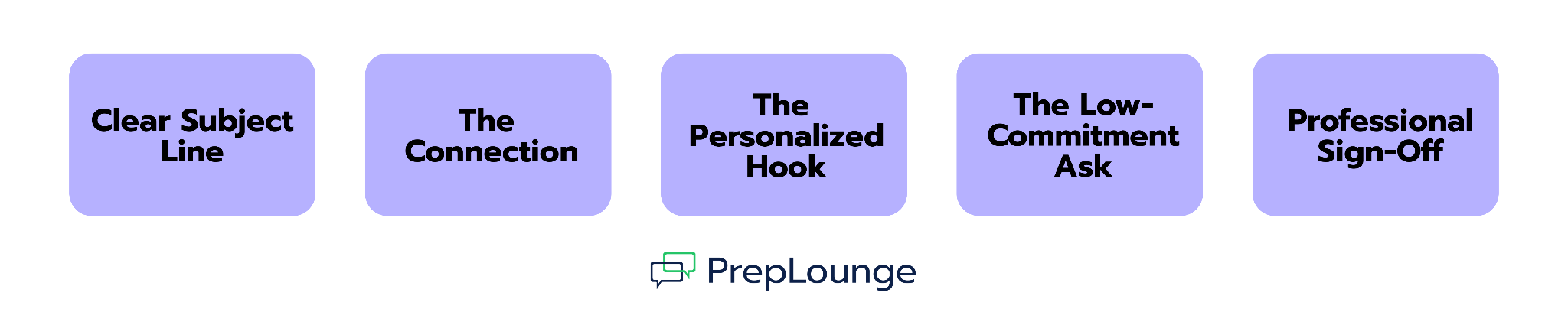
- Clear Subject Line: Make it specific, personalized, or relevant. You can include your school or mutual connection for instance: [School Name] student - 15 min advice call).
- The Connection (Sentence 1): Introduce yourself and immediately state how you found the person or the connection between you. For instance, “I'm a junior at [School] and saw you graduated from our program.”
- The Personalized Hook (Sentences 2–3): Show you've done research by mentioning something specific like a transaction their team closed or a specific sector focus that interests you.
- The Low-Commitment Ask (Sentence 4): Make a clear coffee chat request and articulate the value or goal, such as discussing their career path or getting insights into a particular role at their firm. Propose a meeting window while emphasizing flexibility around their schedule.
- Professional Sign-Off (Sentence 5): Thank them politely and sign off with a clean email signature where you include your university, year, and phone number.
Cold Email Templates for Investment Banking
The structure above works well overall, and you can use it to craft different cold email templates for investment banking that work for various professionals like alumni, warm connections, complete strangers, and post event contacts. Here are a few samples that show how to cold email investment bankers.
Investment Banking Cold Email Template for Alumni
Subject: [University] student / Quick question regarding [Bank Name]
Hi [First Name],
I’m a [Junior/Senior] at [University] studying [Major]. I noticed through our alumni network that you graduated from [University] and are now an Analyst in [Bank Name]’s [Group/Sector] team.
I have been following your group’s recent work on [specific deal or sector trend], and as a fellow alum preparing for investment banking recruiting, I would love to learn about your path to [Bank Name].
Would you be open to a brief 15-minute phone call in the coming weeks to share your perspective? I am happy to work around your schedule.
Best regards,
[Your Name]
[University] ’[Grad Year] | [Phone Number]
IB Cold Email Template for a Referral or Mutual Connection
Subject: Referral from [Referrer’s Name] / [University] student
Hi [First Name],
Our mutual connection, [Referrer’s Name], suggested I reach out to you given your experience in [Bank Name]’s [Group Name] team.
I am a [Year] at [University] actively preparing for upcoming investment banking recruiting. I’ve been reading about [Bank Name]’s recent coverage in [Sector], and [Referrer’s Name] spoke very highly of your perspective on the team's culture.
Do you have 15 minutes for a quick phone chat sometime next week or anytime that works for you? I’d appreciate hearing about your journey and experience at the firm.
Best regards,
[Your Name]
[University] ’[Grad Year] | [Phone Number]
IB Cold Email Template for a Pure Cold Outreach with no Mutual Contact
Subject: [University] student / Question regarding [Bank Name] [Group Name]
Hi [First Name],
I’m a [Year] student at [University] studying [Major]. I came across your profile while researching [Bank Name]’s [Group Name], and I noted your recent work advising on the [Company A / Company B] deal.
I am focused on pursuing a career in [Sector] investment banking, and I am keen to learn more about the day-to-day execution experience within your specific group.
Would you be open to a brief, 15-minute call next week? I will keep my questions concise and respect your time.
Thank you for your time,
[Your Name]
[University] ’[Grad Year] | [Phone Number]
IB Cold Email Template for a Post-Event Follow-Up
Subject: Following up from [Event Name] — [University] student
Hi [First Name],
Thank you for taking the time to present at [Bank Name]’s [Event/Session Name] on [Day of week]. I really enjoyed your insights regarding [mention a specific takeaway or point they made].
As I prepare for investment banking recruiting, I would love to ask a couple of quick follow-up questions about your transition into the [Group Name] group.
Do you have 10–15 minutes available for a brief phone call next week? I’m happy to workaround your schedule too.
Best regards,
[Your Name]
[University] ’[Grad Year] | [Phone Number]
How to Follow Up on Your Investment Banking Cold Emails Professionally
Unfortunately, some cold emails will go unanswered and it has nothing to do with the effectiveness of your messaging. Expect it, don’t take it personally, and follow up about two times. You should wait five to seven business days to pass before sending your first follow-up. Always reply directly within the original email thread so the banker can easily see your initial context without searching through their inbox. Keep the message to a polite two-sentence reminder reaffirming your interest.
If there is still no reply after another seven to ten business days, send another, gracious follow-up. It’s okay to archive them in your tracking system and focus on the others in your list if they remain silent after the third attempt.
Common Investment Banking Cold Emailing Mistakes to Avoid
To ensure you maximize your chances of getting replies and expanding your professional network, watch out for these frequent mistakes when sending cold emails to investment bankers:
- Treating Email Like a Cover Letter: Writing dense, multi-paragraph essays detailing your full resume counts as a cover letter not a cold email for networking. Keep your message under 120 words while focusing on who you are, why you're reaching out to them, and a quick call-to-action.
- Generic Mass-Blasting: Copying and pasting identical text without tailoring names or groups will instantly mark you as spam or lower your reply rates. Personalize every single email with a specific detail about the banker, their group, or a shared affiliation.
- Ending With a Vague Ask: Closing with open-ended statements like "Let me know whenever you have time to chat" isn’t effective as it forces the busy banker to do the scheduling work. Instead, propose a clear, low-friction time frame such as, "Do you have 15 minutes for a quick call sometime next week?".
- Attaching Unsolicited Resumes: Sending a heavy PDF file in your initial message can trigger spam filters and feel overly transactional. Focus first on establishing a connection. Bring up your resume only if they request it or after you've built rapport on a call.
- Sending Obviously AI-Generated, Generic Outreach: Using AI is not out of bounds. But if the recipient or email provider can tell the message was AI-written, there’s a high chance it will be ignored or filtered.
Conclusion
Landing an investment banking offer takes a lot of work, sometimes including networking via cold emails. But some of the people you’ll reach out to were in your shoes before and are willing to help. You can increase the effectiveness of your cold email outreach by keeping every message short, personalized, and built around one clear, low-pressure ask for a conversation. Do your research on the banker, respect the person's time, and follow up without being pushy.
Not everyone will respond, and that's fine. Every email is still a chance to build a genuine connection, learn something you couldn't find online, and grow your network beyond the people you already know. Over time, those conversations add up, and one of them might just be the person who puts in a good word for you when it counts.