



Expert case by
Cristian

Poliglot Language App Needs Users

Case Prompt:

Let’s assume our client is Poliglot, a popular language app. Poliglot is five years old, originally from the US, but available worldwide. The app currently offers the possibility of learning over twenty languages for free, with extra benefits (e.g., no ads, additional exercises) available to premium members.

Historically, the app has been very successful and has seen significant growth over the past few years. However, over the past year, the app noticed a stagnating usage and app adoption. Considering that the market is very competitive, the client expects a decline in the customer base unless the root causes are identified and addressed. 

As a consequence, the CEO of the company that owns the app asked us to support them in figuring out the reasons for the decline and laying out a plan for growth. 

Overview of All Exhibits
Practice makes the difference
Practicing alone helps – with a partner it’s even better. Solve this case in a realistic mock interview.
Schedule on Meeting Board

Question 1

What are some of the reasons for why the app has seen a stagnating trend within its customer base?

Show solution Hide solution

Question 2

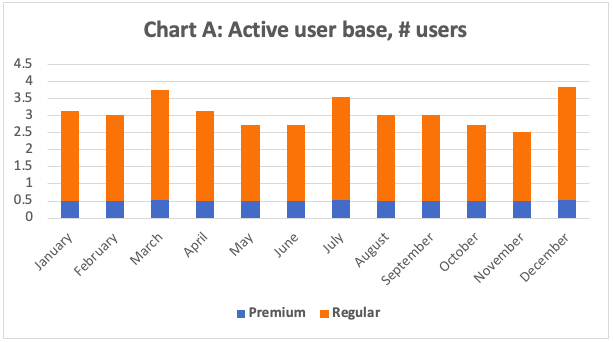
To help us get a better understanding of the small fluctuations in the customer base, the client has shared with us an exhibit containing the number of active users in the customer base over the course of a year. What are some of the insights that you can generate based on this chart?

Show additional information Hide additional information
Show solution Hide solution

Question 3

The client is inspired by the insights you shared earlier and is letting us know that the peaks in the active customer base indeed coincide with promotional campaigns they are running over social media. They agree that these campaigns have had limited effect in terms of converting the additional customers into premium customers or even retaining them as long-term active users on the platform. 

What are the three-four levers they could pull to maximize the revenue out of their active base of customers? 

Show solution Hide solution

Question 4

The client decided they would like to focus within the coming year on increasing their overall app adoption and number of premium users, in an effort to fun other qualitative upgrades there are developing for the app. 

Currently, they have 5 million downloads of the app. 4 million of these lead to actual users opening the app, out of which 3 million make an account. 0.5M sign up for a premium plan. The leadership team in charge of the app claims they developed a set of measures to increase the total downloads to 7 million, as well as increase the conversation rate between those who open the account and who end up creating an account by 15 p.p. They would like to understand by how many percentage points does the conversion rate have to increase between those who create an account and who purchase the premium plan in order to reach a total base of 1.2 million users with a premium plan. 

Show solution Hide solution

Question 5

The CEO drops by for a short update from the team. Considering the work done until know, what is your recommendation at this stage?

Show solution Hide solution
Practice This Case With Peers Who Are Currently Looking for Interview Partners.
Do you have questions on this case?
Ask our community and receive answers and tips directly from our experts.
Ask a question Ask a question
Related Case Interview Basics Articles
The Cynefin Framework
Useful Business Analysis Tools
For graduates aspiring to embark on a career in consulting, understanding and effectively navigating complex situations is essential. The Cynefin Framework (pronounced: Kin-ev-in) provides a powerful tool for consultants to make sense of different problem domains and determine appropriate approaches.In this article, we will explore the Cynefin Framework, its sections - Simple, Complicated, Complex, and Chaotic and the Disorder domain. Additionally, we will provide an example of how the framework can be applied in the consulting industry.
To the article
The Tuckman Model
Common Terms of Business
At the core of comprehending team dynamics is the ingenious creation of Bruce Tuckman, the Tuckman Model. Bruce Tuckman, an eminent psychologist and researcher, introduced this model in 1965, and it has since been a fundamental framework for understanding team behavior and guiding team development.Tuckman, with his deep-rooted interest in group dynamics, recognized the evolution teams go through in their journey towards high performance. His model offered a lucid, linear path for this evolution, making it easily understandable and implementable in varied team environments.His ground-breaking work has led to profound shifts in how organizations manage their teams, promoting a more empathetic and result-oriented approach. Tuckman's model stands out as an insightful roadmap that helps navigate the complex maze of team development, and its utility spans multiple disciplines and industries.In a consultancy environment, the model is especially relevant due to the constant team reshuffling and the high value placed on effective teamwork. With consultants often stepping into pre-established teams, understanding the team's current developmental stage - whether it's forming, storming, norming, performing, or adjourning—is invaluable.By using Tuckman's model as a reference, consultants can quickly assess team dynamics, identify issues, and devise strategies to move the team towards the next stage. In essence, Tuckman's model provides a clear framework that can be used to maximize team effectiveness, making it a critical tool in the consultant's toolkit.
To the article
General Knowledge
Consulting Skills & Preparation
In case interviews, having solid general knowledge can make a big difference, especially in market sizing questions. Knowing basic facts about regions, population sizes, and economic indicators helps you build stronger arguments. It’s not just about the analysis itself but also about showing interviewers that you understand global trends and can quickly process key information — an important skill in consulting.In a case interview, quick and accurate estimates are essential. For example, if you're asked to evaluate the potential market for a product in a specific country, having solid data — like the population size — is crucial. Without this information, it can be challenging to make a meaningful calculation.In addition to national market data, it's important to know about key global markets. Being familiar with major economic regions like the U.S., China, and the EU is valuable because large consulting firms such as McKinsey and BCG operate extensively in these areas. A solid understanding of these regions shows that you can think about global factors and helps you stand out from other candidates. What Your Knowledge of Population, Economy & Geography Says About YouHaving strong general knowledge in specific areas not only shows that you are well-prepared, but also that you can quickly understand economic relationships—a crucial skill in consulting. When you have information like population sizes or a country's Gross Domestic Product (GDP) at your fingertips, you can quickly verify assumptions and make informed decisions, which is exactly what case interviews expect.Additionally, your knowledge of these topics demonstrates a genuine interest in world affairs and your ability to recognize and understand global trends. This insight is vital for evaluating how political, economic, and social changes affect businesses. It also highlights your capability to absorb and use complex data effectively.PopulationCountry/RegionPopulation (approx.)Worldwide8.05 billionChina1.426 billionIndia1.419 billionEurope (EU states)450 millionUSA335 millionIndonesia277 millionBrazil203 millionRussia143 millionJapan124 millionGermany83 millionUK68 millionGDP Forecast in USD for 2024Country/RegionGDP 2024 (approx. in trillions USD)Worldwide105 trillion USDUSA25 trillion USDChina18 trillion USDJapan4.3 trillion USDGermany4.5 trillion USDFrance3.0 trillion USDUK3.1 trillion USDIndia3.9 trillion USDItaly2.2 trillion USDBrazil2.1 trillion USDCanada2.2 trillion USD Key Data to Know for Your Case InterviewIn case interviews, making quick and accurate estimates is key. A good grasp of units, along with basic fraction and percentage calculations, is essential for working efficiently. Additionally, being comfortable with time units is important for making rough estimates and calculations. The table of larger and smaller time units below provides a handy overview of commonly needed values. These fundamental skills help you tackle tasks confidently and quickly.Overview of Time Conversions: Days, Weeks and HoursLarger UnitsSmaller UnitsDays/Year365 days (In leap years: 366 days)Days/3 Years1,095 daysDays/4 Years1,461 days (including 1 leap year)Weeks/Year52 weeksHours/Week168 hoursSeconds/Hour3,600 secondsConversion of Fractions to Percentages and Decimal ValuesFractionPercentageDecimal1/520%0.201/616.67%0.16671/714.29%0.14291/812.5%0.1251/911.11%0.11111/1010%0.101/119.09%0.09091/128.33%0.08331/137.69%0.07691/147.14%0.07141/156.67%0.06671/166.25%0.06251/175.88%0.05881/185.56%0.05561/195.26%0.05261/205%0.05Remember, it’s not enough to just memorize these numbers—you also need to be able to calculate with them effectively!Use our Mental Math Tool to specifically train your math skills and prepare for your next interview.
To the article
7S-Framework of McKinsey
Frameworks
If you're aiming for a career in consulting, learning about key frameworks is essential. One of the most popular and effective tools is the McKinsey 7S Framework. Created by McKinsey & Company, this framework helps you understand and evaluate how different parts of an organization work together to improve overall performance.In this post, we’ll explain the seven elements of the McKinsey 7S Framework and how you can use it in case interviews. Whether you're preparing for consulting roles or just want to boost your business knowledge, this framework is a valuable tool to have in your skillset!
To the article
McKinsey Growth Pyramid
Useful Business Analysis Tools
The McKinsey Growth Pyramid is a strategic tool that helps businesses systematically explore growth opportunities. As the name suggests, it was developed in the 1980s by the renowned management consulting firm McKinsey & Company. It prioritizes different approaches to expansion and offers a structured roadmap for companies to increase revenue, expand their market presence, and drive long-term sustainability. This framework is widely used in consulting, including in case interviews, as it provides a clear methodology to assess how companies can scale efficiently.

To the article
Practice makes the difference
Practicing alone helps – with a partner it’s even better. Solve this case in a realistic mock interview.
Add invitation
Do you have questions on this case?
Ask our community and receive answers and tips directly from our experts.
Ask a question Ask a question