



Expert case by
Cristian

Hara Coffee Co's innovative coffee subscription model

Difficulty: Intermediate
Interviewer-led
< 100 Ratings
Times solved: 1.6k

Case Prompt:

Our client, Hara Coffee Company, is a large coffee chain with over 200 locations in the United Kingdom. They import beans from numerous regions and batch-roast them in the UK, offering customers a vast selection of premium blends. In addition to serving delicious coffee, our client offers freshly made sandwiches, pastries, and salads of the highest quality. Hara Coffee Co. is also one of the most socially and environmentally responsible coffee brands in the United Kingdom, and their value proposition heavily relies on customers paying a premium for delicious products that do not compromise on sustainability metrics.

The rising cost of living has significantly reduced the revenue of coffee chains throughout the United Kingdom over the past year. People are increasingly choosing to brew their own coffee at home, with beans delivered by subscription. The CEO of Hara Coffee Company is intrigued by the expansion of coffee subscription models in the UK.  They requested that our team investigate whether their chain could also introduce a coffee subscription model, in which customers pay a fixed monthly fee and receive a certain number of coffees throughout the month. 

Overview of All Exhibits
Practice makes the difference
Practicing alone helps – with a partner it’s even better. Solve this case in a realistic mock interview.
Schedule on Meeting Board

Question 1:

What factors would you evaluate to determine whether it is a good idea for our client to implement a coffee subscription model?

Show additional information Hide additional information
Show solution Hide solution

Question 2:

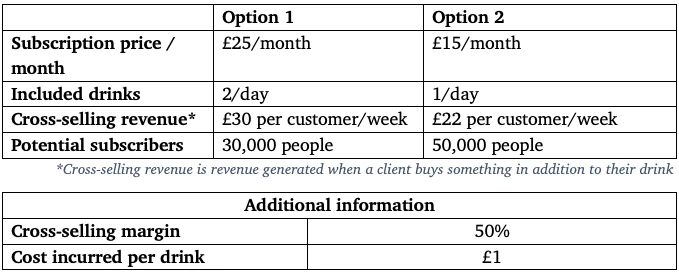
The client would now like your help in deciding how to price the subscription. They have done some market research and have identified two possible options, as illustrated in Exhibit 1. How would you decide between these two options, and which one would you choose? 

Show additional information Hide additional information
Show solution Hide solution

Question 3:

The client appreciated your analysis and is considering implementing the £15/month subscription option. What additional revenue streams could they implement to maximise cross-selling revenue? Second, what are some additional ideas for revenue growth that do not necessarily involve cross-selling?

Show solution Hide solution

Question 4:

The client likes your ideas and they are considering adding smoothies to their product mix and even offering them as part of the subscription that we were discussing. Your colleagues came up with the following estimates to help you make sense of this opportunity: 

  • Smoothies are a higher margin item for us, but they are also more expensive, at a cost of £2 per drink vs £1 for coffees
  • The number of subscribers is expected to increase by 30% from the 50k we previously estimated
  • Cross-selling profits will increase from £44 per month (£22/week x 4 weeks x 50%) to £50 per month

If we introduce smoothies, we anticipate that our customer base will order a smoothie 1/3 of the times on average. Assuming we continue to charge £15 per month for the subscription, does it still make sense to include smoothies?

Show additional information Hide additional information
Show solution Hide solution

Question 5:

What would you recommend to the client in light of everything we have analysed?

Show solution Hide solution
Practice This Case With Peers Who Are Currently Looking for Interview Partners.
Do you have questions on this case?
Ask our community and receive answers and tips directly from our experts.
Ask a question Ask a question
Related Case Interview Basics Articles
Design Thinking
Common Terms of Business
Design Thinking is more than just an approach or a method – it's a non-linear, iterative process that places creativity and problem-solving at its core. To understand this mindset, let's look at the three essential elements of Design Thinking: People, Process, and Place. These elements form the foundation for applying Design Thinking in business consulting.
To the article
The Cynefin Framework
Useful Business Analysis Tools
For graduates aspiring to embark on a career in consulting, understanding and effectively navigating complex situations is essential. The Cynefin Framework (pronounced: Kin-ev-in) provides a powerful tool for consultants to make sense of different problem domains and determine appropriate approaches.In this article, we will explore the Cynefin Framework, its sections - Simple, Complicated, Complex, and Chaotic and the Disorder domain. Additionally, we will provide an example of how the framework can be applied in the consulting industry.
To the article
The Capability Maturity Model (CMM)
Useful Business Analysis Tools
A career in consulting requires a deep understanding of various methods and models that can help clients optimize their processes and maximize performance. One such model is the Capability Maturity Model (CMM), which can serve as a compass for organizations seeking to improve their project management and service capabilities.Developed by the Software Engineering Institute (SEI) at Carnegie Mellon University, the CMM, as well as its extension to the Capability Maturity Model Integration (CMMI), focuses on improving processes within an organization. The models provide a better view of process improvement within five levels (initial to optimized). Each level represents a different level of process maturity and guides an organization toward continuous process improvement.
To the article
The Tuckman Model
Common Terms of Business
At the core of comprehending team dynamics is the ingenious creation of Bruce Tuckman, the Tuckman Model. Bruce Tuckman, an eminent psychologist and researcher, introduced this model in 1965, and it has since been a fundamental framework for understanding team behavior and guiding team development.Tuckman, with his deep-rooted interest in group dynamics, recognized the evolution teams go through in their journey towards high performance. His model offered a lucid, linear path for this evolution, making it easily understandable and implementable in varied team environments.His ground-breaking work has led to profound shifts in how organizations manage their teams, promoting a more empathetic and result-oriented approach. Tuckman's model stands out as an insightful roadmap that helps navigate the complex maze of team development, and its utility spans multiple disciplines and industries.In a consultancy environment, the model is especially relevant due to the constant team reshuffling and the high value placed on effective teamwork. With consultants often stepping into pre-established teams, understanding the team's current developmental stage - whether it's forming, storming, norming, performing, or adjourning—is invaluable.By using Tuckman's model as a reference, consultants can quickly assess team dynamics, identify issues, and devise strategies to move the team towards the next stage. In essence, Tuckman's model provides a clear framework that can be used to maximize team effectiveness, making it a critical tool in the consultant's toolkit.
To the article
4P Framework
Frameworks
The 4P Framework – consisting of Product, Price, Place, and Promotion – is one of the fundamental marketing strategies that helps companies successfully position their products or services in the market, a classic task often encountered in case interviews. It provides a structured approach to consider all critical aspects of a product or service and ensure they are optimally aligned with customer needs.💡 By the way: In our Case Interview Basics, you can find all the essential frameworks you need for case interview preparation. Check it out!

To the article
Practice makes the difference
Practicing alone helps – with a partner it’s even better. Solve this case in a realistic mock interview.
Add invitation
Do you have questions on this case?
Ask our community and receive answers and tips directly from our experts.
Ask a question Ask a question