Behavioral Interview Questions in Investment Banking & How to Prepare
Key Takeaways
Investment banking behavioral interviews assess much more than technical knowledge. Interviewers evaluate how candidates handle pressure, teamwork, and communication.
Strong storytelling and structured answers can significantly improve interview performance.
Preparation becomes more effective when behavioral and technical practice are combined.
If you got an investment banking interview invite, you clearly have a strong GPA, a great resume, and solid experience. But so does every candidate who passed the screening stages. Most shortlisted candidates will also have strong technical skills, but the analyst and associate positions at the top IB firms are limited. So, banks use behavioral and fit questions to determine who gets an offer among the best.
Want to make the cut? Read on to learn how to stand out in IB behavioral interviews and land the job offer.
What Are Behavioral Interviews in Investment Banking?
Behavioral interviews are one of several interview formats you’ll encounter in the investment bankingrecruitment process. The interviewer asks you to recall specific past experiences and walk them through how you handled them. They do this because how you behaved in the past gives them hints of how you’re likely to show up in the role.
Behavioral interview questions in IB tend to open with phrases like "Tell me about a time when...""Give me an example of..." or “Describe…” They often come up alongside fit questions in the same interview, but they have subtle differences.
Fit questions assess your motivations or the why behind your choices. They include "Why investment banking?" or "Why our firm?" On the other hand, behavioral questions dig into your decision-making process and actions in specific situations. Each behavioral or fit question has a subtext, which is why even bright candidates trip up.
Land your top job with PrepLounge!
Sign up now for free and get access to our Q&A, top coaches, preparation tools and much more.
Why Behavioral Interviews Matter in the IB Recruiting Process
Behavioral interviews carry serious weight in investment banking because analyst and associate roles demand more than technical skills. Banks want people who can handle 70–100+ hour work weeks, who they can stand working alongside at 2am on a Saturday, and who will genuinely fit the culture.
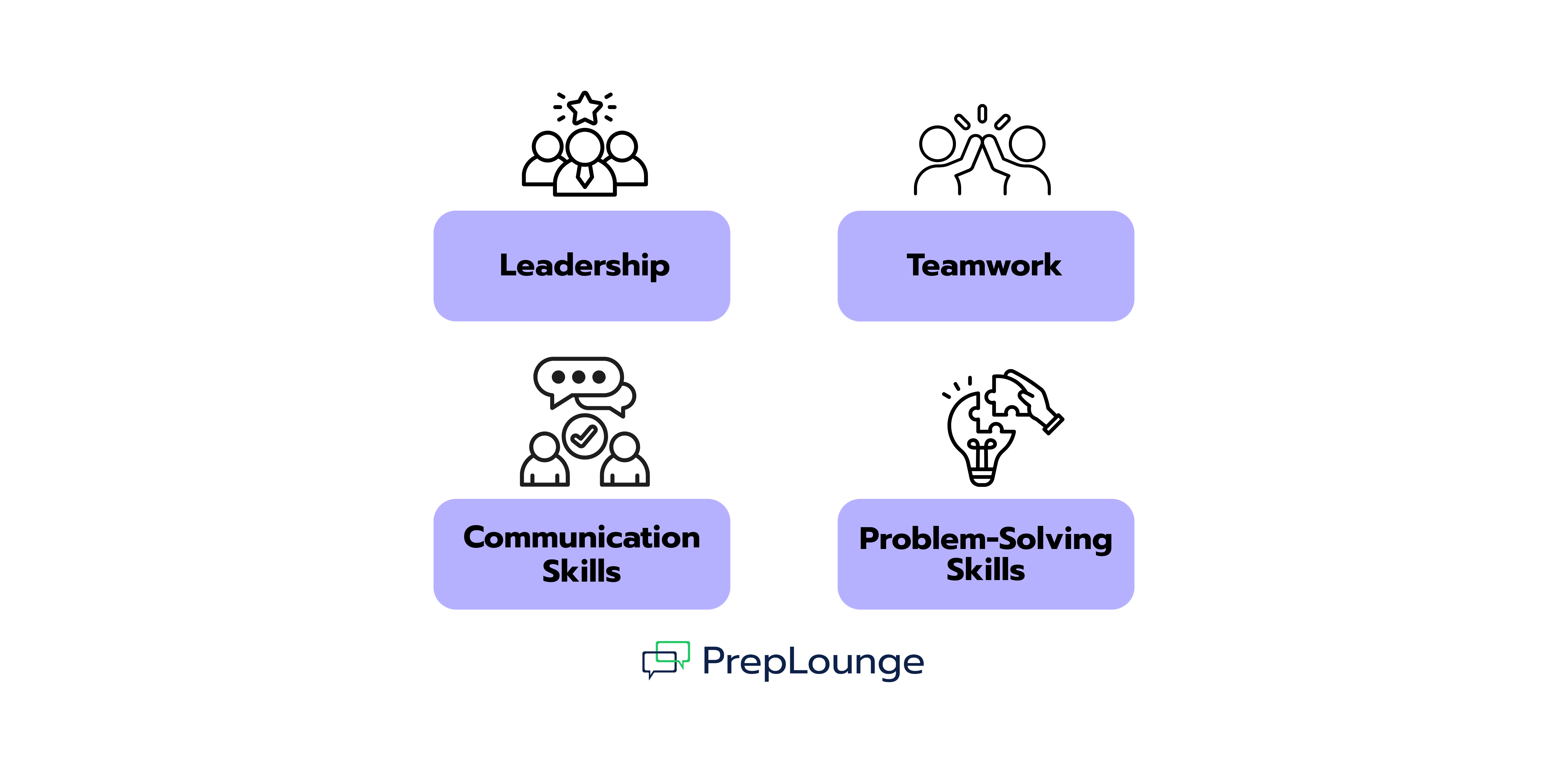
So, your answers are held up against core competencies or a profile of the ideal junior banker. That profile generally comes down to four things:
Leadership: Takes initiative without waiting to be told, influences others without needing a title, and owns outcomes regardless of how things turn out.
Teamwork: Contributes actively, handles disagreements professionally, and Tendencies to either dominate the room or free-ride are a red flag.makes the group better.
Communication Skills: Speaks clearly and concisely, and also reads the room well, whether in front of a senior MD or a client. Not someone who rambles, over-explains, or misses social cues.
Problem-Solving Skills/Handling Pressure: Stays structured and calm under pressure, focuses on solutions rather than just flagging problems, and doesn't need hand-holding in ambiguous situations.
Your answers either map onto that profile or they don't. A story where you needed constant direction, fell apart under a deadline, or blamed teammates hints the wrong fit. The interviewers build their judgment from the sum of your answers, your tone, your self-awareness, and how you carry yourself in the room.
Most Common Behavioral Interview Questions in Investment Banking - with Examples
Below is an overview of the most common investment banking behavioral questions. We’ve explained the subtext for each type of question to help you in preparing convincing answers and ace the interview.
Motivation & Fit
Walk me through your resume
Most candidates think this question is an invitation to read their CV out loud. But what interviewers want to hear is how relevant your work experience is, what relevant qualities you have, and how each move led to the next.
Example: "I studied Finance at the University of Toronto, where I developed a strong interest in financial modeling through my coursework. That led me to a corporate finance internship where I worked on valuation and due diligence for M&A transactions. From there I knew I wanted to work on larger, more complex deals, which is what drew me to investment banking and ultimately to this firm."
Why investment banking?
This is one of the most common fit questions you'll face, and a vague or clichéd answer can cost you the offer. Avoid mentioning money, prestige, or glamour. Instead, start with your background, then the moment IB clicked for you, an d finish with the actionable steps you've taken since to pursue it.
Example: “Studying Finance sharpened my interest in how companies are valued and how capital decisions get made. That interest became concrete during an M&A internship, where working on a live deal showed me how much I enjoyed the analytical rigor and the advisory dynamic between bankers and clients. Since then I've completed a financial modeling course and networked extensively within the industry. This is deliberately where I want to build my career."
Why this firm specifically?
Interviewers here want to see whether you’ve researched and understood the firm's culture, deal flow, and reputation well enough. Generic answers like "great reputation and interesting deals" won't cut it. Answer by tying specific things you've learned about the firm to your own strengths, traits, and working style.
Example: "I've followed several of your recent infrastructure deals in EMEA, and the firm's focus on emerging markets aligns with both my background and the work I find most compelling. I’ve also noticed a collaborative culture here from speaking with your analysts. That stood out because I feel at home and do my best work in environments where people genuinely invest in each other's development."
Leadership
Tell me about a time when you led a team successfully.
When answering leadership skills-based questions, research and keep in mind the traits investment bankers love in leaders like empathy, composure under pressure, and teammate mentality. Then use stories from different settings like a group project, student organization, or internship where there was a real challenge or tight deadline. Emphasize how you kept the team motivated and on track rather than how you personally saved the day.
Example: "During a university finance competition, two team members had a disagreement over our valuation approach the night before the presentation. I thought the best way to help is facilitating a quick discussion instead of picking a side. That helped us reach a middle ground and we redistributed tasks to meet the deadline. We placed second out of fourteen teams, but more importantly, the team felt the process was fair and collaborative."
Teamwork, Conflict, & Handling Pressure
Tell me about a time a team member wasn't pulling their weight. What did you do?
In team contexts, bankers want to see capacity to handle difficult teammates or underperformance maturely and empathetically. Most importantly, they like people who don’t throw colleagues under the bus.
Example: "During a group project in school, one member fell behind and it felt like disengagement. But I checked in privately and learned they were overwhelmed. We resolved to redistribute tasks and finished on time. Afterwards it hit me how clear communication and early intervention keep teams aligned, especially under pressure."
Tell me about a time you worked under a tight deadline
IB is deadline-driven and often involves high-pressure work. So this question is a preview of how you'll perform on the job. Show composure, prioritization, and quantitative impact even on tight deadlines.
Example: "During my internship, I was given 24 hours to build a comparable company's analysis for a live pitch. I did nothing else but the task till late night and the next day too. I double-checked every assumption and delivered clean output just a few minutes to the deadline. The deck went to the client without revisions."
Tell me about a time you faced a complex problem and how you overcame it.
Besides showing that you solved a problem, demonstrate ownership, structured thinking, and composure. Giving details on how you managed to approach it under pressure is also important.
Example: "During an internship, our model flagged a significant valuation discrepancy the day before client delivery. I took ownership, systematically isolated the error to a flawed assumption in the revenue forecast, corrected it, and stress-tested the outputs before resubmitting.”
Failure & Self-Awareness
Tell me about a time you failed.
What the interviewer is really looking for with this question is your ability to own a mistake and learn from it. So, don’t deflect or over-explain.
Example: “During a group project, I misunderstood the client brief and delivered an analysis that missed the mark. Rather than making assumptions going forward, I developed a habit of repeating back key requirements at the start of any assignment to make sure I'm fully aligned before diving in."
Tell me about your strengths and the biggest weakness
For strengths, pick qualities that genuinely describe you from the job specs and the firm’s core values. These may include analytical thinking, attention to detail, or working well under pressure. Be ready to back each one up with a solid example.
Strength example: "I'm highly detail-oriented and tend to notice even subtle details. During my internship, I caught a compounding error in a DCF model that would have changed the valuation output massively."
As for the weaknesses, go for one that’s real but non-critical to the role.
Weakness example: "I used to struggle with presenting to senior stakeholders. So I joined a public speaking club and have since led two client-facing presentations during my internship."
Typical Challenges Candidates Face During Behavioral Interviews
Even after knowing and practicing with the common IB behavioral questions, some candidates trip up during the interviews. Here are some of the reasons for that and how to avoid them.
Sounding too Rehearsed
The most common trap is memorizing answers word for word. It works fine until an interviewer interrupts or pushes with a follow-up. Then candidates freeze or struggle to adapt, and the whole thing falls apart.
Prepare your stories as bullet points instead, covering the problem, the action, the result. Never write full paragraphs. If you can tell the same story three different ways, you're ready.
Weak Storytelling
Some candidates have genuinely strong experiences but still leave a weak impression because of how they tell the story. The most common culprit is vagueness. For instance, saying "I found a way through" or "I handled it well" instead of walking through what they actually did.
The other issue is not making thestakes clear. "The pitch was in four hours, I still didn't have the data, and no one on the team knew where to find it" creates tension an interviewer will remember. "I worked on a group project with a tight deadline" does nothing.
Lack of Structure
Even strong candidates can lose behavioral interviews by not organizing their thoughts before they start talking. The result is rambling which leads to burying the key point under too much backstory, or missing it entirely. This can happen to naturally great conversationalists too.
Unfortunately, interviewers take disorganized answers as a sign that you'll struggle to communicate clearly on the job. Avoid that by using the STAR framework (Situation, Task, Action, Result) during prep until it stops feeling like a formula. Also, take one or two seconds before answering to pick the right story and find your thread.
Lack of Authenticity
In an effort to impress the interviewer and secure the job, some candidates try to say the right things and come off as inauthentic. A common sign of insincere responses is over-polished answers about your weaknesses, for instance, “I work too hard” or “I cared too much about quality.” You don’t have to share anything that can hurt your chances, but pretending a strength is a weakness won’t help either.
The same goes for over-polished answers, generic examples, and overstated achievements. Most candidates get here by preparing the wrong way — trying to build the perfect banking persona instead of figuring out how to tell their own story well. Focus on that, and authenticity takes care of itself.
How to Structure Strong Behavioral Answers
Strong behavioral answers require compelling examples, a clear structure, and clean delivery. Here's how to nail each one.
Prepare Impactful Examples
Before anything else, build a personal story bank that covers the core IB competencies. These include leadership, teamwork, problem-solving, communication, failure, and working under pressure. You can pull them from jobs, internships, clubs, coursework, and extracurriculars to diversify.
Also map your examples to the job description. Look at the listed responsibilities and required competencies, then choose stories that highlight them deliberately. That alignment is what makes you look like the obvious hire.
Strong examples are specific, personal, and outcome-driven. Weak ones are vague, group-focused, or trail off without a clear result.
Use the STAR method
STAR gives your answer a clear beginning, middle, and end, without rambling. Here's how it works using the question "Describe a conflict with a colleague and how you handled it."
Situation: Set the context in one or two sentences. “During a case competition, my partner and I clashed over using a DCF versus a Comps model for our pitch.
Task: Define your role or the specific challenge to be resolved. "I needed to resolve this analytical impasse within 24 hours to finalize our presentation.”
Action: This is the most important step. Describe specifically what you did and show your thinking. “I built a quick sensitivity analysis comparing both models, proposing we lead with the DCF and use Comps to cross-verify the valuation.”
Result: Close with the outcome, ideally with a number to show impact. Then add a one-sentence reflection. “We secured first place, and I learned that data-driven compromise eliminates emotional friction.”
Communicate Clearly
Knowing what to say and saying it well are two different things. Speak in plain, direct language and drop the jargon and filler words like "basically" or "kind of." Pause between STAR steps, keep a measured pace, and make eye contact. If your interviewer can't follow the story, the content won't matter.
How to Prepare Effectively for Investment Banking Behavioral Interviews
Beyond structuring your responses, you can prepare well for behavioral questions in investment banking by nailing the motivation questions, practicing out loud, recording yourself to review later, doing mock interviews, and combining with technical prep.
Nail the Core “Why” Questions
You’re almost guaranteed to get these three questions in an investment banking interview:
Why investment banking?
Walk me through your resume
Why this firm?
So, spend a good amount of your preparation time refining your story to align with what interviewers are looking for when asking each of these questions. Get comfortable enough with your own story that it flows naturally without sounding rehearsed.
Practice Out Loud & Record Yourself
Reading over your answers in your head doesn't count as practice. Speak out loud as if you're in the actual interview, and record yourself. Watch it back and look specifically for: answers running past two minutes, filler words, robotic delivery, nervous habits, and disengaged body language.
If your delivery sounds stiff, the likely culprit is writing full scripts. Don't do that. Write three or four bullet points per story and practice improvising the transitions. That's what makes answers sound natural under pressure.
Do Mock Interviews
Once you've done enough solo reps, bring in other people. Start with peer mock interviews with those who are also prepping. Then step it up with university alumni or mentors who can push back on your stories, throw intentional curveballs, and give you real feedback.
If you can, do at least one mock with an industry professional or interview coach. They’re the best at replicating the pressure of the interview environment.
Combine Technical and Behavioral Prep
A typical IB first round runs three or four behavioral questions followed by two or three technicals, all in one session. So, practice transitioning between them. The mental load of storytelling is real, and if you're not used to it, it will affect your DCF walk-through.
Common Mistakes to Avoid in IB Behavioral Interviews
Here are the pitfalls that quietly cost candidates offers and how to avoid them.
Not Tying Stories to IB Competencies
A compelling story that doesn't connect to a core banking competency like attention to detail, critical thinking, or logical reasoning, doesn't do much work for you. Interviews exist to evaluate fit, so every story you tell should clearly demonstrate at least one of the traits banks are actually hiring for or their core values. Review your story bank with that filter in mind.
Saying "We" When You Mean "I"
Candidates often overuse "we" trying to signal collaboration, but it leaves interviewers without a clear picture of what you specifically did. Use "we" to acknowledge the team, then change to "I" when talking about your decisions and actions. That balance shows both teamwork and individual ownership.
Forgetting the Result
After walking through your action, interviewers are waiting to hear what it led to. Trailing off without a clear outcome is a missed opportunity. Always close with a specific result, ideally a measurable one. "Closed a $15M deal" works while "Things worked out well" doesn't.
Using Negative Language
Questions about teamwork and conflict make it tempting to subtly blame a difficult teammate, a bad manager, or a frustrating situation. Don't, because it reads as a red flag immediately.
If you'll speak that way about past colleagues, they'll assume you'll do the same here. Keep the focus on how you responded, not what others did wrong. Even if the situation was genuinely bad, stay neutral.
Weak Body Language and Presence
Interviewers notice how you carry yourself. So, strong answers delivered with closed posture, nervous fidgeting, or a monotone voice tend to lose their impact. Maintain natural eye contact, vary your tone, and speak at a measured pace. Your presence matters, especially because it’s a role where you'll eventually be in front of clients.
No questions for Interviewers
Some interviewers take “I don’t have questions” at the end of the interview as disinterest. Prepare at least two thoughtful questions for them to show genuine curiosity and that you've done your homework. Ideas for the questions include the team, culture, and recent deals.
Conclusion
IB behavioral interviews aren't a personality test but interviewers use every story you tell as evidence of how you'll perform in the role. This means the interviews are a structured evaluation of whether you have the competencies, soft skills, self-awareness, and the presence to do the job well — and to do it alongside people who will be counting on you at 2am on a Saturday.
The candidates who perform best structure their stories using a framework like STAR, tell them with clarity, and make it easy for the interviewer to see the fit. Prepare with that standard in mind, and the offer will follow.
Common Questions about Behavioral Interviews in Investment Banking
Behavioral interviews help banks evaluate whether candidates have the soft skills and the mindset needed for investment banking. They also show how applicants handle pressure, teamwork, and professional challenges in real situations.
Investment banks mainly look for leadership, teamwork, communication skills, and problem-solving abilities. They also value candidates who stay calm under pressure and fit well into the company culture.
The STAR method helps candidates structure their answers in a clear and logical way. It also makes it easier for interviewers to understand the situation, actions, and results behind each example.
One of the most common mistakes is sounding too rehearsed or scripted during answers. Candidates also lose points when they give vague examples without showing their personal contribution or the final result.
Candidates should practice answering questions out loud and review their delivery by recording themselves. Mock interviews and strong personal examples linked to banking competencies can also improve confidence and performance.