Private Banking focuses on personalized wealth management for high- and ultra-high-net-worth individuals.
The role combines relationship management with deep financial markets expertise.
It offers high compensation and work-life balance, but fewer exit opportunities than investment banking.
Ever considered a career in private banking? It’s an ideal finance career path for someone who builds and maintains relationships almost effortlessly. You will still need extensive knowledge of the financial markets, but the ability to build your own client portfolio and maintain long-term relationships will determine your success as a private banker.
In this article, we’ll explain what exactly private banking is, discuss the services private banks offer, and give examples of major firms with private banking divisions. We’ll also talk about the pros and cons of this career path, how to get started, and future trends.
Private banking refers to an area of banking reserved for high-net-worth individuals (HNWIs) and ultra-high-net-worth individuals (UHNWIs) as well as their families. The eligibility varies by firm but most require a minimum of $1-$5 million in investable assets. Such clients get personalized wealth management and exclusive banking services at a monthly management fee.
This means each client is assigned a dedicated relationship manager or private banker who serves as their main point of contact for all financial needs. Then the banker works with other specialists like investment advisors, mortgage bankers, and tax professionals to offer tailored solutions to the client or help them with specialized financial needs.
What Services Do Private Banks Offer?
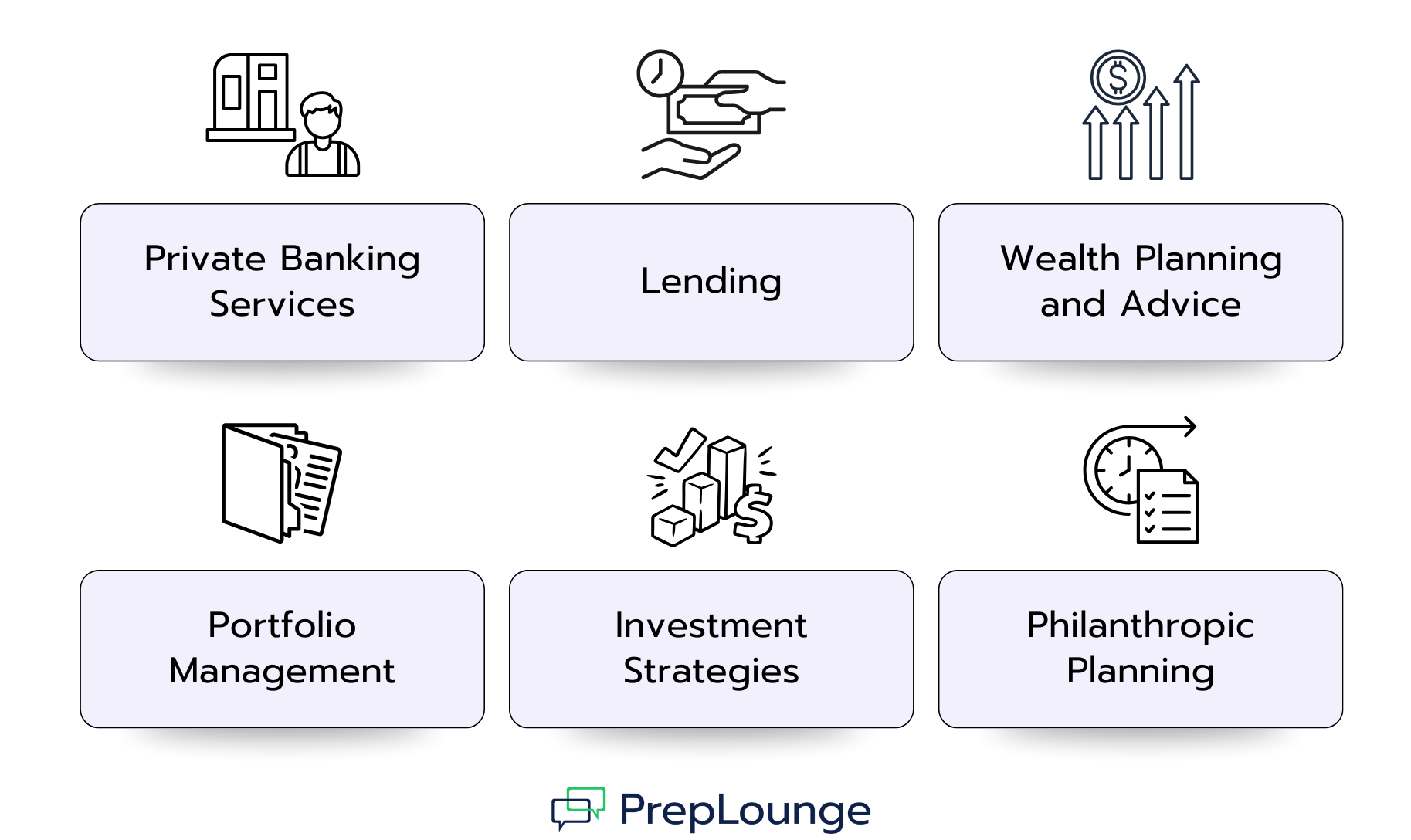
The customized solutions and services private banks offer go beyond standard banking. They include:
Private Banking Services: These are essentially customized personal and business banking services including online and mobile banking.
Lending: Clients get access to credit facilities including mortgages, lines of credit, and loans.
Wealth Planning and Advice: This is financial planning that covers estate, tax strategy, retirement, private business, asset allocation, strategic plans to preserve and grow assets, and multi-generational wealth transfer.
Portfolio Management: This involves building an investment portfolio and strategy the client can direct or allow the bank to fully manage. The services here may include sustainable investing, asset allocation, custody services, investment management, and outsourced chief investment office.
Investment Strategies: Banks offer clients options for investing such as alternative investments, fixed income, equities, annuities, custody services, and currencies, commodities, and interest rates trading.
Philanthropic Planning: For those with foundations or charitable initiatives, private banks help them structure strategies for managing their giving.
Which Companies Operate in Private Banking?
If you’re wondering what private banks exist to provide such services, don’t be surprised as you may already know them. Most of the major global financial institutions do have private banking divisions, including UBS, J.P. Morgan, Citi, Bank of America, HSBC, Morgan Stanley, and Goldman Sachs. Here’s a brief overview of each.
UBS
UBS is a major Swiss investment bank and one of the world’s largest wealth managers. It’s known for managing the largest amount of private wealth and having a good number of the world’s billionaires among its clients. The private banking division at UBS offers various financial services but majors on wealth advice and management. Euromoney Private Banking Survey 2021 affirmed the bank’s position by awarding UBS the global top prize for "Best Private Banking Services Overall.”
J.P. Morgan Private Bank
J.P. Morgan Private Bank is part of JPMorgan Chase, which is the world's fifth largest bank by total assets. The bank curates and assigns finance professionals to each private client based on their goals such as building, preserving, or transferring wealth. Services cover banking, investing, lending, and wealth planning.
Citi Private Bank
All Citi Private Bank operations are under the division of Citi Global Wealth. It’s one of the private banks with a high minimum eligibility amount of $10 million USD. You can join Citi’s private bank division through a summer analyst program for 10-12 weeks, a placement analyst program which lasts 6-12 months, or a full time analyst program if you’re in your final year undergraduate or pursuing a masters. Tasks may include analyzing data, building financial models, and helping with client presentations.
Bank of America Private Bank
Another American multinational with significant private banking operations is Bank of America. It’s particularly strong in the North American market but also has a great presence in other major financial centers. The bank’s private banking services include investment management, financial and succession planning, philanthropy, art services, trust and fiduciary solutions, and credit. Teams in the private bank include investment management, relationship management, and wealth structuring. Summer analyst interns usually rotate around those groups.
HSBC Private Bank
HSBC Holdings plc is a global bank with historic origins in Asia but now headquartered in London. Their private banking business area ranks among the largest private banks, especially in Asia. The kind of clients HSBC private bank attracts and serves include entrepreneurs, individual investors, family offices and UHNW.
Morgan Stanley
You probably know Morgan Stanley for its investment banking services but it also has a private banking segment. The services include cash management, securities based lending, mortgage, investment management, family office support, and wealth management. Clients must have a minimum of $5 million in investable assets to enjoy the private banking services.
Goldman Sachs
Goldman Sachs does have a private banking division for high-net-worth individuals (HNI) and ultra-high-net-worth individuals (UHNI) that focuses on three areas. These are wealth planning, investment advice, and private banking services such as cash management and strategic lending. Generally, the minimum client assets for engagement are around $10 million, targeting wealthy individuals, families, and institutions.
Land your top job with PrepLounge!
Sign up now for free and get access to our Q&A, top coaches, preparation tools and much more.
Benefits and Challenges of Working in Private Banking
If you’re loving everything about private banking so far including the potential employers, it’s time to look at the benefits and challenges of this career path:
Benefits
Challenges
Attractive base salaries and significant performance-based bonuses
Intense pressure to attract and retain high-net-worth clients and generate new business
Exclusive networking opportunities with ultra-high-net-worth individuals, influential business leaders, and industry experts
Limited exit opportunities, especially at mid-levels
Better hours and work-life balance compared to investment bankers and stock brokers
High customer expectations
Education & Qualifications – How to Start a Career in Private Banking
In case you decide to go for a career in private banking, there are a few ways you can get started. If you’re still in your undergraduate or graduate studies, check out the student and graduate programs your target firms offer in their private banking divisions. Most do have private bank summer analyst programs that will help you understand the different teams within that area. There are also full-time graduate analyst programs if you’re in your final year of studies. Also, some firms like Citi offer additional opportunities such as the placement analyst program which takes six to 12 months.
Beyond the student and graduate programs, there are opportunities for experienced professionals with finance backgrounds to join private banking as relationship managers, investment strategists, and wealth advisers. These positions mostly require a few years of experience in areas like economics, investment advisory, or front office work in finance firms.
Most private banks do not specify the must-have degree to join these student and professional roles. However, a background in finance and related areas can be preferable. What’s most important is to have a strong interest in financial markets, banking, and wealth management. Soft skills like analytical thinking, excellent interpersonal and communication skills, and empathy are also important.
Future Trends in Private Banking
The future trends in private banking are being dictated by technology, changing client demographics, and societal values. One of the most interesting trends is digital transformation where technology is being used both for back office and client experience. For instance, artificial intelligence and machine learning will be increasingly used for advanced predictive analytics to anticipate client needs, create highly personalized investment recommendations, detect fraud more effectively, and automate routine tasks like compliance checks.
Another trend in private banking is the rise of ESG and impact investing especially among the younger, next-generation of HNWIs. Clients are demanding that their wealth aligns with their personal values and social goals. Also, they want investments specifically designed to generate a measurable, beneficial social or environmental impact alongside a financial return. There’s also the pressure for private banks to provide detailed, transparent reports on the non-financial impact of client investments to mitigate "greenwashing" concerns.
The line between private and institutional investing is also blurring. In the future, more high net worth clients will own a lot of alternative investments such as private equity, private debt, and real estate. Banks are utilizing technology to make access easier.
Conclusion
Private banking is the section of banking that offers personalized financial services to high net-worth individuals, ultra-high-net-worth clients, and family offices. The services private banks offer such clients include online and mobile banking, lending, wealth planning, portfolio management, investment strategies, art services, and philanthropic planning.
Some of the firms with strong private banking operations are UBS, J.P. Morgan, Citi, Bank of America, HSBC, Morgan Stanley, and Goldman Sachs. If you get an offer for a private banking role in such firms, you can expect lucrative compensation, extensive networking opportunities, and better hours than other divisions like IB. However, working in private banking also comes with challenges such as intense performance pressure, high stress to build a client base, and limited exit opportunities.
You can join private banking through summer analyst or graduate programs without prior experience. If successful, the trends you can expect to juggle with soon are digital transformation in services, ESG and impact investing, and expanding access to private markets for individuals.
Most Asked Questions About Private Banking
Private banking is a financial service that provides personalized banking, investment management, and wealth planning to high-net-worth individuals (HNWIs) and ultra-high-net-worth individuals (UHNWIs), typically with $1–5 million or more in investable assets.
A private banker manages client relationships and offers tailored financial solutions, including investment advice, lending, wealth planning, and portfolio management, while coordinating with internal specialists to meet complex client needs.
You can start a private banking career through summer analyst or graduate programs at major banks, or by transitioning from finance roles such as investment advisory, asset management, or investment banking with strong client-facing skills.
Private banking is a good career path for professionals who enjoy relationship management, long-term client work, and wealth management, offering attractive compensation and better work-life balance, but fewer exit opportunities than investment banking.