




Company case by
CTcon

CTcon Case: Das beste Eis der Stadt!

Difficulty: Intermediate
Interviewer-led
200+ Ratings
Times solved: 15.9k

Case Prompt:

Deine Klientin ist die Besitzerin der Eisdiele TOTO in einer deutschen Großstadt. Das Geschäft läuft so gut, dass die Besitzerin eine weitere Filiale eröffnen will. Sie ist hellauf begeistert und möchte auf Nummer sichergehen. Sie fragt Dich daher: Ist das eine gute Idee?

Overview of All Exhibits
Sample cases are the perfect preparation for your interview preparation.
Sign up now and solve your first case, either alone or together with another candidate that is currently preparing for their case interview.
Practice makes the difference
Practicing alone helps – with a partner it’s even better. Solve this case in a realistic mock interview.
Schedule on Meeting Board

I. Informationen und Struktur

Welche Gesichtspunkte hältst Du für wichtig, um Ihr eine Empfehlung auszusprechen?

Show additional information Hide additional information
Show solution Hide solution

II. Umsatzprognose

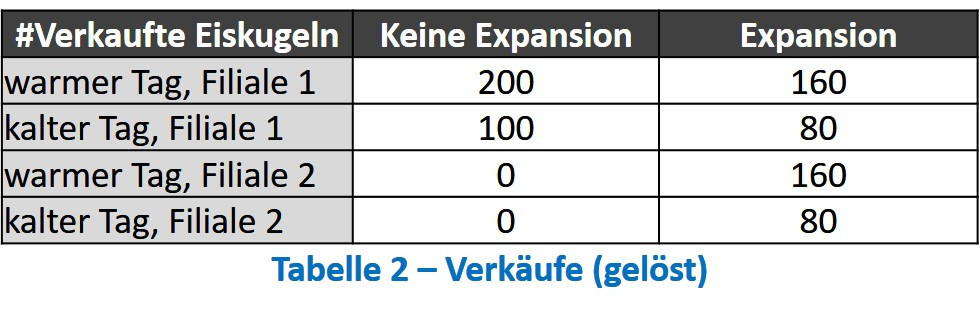
Wie viel verkaufte Eiskugeln könnten wir im Jahr erwarten?

Show additional information Hide additional information
Show solution Hide solution

III. Gewinnprognose

Wie unterscheiden sich die Szenarien im Hinblick auf den Gewinn?

Show additional information Hide additional information
Show solution Hide solution

IV. Mehrmenge

Wenn wir die zweite Filiale eröffnen: Wie viel Eiskugeln müssten wir pro Jahr mehr verkaufen, um 5.900€ mehr Gewinn zu machen?

Show solution Hide solution

V. Weitere Optionen

Welche anderen Möglichkeiten, Expansion ausgeschlossen, siehst Du den Gewinn zu erhöhen?

Show solution Hide solution

VI. Chancen & Risiken

Welche Vorteile bzw. Risiken siehst Du bezüglich der Expansion abseits des direkten Gewinnes?

Show solution Hide solution

VII. Abschließende Empfehlung

Deine Klientin würde nun gerne informiert werden. Was empfiehlst Du Ihr?

Show solution Hide solution

Further Questions

Inwieweit unterscheidet sich eine Expansion in der selben Stadt zu einer Expansion in eine andere Stadt?

Practice This Case With Peers Who Are Currently Looking for Interview Partners.
Do you have questions on this case?
Ask our community and receive answers and tips directly from our experts.
Ask a question Ask a question
More Cases from CTcon
Related Case Interview Basics Articles
Market Entry
Types of Cases
Market entry cases are one of the key issues in the consulting industry and present consultants and firms with unique challenges and opportunities. These cases require deep analysis and strategic planning to successfully enter new markets.
To the article
The Blue Ocean Strategy
Common Terms of Business
The Blue Ocean Strategy, developed by W. Chan Kim and Renée Mauborgne in their book Blue Ocean Strategy (2005), turns traditional business thinking upside down. It focuses on tapping into undiscovered markets – the "blue oceans" – where companies can operate alone and avoid competition. The result? More growth and higher profits.In contrast, the "red ocean" refers to the already overcrowded market space where competition is fierce, and companies are constantly striving to outdo each other. This often leads to declining profits and limited growth. 🌊The Blue Ocean Strategy represents a shift away from this destructive competition towards a more constructive and creative form of market development. It encourages companies to go beyond the industry's conventional boundaries and create new markets, making competition irrelevant.
To the article
Growth Strategy
Types of Cases
In case interviews, you are often tasked with developing strategies to increase a company's revenue. It's crucial to conduct a systematic analysis to provide well-founded and actionable recommendations.Below, we’ll break down the key factors you need to consider and show you how to structure your response in a clear, effective way. Our goal is to give you a practical guide to help you ace your case interviews and build strong growth strategies.
To the article
GROW Model
Useful Business Analysis Tools
The GROW model, an acronym for Goal, Reality, Options, and Will, was developed in the late 1980s by Sir John Whitmore and his colleagues Graham Alexander and Alan Fine. It emerged from the realization that traditional training methods often failed to achieve sustainable performance improvements. Whitmore, a former racing driver and a pioneer in the field of executive coaching, played a significant role in popularizing the model and establishing it as a method for performance enhancement in the business world.
To the article
Practice makes the difference
Practicing alone helps – with a partner it’s even better. Solve this case in a realistic mock interview.
Add invitation
Do you have questions on this case?
Ask our community and receive answers and tips directly from our experts.
Ask a question Ask a question
More Cases from CTcon