






Case by
PrepLounge

SuperBurger

Difficulty: Advanced
Interviewer-led
1.2k Ratings
Times solved: 16.4k

Case Prompt:

Our client is SuperBurger, a fast food chain that operates in the same class as McDonalds, Wendy's, Burger King and so on. They're the fourth largest fast food chain worldwide in terms of number of stores in operations. SuperBurger owns some of its stores, but 85% of its stores are owned by franchisees. As part of its growth strategy, the company has analyzed some potential acquisition targets including Tasty Donuts which is a growing doughnut producer active in the US and internationally. 

The client asked us to help him decide whether he should acquire the company or not. 

Overview of All Exhibits
Practice makes the difference
Practicing alone helps – with a partner it’s even better. Solve this case in a realistic mock interview.
Schedule on Meeting Board

Sample Structure

Show sample structure Hide sample structure

I. Background – 1

What areas would you want to explore to determine if SuperBurger should acquire Tasty Donuts?

Show solution Hide solution

I. Background – 2

Assume we want to dig a bit deeper into the possible value of Tasty Donuts to SuperBurger, how would you approach it?

Show solution Hide solution

II. Analysis – 1

We've started thinking about potential synergies that could be achieved post-acquisition. What synergies do you think that can be realized based on key data.

Show additional information Hide additional information
Show solution Hide solution

II. Analysis – 2

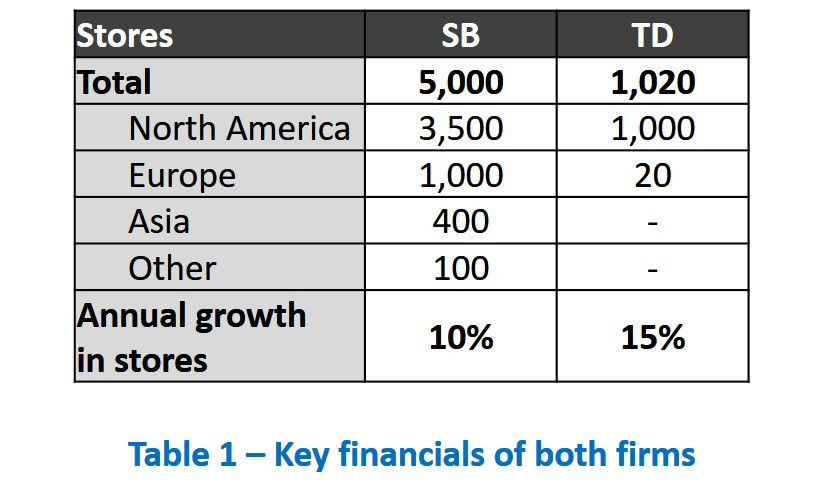
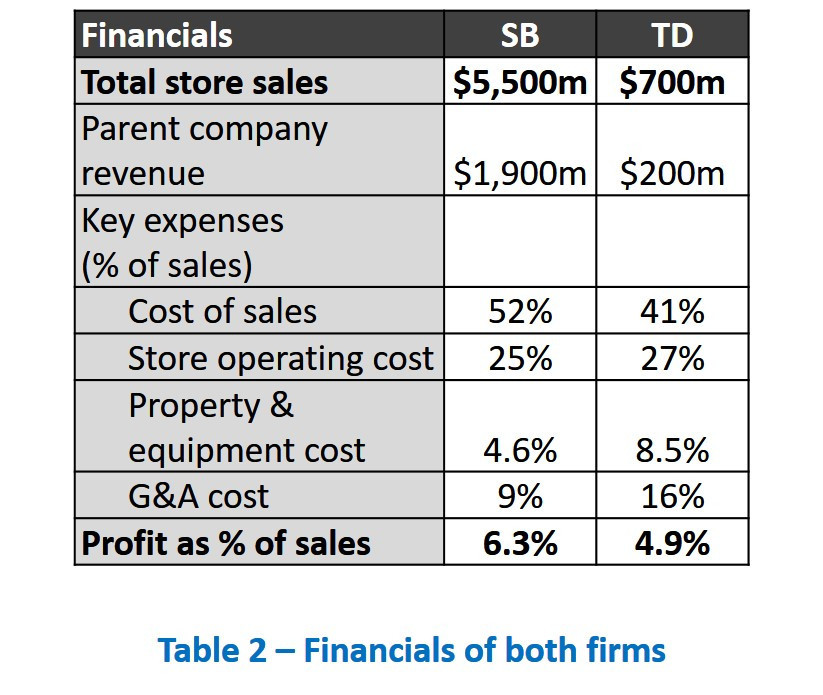
The client thinks that with these synergies it should be possible to double the market share of Tasty Donuts in the US and increase their US stores by 2.5 times in 5 years. What sales per store will Tasty Donuts require in 5 years to achieve these goals? Assume that doughnut consumption is now $10/person and will grow to $20/person in 5 years and that US population is 300 m. You can also use data from Table 1 & 2.

Show solution Hide solution

II. Analysis – 3

Another form of synergy that could be valuable is the sale of doughnuts in SuperBurger's stores. How would you approach calculating/assessing the impact of this on profitability?

II. Analysis – 4

What would the extra profit per store be if we sell 60,000 doughnuts per store at a price of $3 and a 70% margin along with a cannibalization rate of 15% of SuperBurger sales?

Show additional information Hide additional information
Show solution Hide solution

III. Solution

What would you recommend so far to our client?

Show solution Hide solution

Further Questions

  • Can you think of factors that could fail such an acquisition even when synergies in revenue & costs can be achieved?
Practice This Case With Peers Who Are Currently Looking for Interview Partners.
Do you have questions on this case?
Ask our community and receive answers and tips directly from our experts.
Ask a question Ask a question
Related Case Interview Basics Articles
Growth Strategy
Types of Cases
In case interviews, you are often tasked with developing strategies to increase a company's revenue. It's crucial to conduct a systematic analysis to provide well-founded and actionable recommendations.Below, we’ll break down the key factors you need to consider and show you how to structure your response in a clear, effective way. Our goal is to give you a practical guide to help you ace your case interviews and build strong growth strategies.
To the article
The Blue Ocean Strategy
Common Terms of Business
The Blue Ocean Strategy, developed by W. Chan Kim and Renée Mauborgne in their book Blue Ocean Strategy (2005), turns traditional business thinking upside down. It focuses on tapping into undiscovered markets – the "blue oceans" – where companies can operate alone and avoid competition. The result? More growth and higher profits.In contrast, the "red ocean" refers to the already overcrowded market space where competition is fierce, and companies are constantly striving to outdo each other. This often leads to declining profits and limited growth. 🌊The Blue Ocean Strategy represents a shift away from this destructive competition towards a more constructive and creative form of market development. It encourages companies to go beyond the industry's conventional boundaries and create new markets, making competition irrelevant.
To the article
M&A Cases
Types of Cases
M&A cases are quite common in management consulting, especially for candidates applying to firms with a focus on strategy, corporate finance, or (of course) mergers and acquisitions. While they don’t make up the majority of cases, they are frequently used to assess your strategic thinking, ability to analyze financial data, and understanding of the impact of complex business decisions. 
To the article
GROW Model
Useful Business Analysis Tools
The GROW model, an acronym for Goal, Reality, Options, and Will, was developed in the late 1980s by Sir John Whitmore and his colleagues Graham Alexander and Alan Fine. It emerged from the realization that traditional training methods often failed to achieve sustainable performance improvements. Whitmore, a former racing driver and a pioneer in the field of executive coaching, played a significant role in popularizing the model and establishing it as a method for performance enhancement in the business world.

To the article
Practice makes the difference
Practicing alone helps – with a partner it’s even better. Solve this case in a realistic mock interview.
Add invitation
Do you have questions on this case?
Ask our community and receive answers and tips directly from our experts.
Ask a question Ask a question