



Back to overview
Expert case by
Margot

EV Strategy for a Leading Luxury Automotive OEM

Difficulty: Intermediate
Candidate-led
0.0
0 Ratings
Times solved: 0

Case Prompt:

Your client is a leading luxury automotive OEM. The company has recently launched its first fully electric flagship vehicle, internally called Project Aurora. The model is priced in the ultra-luxury segment and represents a major departure from the company’s traditional portfolio.

  • It is the brand’s first five-seater vehicle.
  • It emphasizes comfort, practicality and daily usability more than track-oriented performance.
  • It features a futuristic aerodynamic design that differs strongly from the brand’s traditional styling language.
  • It uses software and acoustic engineering to recreate some of the emotional cues that customers associate with combustion-engine vehicles.

Initial reactions have been polarized. Some analysts believe the company is modernizing its brand and preparing for the future of luxury mobility. Others argue that Project Aurora risks damaging the company’s iconic identity and alienating core customers. After the unveiling, investor reaction was negative.

The client has hired your consulting team to answer one key question: What should the company’s EV strategy be over the next five years?

Overview of All Exhibits
Practice makes the difference
Practicing alone helps – with a partner it’s even better. Solve this case in a realistic mock interview.
Schedule on Meeting Board

Sample Structure

Interviewer prompt: How would you structure the problem?

Interviewer guidance: The following framework is intentionally comprehensive and should be used as guidance on relevant themes the candidate may cover. The candidate is not expected to mention every point within the interview. The sample verbal answer at the end reflects a realistic level of depth that a strong candidate could deliver within the available reflection time.

Show sample structure Hide sample structure

Question 2 - Brand Dilution

The CEO is particularly worried about brand dilution. How could the client successfully participate in EVs without destroying its core brand identity?

Show solution Hide solution

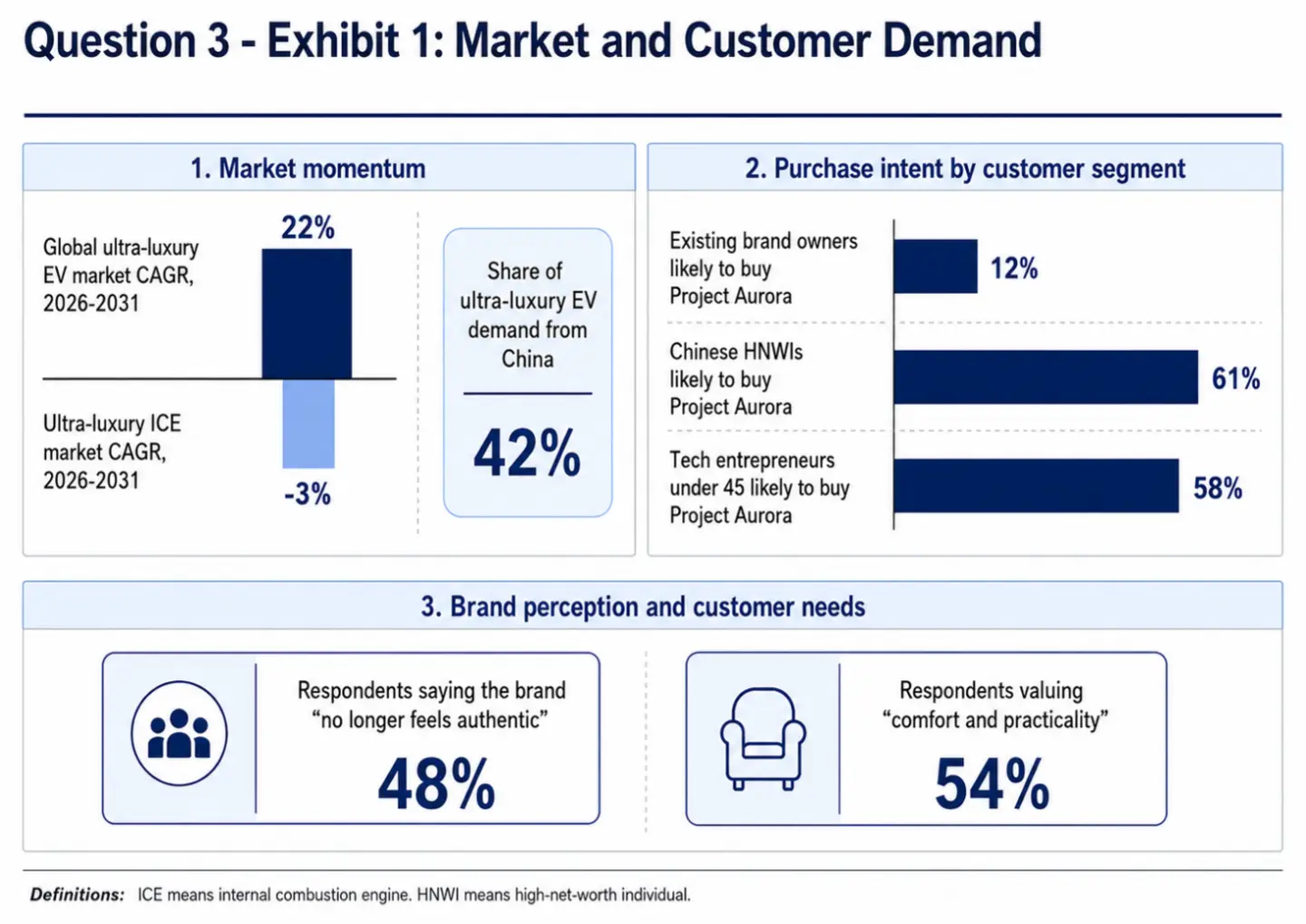
Question 3 - Exhibit 1: Market and Customer Demand

Interviewer prompt: The client conducted customer and market research to better understand demand for Project Aurora. Please analyze the exhibit and share your key insights.

Show additional information Hide additional information
Show solution Hide solution

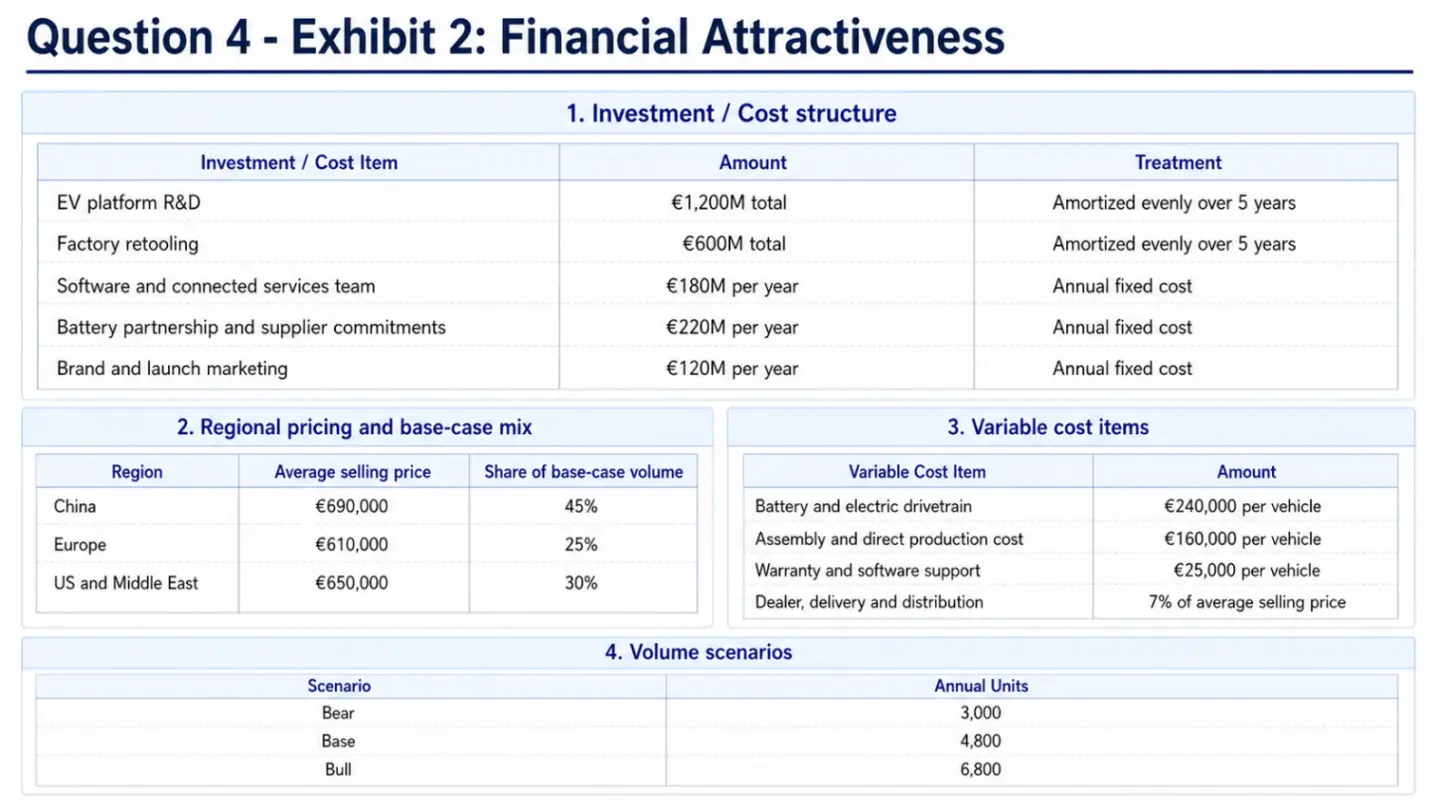
Question 4 - Exhibit 2: Financial Attractiveness

Interviewer prompt: The client now wants to assess whether Project Aurora is financially attractive. Please analyze the exhibit and calculate whether the program is likely to create value.

Please calculate:

  1. Annualized fixed costs.
  2. Weighted average selling price in the base case.
  3. Contribution margin per vehicle in the base case.
  4. Break-even volume before cannibalization.
  5. Operating profit or loss in each volume scenario before cannibalization.
Show additional information Hide additional information
Show solution Hide solution

Cannibalization Twist - Hard Round 2 Push

Interviewer prompt: The CFO adds that 30% of Project Aurora buyers would otherwise have purchased another vehicle from the brand with a contribution margin of EUR 330k. How does this affect your view? Use the base-case economics you calculated above.

Show solution Hide solution

Optional Follow-up: China Rollout

Interviewer prompt: Suppose the client can redesign the rollout so that China represents 65% of volume and cannibalization falls to 15%, while the average selling price becomes EUR 675k. What does this imply directionally and quantitatively?

Show solution Hide solution

Final Recommendation

Interviewer prompt: What would you recommend to the CEO?

Show solution Hide solution
Practice This Case With Peers Who Are Currently Looking for Interview Partners.
Do you have questions on this case?
Ask our community and receive answers and tips directly from our experts.
Ask a question Ask a question
Related Case Interview Basics Articles
Market Entry
Types of Cases
Market entry cases are one of the key issues in the consulting industry and present consultants and firms with unique challenges and opportunities. These cases require deep analysis and strategic planning to successfully enter new markets.

To the article
Growth Strategy
Types of Cases
In case interviews, you are often tasked with developing strategies to increase a company's revenue. It's crucial to conduct a systematic analysis to provide well-founded and actionable recommendations.Below, we’ll break down the key factors you need to consider and show you how to structure your response in a clear, effective way. Our goal is to give you a practical guide to help you ace your case interviews and build strong growth strategies.
To the article
The Blue Ocean Strategy
Common Terms of Business
The Blue Ocean Strategy, developed by W. Chan Kim and Renée Mauborgne in their book Blue Ocean Strategy (2005), turns traditional business thinking upside down. It focuses on tapping into undiscovered markets – the "blue oceans" – where companies can operate alone and avoid competition. The result? More growth and higher profits.In contrast, the "red ocean" refers to the already overcrowded market space where competition is fierce, and companies are constantly striving to outdo each other. This often leads to declining profits and limited growth. 🌊The Blue Ocean Strategy represents a shift away from this destructive competition towards a more constructive and creative form of market development. It encourages companies to go beyond the industry's conventional boundaries and create new markets, making competition irrelevant.
To the article
Pricing
Types of Cases
Pricing plays a crucial role in a company's profitability as it directly contributes to it. For this reason, establishing optimal prices for products or services is of great importance. Business consultants therefore assist their clients in developing pricing strategies.A case study on pricing is an analysis focusing on the pricing of a product or service. It can stand alone or be part of a broader case, such as entering a new market.
To the article
GROW Model
Useful Business Analysis Tools
The GROW model, an acronym for Goal, Reality, Options, and Will, was developed in the late 1980s by Sir John Whitmore and his colleagues Graham Alexander and Alan Fine. It emerged from the realization that traditional training methods often failed to achieve sustainable performance improvements. Whitmore, a former racing driver and a pioneer in the field of executive coaching, played a significant role in popularizing the model and establishing it as a method for performance enhancement in the business world.
To the article
Practice makes the difference
Practicing alone helps – with a partner it’s even better. Solve this case in a realistic mock interview.
Add invitation
Do you have questions on this case?
Ask our community and receive answers and tips directly from our experts.
Ask a question Ask a question