




Expert case by
Ian

MBB - Climate Change Operations

Difficulty: Intermediate
Candidate-led
< 100 Ratings
Times solved: 3.6k

Case Prompt:

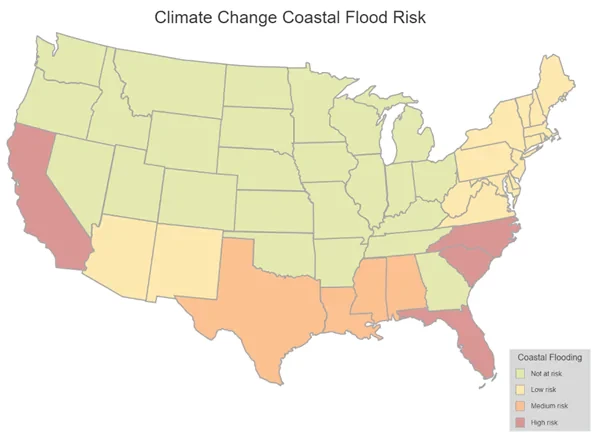
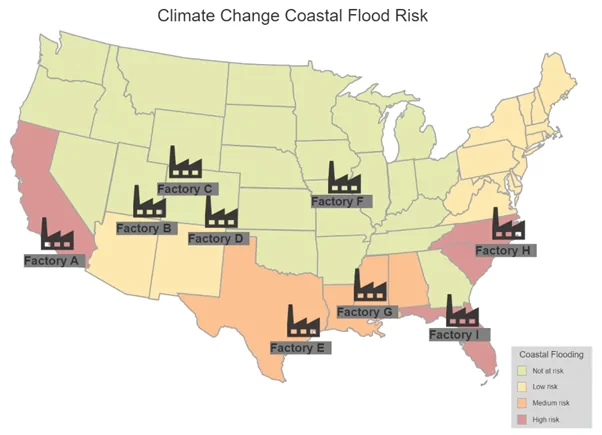
A mid-sized manufacturing company is concerned about the potential impacts of climate change on its operations. The company has a number of factories located in coastal regions that are vulnerable to flooding and other weather-related events, and it is concerned about the potential financial and reputational risks associated with these events. The company's leadership team has asked your consulting firm to help them understand the risks they face and develop a plan to mitigate those risks.

Clarifying Info:

  • Our client’s objective is to maintain long-term profitability
  • Our client’s factories are located throughout the US

===================================================

Note: Once you have solved this case, make sure to solve the 2nd version of this case: MBB - Climate Change Operations - Part 2 | PrepLounge.com

This case is designed to show you how a case can evolve/change based on new information. The first half of this case is the same, but diverges once data and #s are provided.

To learn more about how to use case leadership to navigate dynamic cases, please read here:  Candidate-Led Cases: What to Expect With Example Cases

Overview of All Exhibits
Practice makes the difference
Practicing alone helps – with a partner it’s even better. Solve this case in a realistic mock interview.
Schedule on Meeting Board

Part 1: Identifying Risk Areas

Show additional information Hide additional information
Show solution Hide solution

Part 2: Risk Mitigation - Brainstorming

Show additional information Hide additional information
Show solution Hide solution

Part 3: Risk Mitigation Evaluation - Brainstorming

Show additional information Hide additional information
Show solution Hide solution

Part 4: Risk Mitigation – Data

Show additional information Hide additional information
Show solution Hide solution

Final Recommendation

Show solution Hide solution
Practice This Case With Peers Who Are Currently Looking for Interview Partners.
Do you have questions on this case?
Ask our community and receive answers and tips directly from our experts.
Ask a question Ask a question
Related Case Interview Basics Articles
The Tuckman Model
Common Terms of Business
At the core of comprehending team dynamics is the ingenious creation of Bruce Tuckman, the Tuckman Model. Bruce Tuckman, an eminent psychologist and researcher, introduced this model in 1965, and it has since been a fundamental framework for understanding team behavior and guiding team development.Tuckman, with his deep-rooted interest in group dynamics, recognized the evolution teams go through in their journey towards high performance. His model offered a lucid, linear path for this evolution, making it easily understandable and implementable in varied team environments.His ground-breaking work has led to profound shifts in how organizations manage their teams, promoting a more empathetic and result-oriented approach. Tuckman's model stands out as an insightful roadmap that helps navigate the complex maze of team development, and its utility spans multiple disciplines and industries.In a consultancy environment, the model is especially relevant due to the constant team reshuffling and the high value placed on effective teamwork. With consultants often stepping into pre-established teams, understanding the team's current developmental stage - whether it's forming, storming, norming, performing, or adjourning—is invaluable.By using Tuckman's model as a reference, consultants can quickly assess team dynamics, identify issues, and devise strategies to move the team towards the next stage. In essence, Tuckman's model provides a clear framework that can be used to maximize team effectiveness, making it a critical tool in the consultant's toolkit.
To the article
Design Thinking
Common Terms of Business
Design Thinking is more than just an approach or a method – it's a non-linear, iterative process that places creativity and problem-solving at its core. To understand this mindset, let's look at the three essential elements of Design Thinking: People, Process, and Place. These elements form the foundation for applying Design Thinking in business consulting.
To the article
Public Value Strategic Triangle
Useful Business Analysis Tools
The Strategic Public Value Triangle is a conceptual framework developed by Prof. Mark H. Moore to guide public managers in creating public value. It emphasizes the interplay between three key elements: public value proposition, the operational capacity to deliver, and the legitimacy and support of the authorizing environment.Prof. Mark H. Moore is a distinguished academic known for his work in public management and leadership. He is the Hauser Professor of Nonprofit Organizations at the Harvard Kennedy School. Moore's research and teachings have significantly influenced the field of public administration, particularly with the introduction of the Strategic Public Triangle in his seminal book "Creating Public Value: Strategic Management in Government" published in 1995.

To the article
7S-Framework of McKinsey
Frameworks
If you're aiming for a career in consulting, learning about key frameworks is essential. One of the most popular and effective tools is the McKinsey 7S Framework. Created by McKinsey & Company, this framework helps you understand and evaluate how different parts of an organization work together to improve overall performance.In this post, we’ll explain the seven elements of the McKinsey 7S Framework and how you can use it in case interviews. Whether you're preparing for consulting roles or just want to boost your business knowledge, this framework is a valuable tool to have in your skillset!
To the article
Interviewer- vs. Candidate-Led Cases
Basics of Case Interviews
Every case interview has a certain structure. An important factor on how your case interview is going to proceed is if the interview is interviewer-led or candidate-led.We’d like to explain the two interview formats – candidate-led cases and interviewer-led cases – highlight their differences, and provide you with tips on how to excel in each of them.
To the article
Practice makes the difference
Practicing alone helps – with a partner it’s even better. Solve this case in a realistic mock interview.
Add invitation
Do you have questions on this case?
Ask our community and receive answers and tips directly from our experts.
Ask a question Ask a question