LinkedIn outreach is a valuable networking strategy in finance. Building genuine relationships with industry professionals can provide insights, expand your network, and increase your visibility during the recruiting process.
Successful outreach requires preparation and personalization. Researching your contacts, optimizing your profile, and tailoring your messages can significantly improve your chances of receiving a response.
Networking is a long-term process, not a one-time interaction. Consistent follow-ups and maintaining professional relationships over time help turn initial conversations into meaningful connections.
If you want to land your dream finance job, professional networking should be a big part of your job search strategy. It takes a lot of work. But in an industry full of brilliant talent with almost identical resumes boasting the same GPA and prestigious internships, networking is one of the most proven ways to stand out.
One of the most effective finance networking strategies you can use is LinkedIn outreach. It allows you to find and connect with alumni and professionals you wouldn't otherwise meet, especially if you don't come from a target school where on-campus networking sessions are common. Once you make meaningful connections, you can discover the hidden job market, which are roles that are never publicly posted, or secure interviews through internal referrals — where an employee recommends your application directly to HR or the hiring team.
LinkedIn outreach in finance is the process of using LinkedIn to find, research, and build relationships with professionals already working in the industry or at your target firms. The goal is to make meaningful connections that give you industry insight, lead to a short informational interview, and eventually earn a referral or improve your odds of landing an interview.
It's one of the main networking channels candidates use to break into finance, alongside cold emailing, networking events, industry conferences, and, less commonly, cold calling. Most people use LinkedIn to find someone, learn enough about them to write a message worth reading, and send a personalized connection request. Then they move to cold emailing to secure a response, which is highly recommended. Others hold the actual conversation over LinkedIn messages instead.
Recommended Linkedin Outreach Timeline
Besides understanding what LinkedIn outreach is all about, it’s also important to master timing and pacing. For finance areas and firms with a scheduled recruitment timeline or a predictable annual hiring period like investment banking, start your outreach 6 to 12 months before applications open. But for those that tend to recruit continuously based on when roles open up like smaller PE firms, venture capital firms, or middle-market funds, start as soon as you've identified your target firms.
You can start with an initial target list of at least 20 to 30 professionals, and pace your outreach to 5 to 10 new messages per week. This accounts for the low response rates for cold messaging while giving you time to properly research each person and stay on top of follow-ups.
Once someone replies and you've exchanged a message or two on LinkedIn, that's typically the right moment to request a short 15-to-20-minute call or coffee chat. Requesting in the initial email after a successful LinkedIn connection works too. If you don't hear back, send a polite follow-up 5 to 10 days later, capping total follow-ups at two to four before moving on.
Land your top job in consulting!
Join the world's leading case interview community today and get everything you need to prepare for your upcoming case interviews!
For Which Finance Areas Is LinkedIn Outreach Useful?
Though LinkedIn networking works, its effectiveness varies by the area of finance you’re targeting. Generally speaking, the more a firm's hiring relies on headhunters (third-party recruiters that firms pay to source and screen candidates on their behalf) and gatekeepers (the people who control access to the actual decision-makers in the hiring process), the less effective cold messaging becomes. Also, the more informal a firm's culture, the more that outreach is expected. But some firms and finance areas run a hybrid of relationship-based recruiting and headhunter hiring.
The most well-known networking-dependent areas of finance include investment banking, smaller to middle-market PE firms or off-cycle PE recruiting, asset management, and venture capital (VC). On the other hand, on-cycle PE or mega-fund PE firms, large hedge funds, and large private credit firms tend to be headhunter-run which means less room for cold outreach. On-cycle recruitment is the highly structured annual process used by large firms to hire candidates about 1 to 2 years in advance while off-cycle refers to rolling or year-round hiring as opportunities open.
Investment Banking
Investment banking networking or direct, informal outreach is standard and almost expected, especially if you're coming from a non-target school or switching careers. Most IB candidates have coffee chats, also called informational interviews, before submitting an application.
Bankers usually submit feedback or a rating of a candidate after informational interviews which forms an internal database of warm referrals. If a banker likes you, they may tell you to email them your CV directly right before applications close, ask for details to help them track down your application in the system, or even pass your resume directly to whoever is coordinating that year's recruiting with a feedback note.
Private Equity
For private equity, networking and LinkedIn outreach is particularly effective for off-cycle recruiting. That typically means middle-market and lower-middle-market firms that rely less on gatekeepers. Instead, direct networking is one of the most effective ways in.
But for on-cycle recruiting, which is the process larger funds use to hire investment banking analysts more than a year before they start, networking with PE professionals isn't always as effective unless it’s an existing relationship. That’s because the process is often run by private equity headhunters, who get a cut for every placement. Your job is mostly to make sure your LinkedIn profile is accurate and current so headhunters can find and verify you.
Venture Capital
Cold LinkedIn outreach and direct partner networking are standard in VC firms with startup roots. They tend to have smaller, informal team cultures. However, this kind of outreach works best paired with visible activity elsewhere like VC clubs, competitions, and conferences rather than as a standalone tactic.
But for firms that grew out of traditional private equity, VC networking may not be very effective at times. Cold outreach to VC partners without real research behind it can backfire quickly.
Hedge Funds
Cold LinkedIn outreach can be challenging at the largest hedge funds, as their hiring process is highly structured and often guided by specialized recruitment agencies.
Instead, hedge fund networking works best for smaller and mid-sized funds. They usually hire ‘as needed’, often when an analyst leaves or they raise more capital. That makes direct networking and LinkedIn outreach among the most reliable ways to uncover these roles, because they are rarely posted on job boards.
Private Credit
Large mega-funds have formal undergraduate internship and analyst programs that use online portals and resume screening. But since these programs are small, they tend to be overwhelmed with thousands of resumes. So, cold outreach to current analysts and associates can improve the odds of getting your resume pulled from the general online application pile.
On the other hand, middle-market private credit firms tend to hire on an as-needed basis. Roles at these firms are rarely posted publicly on standard job boards. As such, direct LinkedIn and email outreach are among the most effective ways to discover these openings before the firm resorts to hiring a headhunter.
Asset Management
For asset management recruiting, many full-time roles get filled from the intern class, so being on a firm's radar early tends to matter more than any single message. Networking comes in handy for the large firms due to the large volume of applicants. If an internal professional requests your resume, it may increase your chances of bypassing automated resume filters and secure a human review or a direct interview.
But boutiques and regional investment managers often rely on the hidden job market, and networking is one of the best ways to learn about open opportunities. They value warm alumni connections and internal referrals.
Corporate Finance and FP&A
LinkedIn outreach is generally not necessary for securing interviews in corporate finance and FP&A, though it can give you a competitive edge. Recruiting runs through a highly structured, corporate HR-driven process, with most entry-level corporate finance roles filled through public job boards and standard campus recruiting pipelines.
Who Should You Reach Out To?
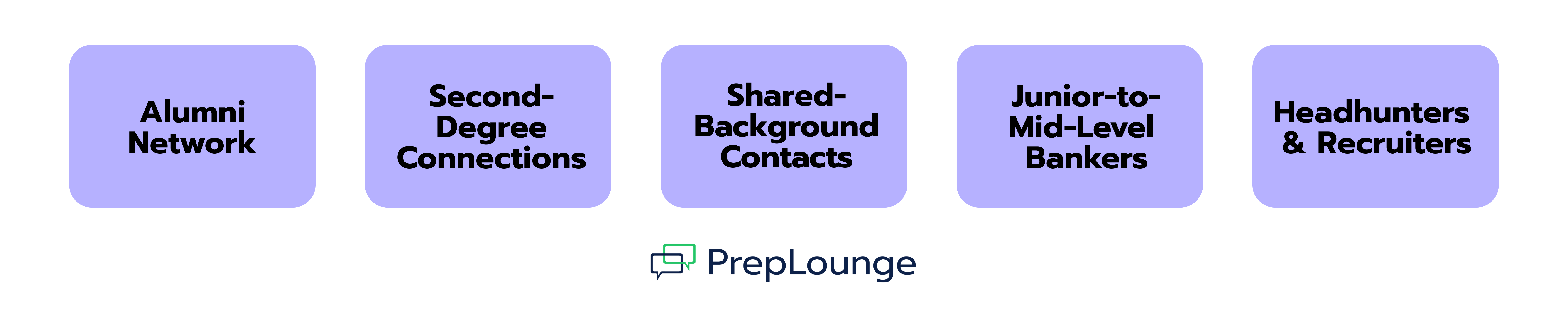
Once you’re ready to kickstart your LinkedIn outreach, use the bottom-up networking strategy which involves:
Alumni Network: The strongest starting point is alumni from your school. A shared school gives you an instant, legitimate reason to reach out, and most alumni genuinely like to help someone from their Alma maters.
Second-Degree Connections: These are warm intros and include a friend of a friend, a professor's contact, or a family connection. A warm introduction almost always beats cold outreach.
Shared-Background Contacts: Look for people with whom you share a hometown, sport, non-target school, career-change story, student organization, or previous employer. Anything you have in common with someone creates a real point of connection.
Junior-to-Mid-Level Bankers: When networking for investment banking recruiting, analysts and associates respond at higher rates than senior bankers and MDs. They can also become a bridge to more senior contacts once you've built some rapport.
Headhunters and Recruiters: This is particularly helpful for PE on-cycle recruiting where they're often the actual gatekeepers. A headhunter LinkedIn connection is worth accepting even before you're ready to recruit. Treat every interaction with them as a first-round interview.
How to Prepare Before Sending a Message
Once you know the type of people to contact, you can start creating your initial target list of bankers or relevant professionals with at least 20 to 30 names on it. The more, the better because response rates for cold outreach are generally low. But before reaching out to any of them, there are a few things you should do to put the odds in your favor.
Optimize Your LinkedIn Profile
Your LinkedIn profile for investment banking, or any other finance path, is the first thing anyone you message will check. Update it with a professional headshot and keep your About section short. Good LinkedIn About section examples in finance run two or three sentences, not a pasted-in resume. Explain who you are, what you're studying, and what you're interested in.
Also write a LinkedIn headline for finance that states your target, not just your school. For instance, "Finance Student Seeking Investment Banking Analyst Roles" or "Finance & Economics Student at [University] | Investment Banking | Seeking Summer 2027 Analyst Role.”
Then match your LinkedIn to your resume, exactly. Dates, titles, and company names should line up perfectly.
Research Your Target List
Target list building starts with LinkedIn's alumni filter. Find people from your school at your target firms, then research each one specifically. Look up their path into the role, whether they lateraled, what group they're in, and what deals or work they've been involved in recently.
The aim is to find at least one genuine, specific detail you can reference. Avoid bringing up anything that could read as tone-deaf, such as recent layoffs, a rough deal, and so on.
Create a Networking Tracker Spreadsheet
Build a simple networking tracker spreadsheet that includes name, firm, title, date messaged, channel, response, and follow-up date. It will help you know who to follow up with, when, and about what, once you're juggling more than a handful of conversations.
Decide Your Messaging Channel
It's generally a good idea to use LinkedIn to find and research people, as well as to send them a connection note. Then move the actual ask to email. Bankers check email far more reliably, and it reads as more serious to senior people in this industry.
Prepare Your Story
Have your story ready before you send anything. Preparing tight one-to-two-minute answers to common questions like "why finance, why this firm, and why this group" is crucial in case a reply comes back sooner than expected.
How to Write a Strong LinkedIn Outreach Message
With your profile in order and list built, you’re ready to start reaching out. A LinkedIn connection request message is capped at 300 characters. That LinkedIn character limit forces specificity instead of a pitch. Aim to make the connection note more personalized to increase the odds of a reply. That means stating one specific, real reason to connect, and saving the substance for the follow-up.
If you have a Premium account, you can choose between InMail vs. connection request. But only use your InMail credits sparingly as they let you message someone you are not connected with directly in their primary inbox.
LinkedIn Cold Message Template
Now, the structure that doubles as a solid LinkedIn cold message template or cold email template for investment banking and other finance careers looks like this:
Who you are, plus a specific reason you're reaching out to this person like shared school, shared background, or something specific about their career path.
A brief line on your own interest or experience.
A small, low-pressure ask — usually 15 to 20 minutes of their time.
A short, professional sign-off.
Here’s a sample personalized outreach message that does this well:
"Hi [Name], I'm a junior at [School] studying finance and noticed you're also a [mascot] now working in [Bank]'s [Group]. I'm very interested in learning more about the M&A group in investment banking and would love to connect."
If you're emailing rather than messaging on LinkedIn, keep the subject line for your finance networking email just as specific. Something like "[School] Student Interested in [Group]" outperforms a vague "Quick Question."
How to Turn Outreach Into a Coffee Chat
Getting the initial reply is a step in the right direction. But how do you turn a LinkedIn connection into a coffee chat? It’s as simple as following up with a request for a coffee chat, also called an informational interview after exchanging a message or two. A coffee chat is a 15-to-30-minute informal conversation, over the phone, on video, or in person, where you ask the questions but they're quietly evaluating whether they'd want to work alongside you. Treat it as a soft interview, because that's functionally what it is and they may log their feedback internally with their firm.
In your request message, offer afew times that work around their schedule and also mention you’re open to what works for them. If you hear nothing after a week, follow up. A polite follow-up five to ten days later can raise your response rate. Two to four total follow-ups is a reasonable ceiling before moving on. Past that, you're not persistent, you're annoying.
If it converts into a coffee chat, prepare a 60–90 second version of your story. Also bring more questions than the time allows since running out mid-call is worse than not getting to all of them. Good questions ask about their path, why they chose this firm over others, and team dynamics. Skip anything Google could answer, and also comp or hours complaints until the conversation has clearly earned that level of candor.
Then send a thank-you within 24 hours, follow through on anything you said you would, and check back in every few months with a genuine update like an internship landed, or a relevant project. This is what turns one good conversation into an actual professional connection and an advocate inside the firm.
Common Mistakes to Avoid When Networking for Finance Recruiting
Here are some of the mistakes finance students and graduates make when networking their way into the industry via LinkedIn outreach and how to avoid them:
Attaching Resume to a First Message. If you're wondering whether you should attach your resume to a cold LinkedIn message, the answer is no. That would make it a job application wearing a disguise, and it skips past the whole point of a coffee chat. Also, attachments from unrecognized senders often get auto-flagged by corporate spam filters, which can hurt your ability to reach that same inbox again later.
Giving Up Early or Pestering: Expect most people not to respond but keep going. Most candidates send a few emails, hear nothing, and conclude networking doesn't work for them. The other end of the spectrum is following up aggressively, which comes off as pestering.
Asking Too Soon: Requesting a referral, interview, or job in your very first message is the fastest way to lose someone before you've built anything. The direct ask of being put in front of the right person comes later, once you've built some actual rapport.
Treating a Coffee Chat Like a Checklist: Rattling through prepared questions without actually engaging with the answers or failing to show genuine interest hurts your chances of connection.
Conclusion
LinkedIn outreach in finance helps in finding the right alumni, researching a group before you reach out, and turning a single reply into a coffee chat and, eventually, a referral. Keep messages short, make personalization genuine rather than templated, follow up when you don't hear back, and work bottom-up starting with alumni. None of it guarantees a response but consistency with improvements gets results eventually.
Common Questions about LinkedIn Outreach in Finance
LinkedIn outreach is the process of connecting with finance professionals to build relationships, learn about the industry, and explore career opportunities. It is commonly used alongside networking events, cold emails, and informational interviews.
The ideal timing depends on the recruiting process of your target firms. For structured recruiting, it is generally recommended to start several months before applications open, while firms with rolling recruitment can be approached earlier.
Good starting points include alumni, second-degree connections, professionals with shared backgrounds, and junior-to-mid-level employees. Building relationships through common connections often leads to better response rates.
A strong message is concise, personalized, and includes a clear reason for reaching out. It should focus on starting a conversation rather than immediately asking for a job or referral.
Following up professionally, preparing for informational conversations, and staying in touch with meaningful updates help strengthen connections over time. Networking is most effective when it is approached as an ongoing relationship rather than a single interaction.