Understand how age is viewed in MBB recruiting. Learn what firms actually look for when evaluating experienced candidates.
Explore the opportunities and challenges of joining MBB later in your career. Find out what to expect before making the transition.
Discover how to position yourself as a strong candidate. Learn practical ways to showcase your experience and tell a compelling story.
Who Is This Article For?
I’ve helped dozens of aspiring experienced hirecandidates whose ages have ranged from the 30s to even the early 40s, and the first question they’ve typically asked is “Am I too old for MBB?”
If you are reading this, you are probably in the same boat. You’ve built a solid career in your industry and field of expertise – perhaps in corporate, academia, government, or elsewhere. You are considering making a switch to MBB, but are unsure if you are too old or not.
In this article, I explain my perspective on age and consulting, and hope it can help you make an informed decision.
What Does the Age Profile at MBB Actually Look Like?
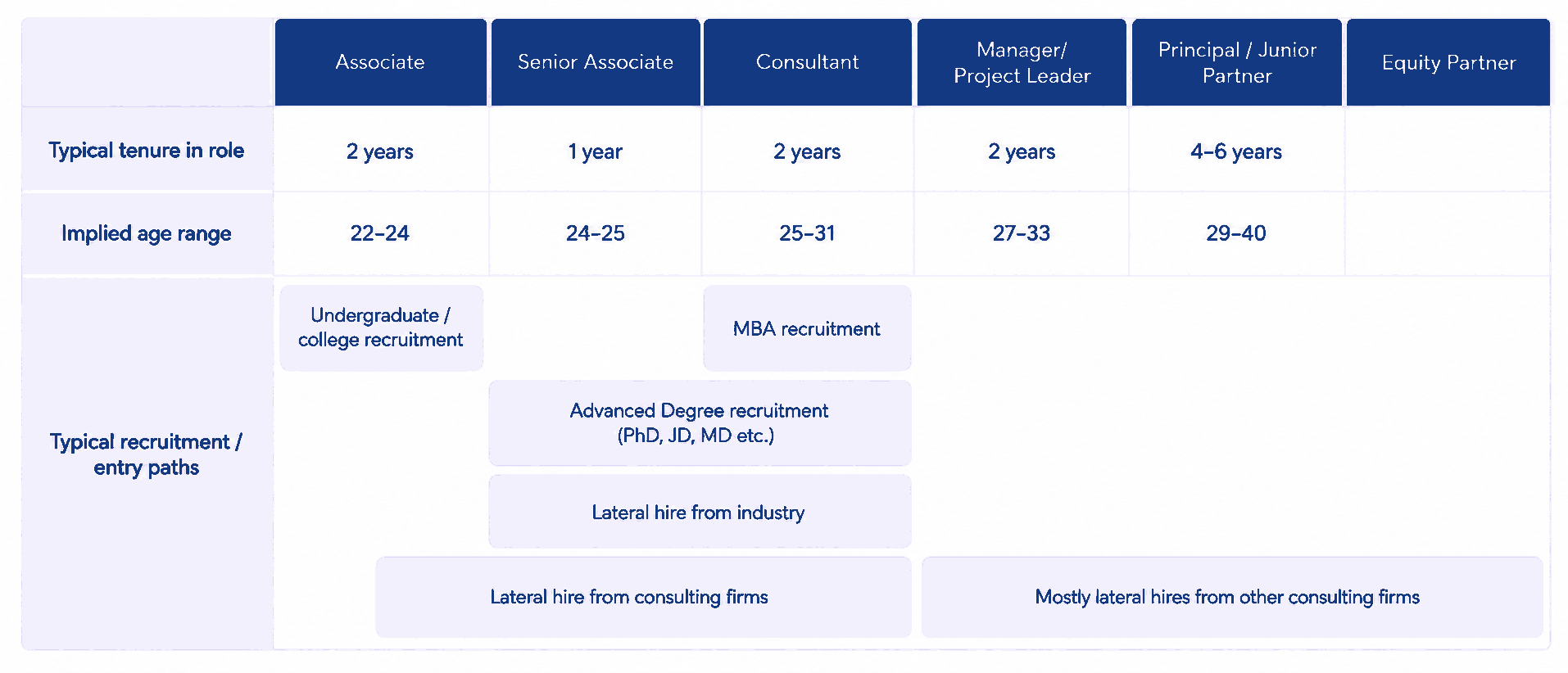
It’s useful to firstly understand what is the ‘typical’ profile in MBB. There is no official published data set detailing the exact age ranges of consultants in the firms, but the table below has been put together given the typical hiring norms, progression norms and my own experience in MBB. I’ve used mostly BCG role nomenclature for the more junior roles, but note that title conventions vary by firm.
Note that not all geographies have the Senior Associate role – e.g. US does not have it, but it exists for Asian markets like SEA & India.
Tenure levels are fairly standard across firms, and the age ranges are of course indicative.
While lateral hires are a growing proportion of the firm, the bulk of consultants are still either hired from campus (undergraduate or MBA) and the bulk of tenured consultants are still ‘home-grown’ so to say.
A statement like “MBB does not prefer older candidates” is lacking nuance – MBB prefers candidates whose profiles match the role's requirements, and it happens that at junior levels those requirements happen to align with what younger candidates typically bring and also the existing recruiting profile.
Therefore, depending on your background and profile, you could be in one of the following scenarios, each with their own challenges:
Applying for a Junior (pre-Manager) role
Coachability & attitude
Stamina
Applying for a more senior role (Manager+)
Coachability & attitude
Consulting problem solving fundamentals
Concerns with Older, Experienced Hires
Coachability & attitude
The idiom that captures this perfectly is “can you teach an old dog new tricks?”
The key concern here is whether you still have the ability to still learn and adapt to new ways of working, thinking & operating
It can be hard to change habits that have been built up over time and perspectives that have been deeply ingrained through years of prior experience and MBB firms have seen their fair share of experienced hires fail to adapt quickly enough
This challenge applies to both junior and senior hires, especially if you are not coming from a consulting background
Stamina
Consulting is a demanding job. There is a reason why more people leave than stay in consulting eventually
The work typically requires long hours, frequent travel, and it is also highly stressful
The concern especially for older hires is – do you really have the stamina to take this on similar to a younger fresh graduate or a younger MBA hire?
While it is not a hard criteria in the evaluation form, this is something that will likely be at the back of the interviewer’s head
This concern will apply a lot more to junior roles, rather than senior roles. While it doesn’t necessarily mean that the job gets easier in senior roles, you have more control in them
Consulting problem solving fundamentals
The consulting approach to problem-solving is an acquired and rare skill — it's the reason clients pay a premium for MBB, and the reason MBB consultants are sought after in industry exits
I would argue this concern is more salient at senior levels. Home-grown managers were promoted precisely because they'd already demonstrated the core toolkit after spending 4-5 years in the associate/consultant role; Principals, because they'd proven they'd mastered the manager role on top of it
So if you enter laterally at a senior level, you're competing against home-grown consultants who already have that toolkit — and you'll be expected to have it from day one, with no runway to ramp up
This is why firms tend to fill Manager and Principal roles with laterals from other consulting firms rather than from industry
Should You Apply?
So is there an age where you are “too old”? Practically, past a certain age I would argue it would be highly unlikely for you to join in a junior role. But that spectrum of acceptable age is wide. Anecdotally, I’ve known individuals who have started at the Consultant level at the age of ~40.
At the end of the day, only HR will be able to tell you if they are interested in your profile or not. But even before that, it’s helpful to think of several questions to help you decide if you should really apply:
Depending on your current seniority, a more junior consulting role or even a Manager type role may require you to take a potential salary cut
Are you ok to take a title cut?
This is the most common scenario, especially if you do not fit into the profile requirements for a more senior hire
Are you ok to take on an intense and unpredictable lifestyle with long hours, potentially heavy travel? (and implicity – will this align to your life stage?)
Depending on the staffing model of the firms and client project, you may be required to fly weekly. This is something that will be very difficult to manage if you have other significant commitments in life that require you to be at home
Working hours can range anywhere from 12-16 hours a day depending on geography/project
Are you ok to be managed by a younger person?
Based on the role progression diagram earlier – it is not common for MBB managers to be younger than 30
Is MBB really necessary to achieve your end goal? or in otherwards, would there be more effective paths to get to where you really want to be eventually?
While the benefits of MBB are clear, it is worth taking an honest look at your end goals and figure out if there is a more optimal way to get there
A few practical actions you can take to help make an informed choice:
Talk to several MBB consultants in your desired office of choice, to get a better understanding of the job. Ask them for the honest truth and the unfiltered ‘downsides’ of the job so you can get a realistic picture
Reflect on your current life stage and where you hope it will evolve in the next few years
Identify your end goal / end-state, and do some research on the path others have taken to get there, and compare that with your choice to go to MBB
Speak to other important people in your life who will be impacted by this decision
Your life is not lived in a vacuum, and my perspective is that its important to also get the support of the people that matter to you for whichever path you take
How to Position Yourself
If you are set on applying to MBB, then what is important is to position yourself strongly. This involves being able to leverage the areas that consulting firms recognize in experienced hires, and also having a compelling and authentic personal story
Leveraging your strengths
There are 2 areas that consulting firms appreciate in older candidates
Domain expertise — Topic expertise is becoming even more important in consulting engagements today, and having experience and knowledge of a particular area always helps to bring credibility and effectiveness in delivering value for the client. This is something that can only be built up over time and something that a fresh graduate simply cannot bring to the table
Maturity — More years spent working would have given you more experience in navigating corporate environments and engaging with stakeholders effectively. Consulting is heavily dependent on people skills, and these skills take time to develop.
Being able to weave this into both your CV, but also your responses & engagement in the actual interview will be critical
Crafting a compelling story
You should also prepare a strong response to 2 common questions for older hires: “Why consulting/MBB” and more importantly “Why now?”. You may have to share a respond to these questions either during networking, or in the interview itself
Avoid generic responses that anyone can Google
Your answer should also be calibrated to your specific context
You want to be able to craft a story that make the person you are interacting with remember you, and want to help you.
Closing Thoughts
So are you too old for MBB? For some of you, the answer will be yes. But for most of you reading this, it will be a no.
Breaking into MBB requires a clear-eyed strategy and serious preparation. The candidates I've seen succeed didn't leave it to chance — they understood what they were applying to, built a narrative that turned their experience into an asset, and prepared deliberately to address the biggest concerns and areas they’d be tested the hardest in. Going in blind, or assuming your current track record is sufficient, is the most common way capable people fail to meet expectations.
If you're an older candidate looking to break into MBB, the journey won't be easy — but it's far from impossible.
Ex-BCG Principal | 8+ years consulting experience in SEA | BCG top interviewer & top performer
Benjamin has >8 years of consulting experience, starting off at Kearney SEA and he joined BCG as an experienced hire, where left as a Principal. At BCG, Benjamin was fast promoted twice (Consultant to PL; PL to Principal) and was also selected to be a CEO Ambassador (internal secondment). Benjamin has a wealth of case experience across multiple functions (Strategy, Operations, Transformation, Due diligence) and industries (PE, TMT, Public Sector, Consumer, Tech). While focused on SEA, Benjamin has also done cases in the Middle East, North Asia as well as South Asia.
At BCG, Benjamin had ~5 years of experience as an interviewer. Having come from a non-traditional background himself, Benjamin can offer practical tips for experienced hires and non-traditional candidates.
Benjamin graduated with a B.A. (First Class Honours) in History from the National University of Singapore.
Common Questions About Age in MBB-Applications
There is no official age limit for joining MBB. However, the more senior you are in your current career, the more important it becomes to demonstrate why you are the right fit for the role and level you're applying for.
Yes, many experienced hires successfully transition from industry, academia, or the public sector. The key is showing strong problem-solving skills, adaptability, and a clear motivation for moving into consulting.
Depending on your background, you may need to accept a lower title or a temporary salary reduction when joining MBB. Many candidates see this as a long-term investment because of the career opportunities consulting can create.
Focus on your transferable skills, leadership experience, stakeholder management, and domain expertise. Equally important is explaining why consulting—and why now—through an authentic and convincing personal story.
Network with consultants, prepare thoroughly for case and fit interviews, and research the realities of consulting before applying. A well-prepared application and a clear narrative often make a stronger impression than experience alone.