




Back to overview
Expert case by
Ian

Based on Bain 1st Round Case (2023): Last Mile Delivery

Case Prompt:

A startup company specializing in last mile delivery with drones is determined to reach $20M in revenue while also becoming profitable. The company's innovation lies in leveraging drone technology to revolutionize the logistics sector, specifically focusing on last-mile delivery, which accounts for a significant portion of shipping costs. However, the firm has to overcome numerous challenges including technological, regulatory, and logistical issues associated with both urban and rural environments.

As the next strategic step, the company is considering pilot launches in two different environments - city and suburb - and is uncertain about which option to choose. You have been engaged to evaluate these options, considering the profitability, revenue potential, and strategic implications of each, and provide a recommendation to the company's leadership team.

Overview of All Exhibits
Practice makes the difference
Practicing alone helps – with a partner it’s even better. Solve this case in a realistic mock interview.
Schedule on Meeting Board

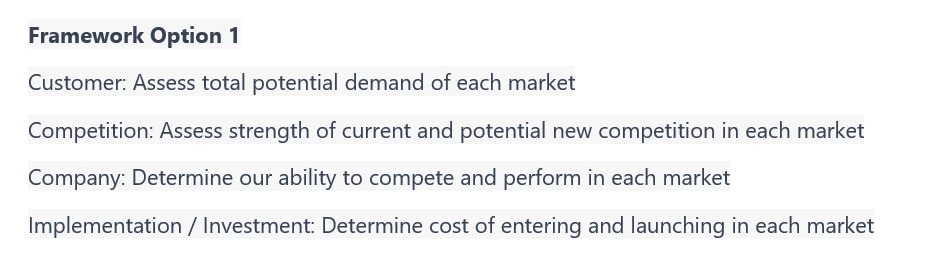
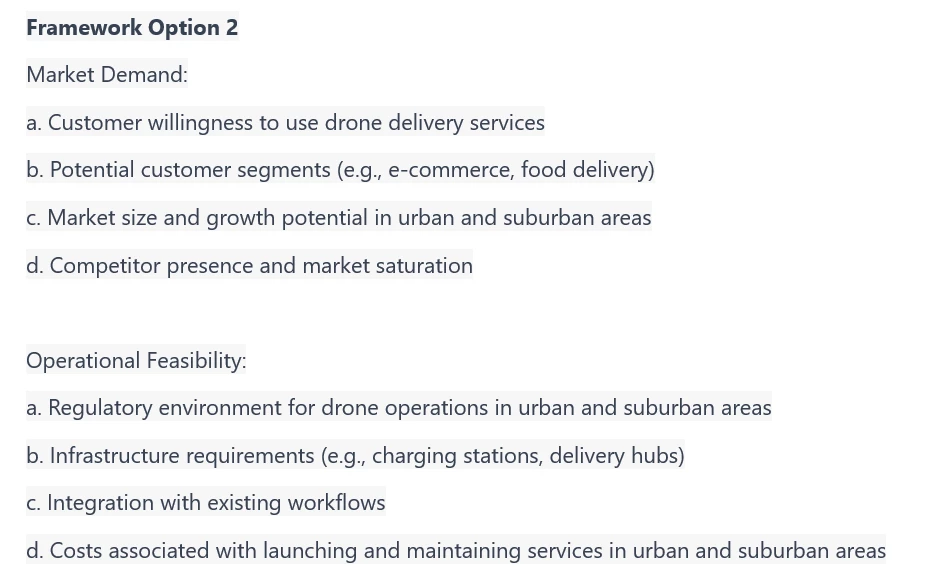
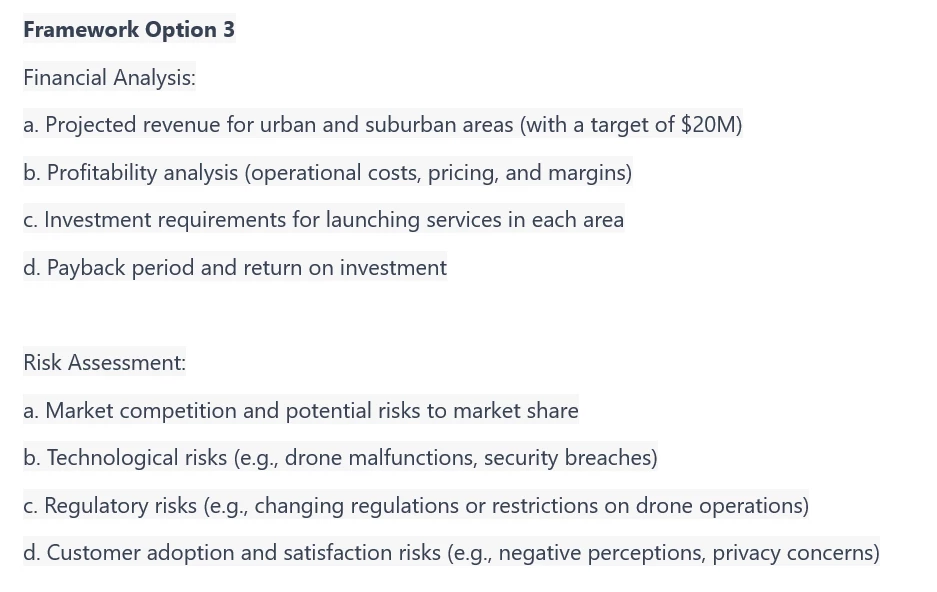
Sample Structure

Clarifying Questions and Answers

Question: What specific drone technology is the company using for last mile delivery? 

Answer: The company is using proprietary drone technology, designed specifically for the challenges of last-mile delivery.

Question: What are the company's specific objectives with the pilot launch in terms of metrics or KPIs? 

Answer: The company wants to choose the most profitable option in the long term.

Question: What is the company's financial standing? Will it be able to support the costs associated with the pilot program? 

Answer: The company has secured adequate funding for the pilot program and has plans in place for further fundraising based on the results of the pilot.

Question: Are there any regulatory restrictions or legal issues that the company should be aware of in relation to drone operations in city and suburb environments? 

Answer: The regulations for drone operations can vary by city, state, and country. The company has a legal team in place to handle regulatory compliance, but this is definitely a major consideration in choosing the pilot location.

Show sample structure Hide sample structure

Part 1 - Brainstorm pricing model options

Show additional information Hide additional information
Show solution Hide solution

Part 2 - Market size demand

Show additional information Hide additional information
Show solution Hide solution

Part 3: Brainstorm costs for the business

Show additional information Hide additional information
Show solution Hide solution

Part 4: Compare costs and revenues

Show additional information Hide additional information
Show solution Hide solution
Show additional information Hide additional information
Show solution Hide solution

Part 5: Brainstorm cost-cutting options

Show additional information Hide additional information
Show solution Hide solution

Part 6: Brainstorm revenue increase options

Show additional information Hide additional information
Show solution Hide solution

Part 7: New revenue opportunities:

Show additional information Hide additional information
Show solution Hide solution

Final Recommendation

Show additional information Hide additional information
Show solution Hide solution
Practice This Case With Peers Who Are Currently Looking for Interview Partners.
Do you have questions on this case?
Ask our community and receive answers and tips directly from our experts.
Ask a question Ask a question
Related Case Interview Basics Articles
How to Build a Good Structure
Case Structuring
Poor structure, or sometimes no structure at all is one of the main reasons why candidates fail in case interviews. Why? Because case interviews are designed to simulate real-life consulting scenarios. And in the real consulting world, you need to structure problems all day long. If you cannot clearly demonstrate this skill during your interview, you probably won’t be able to apply it on the job and therefore not succeed in a consulting career. But let’s stay positive: Structuring skills can be learned. With some basic principles in mind and lots of practice afterwards, you will be able to excel in this consulting-crucial discipline.
To the article
Practice with Coaches
Consulting Skills & Preparation
When preparing for a case interview, especially under time constraints, working with an experienced coach can significantly enhance your chances of success.💡 Pro Tip: PrepLounge offers access to over 800 (former) management consultants from top firms like McKinsey, BCG, and Bain, who are ready to help you perfect your interview technique.
To the article
Creativity
Consulting Skills & Preparation
Creativity is a crucial skill assessed during case interviews. While traditional case interview preparation often emphasizes analytical and quantitative abilities, creativity is equally important. This skill demonstrates a candidate's ability to think outside the box, develop a wide array of viable ideas, and propose innovative solutions. In this article, we will explore why creativity is vital in case interviews, how interviewers assess it, and strategies to ensure you never run out of creative ideas during your case-solving process. 
To the article
Five Dysfunctions of a Team
Common Terms of Business
The model of the "Five Dysfunctions of a Team" comes from the business novel of the same name by Patrick Lencioni. The author, an experienced consultant in team development, tells the story of a tech company that was once successful – until the team began to fall apart. Lencioni shows how certain patterns can hinder a team – leading to a real crisis.Especially in study projects, group work, or later in your career (especially in consulting), it’s important to recognize these dysfunctions – and actively address them. Teamwork is more than task division. It thrives on trust, clarity, and real collaboration.Here are the five main dysfunctions – and how to avoid them. 
To the article
Product Life Cycle
Useful Business Analysis Tools
The product life cycle is a way to map the common stages a product undergoes throughout its lifespan. The product life cycle is typically divided into 5 different stages, each having specific strategic decisions affecting profits and revenues.
To the article
Practice makes the difference
Practicing alone helps – with a partner it’s even better. Solve this case in a realistic mock interview.
Add invitation
Do you have questions on this case?
Ask our community and receive answers and tips directly from our experts.
Ask a question Ask a question