












A firm managing hospitals has recently been experiencing growing pains. It has contacted our firm to ask for help.
Case Prompt:
Sample Structure
I. Background
Provide the following answers only if the interviewee asks questions.
Q: What do you mean by growing pains?
A: The now formed hospital group originally consisted of only one hospital, acquired 3 other hospitals. Lately its profits are going down.
Q: Have there been other changes in the organization?
A: Yes, the CEO of the main hospital has changed; currently it is a business experience MBA, before it was an MD doctor.
Q: Have there been other changes or events affecting the hospital group?
A: None.
Q: Have external market conditions changed?
A: No.
Clarifying Questions the candidate should ask:
Q: What do you mean by growing pains?
Q: Have there been other changes in the organization?
Q: Have there been other changes or events affecting the hospital group?
Q: Have external market conditions changed?
The interviewee should synthesize that he/she needs to look into more details to track down the reason for the profitability decline.
II. Profitability
The interviewee should ask questions in order to identify reasons for the profitability decline. If not, give guidance.
- The acquired hospitals did not experience any decline in profits.
- Costs - No change
- Revenue - Declining
The interviewee should ask about the revenue stream for the hospital. Again, provide answers only upon request
- As the main source of revenue the hospital treats patients and thereafter collects payments from the insurance companies based on the service provided.
- Volume of patients remains unchanged
- Product mix of the hospital (surgeries, consultations,...) remains unchanged
The interviewee should ask questions in order to identify reasons for the profitability decline.
Key expected response/insight: The primary reason for profits to decline is that the revenue for the main hospital is going down.
The interviewee should ask about the revenue stream for the hospital.
Key Expected Insight: In a way the average revenue per patient is decreasing, which implies that the patient mix is changing (revenue-wise).
II. Customer Analysis
If candidate asks to explain the insurance coverage, provide the following facts:
Primarily the patients can be categorized into the following categories:
- Private Insurance Covered Patients
- Public Insurance Covered Patients
- No Insurance Covered Patients (Usually homeless people)
Payments from private insurance is greater than public insurance.
Encourage the candidate to develop hypotheses on why the number of referrals could have declined and how one could test the developed hypotheses.
The reason for the revenue decline is lower revenue per customer. This seems to be caused by a lower number of patients covered by a private insurance.
With this insight, the candidate has to think about where privately insured patients come from. Mainly they arrive at the hospital through a referral by a physician.
Finally, the following hypothesis should be formulated or the direction be suggested by interviewer
- It seems like the number of referrals by physicians has declined. This could mainly be due to the management change. Maybe physicians have a lower appreciation towards a chief executive with an MBA background.
- To test this hypothesis, the physicians could be surveyed.
III. Opportunities
Share diagram 2 & 3 with the interviewee
Encourage the interviewee to develop next steps of action
The hospital has a outsourcing billing service which it does not market to the physicians yet. It is unknown, whether this is a viable service for the physicians.
Share with the candidate the following numbers:
- Cost of the billing service: $40,000
- Physician Annual Profit: $180,000
- Physician time-allocation: 75% on patient care, 10% on billing, 15% on administrative overhead
Let the interviewee outline a plan of approach before starting with the calculations and come up with KPI relevant to the physicians
Upon request provide the following information
- Revenue of an average physician: $450,000
- All of the time saved on billing can be used to see more patients
Key learnings from the survey:
- A significant number of physicians is indifferent towards the hospital, which is disadvantageous for the hospital in terms of referrals.
- Many doctors have issues with the complex billing.
Next steps of action:
- The hospital should strengthen its relationships with the physicians. This could lead to a higher number of referrals and increase the revenue per customer (=patients).
- The physicians complain about the complex billing. This could be an opportunity to follow up.
It looks like the hospital is offering a yet unpromoted service that could satisfy an existing demand by physicians. To see, whether this could be a viable business opportunity, we would need to know numbers to calculate the economics of this service.
Plan of approach:
- We assume that the physician can use the time saved on the billing completely on seeing more patients. While billing does not generate revenue, seeing patients does.
- Relevant KPI for the physicians are Return on Investment, New Annual Profit, Increase in Annual Profit
Good candidates would clarify the cost structure of a physician, namely whether additional costs occur, when more patients are seen. In the case, the calculations wouldn't change, as seeing more patients will not increase the cost of the physician/ All costs are fixed costs
IV. Calculations
There are several ways to get to the correct numbers. Here is an exemplary one:
V. Conclusion
- The profitability decrease is due to a revenue decrease in the main hospital.
- As the number of patients as well as the product mix remain unchanged, average revenue per customer has declined.
- Due to low(er) number of referrals made by physicians, less privately insured patients come to the hospital
- Revenue could be increased by tightening relationships with physicians
- Additionally, the hospital could offer its outsourcing billing service to physicians, thereby increasing its own revenue and generating additional profit for the physicians (ROI=50%, increase in profits=11%)
- The two proposed measures could support each other
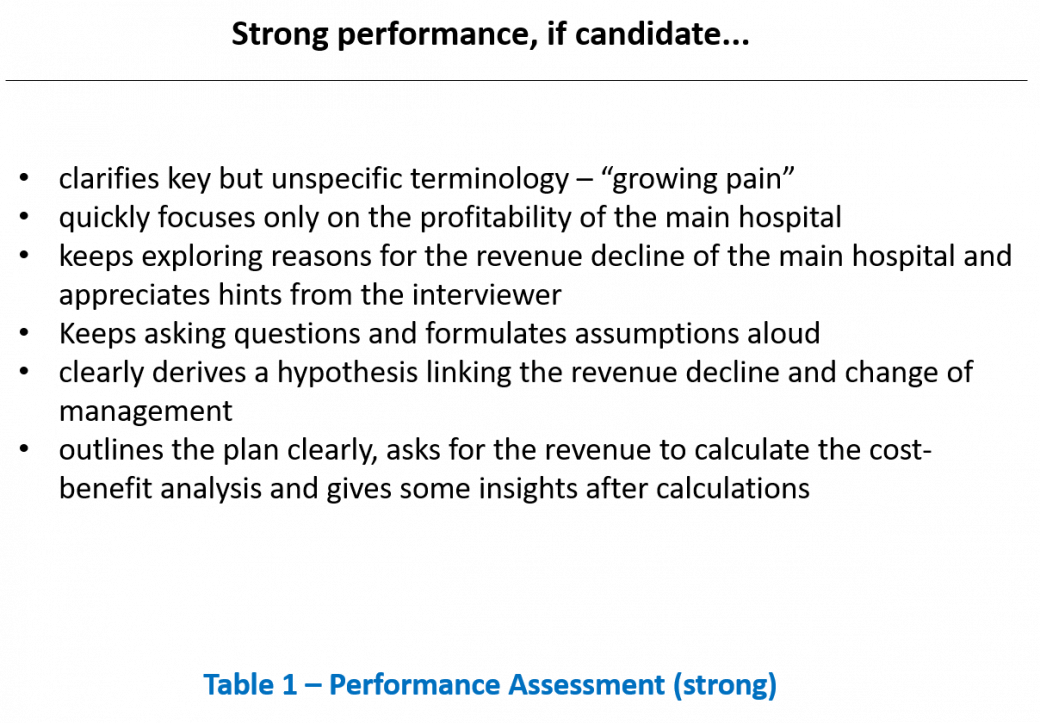
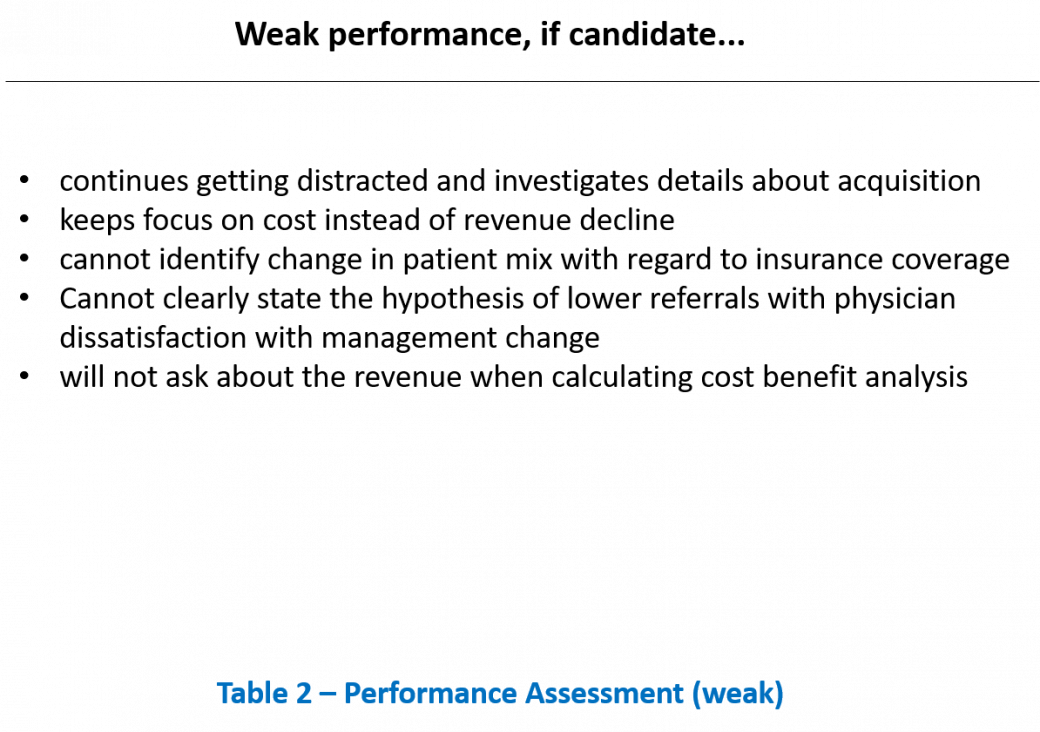
After the interview share tables 1 and 2 with the candidate
Further Questions
More questions to be added by you, interviewer!
Hospital's ill finances
i