



Expert case by
Clara

Swiss Coffins – The Death Business

Difficulty: Advanced
Candidate-led
< 100 Ratings
Times solved: 2.7k

Case Prompt:

Your client is  the CEO of a coffin manufacturing company based in Geneva, Switzerland (Europe). 

The company has existed with little changes to the business model for three generations, manufacturing high-quality, hand-crafted coffins, with a highly skilled and specialized labor force. The industry has been recently disrupted by new technologies that no longer need human manufacturing: machines can manufacture faster and cheaper. 

Your client needs your help in deciding whether to invest in this technology and transform his business, or remain in the hand-manufactured business for coffins

*Note: On top of this initial question that focuses on the strategy and should be tackled by the candidate with an issue tree, the case includes more questions that can be found in the "Detailed solutions" and "Difficult questions" boxes below, with the correspondent proposed answers. 

Practice makes the difference
Practicing alone helps – with a partner it’s even better. Solve this case in a realistic mock interview.
Schedule on Meeting Board

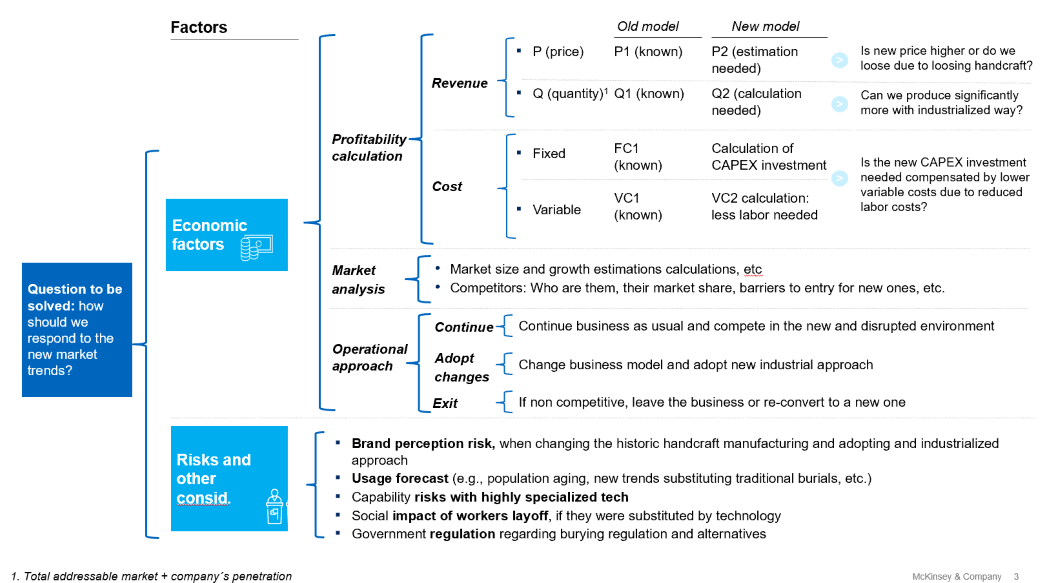
Question 1 – Structuring

Should your client invest in this technology and transform his business, or remain in the hand-manufactured business for coffins? Which analysis and data would you like to know to help our client?

Suggestion: present as an issue tree or a list

Show additional information Hide additional information
Show solution Hide solution

Question 2 – Math

Now that we have structured our problem, let´s start with market estimation. In order to calculate (1) the market size for coffins in Switzerland and (2) our customer´s current production, what data would you need?

Show additional information Hide additional information
Show solution Hide solution

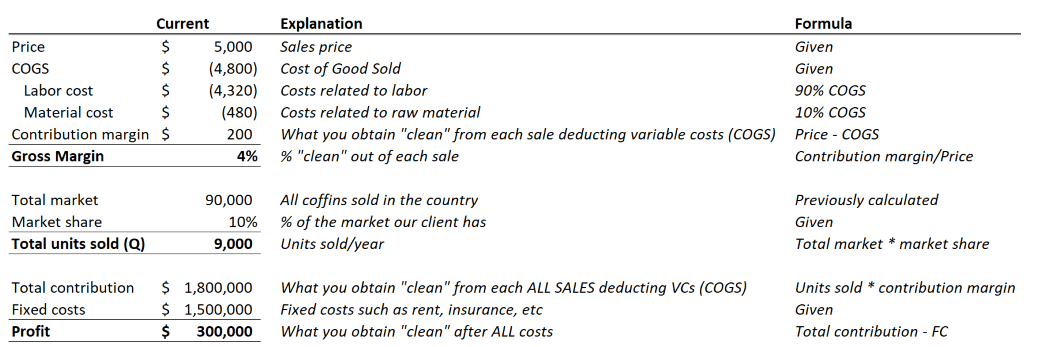
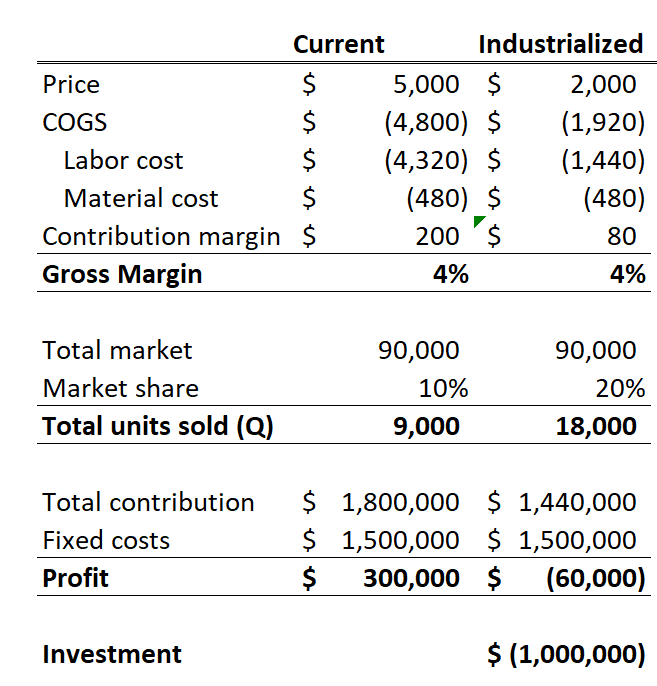
Question 3 – Math

What our client´s business profitability is both with and without the new technology?

Show additional information Hide additional information
Show solution Hide solution

Final question – Executive summary

You are the business analyst who worked in this project, and who is currently guiding the client to the ExCom meeting with the partners. In the elevator ride (1 minute), she asks you to provide her a quick note on what the conclusions are.

Show solution Hide solution

Further Questions

Extra question I - Value of the business in perpetuity: Now that we know that it´s not worth implementing changes, we would like to understand the value in perpetuity of the business (i.e., what the value is worth if we took into consideration all the future cash flows). What would we need to know about this? What is the perpetuity value?

Note for Interviewer

The candidate must know that we need the discount rate to calculate the value in perpetuity. In this case, the discount rate is 10%.

Show solution Hide solution

Extra question II: What would be the value of the company if it were shut down and its assets sold?

Note for Interviewer

Information to be shared with the candidate:

  • Book Value of Land: $20,000
  • Book Value of Improvements: $80,000
  • Years Owned: 48
  • Avg. Real Estate Appreciation: 6% per year
Show solution Hide solution
Practice This Case With Peers Who Are Currently Looking for Interview Partners.
Do you have questions on this case?
Ask our community and receive answers and tips directly from our experts.
Ask a question Ask a question
Related Case Interview Basics Articles
Market Sizing
Types of Cases
Questions about market size are frequently asked in case interviews in consulting because they require a blend of logic, mathematics, and common sense. They can be asked as standalone questions or as part of a larger case. Applicants who are familiar with market sizing questions can really perform here.

To the article
The Blue Ocean Strategy
Common Terms of Business
The Blue Ocean Strategy, developed by W. Chan Kim and Renée Mauborgne in their book Blue Ocean Strategy (2005), turns traditional business thinking upside down. It focuses on tapping into undiscovered markets – the "blue oceans" – where companies can operate alone and avoid competition. The result? More growth and higher profits.In contrast, the "red ocean" refers to the already overcrowded market space where competition is fierce, and companies are constantly striving to outdo each other. This often leads to declining profits and limited growth. 🌊The Blue Ocean Strategy represents a shift away from this destructive competition towards a more constructive and creative form of market development. It encourages companies to go beyond the industry's conventional boundaries and create new markets, making competition irrelevant.
To the article
Growth Strategy
Types of Cases
In case interviews, you are often tasked with developing strategies to increase a company's revenue. It's crucial to conduct a systematic analysis to provide well-founded and actionable recommendations.Below, we’ll break down the key factors you need to consider and show you how to structure your response in a clear, effective way. Our goal is to give you a practical guide to help you ace your case interviews and build strong growth strategies.
To the article
Brainteaser
Types of Cases
Brainteasers are a type of problem that focuses on a single issue rather than complex business cases. They require out-of-the-box thinking, logic or math skills and can take the form of riddles, word problems or visual puzzles. These tasks are designed to test your problem-solving skills, analytical thinking and ability to remain calm under pressure.Typical problems cover everyday life's topics and might even include unrealistic assumptions. All necessary information is usually included in the question so that further assumptions are not necessary. This article explains in more detail why brainteasers are useful in case interview preparation and how to solve them.
To the article
GROW Model
Useful Business Analysis Tools
The GROW model, an acronym for Goal, Reality, Options, and Will, was developed in the late 1980s by Sir John Whitmore and his colleagues Graham Alexander and Alan Fine. It emerged from the realization that traditional training methods often failed to achieve sustainable performance improvements. Whitmore, a former racing driver and a pioneer in the field of executive coaching, played a significant role in popularizing the model and establishing it as a method for performance enhancement in the business world.
To the article
Practice makes the difference
Practicing alone helps – with a partner it’s even better. Solve this case in a realistic mock interview.
Add invitation
Do you have questions on this case?
Ask our community and receive answers and tips directly from our experts.
Ask a question Ask a question