




Our client is Chic & Stitch. They make tailor-made clothes for modern women. They focus on quality and fit. Their work covers design, retail, and tailoring. Now, they want to expand to the Barcelona. They hired you to see if that’s a good idea.
Case Prompt:
Sample Structure
Additional information (only if candidate asks):
- Chic & Stitch launched in Spain three years ago. They have one store in Madrid
- Their online sales channel is the store in Madrid. They have no online presence
- Their target customer is a working woman looking for high-quality, mid-priced, tailor-made clothing
- They sell dresses, blazers, slacks, shirts, skirts, and sweaters
- Their goal is to increase profits recovering their investment within two years
- They work with manufacturers in Vietnam, Cambodia, and Mexico
- Average items cost between 75€ and 125€
A sample answer would go along the following line:
- Women’s clothing market landscape
- Barcelona market size
- Market growth
- Competition
- Costumer preferences
- Chic & Stitch business model
- Product mix
- Product differentiation
- Distribution channels
- Financials
- Revenues
- Running costs
- Investments
- Risks
- Customer adoption
- Supply chain risks
- Product/brand differentiation
Part 2: estimate potential revenues
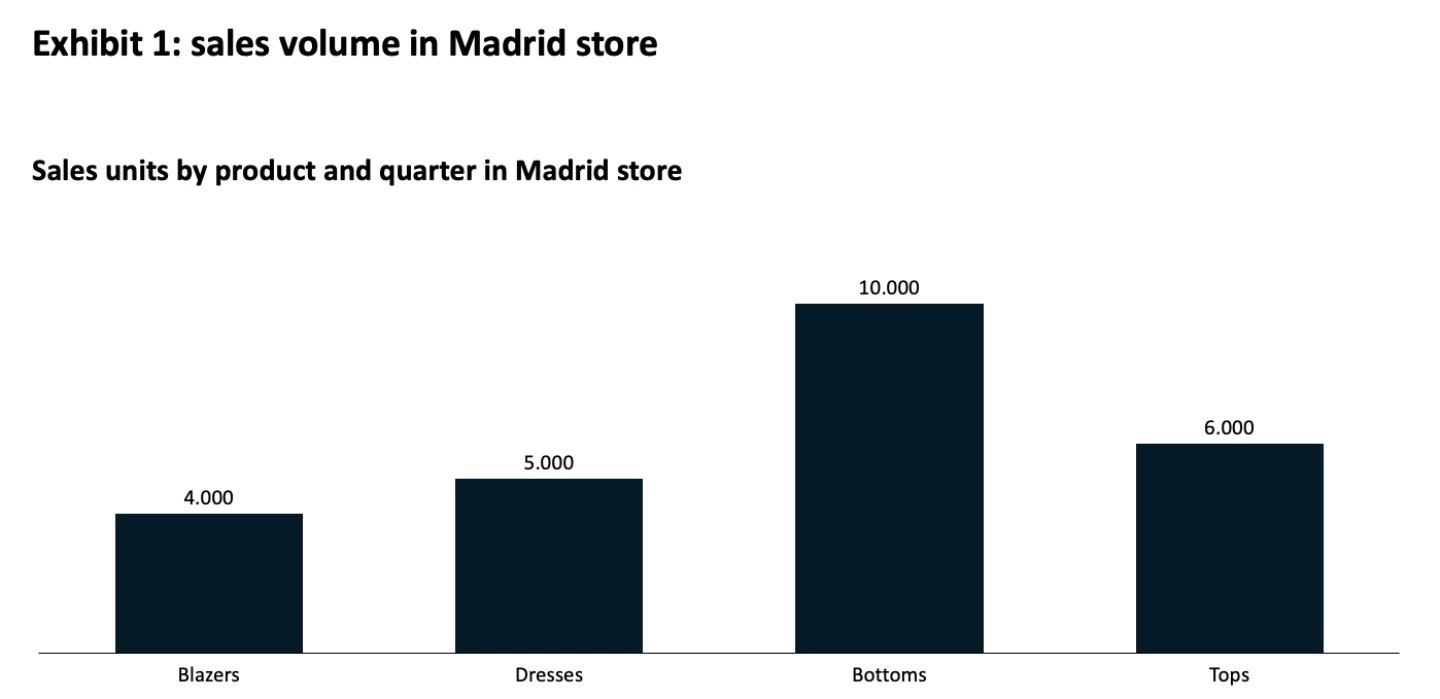
The client gave us data from their Madrid store (exhibit 1).
How would you project annual revenues for the new Barcelona store?
Additional facts if the candidate asks
- The average price at the Madrid store is 100€ per item
- The sales mix in Barcelona will be very similar to Madrid, since consumer preferences are very similar after running a consumer survey
- Once the candidate is done discussing the framework, indicate that challenges around market landscape and business model are largely resolved for the moment
- Invite the candidate to start with the financial analysis of the market entry, specifically with revenues, if he/she didn’t move the case into that direction
- If the candidate starts a market sizing analysis in Barcelona, indicate that estimated revenues in Barcelona are similar to the ones today in Madrid
- Share exhibit 1 when the candidate ask about the current revenues in Madrid
- If the candidate need direction, ask how he/she will project revenues of the Barcelona store
Annual revenues for Barcelona store = 25.000 items per quarter x 4 quarters x 100€ per item = 10M€
A good candidate will mention things as:
- There might be a seasonality effect we need to consider (sales mix will be potentially different by quarter)
- Sales mix and revenues not only depend on the mix but also on the location of the store, so this will be an important factor to consider in Barcelona
Part 3: recommend distribution model
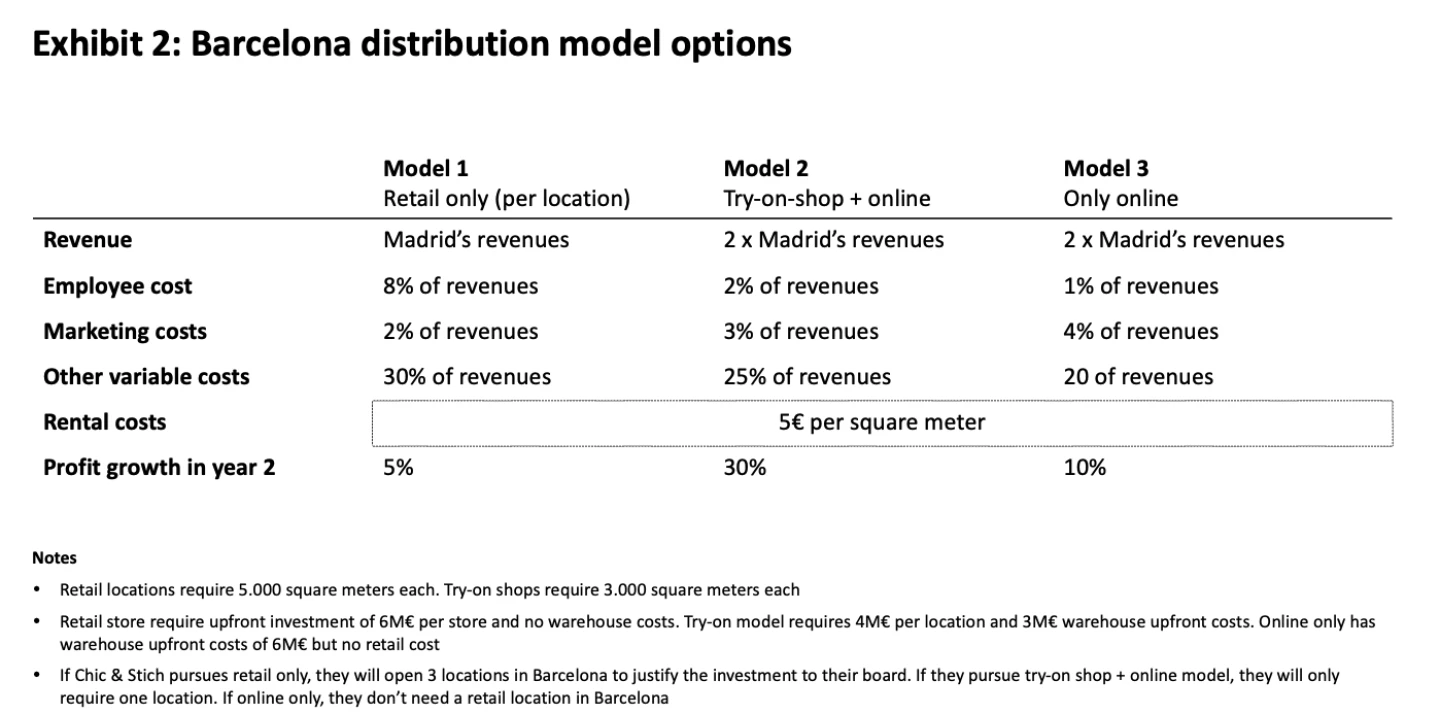
We know the client wants to consider one of three models: retail only, try-on shop + online sales, or online sales only. We would like your help to determine which model makes the most sense to pursue. Assume a Barcelona retail location has the same annual revenue as the Madrid location.
Which retail option is most profitable on a 2-year timeline given the following revenue and costs?
- Share exhibit 2 when candidate asks about costs. If not, point the candidate into cost calculation
- Ask interviewee to round numbers if not proficient with calculations
- A strong candidate would discard the retail option without running any calculation since it has the lower revenues, the higher variable cost, the higher rental cost and the lowest profit growth in year 2
Retail only (3 locations)
- Revenue = Madrid x (3 locations) = €10m x 3 = €30 million
- Costs = (8%+2%+30%) x €30m + (€5/month/m²) x (5000 m²/store) x (12 months) x (3 stores) = €12m + €0.9m = €12.9 million
- Profits year 1 = €30m - €12.9m = €17.1 million
- Profits year 2 = €17.1m x (1.05) = €18 million
- 2-year Profits = €17.1 m + €18 m = €35.1 million
- Initial investment required = €6m x (3 stores) = €18 million
- Total profit in 2 years = €35.1m - €18m = €17.1 million
Try-on Shop + online sales (1 location)
- Revenue = 2 x Madrid = 2 x €10m = €20 million
- Costs = (2%+3%+25%) x €20m + (€5/month/m²) x (3000 m²/store) x (12 months) = €6m + €120k = €6.2 million
- Profits year 1 = €20m - €6.2m = €13.8 million
- Profits year 2 = €14m (rounded) x (1.3) = €18.2 million
- 2-year Profits = €13.8m + €18.2m = €32 million
- Initial investment required = €4m + €4m = €8 million
- Total profit = €32m - €8m = €24 million
Online Only (no physical store)
- Revenue = 2 x Madrid = 2 x €10m = €20 million
- Costs = (1%+4%+20%) x €20m = €5 million
- Profits year 1 = €20m - €5m = €15 million
- Profits year 2 = €15m x (1.1) = €16.5 million
- 2-year Profits = €15m + €16.5m = €31.5 million
- Initial investment required = €6 million
- Total profit = €31.5m - €6m = €25.5 million
A very strong candidate will mention:
Based on calculations, we can see the online-only option is the most profitable within 2 years. Given reduced investment costs, it appears to be a good option.
However, if growth trends continue, the Try-on Shop + Online would be the most appealing option in the mid-term. Assuming the client wants to be in the market for longer than 2 years, this option would likely be the most profitable.
Part 4: brainstorming on evaluation criteria
What other evaluation criteria are relevant to select the distribution model?
The interviewee may ask for 10-15 seconds to structure her thoughts – this is recommended. Feel free to push in areas that seem lacking.
- Alignment with long-term growth strategy
- Strategic fit – alignment with Chic & Stitch’s overall vision and goals
- Brand positioning – impact on Chic & Stitch's brand and market positioning
- Sustained Growth and Expansion within Markets
- Scalability – model support for future growth and expansion into other Markets
- Adaptability – flexibility to adapt to changing market conditions and preferences
- Customer reach – factors such as location, accessibility, and online presence.
- Profitability in short and long term
- Revenue potential – revenue generation capabilities of each model based
- Cost structure – operational costs, including rent, staff, logistics, or marketing
- Initial investment – upfront costs associated with each model
- Internal expertise and strengths
- Capabilities and resources – availability of tech, personnel, financial resources
- Expertise – experience and skills of the management team
- Competition in each space (online only vs. brick and mortar)
- Barriers to entry – level of competition in each model
- Market differentiation – potential to differentiate with each model
Part 5: pros and cons analysis
The client will be meeting their board soon. Assuming the client goes with the Try-on + Online option, what are the advantages and disadvantages of the selected opportunity?
The interviewee may ask for 10-15 seconds to structure her thoughts – this is recommended. Feel free to push in areas that seem lacking.
- Advantages of the Try-on + online mode:
- High growth rate – if sustained in time, CAGR would be 3x and 6x higher than others
- Lower investment costs – lower compared to compared to setting up multiple stores
- Reduced retail cost – minimizes retail space required
- Lower marketing costs – combines the benefits of physical presence with online reach
- Optimized inventory – reduces the need for large inventory storage, as the try-on shop can serve as a display and fitting area, leading to lower inventory holding costs
- Enhanced customer experience – opportunity to try on clothes and experience the brand in person
- Sustainability – reduces unnecessary returns by allowing customers to try on products before purchasing, aligning with sustainability goals
- Additional customer data – collects valuable customer insights from both online and in-person interactions
- Disadvantages of the Try-on + online model
- Retail costs – still incurs additional costs such as rent and utilities
- Scalability – less asset-light compared to an online-only model
- Competitive pressure – faces competition from fast-fashion brands offering free return shipping, which can make the try-on model less attractive to some customers
- Limited foot traffic – one location may not capture as much foot traffic as multiple stores
Part 6: final recommendation
The client wants to know where we are with our analysis.
The interviewee may ask for 10-15 seconds to structure her thoughts – this is recommended.
We recommend Chic & Stich to proceed with the Try-On Shop + Online for their Barcelona launch because:
- Meet’s client criteria – profitable within a 2-year period, closely matching the profitability of the online-only model
- Higher growth potential – if sustained in time, CAGR would be 3x and 6x higher than other options
- Client first – superior customer experience through in-store interactions and a sustainable focus
Risks
- Cultural fit in Barcelona – ensure model aligns with local consumer preferences and shopping behaviors
- Costs assumptions – to be validated to ensure they remain flat and manageable
- Sustainable growth – supports long-term growth without overextending resources
- Online competition – competitive pressure from fast-fashion brands and free return shipping
Next Steps
- Conduct focus groups, surveys, and consumer studies to better understand local consumers
- Analyze actual costs and revenue figures from existing retailers in Barcelona to refine financial projections
- Explore long-term lease contracts for potential try-on shop locations
MBB Second Round - Fashion Market Expansion