




Expert case by
Ian

MBB - Climate Change Operations

Difficulty: Intermediate
Candidate-led
< 100 Ratings
Times solved: 3.7k

Case Prompt:

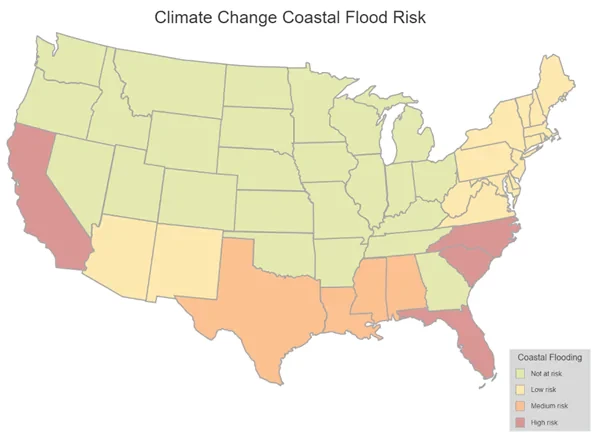
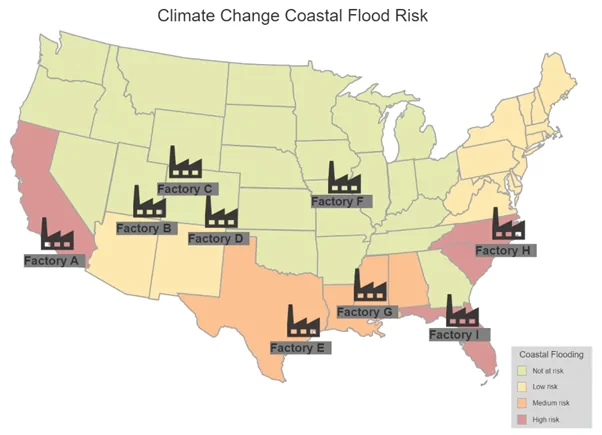
A mid-sized manufacturing company is concerned about the potential impacts of climate change on its operations. The company has a number of factories located in coastal regions that are vulnerable to flooding and other weather-related events, and it is concerned about the potential financial and reputational risks associated with these events. The company's leadership team has asked your consulting firm to help them understand the risks they face and develop a plan to mitigate those risks.

Clarifying Info:

  • Our client’s objective is to maintain long-term profitability
  • Our client’s factories are located throughout the US

===================================================

Note: Once you have solved this case, make sure to solve the 2nd version of this case: MBB - Climate Change Operations - Part 2 | PrepLounge.com

This case is designed to show you how a case can evolve/change based on new information. The first half of this case is the same, but diverges once data and #s are provided.

To learn more about how to use case leadership to navigate dynamic cases, please read here:  Candidate-Led Cases: What to Expect With Example Cases

Overview of All Exhibits
Practice makes the difference
Practicing alone helps – with a partner it’s even better. Solve this case in a realistic mock interview.
Schedule on Meeting Board

Part 1: Identifying Risk Areas

Show additional information Hide additional information
Show solution Hide solution

Part 2: Risk Mitigation - Brainstorming

Show additional information Hide additional information
Show solution Hide solution

Part 3: Risk Mitigation Evaluation - Brainstorming

Show additional information Hide additional information
Show solution Hide solution

Part 4: Risk Mitigation – Data

Show additional information Hide additional information
Show solution Hide solution

Final Recommendation

Show solution Hide solution
Practice This Case With Peers Who Are Currently Looking for Interview Partners.
Do you have questions on this case?
Ask our community and receive answers and tips directly from our experts.
Ask a question Ask a question
Related Case Interview Basics Articles
Design Thinking
Common Terms of Business
Design Thinking is more than just an approach or a method – it's a non-linear, iterative process that places creativity and problem-solving at its core. To understand this mindset, let's look at the three essential elements of Design Thinking: People, Process, and Place. These elements form the foundation for applying Design Thinking in business consulting.

To the article
The Kanban Framework
Common Terms of Business
In your journey to becoming an efficient consultant, understanding various work management systems is crucial. One such system that has made a profound impact, particularly in the world of technology and services, is Kanban.Before we dive into the current applications of Kanban, it's important to acknowledge its origins. Kanban was born in the late 1940s within the walls of Toyota's manufacturing plant in Japan. Taiichi Ohno, an industrial engineer at Toyota, introduced Kanban to improve manufacturing efficiency. The word 'Kanban' translates to 'billboard' or 'signboard' in English, emphasizing the visual nature of the system. Ohno was inspired by the supermarket model of product replenishment, where stock is replaced as soon as it depletes. He applied the same principle to Toyota's production lines, effectively aligning inventory levels with actual parts of consumption. The implementation of Kanban led to significant improvements in Toyota's productivity and efficiency, setting the foundation for what we now call 'Lean Manufacturing'.Fast-forward to the present, Kanban has evolved beyond manufacturing and found its way into the technology and services industries. The system, still true to its origins, is designed to maximize efficiency, limit work in progress, and, most importantly, visualize your work. Derived from the Japanese word for 'visual signal', Kanban is an effective tool for making intangible or invisible work more understandable.By understanding the roots and evolution of Kanban, you, as a consultant, can better appreciate its applicability across industries and harness its principles to improve operational efficiency on diverse projects. It is also important to realize that Kanban is a process management system that aids decision-making in a collaborative manner.
To the article
SMART Goals in Consulting
Useful Business Analysis Tools
As a consultant, setting clear and concise goals is critical to making your work effective and successful. SMART goals are a proven way to achieve this. In this article, we'll go into detail about what smart goals are and how you can use them effectively in consulting.
To the article
ADKAR Model
Useful Business Analysis Tools
The ADKAR Model, developed by Jeff Hiatt, founder of Prosci, is a practical change management framework. It's designed to help organizations to successfully implement change and increase employee acceptance. As one of the most popular models for change management, ADKAR highlights an often overlooked fact: changes can only be successful if employees are actively involved.🔎 In this article, we'll introduce you to the components of the ADKAR Model and how it can be applied to challenges within organizations. 
To the article
The Tuckman Model
Common Terms of Business
At the core of comprehending team dynamics is the ingenious creation of Bruce Tuckman, the Tuckman Model. Bruce Tuckman, an eminent psychologist and researcher, introduced this model in 1965, and it has since been a fundamental framework for understanding team behavior and guiding team development.Tuckman, with his deep-rooted interest in group dynamics, recognized the evolution teams go through in their journey towards high performance. His model offered a lucid, linear path for this evolution, making it easily understandable and implementable in varied team environments.His ground-breaking work has led to profound shifts in how organizations manage their teams, promoting a more empathetic and result-oriented approach. Tuckman's model stands out as an insightful roadmap that helps navigate the complex maze of team development, and its utility spans multiple disciplines and industries.In a consultancy environment, the model is especially relevant due to the constant team reshuffling and the high value placed on effective teamwork. With consultants often stepping into pre-established teams, understanding the team's current developmental stage - whether it's forming, storming, norming, performing, or adjourning—is invaluable.By using Tuckman's model as a reference, consultants can quickly assess team dynamics, identify issues, and devise strategies to move the team towards the next stage. In essence, Tuckman's model provides a clear framework that can be used to maximize team effectiveness, making it a critical tool in the consultant's toolkit.
To the article
Practice makes the difference
Practicing alone helps – with a partner it’s even better. Solve this case in a realistic mock interview.
Add invitation
Do you have questions on this case?
Ask our community and receive answers and tips directly from our experts.
Ask a question Ask a question