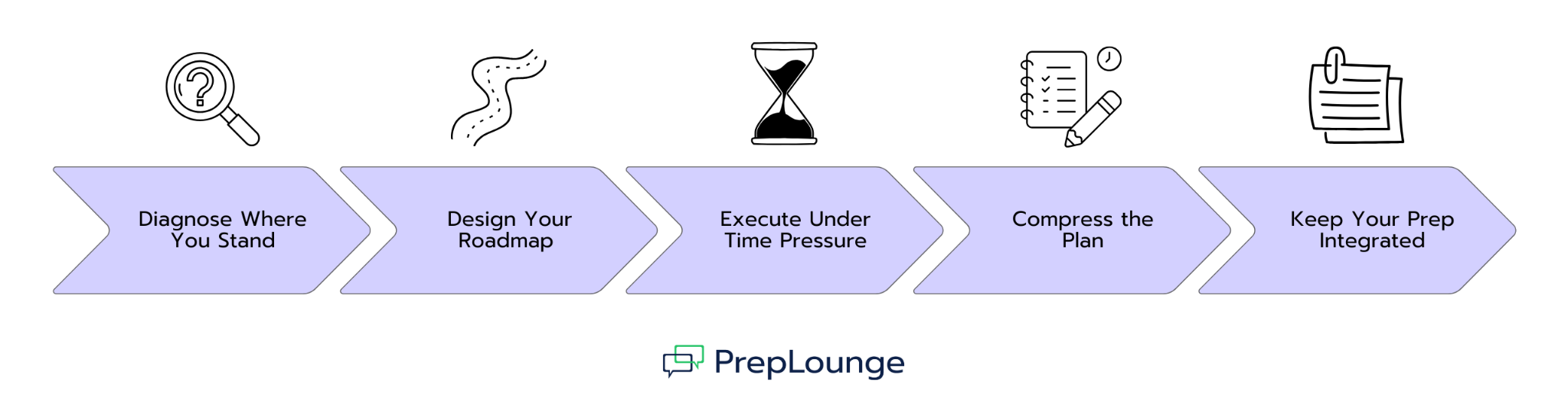
Step 2: Design Your Roadmap
If you have around three weeks, structure your preparation in phases that mirror how consultants work: building the foundation, refining performance, and simulating real pressure.
Week 1: Strengthen The Fundamentals
Revisit core frameworks, case openings, and mental math. Work in short, focused sessions that are free from distractions. Research on deep focus demonstrates that concentrated work produces higher quality learning in less time².
Week 2: Practice Deliberately
Move from study to action. Every case should have a single, specific goal, such as improving transitions or summarizing charts more clearly. Small, measurable targets combined with quick feedback create the steepest learning curve.
Week 3: Simulate Pressure
Practice under real conditions. Use a timer, limit preparation time, and rehearse complete cases from start to finish. Sustainable confidence comes from repetition under realistic
Step 3: Execute Under Time Pressure
As interviews approach, skill must meet composure. To build that composure, train your brain to stay focused when time feels tight.
Practical drills to sharpen performance
- Practice your case opening in ninety seconds, delivering a clear and concise structure.
- Narrate exhibits out loud in one minute, using headlines followed by evidence.
- Solve short math problems in four steps: define the question, set up the formula, estimate inputs, and calculate with care.
These exercises build reflexes that stay stable even when stress increases.
When fatigue appears, step back instead of pushing through. Short breaks and reflection days help the brain consolidate learning. Productive rest is part of efficient preparation.
Step 4: Compress the Plan (7-Day Focus Roadmap)
Many candidates prepare on short notice. If you have less than a week, keep your plan focused on clarity, repetition, and immediate feedback.
- Day 1 – Diagnose and plan: Book one expert session on PrepLounge to identify your top two weaknesses. Outline a micro-plan for the remaining days.
- Days 2–3 – Strengthen foundations: Run structure and math drills daily. Protect at least one hour of deep, uninterrupted practice.
- Days 4–5 – Simulate interviews: Complete two full peer cases each day. Record yourself and analyze where timing or clarity slips.
- Day 6 – Patch weaknesses: Repeat targeted drills for the weakest areas. Focus on accuracy and reasoning speed.
- Day 7 – Consolidate and rest: Review your notes lightly, visualize your interview flow, and rest early. Calm and clarity outperform last-minute cramming.
Even within one week, you can make measurable progress by focusing on deliberate repetition and quick feedback loops.
Step 5: Keep Your Preparation Integrated on PrepLounge
Effective preparation happens when all resources work together. PrepLounge provides this integration.
- Book expert sessions to target specific gaps.
- Practice with peers to gain diverse feedback and case variety.
- Learn frameworks from the library and apply them immediately.
- Strengthen mental math through daily drills.
- Use the Q&A section to clarify doubts quickly.
Everything you need to learn, practice, and refine sits within one platform, helping you use your time intelligently and stay consistent.